Why Understanding Your California Purchase Agreement is Critical
A California purchase agreement is the cornerstone of every residential real estate sale in the Golden State. This legally binding contract defines the terms and conditions between buyer and seller, covering everything from the purchase price and closing date to contingencies and required disclosures.
Quick Answer: What is a California Purchase Agreement?
- Legal contract that commits a buyer to purchase real estate according to specific agreed-upon terms
- Becomes binding once both parties sign and all terms are accepted
- Contains essential elements: property description, purchase price, earnest money, financing terms, contingencies, and closing date
- Includes mandatory disclosures required by California law to protect buyers
- Serves multiple functions: offer, contract, earnest money receipt, escrow instructions, and dispute resolution framework
The document becomes legally binding once both parties fully agree on the terms and sign it. However, failing to understand the agreement’s complexities can lead to costly mistakes – from losing your earnest money deposit to facing legal action for breach of contract.
California’s real estate laws are particularly complex, requiring sellers to provide numerous specific disclosures about property conditions and potential hazards. Unlike “caveat emptor” (buyer beware) states, California prioritizes transparency and buyer protection through extensive disclosure requirements.
I’m David Greiner, Esq., and during my years in transactional law practice, I’ve guided numerous clients through California purchase agreement negotiations and closings, helping them steer the complexities while protecting their business interests. My business-focused approach ensures clients understand every clause and contingency before signing this critical document.
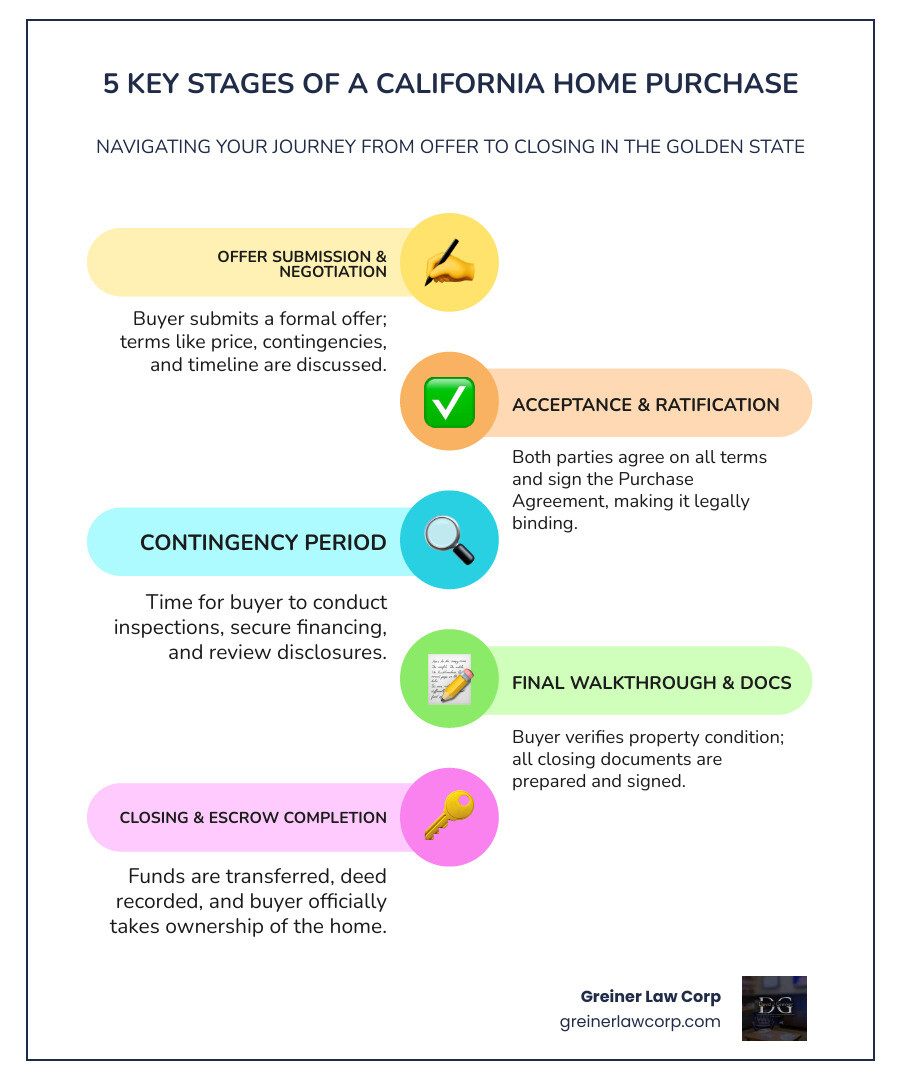
Anatomy of the California Purchase Agreement: Key Components
Think of a California purchase agreement as the DNA of your real estate transaction. This comprehensive document – often stretching across multiple pages – maps out every detail of how your property sale will unfold. It’s far more than a simple “I’ll buy, you’ll sell” handshake deal.
Understanding each component is like learning to read a roadmap before starting on a cross-country journey. You’ll know exactly where you’re going, what to expect along the way, and how to avoid costly detours.
The Basics: Parties, Property, and Price
Every great story needs characters, a setting, and stakes – and your California purchase agreement follows this same formula. First, we identify the cast: all buyers and sellers must be clearly named in the contract. Here’s a pro tip: if you’re buying with others, list everyone but hold off on deciding how you’ll take title. This simple step helps avoid potential discrimination issues under Federal Fair Housing laws.
Next comes the star of the show: the property itself. The agreement includes both the street address you’ll proudly call home and the Assessor’s Parcel Number (APN) – think of this as your property’s unique fingerprint in the county records.
Finally, we get to the bottom line: the agreed-upon purchase price and how you’ll split various transaction costs. This foundation sets everything else in motion.

For a comprehensive look at how these contracts protect both parties, check out our detailed guide on Real Estate Purchase Contracts.
Earnest Money Deposit: Showing Good Faith
Your earnest money deposit is your way of telling the seller, “I’m not just window shopping – I mean business!” This good faith gesture typically runs 1% to 3% of the purchase price in California, though competitive markets sometimes push this higher.
Here’s what makes this deposit smart: it doesn’t go directly to the seller. Instead, a neutral escrow company holds it safely until closing. This protects everyone involved and ensures the money only moves according to your agreement’s terms.
When everything goes smoothly, your earnest money applies toward your purchase price at closing. But what happens if the deal falls apart? If you cancel for valid reasons – like failed inspections or financing issues – you’ll typically get your deposit back, minus any agreed-upon costs. However, if you walk away without cause after removing your contingencies, the seller may keep your deposit as liquidated damages.
Key Timelines: From Offer to Closing
Time moves differently in real estate – every day counts, and missing a deadline can cost you dearly. Your California purchase agreement operates like a precisely timed orchestra, with each section playing its part at exactly the right moment.
Everything starts with two critical dates: when you submit your offer and when both parties accept all terms (called the “contract date” or “date of final acceptance”). This second date is crucial because it starts the clock on most other deadlines.
From the contract date, your contingency periods begin. You might have 17 days to complete inspections, a few weeks to finalize financing, or specific timeframes to review disclosures. All these deadlines build toward your ultimate goal: the Close of Escrow (COE) date, when you’ll finally get those keys.
Missing these deadlines isn’t just inconvenient – it can derail your entire transaction or cost you thousands in penalties.
Ready to understand what happens at the finish line? Our guide to the Real Estate Closing Process walks you through those final crucial steps.
Navigating Contingencies: Your Contractual Safety Nets
Contingencies are your contractual safety nets in a California purchase agreement. These protective clauses allow buyers to walk away from a deal without losing their earnest money deposit if specific conditions aren’t met, ensuring you’re not stuck with a bad investment or a loan that falls through.
In California, most contingencies are “active,” meaning you must formally remove each one in writing before its deadline. If you miss a deadline, the contract might be automatically canceled, which isn’t ideal if you still want the property.

These safety nets protect buyers during a major purchase and represent problems sellers must clear to close the sale. If you’re considering backing out, our guide on Valid Reasons to Back Out of Buying a House explains your rights.
The Financing and Appraisal Contingency
Since most buyers need a loan, the financing contingency is a financial lifeline in the California purchase agreement. It provides a specific window to secure financing.
Pre-qualification is an estimate of what you can borrow, while pre-approval is a conditional commitment from a lender based on your finances. Though pre-approval is stronger, the financing contingency protects you if the loan falls through.
The appraisal portion of this contingency is equally important. Your lender will order an appraisal to make sure the property is worth what you’re paying for it. When the appraisal comes back lower than your purchase price, you have options: negotiate a lower price with the seller, bring extra cash to make up the difference, or use your contingency to walk away.
Here’s a critical warning: if you waive your loan contingencies to make your offer more competitive, you’re promising to buy the house even if your financing disappears. That means if you can’t close without the loan, you’ll be in breach of contract and could lose your deposit.
The Investigation and Inspection Contingency
The investigation and inspection contingency is your license to thoroughly examine your potential new home.
During this period, you can arrange for inspections like a general home inspection (structure, major systems) and specialized ones for pests, the roof, sewer lines, or radon levels. These can uncover issues from minor maintenance to major structural problems that could cost thousands.
Once you receive the inspection reports, the real negotiation begins. Found some issues? You can submit a Request for Repairs (RR) asking the seller to fix problems or provide credits toward the repairs. If the seller refuses or you can’t reach an agreement, your contingency allows you to cancel the California purchase agreement and get your earnest money back.
The key is being reasonable. Sellers aren’t expected to deliver a perfect house, but they should address significant safety or structural issues.
Title and HOA Document Contingencies
The title contingency ensures the seller has the right to sell the property. It gives you time to review a preliminary title report for any liens, easements, or other claims against the property.
If you find unexpected issues, like an old contractor’s lien or an easement giving a neighbor rights to your yard, and the seller can’t clear them, your contingency lets you walk away.
For properties with Homeowners’ Associations (HOAs), you’ll also want to review the HOA documents carefully. This includes the Covenants, Conditions, and Restrictions (CC&Rs), which spell out what you can and can’t do with your property. Want to paint your front door purple? The CC&Rs will tell you if that’s allowed.
You’ll also review HOA budgets and any pending special assessments. That dream condo might come with a surprise $10,000 special assessment for roof repairs that wasn’t mentioned during your initial tour. The HOA document contingency gives you the chance to find these financial obligations before you’re stuck with them.
The Seller’s Duty: A Deep Dive into California’s Required Disclosures
California places a serious legal obligation on sellers to disclose known material facts about their property. This isn’t just good practice; it’s the law, ensuring “no surprises” for buyers in major real estate investments.
Here’s something important to remember: if a buyer doesn’t receive any of the legally required disclosures, they typically have three days to terminate their California purchase agreement (or five days if the notice was mailed) simply by notifying the seller or their agent. This right to cancel shows just how seriously California takes these disclosure duties.

Key Statutory Disclosure Forms
Three key forms are the backbone of California’s disclosure requirements:
The Transfer Disclosure Statement (TDS) is mandatory for most residential sales. Sellers must disclose known issues that could affect the home’s value or safety. The TDS is not a warranty but the seller’s honest account of the property’s condition, which buyers use for negotiations. You can find the legal requirements in California’s TDS law (CIV § 1102 et. seq.).
The Seller Property Questionnaire (SPQ) goes beyond the TDS, asking about past repairs, neighbor disputes, or other issues that might affect a buyer’s decision. Sellers must complete and provide this form to buyers.
Finally, the Natural Hazard Disclosure Statement (NHDS) addresses California’s unique environmental challenges. If your property sits near any natural hazard area – flood zones, high fire risk areas, earthquake fault zones, or seismic hazard areas – this disclosure is required. Given California’s geography, this form applies to many properties throughout the state.
A Checklist of Other Legally Required Disclosures
Beyond the main three, California requires other disclosures to keep buyers informed.
Lead-based paint disclosure applies to any home built before 1978. Federal law requires sellers to disclose the presence of lead-based paint and provide educational materials about its dangers. This isn’t just a California requirement – it’s federal law, detailed in the Federal Lead-Based Paint Disclosure Rule.
Megan’s Law database notice must be included in every California purchase agreement for residential properties. This informs buyers that information about registered sex offenders is available through a public database.
Mello-Roos Community Facilities District disclosures are required when properties fall within these special tax districts. Buyers need to know about any additional taxes they’ll be responsible for beyond standard property taxes.
Water heater and smoke detector compliance must be certified in writing. Sellers confirm that water heaters are properly secured against earthquake displacement and that fire detectors meet current legal requirements.
Death on the property within three years must be disclosed to prospective buyers, with specific exceptions for deaths related to HIV or AIDS complications. This disclosure period reflects California’s balance between transparency and privacy.
Military ordnance location disclosures are required for properties near military bases or facilities. Buyers deserve to know if they’re purchasing near areas where military activities might affect their daily lives.
Other important disclosures include the Environmental Hazards Pamphlet, which can sometimes help sellers avoid additional environmental disclosures, and the Homeowner’s Guide to Earthquake Safety, especially for certain construction types built before 1960.
Methamphetamine contamination requires disclosure if a property has been contaminated by chemicals used in drug manufacturing. Sellers must provide notice while awaiting confirmation that the property is safe.
Notice of Supplemental Property Tax Bill informs buyers that California reassesses property taxes when ownership changes, and these supplemental bills go directly to homeowners, not mortgage lenders.
Structural pest control reports, title insurance advisory notices, water-conserving fixtures and detector notices, and local option real estate transfer disclosure statements round out the extensive list of required disclosures.
While the paperwork may seem daunting, each disclosure is designed to help buyers make informed decisions about one of life’s biggest purchases.
Rights, Responsibilities, and When Things Go Wrong
When you sign a California purchase agreement, you’re not just making a promise—you’re entering into a legal relationship with specific rights and duties for both sides. Think of it as a carefully choreographed dance where everyone needs to know their steps.
As a buyer, your primary right is thorough due diligence. You can investigate every nook and cranny of that property, from the foundation to the roof. It’s your chance to make sure you’re getting what you’re paying for. Meanwhile, sellers have their own responsibility: keeping the property in substantially the same condition from acceptance until closing. That means no surprise renovations that could damage the home or removal of fixtures that were supposed to stay.
But what happens when someone doesn’t hold up their end of the bargain? That’s when things can get complicated, and we enter breach of contract territory. For a comprehensive look at these situations, check out our detailed guide on Real Estate Breach of Contract.
Understanding the “As-Is” Clause in a California Purchase Agreement
You might see an “as-is” clause in your California purchase agreement and think it means “buyer beware, anything goes.” Not so fast! In California, “as-is” has specific limitations that protect buyers from getting blindsided.
Here’s what “as-is” actually means: you’re accepting the property in its current condition, and the seller won’t be obligated to make repairs based on what inspections reveal. But—and this is a big but—it does not protect sellers from fraud and does not waive the seller’s disclosure duties. Sellers still must tell you about any known material defects that could affect the property’s value or make you think twice about buying.
Your right to inspect remains critical, even with an “as-is” clause. You can still hire inspectors, review reports, and make informed decisions. The difference is that if they find issues, you can’t demand the seller fix them. You can still negotiate or walk away if you’re within your contingency periods.
For more insights on navigating these agreements, our guide on California As Is Real Estate Contract breaks down exactly what you’re getting into.
Breach of Contract and Potential Remedies
A breach of contract happens when someone fails to do what they promised in the California purchase agreement. This could be a buyer who doesn’t deposit earnest money on time, or a seller who suddenly decides they don’t want to sell without a valid reason.
When buyers breach the contract, sellers typically have one main remedy: keeping the earnest money deposit as liquidated damages. For residential properties, this is usually capped at 3% of the purchase price. It’s designed to compensate the seller for taking the property off the market and the hassle of starting over.
Sellers who breach face more serious consequences. Buyers have stronger options, including suing for specific performance—essentially forcing the seller to complete the sale—or seeking monetary damages to cover their losses. Real estate is unique, and courts recognize that finding an identical replacement property might be impossible.
Most California purchase agreements include clauses for mediation and arbitration to avoid costly courtroom battles. Mediation comes first—a neutral third party helps both sides find common ground. If that doesn’t work, arbitration (if both parties agreed to it) involves a neutral arbitrator making a binding decision.
These alternative dispute resolution methods are designed to save time, money, and sanity. Trust me, after years of practice, I’ve seen how much smoother things go when people can resolve their differences without involving judges and lengthy court proceedings.
Frequently Asked Questions about the California Purchase Agreement
We often get questions about the intricacies of the California purchase agreement. Here are some of the most common ones that come up in our practice:
What’s the difference between a standard agreement and the C.A.R. form?
When we talk about a “standard” California purchase agreement, we’re almost always referring to the form developed by the California Association of REALTORS® (C.A.R.). This isn’t just another form – it’s become the industry gold standard for good reason.
The C.A.R. form is comprehensive and legally vetted, meaning it’s been thoroughly reviewed by attorneys and regularly updated to keep pace with California’s ever-changing real estate laws. Think of it as a Swiss Army knife for real estate transactions – it serves multiple functions all in one document.
This single form acts as an offer to purchase, becomes a completed contract upon acceptance, provides a receipt for earnest money, includes joint escrow instructions, and even has built-in provisions for mediation and arbitration. It’s like having five different documents rolled into one efficient package.
Using generic templates or forms you find online can be risky business. They often miss crucial disclosures or legal protections that are specific to California law. It’s a bit like trying to steer San Francisco with a map of Los Angeles – you might get somewhere, but probably not where you intended to go safely.
For more detailed information about the forms used in California transactions, check out our page on California Real Estate Forms Purchase Agreement.
Can I back out of buying a house after signing the agreement?
Yes, you can back out, but only under specific conditions. This is where understanding contingencies becomes your lifeline. Remember those contractual safety nets we discussed earlier? They’re your legitimate exit ramps from the deal.
If you need to back out during an active contingency period – say, after an inspection reveals that the foundation has more cracks than a desert floor, or if your financing falls through despite your best efforts – you can typically do so without penalty. Your earnest money deposit should come back to you, minus any agreed-upon costs.
However, once you’ve removed your contingencies in writing, the game changes completely. Backing out at this point becomes much riskier territory. You could lose your earnest money deposit, and in some cases, the seller might pursue legal action for specific performance or damages. It’s like jumping off a cliff – once you’re airborne, there’s no changing your mind about gravity.
This is why we always advise clients to be absolutely certain before removing contingencies. It’s a serious decision that can have significant financial and legal consequences. For a deeper dive into your options, our guide on Can You Back Out of Buying a House Before Closing? provides comprehensive insights.
What is the significance of the Transfer Disclosure Statement (TDS)?
The Transfer Disclosure Statement (TDS) is arguably one of the most significant documents in a residential real estate transaction in California. If the California purchase agreement is the backbone of your deal, the TDS is like the property’s medical history – it tells you what’s wrong and what might need attention.
This isn’t just a courtesy from the seller; it’s a legal requirement for most residential sales. The seller must outline known property defects, from that leaky faucet in the guest bathroom to more serious structural issues. It’s California’s way of ensuring transparency in real estate transactions.
Here’s what makes the TDS particularly important: it’s not a warranty guaranteeing the property’s condition, but it is a crucial tool you can rely on during negotiations. Think of it as the seller saying, “Here’s what I know is wrong with this place.” This transparency helps you make informed decisions about whether to proceed, negotiate repairs, or adjust your offer price.
The legal consequences are significant too. If the seller fails to provide a TDS, or if they intentionally misrepresent information on it, you have substantial cancellation rights – usually within three to five days of receiving the disclosure. This protection is outlined in CIV § 1102.4, which underscores just how seriously California takes buyer protection in real estate transactions.
The TDS essentially levels the playing field, ensuring that buyers aren’t flying blind when making one of the biggest financial decisions of their lives.
Navigating Your Real Estate Transaction with Confidence
The California purchase agreement is like a detailed roadmap for one of the biggest financial decisions you’ll ever make. From the basic identification of parties and property to the intricate web of contingencies and California’s extensive disclosure requirements, every clause serves a purpose in protecting your interests and ensuring a fair transaction.
What makes California unique is its commitment to transparency. Unlike many states where “buyer beware” is the rule, California puts the responsibility squarely on sellers to disclose material facts about their property. This creates a more balanced playing field, but it also means there’s a lot more paperwork and legal requirements to steer.
The complexity can feel overwhelming, especially when you’re dealing with timelines that can make or break your deal. Missing a contingency removal deadline or failing to provide a required disclosure isn’t just a minor hiccup – it can derail your entire transaction or expose you to legal liability.
At Greiner Law Corp, I’ve seen too many people treat their California purchase agreement like just another piece of paperwork to sign. That approach can cost you dearly. Whether you’re buying your first home in Riverside, selling a property in Los Angeles, or dealing with a complex transaction in San Bernardino or Victorville, understanding what you’re signing is crucial.
My business-minded approach means I don’t just explain the legal jargon – I help you understand how each clause affects your specific situation and goals. Every client has different risk tolerance levels, and part of my job is helping you make informed decisions that align with your comfort zone and objectives.
Real estate transactions don’t have to be stressful when you have the right guidance. The key is working with someone who understands both the legal requirements and the practical realities of California’s real estate market.
Ready to move forward with confidence? Get expert guidance on your California Real Estate Purchase Agreement from Greiner Law Corp. Let’s make sure your next real estate transaction goes smoothly from contract to closing.


