Why California Real Estate Forms Purchase Agreement Knowledge Is Your Best Investment
The california real estate forms purchase agreement is a legally binding contract foundational to every property transaction in California. This comprehensive document outlines all terms, conditions, and obligations for buyers and sellers, becoming enforceable upon signing.
Key Components of California Purchase Agreements:
- Purchase price and financing terms – Including deposits, loan contingencies, and payment structure
- Property disclosures – 12 mandatory disclosures including Transfer Disclosure Statement (TDS) and Natural Hazard Disclosure (NHD)
- Contingencies – Buyer protections for inspections, financing, and appraisals
- Closing conditions – Escrow instructions, title transfer, and possession details
- California-specific clauses – Supplemental property taxes, Megan’s Law disclosures, and earthquake safety requirements
Whether it’s a residential C.A.R. Form RPA or a commercial Form CPA, these standardized documents have critical clauses. Missing a disclosure deadline can give buyers a right to cancel, while misunderstanding contingency removal could cost you your earnest money. The stakes are high, but understanding what you’re signing makes the process manageable.
I’m David Greiner, Esq., and through my transactional law practice, I’ve guided clients through complex real estate deals, business formations, and california real estate forms purchase agreement negotiations, always focusing on achievement rather than billable hours. My business-focused approach helps clients steer these critical documents while protecting their interests and ensuring their goals are met.
First Things First: What is a California Purchase Agreement?
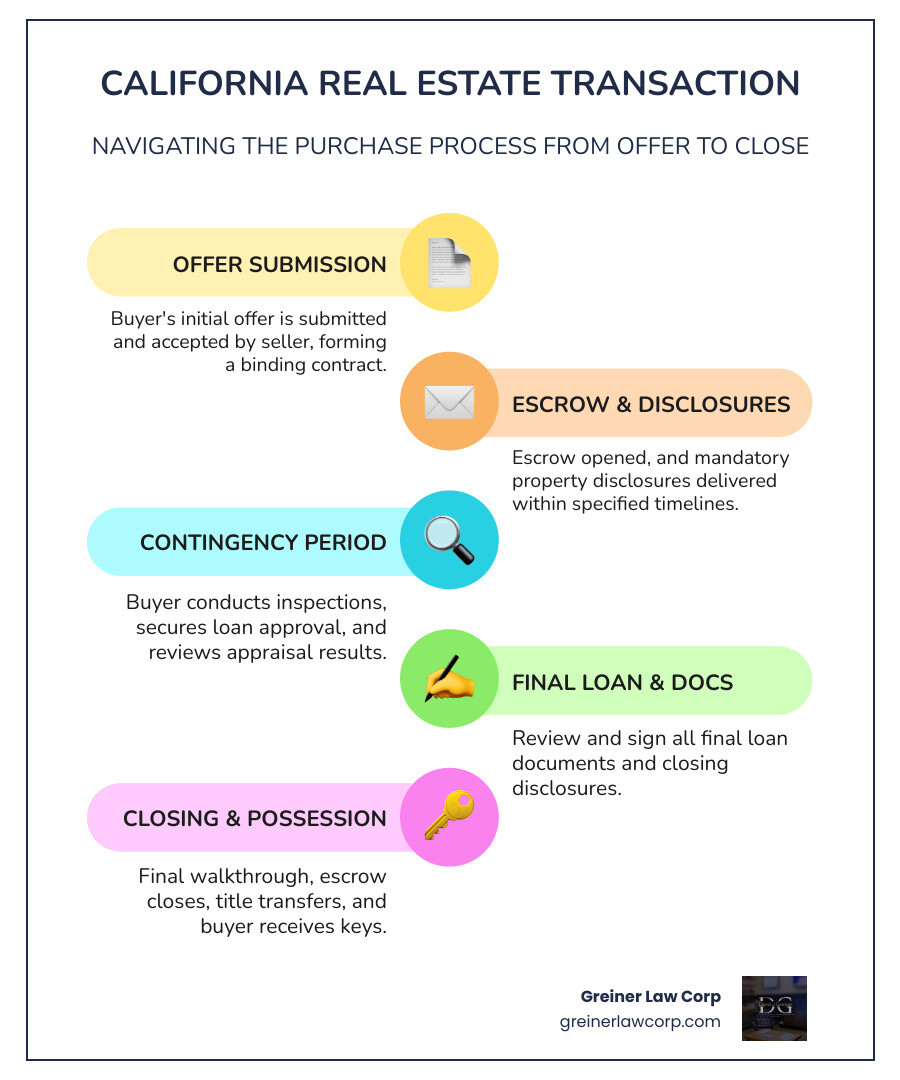
A california real estate forms purchase agreement is the legal roadmap for a property transaction. It’s a binding document detailing the price, terms, and conditions for a buyer to purchase real estate from a seller. Once signed, it guides buyers, sellers, agents, and escrow holders through to closing.
The most common version for homes is the California Residential Purchase Agreement and Joint Escrow Instructions (C.A.R. Form RPA), which also includes instructions for the escrow holder. This comprehensive form protects against disputes by clearly defining everyone’s responsibilities.
More info about real estate contracts
The Two Main Types: Residential vs. Commercial
While both facilitate real estate sales, residential and commercial agreements are quite different.
Residential Purchase Agreements (RPA) are for 1-4 unit properties like homes and condos. These standardized forms (e.g., C.A.R. Form RPA) prioritize consumer protection, focusing on disclosures about property condition, lead-based paint, and natural hazards.
Commercial Purchase Agreements (CPA) handle non-residential properties like offices, retail spaces, or industrial buildings. These are far more complex, requiring longer due diligence for environmental assessments, zoning analysis, and financial reviews of leases. CPAs also heavily address tenant lease transfers, security deposits, and ADA compliance.
Here’s how they compare:
| Feature | Residential Purchase Agreement (RPA) | Commercial Purchase Agreement (CPA) |
|---|---|---|
| Property Type | 1-4 unit residential (homes, condos) | Non-residential (office, retail, industrial, vacant land) |
| Primary Focus | Consumer protection, habitability, standard disclosures | Investment analysis, due diligence, business operations |
| Disclosures | Highly standardized (TDS, NHD, Lead, Megan’s Law) | Broader scope, including environmental, financial, lease reviews |
| Due Diligence | Property inspections, appraisal, loan contingency | Extensive environmental, zoning, financial, lease analysis |
| Complexity | Generally less complex, more template-driven | Highly complex, often requires specialized legal review |
| Contingencies | Standardized (loan, appraisal, inspection) | Often customized with longer investigation periods |
| Tenant Considerations | Rarely applicable (unless multi-unit) | Crucial, includes lease assignments, estoppel certificates |
| ADA Compliance | Minimal focus | Significant negotiated item |
Why Standardized Forms are Used
California relies on standardized forms from the California Association of REALTORS® (C.A.R.) for several key reasons:
- Consistency and Clarity: They ensure essential terms are handled uniformly, reducing confusion and disputes.
- Legal Compliance: Drafted by legal experts, these forms comply with California’s many disclosure laws and regulations.
- Risk Reduction: Using legally vetted, approved forms reduces liability for agents, brokers, buyers, and sellers.
- Efficiency: Standardized forms streamline transactions, making them faster and more familiar to professionals.
- Comprehensive Terms: The 16-page C.A.R. RPA covers nearly every conceivable aspect of a transaction, ensuring nothing is overlooked.
At Greiner Law Corp, we leverage these solid forms to focus on your unique goals, tailoring advice without reinventing the basic legal framework.
Find California Association of Realtors Forms
Decoding the Key Sections of California Real estate Forms Purchase Agreement
A california real estate forms purchase agreement is a detailed roadmap. While its thoroughness can be overwhelming, understanding its key components is crucial for a smooth transaction. Let’s break down the most critical sections.

Essential Financial Terms in a California Real Estate Forms Purchase Agreement
This section details how money changes hands. Key terms include:
- Purchase Price: The agreed-upon sale price.
- Initial Deposit (Earnest Money): Shows the buyer’s serious intent, typically due to escrow within three business days of acceptance. An increased deposit may be required later.
- Loan Amounts and Types: Specifies financing details (e.g., conventional, FHA, VA), interest rates, and points to prevent payment disputes.
- All-Cash Offers: Require verification of funds to prove the buyer has the cash to close without a loan.
- Seller Credits: Clearly outlines any amounts the seller agrees to credit the buyer for closing costs or repairs.
The Buyer’s Safety Net: Common Contingencies
Contingencies are your safety net, allowing you to cancel the purchase without penalty under specific conditions, typically within a 17-day default period. Common contingencies include:
- Loan Contingency: Lets you back out if you cannot secure financing.
- Appraisal Contingency: Protects you if the property appraises for less than the purchase price, allowing for renegotiation or cancellation.
- Property Investigation Contingency: A broad protection giving you time to conduct inspections (home, pest, lead-based paint, etc.) and review seller documents.
An “as-is” clause refers to the physical condition, but it does not waive the seller’s legal duty to disclose all known material defects. Removing contingencies is a formal, written step that signals your commitment to proceed. Failing to remove them or cancel on time can put your earnest money deposit at risk.
More info about purchase and sale agreements
Navigating Disclosures in a California Real Estate Forms Purchase Agreement
California law mandates extensive disclosures to ensure buyers are fully informed. Sellers must disclose all known material facts affecting the property’s value. If you don’t receive a required disclosure, you generally have 3-5 days to cancel the agreement in writing. Key disclosures include:
- Transfer Disclosure Statement (TDS): Details the property’s condition and any known defects.
- Natural Hazard Disclosure (NHD) Statement: Identifies if the property is in a flood, fire, or earthquake zone.
- Lead-Based Paint Disclosure: Mandatory for homes built before 1978.
- Environmental Hazards Pamphlet: A guide to various environmental risks.
- Megan’s Law Disclosure: Informs buyers of the public database for registered sex offenders.
- Real Estate Tax Disclosure: Warns of a potential supplemental property tax bill after the sale.
- Safety Disclosures: Cover water heater strapping, smoke detectors, and water-conserving fixtures.
Review these documents carefully, as they are your window into the property’s history and condition.
Environmental Hazards Pamphlet
Unique to the Golden State: California-Specific Clauses
California’s california real estate forms purchase agreement includes unique provisions reflecting the state’s distinct laws and consumer protection priorities. These aren’t just fine print; they address situations that can significantly impact your transaction.

Supplemental Property Taxes Explained
A surprise for many new California homeowners is the supplemental property tax bill. When you buy a property, the county assessor revalues it at the purchase price. If this new value is higher than the previous owner’s, you’ll receive a one-time bill for the tax difference from your closing date to the end of the tax year. This bill is separate from your regular property tax payments (which are often handled by your lender’s escrow account) and must be paid directly by you. The california real estate forms purchase agreement includes a warning about this to ensure you’re prepared.
Megan’s Law and Other Safety Disclosures
California’s purchase agreement includes several unique safety disclosures:
- Megan’s Law Disclosure: Informs buyers about the public database of registered sex offenders, directing them to the Department of Justice website for information.
Megan’s Law Disclosure (PEN § 290)
Gas and Hazardous Liquid Pipelines: A notice about potential pipelines near the property, with a link to the National Pipeline Mapping System for research.
Death on Property Disclosure: Requires sellers to disclose if a death occurred on the property within the last three years and, if known, the manner of death.
Industrial Use and Military Ordnance Disclosures: May apply to properties near former military bases or industrial areas, addressing potential environmental or noise issues.
These disclosures empower you with information to make a fully informed decision. At Greiner Law Corp, we help clients understand how these disclosures apply to their specific circumstances.
The Final Stretch: Closing Conditions and Possession
Once contingencies are removed, you enter the final stretch leading to the Close of Escrow (COE), where ownership is transferred. While the hard work is mostly done, several key steps remain before you get the keys.

Prorations, Closing Costs, and Title
At COE, finances are settled. Prorations divide ongoing expenses like property taxes, HOA dues, and rent fairly between buyer and seller based on the closing date. The california real estate forms purchase agreement specifies who pays for various closing costs, which typically include:
- Escrow and Title Fees: For managing the transaction and providing title insurance (CLTA/ALTA policies) to protect against ownership claims.
- Taxes and Recording Fees: County and city transfer taxes and fees to publicly record the deed.
- Loan Fees: Costs associated with the buyer’s mortgage.
- Home Warranty Plans: Optional plans covering major home systems post-closing.
Ensuring clear title is vital. The sale is contingent on your approval of a preliminary title report, which lists any liens or encumbrances the seller must resolve before closing.
The Final Walk-Through and Taking Possession
Just before closing, you’ll conduct a final walk-through. This isn’t a new inspection, but a verification that the property is in the same condition as when you made the offer, agreed-upon repairs are complete, and all included fixtures remain.
If the seller needs to remain in possession after closing, a formal Seller In Possession Addendum (SIPA) or Residential Lease After Sale (RLAS) is crucial. This creates a legal landlord-tenant relationship and protects you from potential issues. Avoid informal agreements.
Upon COE, you’ll receive the keys, codes, and openers, officially making you the new owner. Congratulations—you’re now a California property owner!
Frequently Asked Questions about California Purchase Agreements
Here are some of the most common questions we encounter regarding the california real estate forms purchase agreement:
What happens to the earnest money deposit if the deal falls through?
The fate of your earnest money deposit depends on why the deal collapsed and the terms of your california real estate forms purchase agreement.
- If you cancel under a valid contingency (e.g., for inspection or financing issues), your deposit is returned.
- If you breach the contract after removing contingencies, the seller can typically keep your deposit as liquidated damages. For owner-occupied homes, this is usually capped at 3% of the purchase price.
- If the seller defaults, you get your deposit back and may pursue other legal remedies.
- In a dispute, the escrow holder holds the funds until both parties agree in writing or a court decides.
Can I write my own purchase agreement?
While technically possible, drafting your own california real estate forms purchase agreement is extremely risky. California real estate law is complex, with numerous mandatory disclosures and legal requirements. A poorly drafted contract can be unenforceable, create costly disputes, or unintentionally waive your rights. Standardized C.A.R. forms are drafted by legal experts and have been refined over decades to protect all parties. Using these forms, ideally with an attorney’s review for complex situations, is the safest approach.
How long does a seller have to respond to an offer?
The buyer sets the deadline in the california real estate forms purchase agreement. You specify an offer expiration date—typically three calendar days is standard, but it can be shorter or longer. If the seller doesn’t accept by this deadline, the offer expires, and you are no longer bound by it. Often, a seller won’t simply accept or reject but will issue a counteroffer with new terms. This begins a negotiation process, with each counteroffer having its own response deadline. A binding contract is formed only when one party’s offer or counteroffer is accepted and that acceptance is delivered to the other party before the deadline.
Conclusion
Navigating a california real estate forms purchase agreement can feel complex, but understanding its structure and protections empowers you to proceed with confidence. The key takeaway is that due diligence is your best friend. Taking the time to investigate the property and understand the agreement is the best way to protect your investment.
Standardized forms like the C.A.R. RPA exist to manage risk, incorporating decades of legal refinement to protect both buyers and sellers. Managing risk is about making informed decisions that align with your goals.
At Greiner Law Corp, our business-minded approach is to help you understand what matters most in your transaction. We focus on helping you manage your risk preferences effectively, providing clear guidance from the initial offer to the final closing, so you can achieve your real estate goals without being overwhelmed.


