Navigating the Golden State’s Real Estate Maze
California association of realtors forms are the standardized documents that govern most real estate transactions in California, providing legal frameworks for purchases, sales, disclosures, and agreements between parties.
Quick Access to CAR Forms:
- Member Access: Available through C.A.R.’s secure member portal at car.org
- Form Categories: Purchase agreements, listing agreements, disclosures, addendums, and notices
- Key Forms: Residential Purchase Agreement (RPA), Transfer Disclosure Statement (TDS), Listing Agreements
- Updates: Forms are regularly revised to reflect current California law
- Support: C.A.R. Legal Hotline provides free attorney consultation for members
Real estate deals are probably the most complex type of legal transaction most people will ever encounter in their lives. In California, where over 200,000 REALTORS® steer intricate state laws and regulations, the California Association of Realtors (CAR) has developed comprehensive standardized forms to reduce complexity and legal ambiguity.
Why standardization matters: Without strict legal rules and regulations, any number of problems can arise during the deal-making process that could derail transactions or lead to unfair outcomes for parties involved. CAR forms set state-wide rules for agreements, disclosures, and contracts – creating the trusted, legally accepted medium for California real estate professionals.
The typical real estate deal takes 50 days to close, involving multiple stakeholders and extensive documentation. CAR’s standardized forms streamline this process by providing clear language, reducing the need for individual legal counsel on every detail, and ensuring compliance with California’s evolving real estate laws.
About the Author: I’m David Greiner, Esq., and through my transactional law practice, I’ve helped clients steer complex real estate transactions using california association of realtors forms for business acquisitions, property transfers, and corporate real estate needs. My business-focused approach ensures clients understand these essential documents and achieve their real estate goals efficiently.
What is the California Association of Realtors (CAR)?

Think of the California Association of Realtors (CAR) as the grandfather of California real estate – it’s been around since 1905, making it older than the Golden Gate Bridge! This massive 501(c)(6) nonprofit organization represents over 200,000 REALTORS® across California, making it one of the largest state trade organizations in the entire United States.
For more than a century, CAR has been the quiet powerhouse behind California’s real estate industry. While most people only see the california association of realtors forms when they’re buying or selling property, CAR does much more than create paperwork. The organization sets professional standards, provides ongoing education, and actively works with lawmakers in Sacramento and Washington D.C. to shape real estate policy.
CAR’s political advocacy efforts are substantial – they operate various Political Action Committees (PACs) and the REALTOR® Action Fund to ensure California’s real estate professionals have a voice in government. When new laws affect property transactions, CAR is often at the table helping craft sensible regulations that protect both agents and consumers.
The Mission: Protecting Agents and Consumers
CAR’s stated mission is beautifully straightforward: “to shape, promote and protect an environment for the entire real estate industry, one in which California REALTORS® can succeed in meeting the real property needs of consumers.” This isn’t just corporate speak – it’s the driving force behind everything CAR does.
What makes CAR special is their dual focus approach. They don’t just look out for real estate professionals; they’re equally committed to consumer protection. When CAR develops new forms or updates existing ones, they’re thinking about both sides of the transaction. The goal is creating clear, understandable documentation that explains everyone’s rights and responsibilities.
This commitment shows up in CAR’s extensive educational resources. The organization provides legal articles on over 150 subjects across 50-plus categories, helping members stay current with California’s complex real estate laws. They also offer risk management resources, Legal Q&As, disclosure charts, and live webinars that help professionals handle challenging situations with confidence.
The result? California association of realtors forms have become the gold standard for real estate transactions throughout the state. They provide legal protection, ensure fair transactions, and create the information and documentation framework that helps both agents and consumers succeed.
CAR vs. DRE: Understanding the Difference
Here’s where things can get confusing – many people mix up CAR with the California Department of Real Estate (DRE). While both organizations play important roles in California real estate, they’re completely different animals.
The DRE is a government licensing body that regulates real estate professionals and handles consumer complaints. DRE forms are typically used for licensing applications, enforcement actions, and regulatory compliance. Think of the DRE as the “traffic cop” of real estate – they make sure everyone follows the rules and has proper licenses.
CAR, on the other hand, creates transactional documents that facilitate actual property deals. These california association of realtors forms cover everything from listing agreements to purchase contracts to disclosure statements. CAR forms are a member benefit, developed by CAR’s Legal Department with input from practicing attorneys and real estate professionals who understand the real-world challenges of California transactions.
The practical difference is simple: DRE forms are for regulatory compliance (getting licensed, reporting violations), while CAR forms are for actual transactions (buying, selling, disclosing). The DRE requires electronic submission through their eLicensing portal, while CAR forms are accessed through secure member platforms.
Understanding this distinction helps everyone know which forms to use when – and why both organizations are essential to California’s real estate ecosystem.
The Essential Guide to California Association of Realtors Forms
Think of california association of realtors forms as a Swiss Army knife for California transactions. Instead of drafting new paperwork for every deal, agents rely on a library of documents that has been refined over decades by attorneys and REALTORS® who work in the field every day.
Why CAR Forms Matter
- Built-in legal protection – Each form incorporates the most current California statutes and court decisions, saving parties the cost and delay of hiring counsel to draft custom contracts.
- Clear, standardized language – Buyers, sellers, and agents know exactly what they are agreeing to, reducing disputes.
- Speed – In a market where multiple offers can appear within hours, standardized forms let parties move quickly while remaining compliant.
- Comprehensive coverage – From residential condos to raw land, CAR offers a form for almost every scenario, so potential issues are addressed before they become costly.
How the Forms Are Structured
- Form codes (RPA, TDS, AVID, etc.) appear at the bottom corner so everyone can confirm they are using the right document.
- Revision dates remind users to pull the newest version—vital in a state where real-estate law changes frequently.
- Fill-in fields let agents add price, dates, and special terms without altering the tested legal language.
- Addendums & advisories bolt on extra clauses when a transaction has unusual elements (for example, leased solar panels or tenant-occupied units).
Use the Latest Version—Always
CAR updates its forms at least twice a year. Using an outdated form is like following an old map after the streets have changed—you may still reach your destination, but the trip will be riskier and more expensive.
Remember: the forms are powerful tools, but they only work when you choose the correct one and fill it out accurately. If a question or grey area pops up, that is the moment to call the C.A.R. Legal Hotline or qualified counsel—before signatures go on the page.
Key CAR Forms Explained: From Purchase to Disclosure

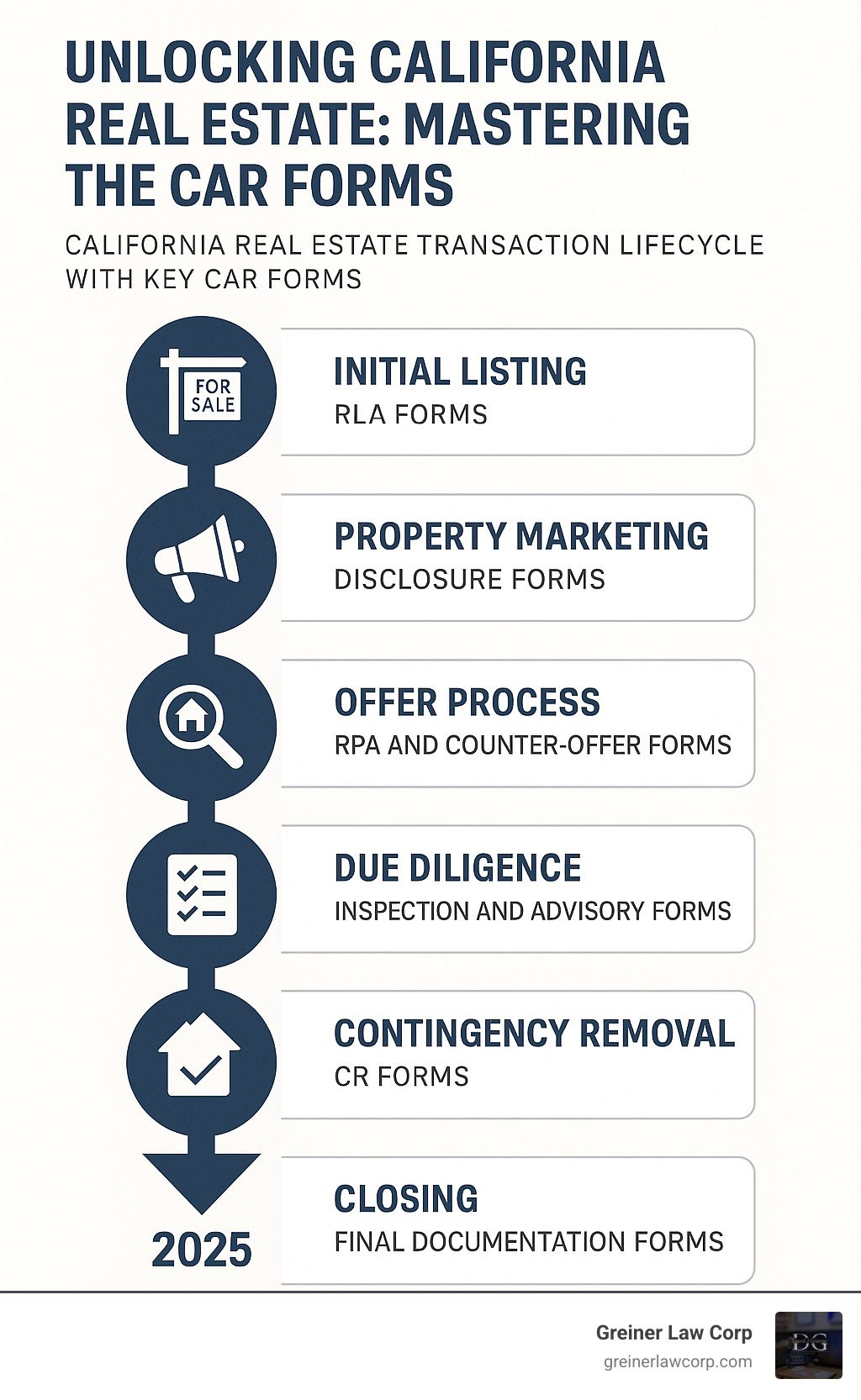
Below are the “greatest hits” that appear in most California transactions.
Purchase & Listing Agreements
- Residential Purchase Agreement (RPA) – The core contract that spells out price, timing, financing, and contingencies. Recent revisions add clearer wording on tenant occupancy, window coverings, and leased solar equipment.
- Vacant Land Purchase Agreement – Custom for property with no structures and different due-diligence periods.
Listing contracts define when and how an agent is paid:
| Form | When Commission Is Earned |
|---|---|
| RLA | If the property sells during the listing period, no matter who finds the buyer |
| RLAA | Only when the listing broker (or another REALTOR®) procures the buyer |
Further reading: Real Estate Purchase Agreement and Listing Agreement.
Mandatory Disclosures & Advisories
- TDS (Transfer Disclosure Statement) – Seller’s legally required overview of known defects.
- SPQ (Seller Property Questionnaire) – Additional details that don’t fit neatly into the TDS.
- AVID (Agent Visual Inspection Disclosure) – What the agents saw during their walk-through.
- NHD (Natural Hazard Disclosure) – Earthquake, flood, and fire zone data.
- BIA (Buyer’s Inspection Advisory) – Educates the buyer on the importance of professional inspections.
- MCA (Market Conditions Advisory) – Context on local market volatility.
Changing Course
- CR (Contingency Removal) – Buyer formally waives financing, appraisal, inspection, or other contingencies.
- NTP (Notice to Perform) – Gives the other party 48 hours (or agreed period) to meet a deadline or risk cancellation.
- Cancellation of Contract / Release of Deposit – Ends the deal and directs how the earnest money is handled.
- Extension of Time Addendum – Adds days to a deadline without rewriting the main contract.
For the mechanics of ending a deal, see Breaking a Real Estate Contract.
Streamlining Your Workflow: Managing and Automating CAR Forms

Paper copies, duplicate data entry, and “missing-signature” phone calls slow closings and invite errors. Digital transaction-management systems replace that chaos with a single online workspace.
Why Go Digital?
- One-time data entry – Type the property address once; every other form fills automatically.
- E-signatures – Clients review and sign from any device, cutting days off the timeline.
- Real-time version control – Everyone sees the latest revision, eliminating “which copy is correct?” confusion.
- Automatic reminders – Built-in alerts for contingency deadlines keep deals from slipping.
- Secure cloud storage – Completed documents are archived and searchable—no more lost files.
How Smart Forms Work
Modern platforms “tag” each field (price, APN, closing date). Update it in one place and the software mirrors that change everywhere else. Brokers can review packets instantly, and integrations with CRMs or calendars keep the entire team aligned.
Bottom line: fewer mistakes, faster closings, and a client experience that matches today’s expectations.
Accessing CAR Forms and Essential Resources
California association of realtors forms are exclusively available to CAR members – think of it as a valuable membership perk that comes with your professional dues. This member-only access makes sense when you consider that these forms are specifically designed for licensed real estate professionals who understand their proper use and legal implications.
Where to Find Forms and Legal Guidance
Getting access to CAR forms and support is straightforward once you know where to look. The C.A.R. Website Forms Libraries serve as your primary headquarters, accessible through the organization’s secure member portal. Here, you’ll find the complete library of forms, neatly organized by category and function – no more digging through filing cabinets or outdated printed versions.
But CAR goes beyond just providing forms. The Forms Advisor and Forms Tutor tools act like your personal assistant, helping you identify which forms you actually need for specific transactions. Forms Advisor asks you transaction-specific questions and recommends the appropriate forms, while Forms Tutor provides step-by-step instruction for completing them properly. It’s like having a seasoned mentor guiding you through the process.
One of the most valuable resources is the C.A.R. Legal Hotline, where members can speak with an attorney about their transactions at no additional cost. This isn’t just a basic help desk – you’re getting real legal expertise when questions arise. Whether you’re dealing with a tricky contingency or need clarification on disclosure requirements, having attorney access can save both time and potential headaches.
The Legal Q&As and Disclosure Charts provide another layer of support, with an extensive library covering over 150 subjects in 50-plus categories. These resources help you understand complex legal issues and ensure compliance with California’s ever-changing real estate laws. Think of them as your quick reference guide when you need answers fast.
CAR also provides comprehensive Educational Tools and Training through webinars, training sessions, and certification programs. These resources help you stay current with form usage and legal requirements – because in California real estate, staying current isn’t optional.
For additional legal guidance on California real estate matters, our team at Greiner Law Corp provides comprehensive Real Estate Legal Advice in California.
Staying Current with Form Revisions and New Laws
California real estate law changes about as frequently as the weather – and just like the weather, ignoring these changes can leave you unprepared. CAR typically releases form updates semi-annually, though urgent changes may be implemented more frequently when new legislation or court decisions require immediate attention.
Using current forms isn’t just good practice – it’s essential protection. Outdated forms can create legal problems and may not provide adequate protection for the parties involved. CAR clearly marks each form with revision dates, and you should always verify you’re using the most current version. It’s a simple step that can prevent major complications down the road.
Training and education become particularly valuable when significant legal changes affect multiple forms. CAR provides regular training webinars and educational sessions to help members understand not just what changed, but why it changed and how it affects their practice. These sessions are worth attending – they can save you from costly mistakes and keep you ahead of the curve.
Continuing education requirements exist for good reason. Many form updates are driven by changes in California law, court decisions, or industry best practices. Real estate professionals have a duty to stay current with legal requirements and use appropriate forms. This includes understanding when specific disclosures are required and ensuring all necessary forms are completed accurately.
Compliance isn’t negotiable in California real estate. You need to understand when specific disclosures are required and ensure all necessary forms are completed accurately. A helpful resource for determining which forms to use is CAR’s Quick guide on the right form to use, which provides guidance based on form codes and transaction types.
The bottom line? Staying current with california association of realtors forms isn’t just about following rules – it’s about protecting your clients, your business, and your professional reputation in one of the most legally complex real estate markets in the country.
Conclusion: Your Partner in California Real Estate Law
Mastering california association of realtors forms isn’t just about filling out paperwork – it’s about understanding the legal foundation that makes California real estate transactions possible. These carefully crafted documents represent over a century of collective wisdom from thousands of real estate professionals who’ve learned what works (and what doesn’t) in the Golden State’s complex market.
Think of CAR forms as your legal safety net. They’re designed to catch the problems before they become disasters, covering contingencies and scenarios that might not occur to even experienced practitioners. But here’s the thing – having the right forms is only half the battle. Knowing when and how to use them effectively is what separates successful transactions from legal headaches.
The key lies in understanding that these forms work together as a system. The Residential Purchase Agreement doesn’t exist in isolation – it connects to disclosure requirements, contingency removals, and potential contract modifications. When you understand these connections, you can steer transactions more smoothly and protect your clients’ interests more effectively.
At Greiner Law Corp, we’ve seen how proper form usage can make or break a real estate deal. Our business-minded approach helps clients understand not just the “what” of california association of realtors forms, but the “why” and “how” that really matter. Whether you’re dealing with a straightforward residential sale or a complex commercial transaction, we help you use these tools strategically to achieve your goals.
Our experience across probate, real estate, business formation, and contract law gives us a unique perspective on how CAR forms interact with other legal requirements. We’ve helped clients steer situations where property transfers involve estate planning, business entities, or unusual financing arrangements – scenarios where standard forms need expert interpretation.
From our offices in Victorville, Riverside, San Bernardino, and Los Angeles, we serve clients throughout California who need more than just form completion. We provide strategic guidance that helps you understand the implications of every clause, every contingency, and every deadline in your transaction.
While CAR forms are comprehensive and battle-tested, they can’t address every unique situation that arises in real estate. When you encounter complex issues – like disputes over form interpretation, unusual property conditions, or transactions involving multiple legal entities – professional legal guidance becomes essential. That’s where our expertise makes the difference.
The California real estate market never stops evolving, and neither do the forms that govern it. New laws, court decisions, and market conditions constantly reshape how these documents work. By staying informed about these changes and understanding how to adapt your approach accordingly, you can handle even the most challenging transactions with confidence.
Steer your transaction with confidence by understanding the Real Estate Purchase Agreement and ensure that your real estate goals are achieved with proper legal protection and smart risk management.
Successful real estate transactions aren’t just about following procedures – they’re about understanding the legal landscape well enough to make informed decisions that protect your interests and achieve your objectives. With the right knowledge and professional support, california association of realtors forms become powerful tools for success rather than just paperwork to complete.


