Understanding Real Estate Breach of Contract
A real estate breach of contract occurs when one party fails to fulfill their obligations as outlined in a legally binding real estate agreement. This can have serious financial and legal consequences for all parties involved.
Quick Answer: What is a real estate breach of contract?
| Element | Description |
|———|————-|
| Definition | Failure to fulfill obligations outlined in a real estate contract |
| Types | Minor, Material, Actual, and Anticipatory breaches |
| Common Examples | Buyer: Failure to secure financing, Missing deposit deadlines
Seller: Refusing to sell after agreement, Failure to disclose defects |
| Remedies | Specific performance, Monetary damages, Liquidated damages, Rescission |
| Time Frame | Legal action must typically be filed within 2-4 years (varies by state) |
Real estate transactions represent some of the largest financial decisions most people make in their lifetime. When a real estate breach of contract occurs, it can derail months of planning and negotiation, potentially costing thousands or even millions of dollars.
According to the National Association of Realtors, approximately 5% of real estate contracts are terminated before closing. The most common reasons include issues related to financing, home inspection, or appraisal problems. However, not all terminations constitute a breach – many contracts include contingencies that allow for lawful exit under specific circumstances.
The distinction between a legitimate contingency-based cancellation and an actual real estate breach of contract is critical. When a true breach occurs, the non-breaching party has several potential remedies available, depending on the nature and severity of the breach.
“Contracts are the foundation of real estate transactions, and when that foundation cracks, the entire deal can collapse.”
I’m David Greiner, Esq., an experienced real estate and business attorney who has handled numerous real estate breach of contract cases throughout my career, first as president of Greiner Buick GMC where I managed complex property transactions, and now as the founder of Greiner Law Corp focusing on business-oriented legal solutions.
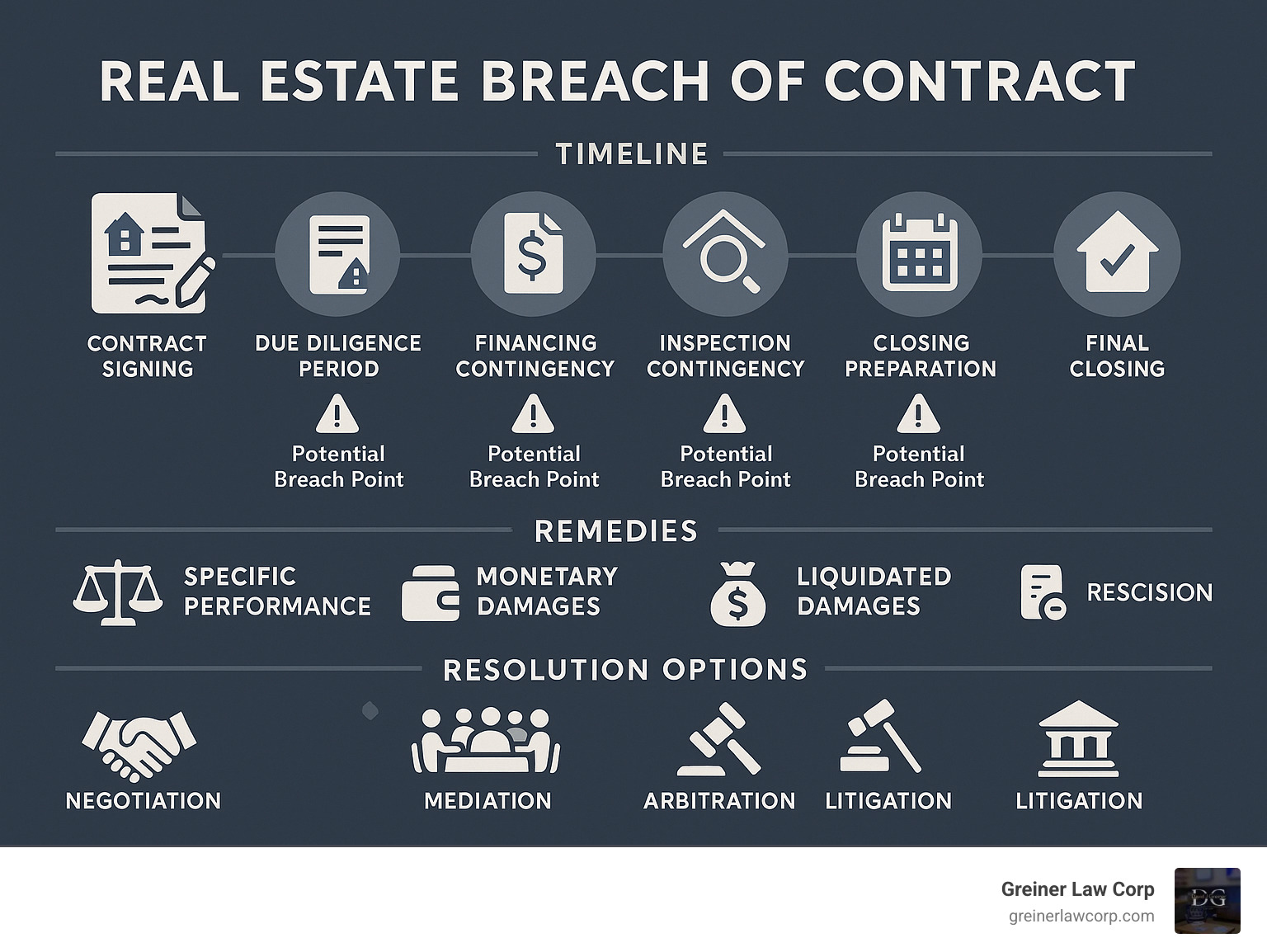
Real estate breach of contract word guide:
– contract for sale of real estate
– property settlement agreement
– real estate closing process
What Constitutes a Real Estate Breach of Contract?
A real estate breach of contract occurs when one party fails to perform their contractual obligations without legal justification. In California and most states, real estate contracts must be in writing to satisfy the Statute of Frauds, which requires certain agreements to be documented rather than merely verbal.
For a valid real estate breach of contract claim, several elements must exist:
- A legally binding contract must be in place
- The contract terms must be clear and definite
- The plaintiff must have performed their obligations (or have a valid reason for non-performance)
- The defendant must have failed to perform their obligations
- The breach must have caused damages to the non-breaching party
Not every disagreement or deviation from contract terms constitutes a breach. The law recognizes that some contract provisions are more fundamental than others.
As we often explain to our clients at Greiner Law Corp, real estate contracts include both express terms (explicitly stated) and implied terms (such as good faith and fair dealing). Breaching either type can lead to legal consequences.
More info about Real Estate Contracts Explained
Key Elements Courts Look For
When evaluating a potential real estate breach of contract case, California courts typically focus on five key elements:
Offer and Acceptance: Evidence that a valid offer was made and properly accepted, creating a meeting of the minds.
Consideration: Something of value exchanged by both parties (typically money for property rights).
Plaintiff’s Performance: Proof that the party bringing the claim either fulfilled their obligations or was ready, willing, and able to do so.
Defendant’s Breach: Clear evidence that the other party failed to perform material obligations under the contract.
Provable Loss: Documentation of actual damages suffered as a result of the breach.
A 2022 survey by the National Association of Realtors found that 22% of terminated contracts were due to issues related to the buyer’s financing, while 20% were due to home inspection or environmental issues. However, many of these terminations occurred through proper contingency procedures rather than constituting actual breaches.
Real Estate Breach of Contract vs. Simple Cancellation
One of the most misunderstood aspects of real estate transactions is the difference between a legitimate cancellation and a real estate breach of contract. This distinction is crucial and can mean the difference between a smooth resolution and costly litigation.
Contract Cancellation: Most real estate contracts contain contingencies that allow either party to exit the agreement under specific circumstances without penalty. Common contingencies include:
– Financing contingencies (buyer can’t secure a mortgage)
– Inspection contingencies (significant property defects finded)
– Appraisal contingencies (property doesn’t appraise for purchase price)
– Home sale contingencies (buyer can’t sell their current home)
When a party properly exercises a contingency within the specified timeframe and follows the notification procedures outlined in the contract, this is a lawful cancellation, not a breach.
Breach of Contract: In contrast, a real estate breach of contract occurs when:
– A party fails to perform without a valid contingency
– A party misses contractual deadlines without proper extensions
– A contingency is improperly invoked or notification procedures aren’t followed
– A party refuses to close despite all contingencies being satisfied
At Greiner Law Corp, we’ve seen cases where sellers wrongly accused buyers of breach when they properly exercised contingency rights. Conversely, we’ve represented clients where the other party attempted to disguise a breach as a contingency cancellation.
More info about Cancel Real Estate Contract
Types of Breaches in Real Estate Contracts
Not all real estate breach of contract situations are created equal. The law recognizes different categories of breaches, each with varying implications for remedies and damages. Understanding these distinctions is crucial for determining the appropriate legal response.
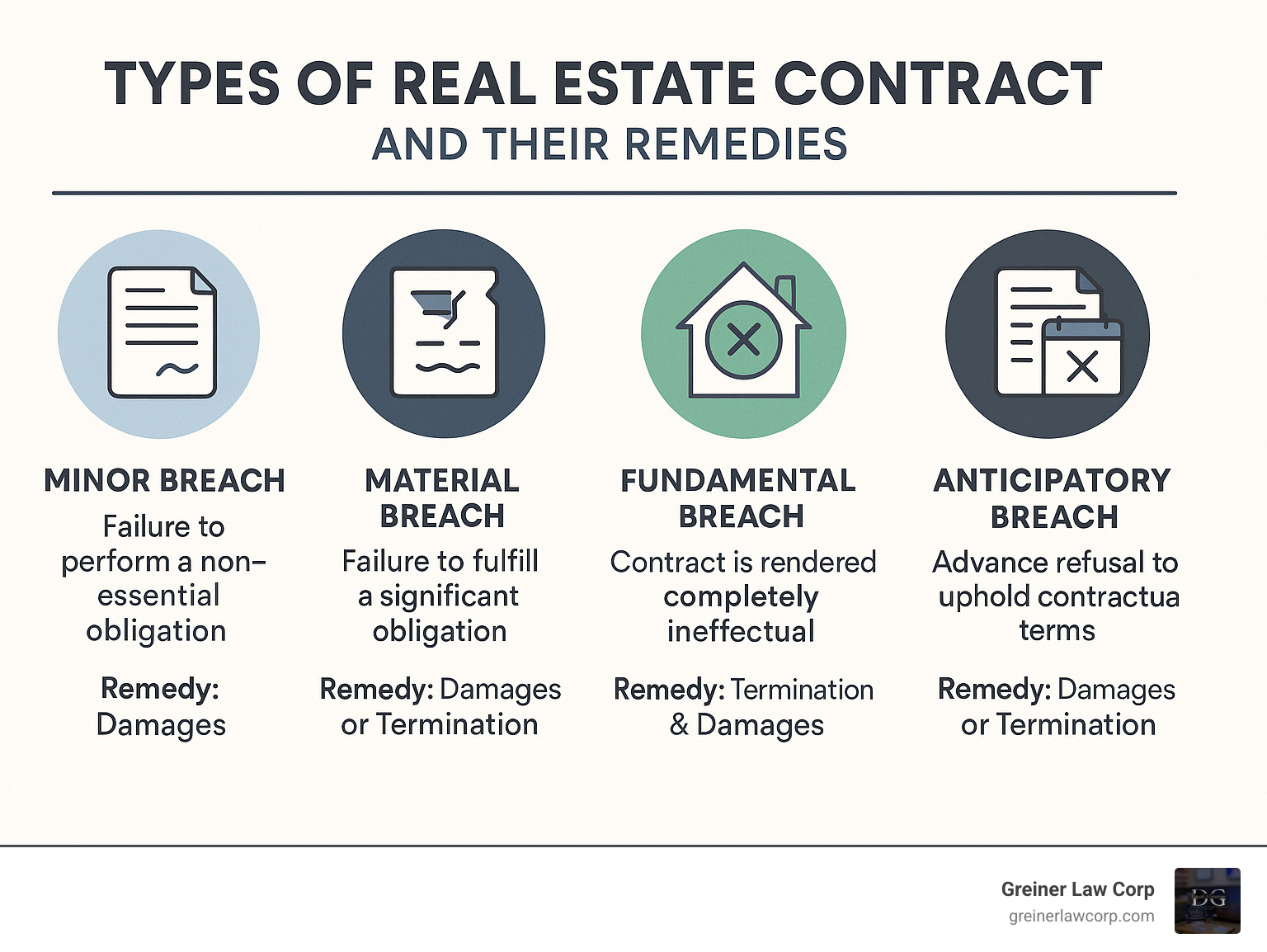
Minor (Non-Material) Breach
A minor or non-material breach is like a small crack in your foundation – noticeable but not threatening the structural integrity of your deal. These small deviations don’t prevent the core purpose of the contract from being fulfilled, though they may cause some inconvenience.
In my years of practice, I’ve seen countless examples: a seller leaving behind a few boxes in the garage after closing, a buyer submitting paperwork a day late, or a seller replacing the promised stainless steel refrigerator with one of equal value but different brand. These situations are frustrating, certainly, but they don’t justify walking away from the entire transaction.
When these minor breaches occur, you can’t terminate the contract, but you may be entitled to reasonable compensation for any actual damages. I remember one client who finded the washer and dryer specified in their contract were missing after move-in. Rather than engaging in costly litigation, we helped negotiate fair compensation for the appliances’ market value – a much more practical solution for everyone involved.
Material Breach – The Heart of a Real Estate Breach of Contract
A material breach is an entirely different animal – it strikes at the very heart of your agreement. Think of it as the difference between a small scratch on your new car versus the engine failing to start. Material breaches significantly affect the value of your deal and essentially defeat its purpose.
When a seller refuses to transfer title after all contingencies are satisfied, or a buyer can’t secure financing by closing without a financing contingency in place, we’re dealing with serious issues. I’ve guided clients through particularly troubling situations where sellers failed to disclose significant known defects like foundation issues or extensive water damage – clear material breaches under California law.
California takes disclosure failures particularly seriously. State law requires sellers to reveal all known defects that materially affect the property’s value or desirability. When these obligations are ignored, the non-breaching party has powerful options: terminate the contract and seek damages, pursue specific performance through court order, or seek monetary damages while still enforcing the contract.
Anticipatory Real Estate Breach of Contract
Sometimes, you don’t have to wait for the deadline to know there’s trouble ahead. An anticipatory breach occurs when one party clearly signals – through words or actions – that they won’t fulfill their obligations before the performance deadline arrives. It’s like someone telling you they’ll miss your wedding a week before the ceremony; you don’t have to wait at the altar to know they’re not showing up.
The booming 2022 California housing market created numerous anticipatory breach situations. With rapidly rising prices, some sellers tried backing out of signed contracts when they received higher offers. I helped several distressed buyers steer these situations, reminding sellers that their contractual obligations remained binding despite market shifts.
For an anticipatory breach to be legally actionable, the indication of non-performance must be clear and unequivocal, relate to a material aspect of the contract, and the non-breaching party must treat the contract as breached rather than adopting a “wait and see” approach.
When a buyer calls to say they can’t secure financing a week before closing, or a seller informs you they’ve accepted another offer despite your binding contract, immediate legal advice becomes essential. These situations require prompt, strategic responses to protect your rights and investment. At Greiner Law Corp, we’ve seen how quick action in these scenarios can mean the difference between a salvaged deal and a protracted legal battle.
More info about Breaking a Real Estate Contract
Common Buyer & Seller Breaches: Real-World Examples
Let’s talk about the real-world situations where real estate breach of contract happens. After years of helping clients steer these choppy waters at Greiner Law Corp, I’ve seen certain patterns emerge in California’s dynamic real estate market. Understanding these common scenarios might just help you avoid similar pitfalls.
More info about Breaking a Real Estate Contract
Buyer-Side Real Estate Breach of Contract Scenarios
That earnest money deposit is often your first commitment in a real estate transaction – typically 1-3% of the purchase price here in California. When it doesn’t arrive on time (or worse, bounces), you’ve got an immediate breach situation. I remember one seller client who received a bounced check and was left wondering what to do next – that’s a clear breach right from the start.
Financing failures create another common breach scenario. In competitive markets, some buyers waive their financing contingencies to make their offers shine brighter than others. It’s a risky move that can backfire spectacularly if the mortgage falls through. According to National Association of Realtors data, financing issues trigger about 22% of all terminated contracts nationwide.
Then there’s the classic case of buyer’s remorse. Sometimes people simply change their minds after signing – perhaps they found a better property or got cold feet about the commitment. Without a valid contingency to lean on, walking away constitutes a clear breach, typically resulting in forfeited earnest money. In some cases, sellers can pursue additional damages if their losses exceed the deposit amount.
Missing the closing date without securing an extension is another breach that happens more often than you might think. Real estate contracts typically specify that “time is of the essence,” making those deadlines particularly meaningful in the eyes of the law.
Seller-Side Real Estate Breach of Contract Scenarios
Seller breaches often happen when temptation strikes in the form of a better offer. In California’s hot markets, it’s not uncommon for sellers to receive higher offers after they’ve already signed a contract. The “seller’s remorse” that follows can lead some to try backing out – a clear breach that often leads to significant liability.
Disclosure failures represent another major category of seller breaches. California law takes disclosure obligations seriously, requiring sellers to reveal all known material defects. Hiding water damage, foundation issues, or even neighborhood nuisances not only violates statutory requirements but also breaches the contract. The consequences can be severe and long-lasting.
When inspection contingencies result in agreed-upon repairs, failing to complete those repairs by closing constitutes a breach. This often creates last-minute drama during the final walkthrough when buyers find the promised fixes weren’t made.
Title problems can blindside even the most well-intentioned sellers. Delivering clear title at closing is a fundamental obligation, and unresolved liens, easements, or judgments can prevent sellers from fulfilling this duty. I’ve worked with sellers who were genuinely shocked to find old liens clouding their title – but surprise doesn’t prevent a breach.
Finally, there’s the awkward scenario where sellers refuse to vacate as agreed. When the contract specifies vacant delivery at closing, sellers who remain in possession have breached the agreement. These situations get particularly messy as they often involve both contract law and landlord-tenant issues.
By recognizing these common scenarios early, both buyers and sellers can take proactive steps to avoid breaches or address them before they escalate into costly litigation. Most real estate breach of contract situations can be resolved through prompt communication and good faith negotiation – something we always encourage before heading to court.
Legal Remedies and Damage Calculation
When someone breaks a real estate contract, you’re not left empty-handed. California law offers several ways to make things right again. The right solution depends on what went wrong, what your contract says, and the specific details of your situation.
Specific Performance in a Real Estate Breach of Contract
Sometimes, money just isn’t enough – you want the actual property you contracted for. That’s where specific performance comes in. This remedy is essentially a court order telling the other party, “You must fulfill your contract.”
In California, courts generally favor this approach for single-family homes when the buyer plans to live there. Why? Because every piece of real estate is considered unique – there’s literally no other property exactly like it on Earth.
To get specific performance, you need:
– A crystal-clear contract with all important terms spelled out
– A fair and reasonable agreement (nothing that would shock the conscience)
– Adequate consideration (you paid or offered a fair price)
– Proof that you’re ready and able to hold up your end of the deal
At Greiner Law Corp, we’ve helped many disappointed buyers get the homes they contracted for when sellers tried to back out. Courts typically find it easier to order a seller to complete a sale than to force someone to buy a property they no longer want.
Monetary Damages & How Courts Calculate Them
When specific performance isn’t the right fit, money damages come into play. These come in several flavors:
Compensatory damages aim to put you where you would have been if everything had gone according to plan. For buyers, this might mean the difference between the contract price and what similar properties now cost (if prices went up). For sellers, it could be the gap between your contract price and what you eventually sold for (if you had to accept less).
Consequential damages cover the foreseeable ripple effects of the breach. Had to pay for temporary housing because your new home fell through? That might be recoverable. Needed to extend your rate lock when closing was delayed? That too.
Incidental damages reimburse you for reasonable expenses dealing with the mess – like inspection fees or appraisal costs you have to pay twice.
California judges want to see receipts, estimates, and clear documentation of all these costs. They won’t award damages based on guesswork or what “might have” happened.
A recent survey showed that in California, most real estate breach of contract claims involve buyers who failed to close or sellers who didn’t disclose known problems with the property.
Role of Liquidated Damages Clauses
Many real estate contracts include liquidated damages provisions – essentially an agreement upfront about how much the breaching party will pay. In California, these clauses often say the seller can keep the buyer’s deposit if the buyer backs out without a valid reason.
For these clauses to hold up in court, three things must be true:
1. The actual damages would have been hard to calculate when you signed
2. The amount represents a reasonable estimate (not a punishment)
3. It’s not functioning as a penalty
Standard California residential purchase agreements typically cap these damages at 3% of the purchase price. Commercial contracts might go higher.
Industry data shows over 80% of standard residential real estate contracts nationwide include liquidated damages provisions. They give both sides clarity about what happens if things go sideways.
We always advise our clients to pay special attention to these clauses before signing. They can dramatically impact your rights if the deal falls apart later. A little attention now can save major headaches down the road.
Scientific research on liquidated damages
Preventing & Responding to a Real Estate Breach of Contract
Let’s face it – nobody enters a real estate transaction hoping for problems. At Greiner Law Corp, we’ve seen how thoughtful preparation can save our clients from the headache and heartbreak of a real estate breach of contract. An ounce of prevention truly is worth a pound of cure when it comes to protecting your property investment.
More info about Real Estate Contracts
Drafting Tips to Avoid a Future Real Estate Breach of Contract

The best defense against a real estate breach of contract starts with a well-crafted agreement. Think of your contract as a roadmap – the clearer the directions, the less likely anyone gets lost along the way.
When drafting your real estate contract, clarity is your best friend. Use specific language that leaves no room for interpretation about property descriptions, including exactly which fixtures and appliances stay with the home. Instead of vague timelines like “within a month,” set precise calendar dates for inspections, financing approvals, and closing.
Contingencies are your safety net in real estate transactions. A thoughtfully drafted financing contingency can protect a buyer if their loan falls through, while sellers might include contingencies about finding suitable replacement housing. The key is making these contingencies specific enough to be enforceable but flexible enough to be practical.
It’s also wise to clearly identify which terms are considered “material” to the contract. This distinction matters tremendously if problems arise, as material breaches offer more remedial options than minor ones. For example, a missing refrigerator might be annoying but not material, while failing to deliver clear title absolutely is.
Your contract should spell out what happens if things go sideways. Consider including reasonable liquidated damages provisions (typically 3% of the purchase price in California), specific performance availability, and attorney fee provisions for the prevailing party if litigation becomes necessary.
I’ve seen many clients benefit from including clear procedures for extending deadlines or modifying terms. Life happens – inspections run long, lenders need extra documentation – and having an agreed-upon process for handling these hiccups prevents them from becoming breaches.
What to Do If You Suspect a Real Estate Breach of Contract
When you suspect the other party has breached your contract, staying calm and strategic is crucial. Your first step should be a careful review of the contract itself – identify exactly which provision has been breached and whether it constitutes a material or minor breach.
Document everything. In potential breach situations, contemporaneous records become invaluable. Save emails, text messages, and voicemails. Take detailed notes after phone conversations, including dates, times, and what was discussed. Photos and videos can be especially helpful for property condition issues.
A formal breach notice often gets results without further escalation. Many contracts actually require this step before pursuing remedies. Even when not required, a professionally drafted letter from your attorney signals that you’re serious about enforcing your rights while potentially opening the door to resolution.
You also have a legal obligation to mitigate your damages. This means taking reasonable steps to minimize your losses after a breach. For sellers, this might mean promptly relisting a property; for buyers, it could involve beginning a new property search. Document these mitigation efforts carefully – courts will want to see that you didn’t sit idle and let damages accumulate.
Consulting with an attorney experienced in real estate breach of contract situations can save you time, money, and stress. At Greiner Law Corp, we often help clients evaluate their position and develop strategic responses that protect their interests while keeping costs manageable.
Before rushing to court, consider alternative dispute resolution options. Mediation and arbitration typically cost less than litigation and resolve much faster. Many real estate contracts now include mandatory mediation clauses for good reason – they work! Industry data shows that over 70% of real estate disputes settle through negotiation or mediation, with relatively few reaching the courtroom.
Timing matters. In California, the statute of limitations for written contract breaches is generally four years, but waiting too long can complicate evidence gathering and damage mitigation. When you suspect a real estate breach of contract, prompt action usually leads to better outcomes.
Resolving Disputes: Negotiation, Mediation, Litigation
When you’re dealing with a real estate breach of contract, figuring out how to resolve the dispute doesn’t have to be overwhelming. Think of it as having different tools in your toolbox—each designed for specific situations. Let’s talk about your options and how to choose the one that makes the most sense for your circumstances.
Choosing the Right Forum for a Real Estate Breach of Contract
Finding the right approach to resolve your real estate breach of contract is a bit like choosing the right vehicle for a trip—the best choice depends on where you’re going and what you need along the way.
Direct negotiation is often your fastest and most cost-effective route. When both parties can sit down and talk things through, you’d be surprised how many issues can be resolved with a simple conversation. At Greiner Law Corp, we’ve seen countless disputes settled through facilitated discussions that lead to practical solutions like price adjustments or extended timelines. This approach works particularly well for minor breaches where both sides have good reasons to find a quick solution.
Mediation brings in a neutral third party to help guide the conversation when direct talks aren’t making progress. It’s private, less confrontational than court, and gives you more control over the outcome. What many people don’t realize is that about 70% of real estate disputes resolve through mediation, often in just one day. That’s why many California real estate contracts now require attempting mediation before filing a lawsuit. It’s especially valuable when creative problem-solving might help break an impasse.
Arbitration offers a middle ground between mediation and litigation. It’s generally faster than court but still provides a binding decision. The process is confidential and often handled by arbitrators with specialized real estate knowledge. While arbitration limits your appeal options and can be costly, it’s particularly useful for technical disputes where the arbitrator’s expertise adds value. We’re seeing arbitration clauses become increasingly common in real estate contracts, especially for commercial transactions.
Litigation is the formal court process that most people think of when they hear “legal dispute.” While it offers the most comprehensive evidence-gathering options and can establish public precedents, it’s also typically the most expensive and time-consuming path. In California, real estate breach of contract cases usually take 12-18 months to resolve—and that timeline has grown even longer since the pandemic created court backlogs. Litigation makes the most sense for high-value disputes or when other resolution methods have failed.
The current real estate market can significantly influence both how likely breaches are to occur and how they’re resolved. In a hot seller’s market, we often see sellers tempted to breach existing contracts when higher offers come in. Conversely, in a cooling market, buyers might look for ways to exit agreements as property values decline.
Taking a business-minded approach to dispute resolution means looking beyond the principle of the matter to consider the full financial picture. At Greiner Law Corp, we help our clients evaluate not just the direct costs of each resolution method, but also the indirect costs like your time, stress levels, and opportunities you might miss while tied up in a lengthy dispute.
The goal isn’t just to win—it’s to resolve the issue in a way that best protects your interests and allows you to move forward.
Frequently Asked Questions about Real Estate Breach of Contract
What is the statute of limitations for a real estate breach of contract in California?
When it comes to time limits, California gives you four years from the date of breach to file a lawsuit for written real estate contracts. That’s a relatively generous window, but don’t let it lull you into a false sense of security.
The tricky part? Figuring out exactly when that clock started ticking. Sometimes the “findy rule” comes into play, which means the countdown begins when you finded (or reasonably should have finded) the breach—not when it actually happened.
I’ve seen too many clients wait until year three to seek legal help, only to find that crucial evidence has disappeared or witnesses can no longer recall important details. While you have four years legally, the practical reality is that your case becomes harder to prove with each passing month.
Can I keep the buyer’s earnest money if they default?
Good news for sellers—in most cases, yes, you can keep that earnest money when a buyer defaults, provided your contract includes a properly drafted liquidated damages clause. Most standard California residential purchase agreements include this provision, typically allowing sellers to retain the deposit (usually up to 3% of the purchase price) as compensation for the breach.
However, before you start counting that money, several conditions must be satisfied:
First, both parties must have separately signed or initialed the liquidated damages clause. Second, the amount must be reasonable compared to the anticipated harm. Third, you as the seller must have clean hands (meaning you didn’t also breach the contract). And finally, the buyer’s breach must be material—not some minor technicality.
An important distinction: if the buyer backs out using a valid contingency—like failing to secure financing when they have a financing contingency—that’s not a breach at all. In those cases, the deposit should be returned.
For larger deposits exceeding 3% of the purchase price, California law requires additional specific disclosures and agreements to make the liquidated damages provision enforceable. This is definitely an area where having proper legal guidance pays dividends.
When will a court refuse to grant specific performance?
While specific performance is often the preferred remedy for a real estate breach of contract, courts won’t always grant it. I’ve seen judges decline specific performance in several situations that might surprise you.
If your contract has a vague property description or ambiguous terms, don’t expect specific performance. Courts need clarity to enforce a contract this way. Similarly, if your agreement is fundamentally unfair, resulted from pressure tactics, or contains grossly inequitable terms, judges will likely refuse.
Buyers seeking specific performance face particular scrutiny—you must prove you were ready, willing, and able to complete the purchase at the time of breach. I recently worked with a client who couldn’t demonstrate they had financing lined up when the seller backed out, and the court declined specific performance on those grounds.
Practical impossibility is another barrier. If performance has become impossible or would require the court to continuously supervise the parties, judges typically opt for monetary damages instead.
Perhaps most importantly, courts look at your behavior throughout the transaction. The legal principle of “unclean hands” means that if you’ve acted unfairly or in bad faith, don’t expect the court to force the other party to complete the deal.
The bottom line? Specific performance is a powerful remedy, but it’s not automatic. The cleaner your contract and your conduct, the better your chances of securing this valuable remedy.
Conclusion
When it comes to a real estate breach of contract, the stakes couldn’t be higher. Your property rights, hard-earned money, and future plans all hang in the balance. It’s like standing at a crossroads where one path leads to resolution and the other to prolonged conflict.
At Greiner Law Corp, we don’t just see legal documents—we see people’s dreams and investments. That’s why we approach these matters with both legal expertise and practical business sense. We help you understand not just what you can do, but what you should do to protect your interests.
Throughout this guide, we’ve walked through the complex landscape of real estate contract breaches. Let’s take a moment to reflect on what we’ve learned:
First, not every failed transaction is a breach. Those contingency clauses we discussed aren’t just legal jargon—they’re safety nets designed to allow legitimate exits when circumstances change. Understanding when someone is exercising a contractual right versus breaking a promise makes all the difference.
The type of breach matters enormously. A minor hiccup in the closing process requires a different response than a seller who suddenly refuses to transfer title. Recognizing whether you’re dealing with a minor, material, or anticipatory breach helps you respond appropriately.
Prevention truly is the best medicine. I’ve seen countless disputes that could have been avoided with clearer contract language and more thoughtful contingencies. A few extra hours with an attorney during drafting can save weeks in court later on.
When problems do arise, time is of the essence. Many clients come to us weeks after a breach, having unwittingly weakened their position through delay or improper communication. Quick, strategic action often leads to faster, less expensive resolutions.
Litigation isn’t your only option—and often isn’t your best one. Negotiation, mediation, and arbitration frequently provide faster, more cost-effective paths to resolution. Sometimes the “win” isn’t in the courtroom but in finding creative solutions that get you back on track toward your real estate goals.
California’s unique real estate market and legal landscape make local expertise particularly valuable. What works in other states may not apply here, and our state’s disclosure requirements and remedies have their own distinct features.
Every real estate breach of contract situation tells its own story. While this guide provides a roadmap, your journey will have its own twists and turns based on your specific contract, circumstances, and goals.
If you’re facing a potential breach—whether as the affected party or the one who may be unable to perform—reaching out for specialized legal guidance early can make all the difference. At Greiner Law Corp, we’re committed to helping clients throughout Southern California find practical, business-minded solutions to their real estate challenges.
The home you’re buying or selling represents more than just a transaction—it’s often the cornerstone of your financial future and personal dreams. We’re here to help protect that investment every step of the way.


