
Understanding Your California Real Estate Purchase Contract
A California real estate purchase contract is a legally binding agreement detailing the terms between a buyer and seller in a property transaction. Most deals use the standardized California Association of REALTORS® (C.A.R.) Residential Purchase Agreement, a comprehensive 16+ page document.
Key components of a California real estate purchase contract include:
- Purchase price and financing terms
- Earnest money deposit (typically 1-3% of the price)
- Contingencies (e.g., inspection, financing, appraisal)
- Required seller disclosures
- Timelines and deadlines (often a 17-day contingency period)
- Closing and possession dates
- Dispute resolution procedures
Most California home purchases close in 30-45 days. The contract also serves as escrow instructions, streamlining the process. Understanding this document is crucial, as missing deadlines or misinterpreting clauses can lead to cancellation, forfeited deposits, or lost opportunities.
As David Greiner, Esq., I've guided countless clients through these complex agreements. My business-focused approach ensures you understand every provision of the California real estate purchase contract, helping you manage risk and prevent costly mistakes.
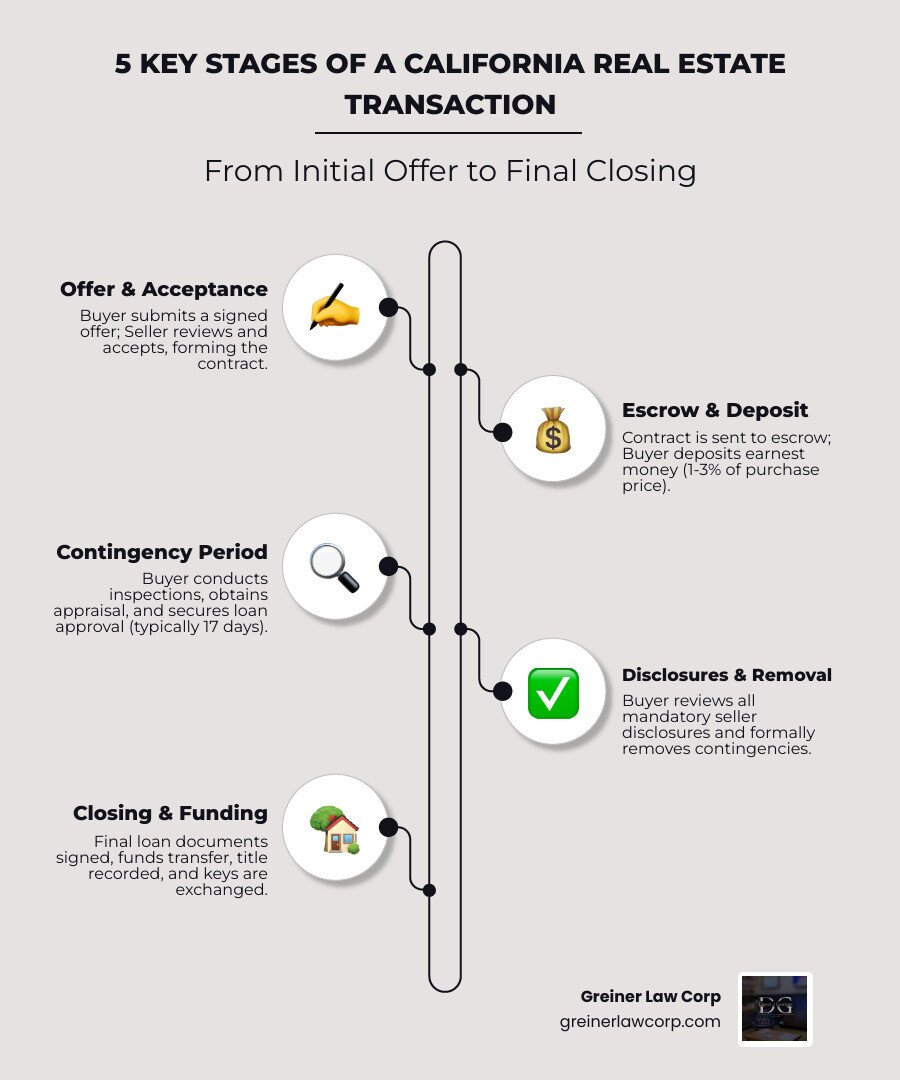
Deconstructing the California Real Estate Purchase Contract (RPA)

The California real estate purchase contract, or Residential Purchase Agreement (RPA), is the blueprint for your property transaction. Once signed, it becomes a legally binding contract and also serves as your escrow instructions. This dual-role design streamlines the process, ensuring your escrow officer follows the exact terms agreed upon for handling funds, inspections, and closing conditions. To understand the broader landscape of how these contracts work, check out our guide on Real Estate Contracts Explained.
Key Components of the California Real Estate Purchase Contract
Every California real estate purchase contract includes several essential elements:
- Key parties: Identifies the buyer, seller, and their respective real estate agents.
- Offer details: States the property address, purchase price, and target closing date (typically 30-45 days).
- Property description: Provides the legal description of the property being sold, including the lot and any attached structures.
- Financing and loan terms: Details how the buyer plans to pay, including loan types and contingencies that protect the buyer if financing fails.
- Cost allocation: Specifies who pays for title insurance, escrow fees, and transfer taxes, which are negotiable terms.
- Items included and excluded: Clearly lists personal property (like appliances or smart home systems) that are part of the sale to prevent disputes.
- Title and vesting: Defines how the buyer will hold title (e.g., joint tenants, community property), which has significant tax and inheritance implications.
For more detailed information about the forms that shape your transaction, explore our resources on California Real Estate Forms Purchase Agreement.
The Role of Earnest Money
Earnest money is a good faith deposit that shows a seller you are serious. In California, this deposit is typically 1-3% of the purchase price. On an $800,000 home, that's between $8,000 and $24,000.
Within three business days of the contract's acceptance, the deposit goes into a neutral escrow account. If you, the buyer, breach the contract after removing your contingencies, you could lose this deposit. However, California law protects buyers by capping these liquidated damages at 3% of the purchase price for owner-occupied properties (1-4 units). This means the seller cannot keep more than 3%, even if your deposit was larger. This system gives sellers assurance while limiting a buyer's potential loss. Understanding these implications is crucial—learn more about What is a Breach of Contract to protect yourself.
Blank vs. Sample Agreements
It's important to know the difference between a blank and a sample California real estate purchase contract.
A blank agreement is the official, up-to-date C.A.R. form. It's a 16+ page template with legally vetted language, ready to be filled in with your transaction's specific details. This is the document your agent will use to write your offer.
Sample agreements, like this sample C.A.R. RPA, are for educational purposes only. They are filled with hypothetical information to show you what a completed contract looks like. Never use a sample for a real transaction, as every deal requires precise, customized terms. While a Real Estate Contract Template is a useful reference, proper completion is what makes it a legally sound agreement.
Navigating Timelines, Contingencies, and Disclosures
Buying a home involves a strict schedule of deadlines, conditions, and information exchanges. The California real estate purchase contract carefully outlines these requirements, which are critical for a successful transaction.
Most California home purchases close within 30-45 days. The standard contract gives buyers a 17-day period for key activities like securing a loan, conducting inspections, and reviewing disclosures. This timeline is enforced by the "time is of the essence" clause, meaning all deadlines are strict. Missing a deadline can put you in breach of contract, allowing the other party to issue a "Notice to Perform" and potentially cancel the deal if the obligation isn't met within a short grace period. Following these deadlines is essential for a smooth Real Estate Closing Process.
Most Common Contingencies and Why They Matter
Contingencies are conditions that protect the buyer, allowing them to cancel the contract without penalty if certain requirements aren't met. Removing contingencies in writing is a major step that signals a buyer's commitment.
Here are the most common contingencies:
- Inspection Contingency: Allows the buyer to conduct thorough property inspections. If significant issues are found, the buyer can request repairs or cancel the contract.
- Appraisal Contingency: Protects the buyer if the property appraises for less than the purchase price. The buyer can then renegotiate, cover the difference, or cancel.
- Loan Contingency (Financing Contingency): Lets the buyer back out if they cannot secure the necessary home loan after making a good faith effort.
- Sale of Buyer's Property Contingency: Makes the purchase conditional on the buyer selling their current home first.
- Contingency Removal: Buyers must remove each contingency in writing by its deadline (often 17 days). If they don't, the seller can issue a Notice to Perform, which may lead to cancellation.
Understanding these provides Valid Reasons to Back Out of Buying a House. Waiving them to be more competitive is risky and removes your contractual safety nets.
Legally Required Seller Disclosures
California law requires sellers to provide extensive information about the property's condition and history. Sellers typically have 7 days after acceptance to deliver these disclosures. If a buyer doesn't receive them, they have a right to terminate the agreement (three days after receipt, or five if mailed).
Key required disclosures include:
- Transfer Disclosure Statement (TDS): The seller must disclose all known material defects affecting the property's value, such as a leaky roof or faulty plumbing.
- Natural Hazard Disclosure (NHD): A report identifying if the property is in a hazard zone for:
- Floods
- Dam Inundation
- Very High Fire Hazard
- Wildland Fire Area
- Earthquake Faults
- Seismic Hazards Buyers also get an Environmental Hazards Pamphlet and a Homeowner’s Guide to Earthquake Safety.
- Megan's Law Disclosure: Informs buyers that information on registered sex offenders is publicly available.
- Lead-Based Paint Disclosure: Required for homes built before 1978, disclosing any known lead hazards.
- Death on Premises: Sellers must disclose if a death occurred on the property within the last three years (with certain exceptions).
- Water Heater and Smoke Detector Compliance: A statement confirming the water heater is braced and smoke detectors are installed and operational.
Failure to provide accurate disclosures can have serious legal consequences for the seller, including contract cancellation or a lawsuit for damages if a Seller Failed to Disclose material facts.
Your Rights and Responsibilities: Cancellation, Disputes, and Common Pitfalls
Entering into a California real estate purchase contract is a major commitment. It's vital to understand your rights and responsibilities, especially regarding cancellation, disputes, and common pitfalls. The contract provides a framework for managing risk, but its effectiveness depends on both parties following the agreed-upon terms.

One crucial rule is to put everything in writing. Verbal promises about repairs or other terms are unenforceable. Any changes must be documented in a formal written addendum signed by all parties to be binding, a key principle of Risk Management in Contracts.
Buyer's and Seller's Rights to Cancel
Both parties have specific rights to cancel the California real estate purchase contract, though buyers generally have more flexibility.
Buyer's Rights: Buyers can typically cancel without penalty during their contingency periods if they are unsatisfied with inspections, the appraisal is too low, or they can't secure a loan. A powerful right also arises if the seller fails to provide required disclosures on time; the buyer gets a new 3-day window (5 if mailed) to cancel after receiving the late documents.
Seller's Rights: Sellers can cancel if the buyer fails to perform. If a buyer misses a deadline (like depositing earnest money or removing a contingency), the seller can issue a "Notice to Perform," giving the buyer a short grace period to comply. If the buyer fails to close on time, the seller can issue a "Demand to Close Escrow." If the buyer still doesn't perform, the seller can cancel and may be entitled to the earnest money as liquidated damages.
For detailed guidance, see our guide on how to Cancel Real Estate Contract.
How Disputes Are Resolved
When disagreements arise, the contract provides a process for resolution that avoids immediate litigation.
- Mediation: The C.A.R. agreement requires parties to attempt mediation first. A neutral mediator helps facilitate a conversation to find a mutually agreeable solution. It's faster and less expensive than court. For local help, consider Real Estate Mediation Los Angeles.
- Arbitration: If both parties initialed the arbitration clause, this is the next step. A neutral arbitrator hears both sides and makes a legally binding decision, which is generally final.
- Attorney Fees: The prevailing party in a legal dispute is typically entitled to have their attorney fees paid by the losing party.
Common Mistakes on a California Real Estate Purchase Contract
Navigating the contract can be tricky. Here are common mistakes to avoid:
- Missing initials or signatures: A single missed initial can invalidate a clause or protection. Use electronic signature platforms to ensure completeness.
- Using vague language: Addendums with unclear terms like "seller to make necessary repairs" can lead to disputes. Be specific.
- Failing to document changes in writing: All agreements made after the initial contract must be in a signed, written addendum to be enforceable.
- Misunderstanding deadlines: The "time is of the essence" clause makes every deadline strict. Keep a calendar and act promptly.
- Waiving contingencies too early: In competitive markets, buyers may waive protections like inspection or appraisal contingencies. This is a high-risk strategy that can be very costly if problems arise.
- Rushing through disclosure reviews: Take the time to read every disclosure document carefully. They contain vital information about the property's condition and history.
- Skipping the final walk-through: This is your last chance before closing to ensure the property is in the agreed-upon condition and that all repairs were completed.
Many of these issues are related to the complexities of the home buying journey. For more insights, read our article on Common Mistakes Homebuyers Make During the Mortgage Process. A California real estate purchase contract is a powerful tool when used correctly. Understanding it can save you from costly errors.
Frequently Asked Questions about the California Purchase Agreement
Navigating a California real estate purchase contract naturally brings up questions. Here are answers to the most common concerns I hear from clients.
How much earnest money is typical in California?
In California, the earnest money deposit is typically 1% to 3% of the purchase price. On a $600,000 home, this would be between $6,000 and $18,000. A larger deposit can make your offer more attractive in a competitive market. Importantly, California law protects buyers by capping liquidated damages at 3% of the purchase price for owner-occupied properties (1-4 units). This means if you default after removing contingencies, the seller generally cannot keep more than 3% of the price, even if your deposit was larger.
Can I cancel if I don't get all disclosures on time?
Yes, absolutely. This is a strong buyer protection in California. Sellers are required to provide disclosures within 7 days of acceptance. If they are late, you gain a new cancellation right. Once you receive the late documents, you have 3 days to review them and cancel the contract (or 5 days if they were mailed). This right applies even if you've already removed other contingencies, underscoring how seriously California law takes seller transparency.
What does "as-is" really mean in a California contract?
The term "as-is" in a California real estate purchase contract means the seller does not intend to make any repairs. You are buying the property in its current condition.
However, "as-is" does not relieve the seller of their legal duty to disclose all known material defects. They must still provide the Transfer Disclosure Statement (TDS) and other required disclosures. The clause simply signals that the price reflects the current state of the property and that repair requests will likely be rejected. This makes your own inspections and due diligence even more critical before you remove your inspection contingency. For a deeper dive, see our guide on the California As Is Real Estate Contract.
Conclusion
The California real estate purchase contract is the roadmap for your property transaction. Understanding its key elements is essential for a smooth and successful journey from offer to closing.
We've covered the critical aspects:
- Contract Components: Know the terms, from financing to title provisions.
- Timelines: Respect every deadline, as "time is of the essence."
- Contingencies: Use these safety nets wisely during your due diligence.
- Disclosures: Thoroughly review all seller disclosures to get the full picture.
- Common Mistakes: Avoid pitfalls like verbal agreements and missed initials.
At Greiner Law Corp, our business-minded approach helps clients manage risk while achieving their real estate goals. We believe an informed client is an empowered client, and knowledge of your California real estate purchase contract is your best defense against costly surprises.
The contract is your guide to successful real estate ownership. With proper preparation and professional guidance, you can steer your transaction with confidence. Ready to move forward? Steer your transaction with confidence by understanding the Real Estate Purchase Contract in California. Professional legal review is a vital step to manage risk and protect your interests.