Why Sales of Real Property in Probate Require Legal Navigation
Sales of real property in probate are challenging, combining emotional stress with complex legal problems.
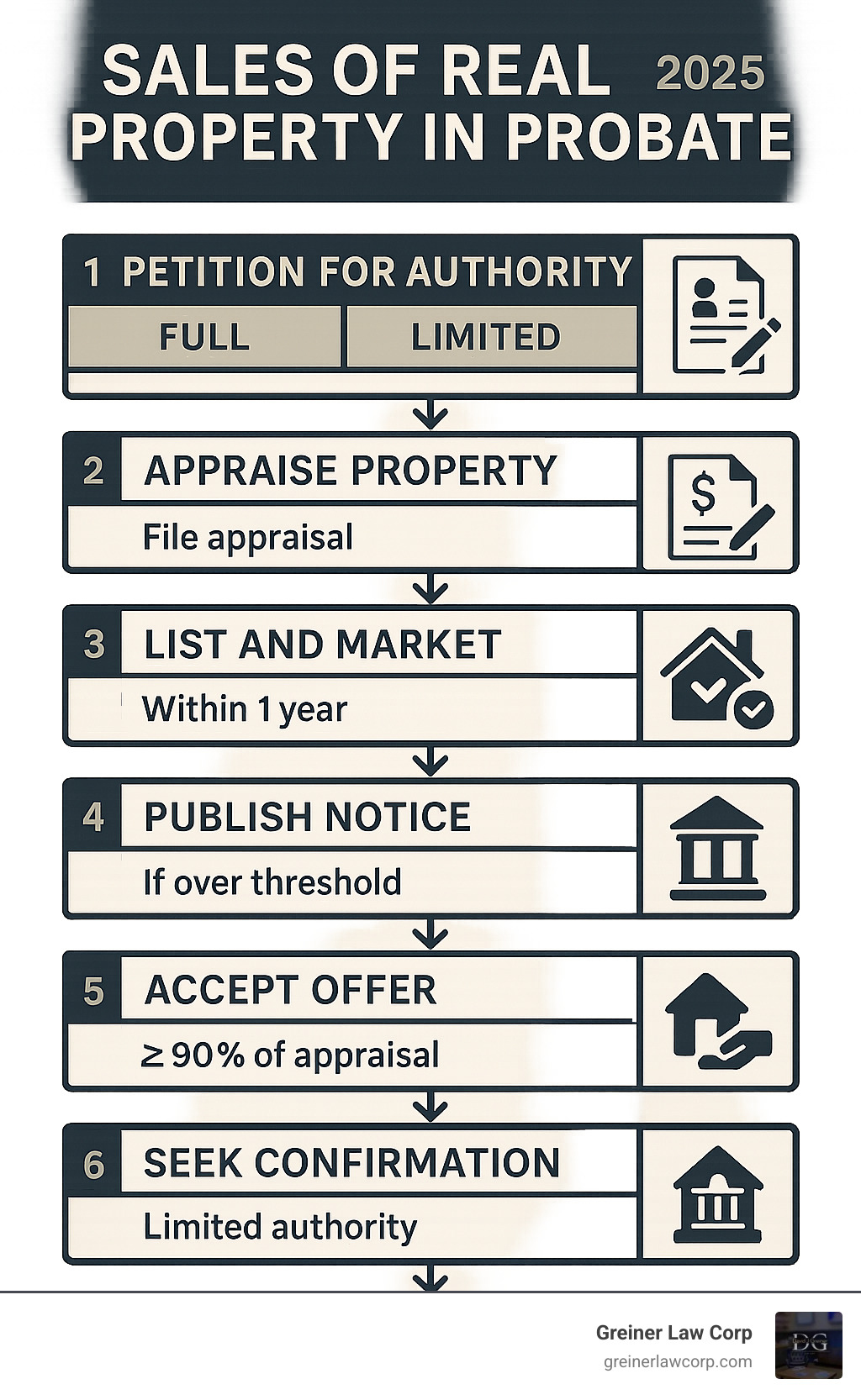
Quick Navigation Guide for Probate Real Estate Sales:
- Get court authority – Petition for Letters of Administration/Testamentary
- Appraise the property – Required by probate court within one year
- List and market – Work with probate-experienced real estate agents
- Publish legal notice – Required for properties over $5,000 in value
- Accept an offer – Must be at least 90% of appraised value (limited authority)
- Seek court confirmation – Unless you have full IAEA authority
- Steer overbidding – Other buyers can outbid at confirmation hearing
- Close escrow – Transfer title and distribute proceeds to beneficiaries
The key difference from a regular sale is court oversight. Most probate sales need a judge’s approval, take longer, and follow specific legal procedures based on your authority under California’s Independent Administration of Estates Act (IAEA).
Properties are sold “as-is” with few disclosures. Buyers face strict terms and risk being outbid at a court confirmation hearing.
Timeline reality check: A regular sale takes 30-45 days; a probate sale can take 6-12 months or more.
I’m David Greiner, Esq. My firm focuses on achievement-oriented solutions, helping personal representatives steer these complex sales, manage legal risks, and meet their goals.
What is a Probate Sale and Why is it Necessary?

When someone dies owning real estate, the property often enters a court-supervised process called probate. Probate is the legal process of settling a deceased person’s financial affairs: validating their will, paying debts, and distributing assets to the rightful heirs. You can learn more in our guide, What is Probate?.
A probate sale occurs when real estate must be sold to settle the estate. Sales of real property in probate become necessary for several reasons:
- To pay estate debts and taxes. If the estate lacks sufficient cash to cover expenses, selling property is often the only solution.
- For fair distribution to heirs. When multiple heirs inherit one property, selling it allows for an easy and equitable division of the proceeds.
- To follow the will’s instructions. The will may explicitly direct the sale of the property.
- When it’s advantageous to the estate. Selling may be best if the property requires costly repairs or if market conditions are favorable.
The Probate Court oversees the sale to ensure all legal requirements are met, protecting creditors, beneficiaries, and the personal representative.
How a Probate Sale Differs from a Regular Sale
A probate sale differs significantly from a regular real estate transaction, affecting the timeline, price, and overall strategy.
- Court Confirmation: A judge must approve most probate sales. This opens the door for an overbidding process at a court hearing, where other buyers can submit higher offers.
- Longer Timeline: A regular sale might close in 30-45 days, but a probate sale can take 6-12 months or more due to court schedules. Our article on How Long Does Probate Take? details these delays.
- “As-Is” Condition: Properties are sold “as-is,” with no warranties. The personal representative usually has limited knowledge of the property’s history, so buyers receive minimal disclosures.
- Pricing Restrictions: An appraisal is required, and offers must typically be at least 90% of the appraised value, limiting lowball offers.
Here’s a quick comparison:
| Factor | Regular Sale | Probate Sale |
|---|---|---|
| Timeline | 30-45 days | 6-12+ months |
| Court Involvement | Minimal | Extensive oversight |
| Overbidding | Not applicable | Common at hearings |
| Property Condition | Negotiable repairs | Sold “as-is” |
| Pricing | Market negotiation | 90% of appraised value minimum |
Understanding these differences helps you set realistic expectations.
The Role of the Personal Representative
The Personal Representative (an Executor named in a will or a court-appointed Administrator) manages the sale. Learn more in our Executor Duties Explained guide.
This individual has a fiduciary duty to act in the best interests of the estate, a serious legal obligation. Their duties include securing the property, paying the mortgage and utilities, and preventing deterioration.
A smart Personal Representative assembles a team of professionals, including a probate attorney (see our Probate Lawyer Services guide), an appraiser, and an experienced Probate Real Estate Agent in Los Angeles. The representative’s diligence is key to a smooth process, avoiding delays and legal issues.
The Executor’s Roadmap: A Step-by-Step Guide to Sales of Real Property in Probate

Selling a home in probate can be overwhelming. This step-by-step guide breaks down the process to help you steer it successfully.
Step 1: Petition the Court and Obtain Authority. You must first petition the court to obtain Letters of Administration (or Letters Testamentary). These documents grant you the legal authority to act for the estate. Without them, you cannot proceed with a sale. Our guide on Probate Letters of Administration explains this further.
Step 2: Appraise the Property. A court-appointed probate referee must appraise the property to determine its fair market value. This appraisal is mandatory and sets the baseline for the sale price; offers generally must be at least 90% of this value if court confirmation is needed.
Step 3: List the Property for Sale. Work with a real estate agent experienced in probate sales. Their specialized knowledge is crucial for navigating the unique requirements of these transactions.
Step 4: Publish a “Notice of Sale.” For most probate sales in California, you must publish a legal notice in a local newspaper to inform the public of the sale, as required by the California Probate Code. This ensures transparency.
Step 5: Accept an Offer. When you accept an offer, it is conditional and subject to court approval. This is a key difference from a standard sale.
Step 6: Report the Sale and Petition for Court Confirmation. You must report the sale to the court by filing a “Petition for Order Confirming Sale of Real Property.” This petition details the transaction and is a key step in the process described in What Happens in Probate Court?.
Step 7: Steer the Court Confirmation Hearing. At the court confirmation hearing, the judge reviews the offer. However, other buyers can appear and submit higher bids in an overbidding process. This process follows specific bidding increment rules. If an overbid is successful, that new buyer wins the property.
Step 8: Close Escrow and Distribute Proceeds. After the court confirms the sale, you proceed to a standard escrow closing. The net proceeds are then used to pay estate debts and costs, with the remainder distributed to the beneficiaries.
Special Considerations for the Sales of Real Property in Probate
- “As-is” sales are standard. As the personal representative, you have limited knowledge of the property’s condition and are not expected to provide warranties. This protects you from the usual Seller Failed to Disclose liability, but buyers must perform their own thorough inspections.
- Pricing restrictions, like the 90% of appraised value rule, protect the estate and ensure beneficiaries receive fair value.
- Contingencies are rare. Most offers must be non-contingent to be presented for court confirmation, as the court prefers firm, unconditional offers.
- Buyer deposits are typically 10% of the purchase price. This substantial deposit shows the court the buyer is serious and financially capable.
Key Documents for the Sales of Real Property in Probate
Properly managing paperwork is crucial. Key documents include:
- Letters of Administration or Testamentary: Your official authority to act for the estate.
- Death Certificate and Will: Legal proof of death and instructions for distribution.
- Probate Petition and Notice of Proposed Action: The initial court filing and the notice required under IAEA authority.
- California Real Estate Purchase Agreement: The contract detailing the sale terms.
- Appraisal Report: The official valuation from the probate referee.
- Report of Sale and Petition for Confirmation: The formal request for court approval of the sale.
- Court Order Confirming Sale: The judge’s final approval to complete the transaction.
Legal Requirements and Timelines in California

California’s Independent Administration of Estates Act (IAEA) offers a significant advantage in probate sales. Understanding the difference between full and limited authority is crucial.
With IAEA Full Authority, you have more freedom. You can sell property without court confirmation, much like a regular sale. This allows for more flexibility in pricing and accepting offers with contingencies. You must still issue a Notice of Proposed Action to heirs, who have 15 days to object. If there are no objections, you can proceed without a court hearing. This certainty often attracts higher offers from buyers, as they don’t face the risk of an overbid at court.
IAEA Limited Authority is more restrictive and requires court confirmation for the sale. This means you must follow the 90% price rule and the sale is subject to overbidding in court, leading to longer timelines.
Typical Timelines
Probate sales require patience. Unlike a regular 30-45 day closing, they operate on a much longer schedule. The entire probate process in California can take a year or more, and a property sale adds several months for appraisals, notices, marketing, and court hearings.
Expect the property sale portion to take six months to a year. Delays are common due to court schedules and paperwork. Our guide on How Long Does Probate Take? offers more detail.
Understanding the Costs Involved
Administering an estate involves several costs. Understanding them upfront helps with budgeting and managing beneficiary expectations.
- Court filing fees and appraisal fees are mandatory initial costs.
- Personal representative compensation is set by a statutory schedule based on the estate’s value. Use our Executor Fees in California calculator to estimate this amount.
- Attorney fees are also statutory and based on the estate’s gross value. For a $600,000 estate, combined statutory fees for the attorney and representative can be around $30,000. These fees cover essential legal guidance. Learn more in our California Probate Fees guide.
- Real estate commissions are paid from sale proceeds and must be approved by the court.
- Ongoing property maintenance costs (taxes, insurance, utilities) are also paid by the estate until the sale closes.
Bypassing Probate: Proactive Estate Planning for Real Estate

Seeing the complexity of probate sales naturally leads to the question: How can my family avoid this? The answer is proactive estate planning. Smart planning can bypass probate for real estate entirely, offering significant benefits: time savings (weeks vs. a year or more), cost reduction (avoiding statutory probate fees), and privacy (trusts keep affairs private, unlike public probate records).
Here are the most effective strategies for avoiding sales of real property in probate.
Revocable Living Trusts are the best tool for avoiding probate. You transfer your property’s title to the trust, but you retain full control during your lifetime. Upon your death, your chosen successor trustee can transfer the property to your beneficiaries without court involvement. Creating and funding the trust has an upfront cost, detailed in our Living Trust Setup Cost guide, but it is significantly less than the cost of probate.
Joint Tenancy with Right of Survivorship is another option, common for married couples. The property automatically passes to the surviving joint owner upon death, avoiding probate. The survivor simply records a death certificate to clear the title. While simple, this method can have drawbacks and offers less control than a trust.
Transfer-on-Death (TOD) Deeds, available in California, are a simple way to name a beneficiary for your real estate. You retain full ownership during your life, and the property automatically transfers to your beneficiary upon your death, avoiding probate. TOD deeds are less expensive than trusts but also offer less flexibility, making them suitable for simpler estates.
Proper execution is critical for any of these strategies. Mistakes in paperwork, like failing to fund a trust, can cause the plan to fail. Our guide to Understanding the Commonly Used Deeds for Transferring Real Estate and the Interests Affected can help clarify these details. A small investment in planning today can save your family immense time, money, and stress in the future.
Frequently Asked Questions about Selling Probate Property
Navigating sales of real property in probate brings up many questions. Here are answers to the most common concerns.
Can a house be sold before probate is complete?
Generally, no. You cannot legally sell the property until the court grants you authority. First, you must petition the court and receive Letters of Administration or Testamentary. These documents grant you the legal authority to act for the estate. A death certificate is not sufficient, and any sale agreement signed without this authority is invalid.
Exceptions exist for properties that avoid probate. A successor trustee can sell property held in a living trust, and property owned in joint tenancy with right of survivorship passes automatically to the surviving owner.
For a deeper dive into these scenarios, check out our guide on Can a Property Be Sold Without Probate?.
Are probate properties always sold “as-is”?
Yes, probate properties are almost always sold “as-is.” This differs from traditional sales where sellers provide extensive disclosures. The reason is that the personal representative has limited knowledge of the property’s history. The law recognizes this, so sales are “as-is” with minimal disclosures.
For buyers, this means they must conduct thorough inspections, as they assume responsibility for the property’s condition upon purchase. For the personal representative, the “as-is” sale provides protection from the liability associated with a Seller Failed to Disclose claim.
What happens if heirs disagree about selling the property?
Disagreements among heirs are common during probate. As the personal representative, your fiduciary duty is to the estate’s best interests, not the wishes of individual heirs. You must follow the will or state law. This may mean making unpopular decisions, such as selling a sentimental family home to distribute assets or pay debts.
If disagreements escalate, court intervention may be necessary, which causes delays and increases legal costs. In extreme cases where heirs co-own the property after probate and still disagree, one may file a partition action to force a sale. This is a costly legal battle. If you anticipate serious conflicts, consult a Probate Litigation Lawyer early in the process.
The best way to prevent disputes is through open and early communication with all heirs about the estate’s needs and your planned actions.
Conclusion
Selling property in probate is a complex journey filled with court hearings, overbidding risks, and long timelines. While overwhelming, it is manageable with the right guidance and professional support.
Each step, from getting court authority and an appraisal to marketing the property and navigating the court confirmation hearing, is a critical part of the process.
The key takeaway is that professional support is essential. An experienced probate attorney and real estate agent will help you meet your fiduciary duties and protect the estate’s interests.
Perhaps the most important lesson is the value of proactive planning. For your own estate, tools like a revocable living trust can help your family avoid the probate process entirely, saving them significant time, money, and stress.
At Greiner Law Corp, our business-minded approach helps clients steer sales of real property in probate. We focus on your goals and manage risks, whether you are a personal representative or planning your own estate.
Ready to take the next step? Learn more about navigating probate homes for sale and how our legal team can assist you. Let’s turn this complex process into a manageable one, together.


