Why Understanding Living Trust Setup Costs Matters for Your Estate Planning
Living trust setup cost can vary dramatically depending on your estate’s complexity and the level of legal support you choose. Here’s what you need to know:
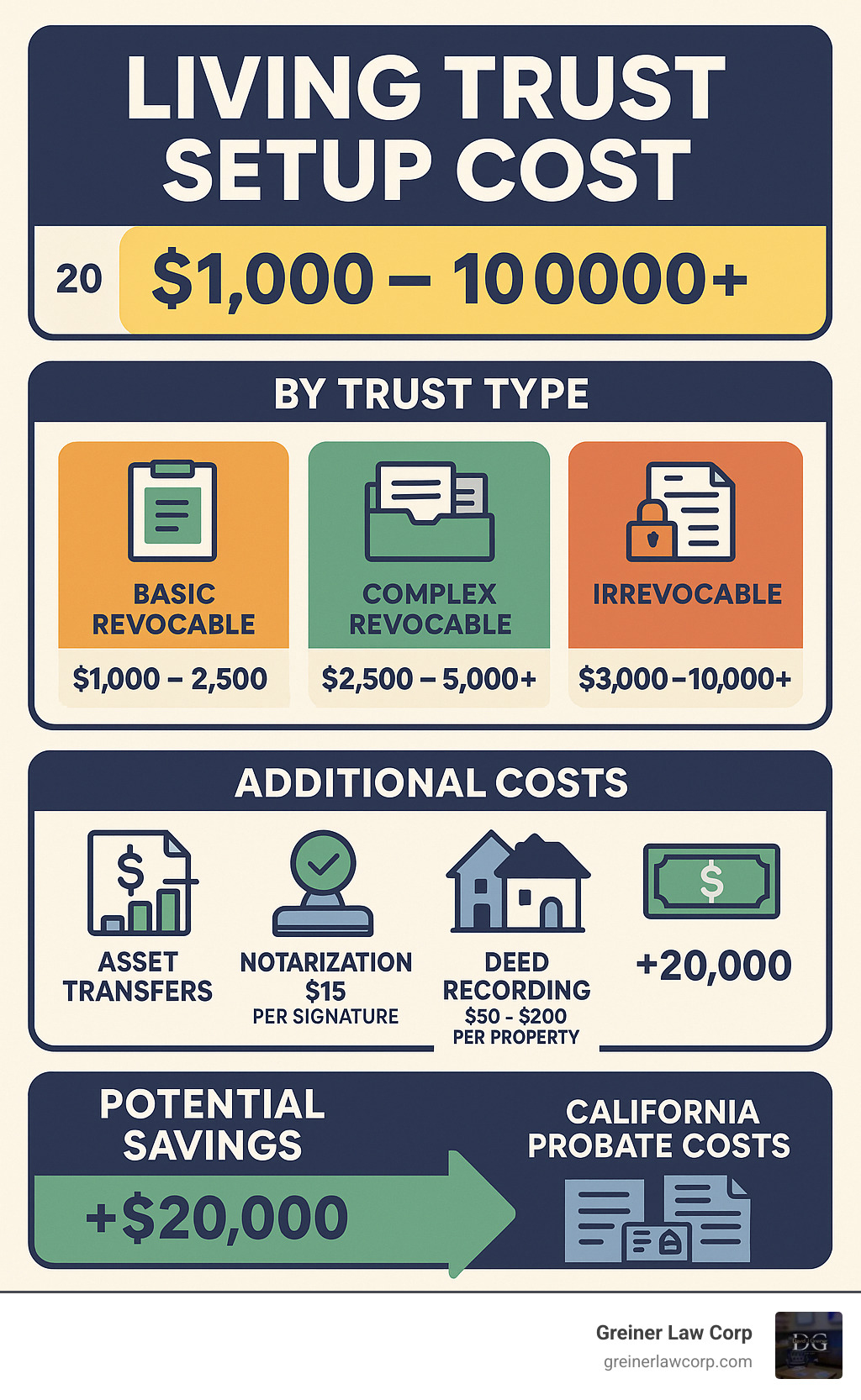
Quick Cost Breakdown:
- Basic revocable living trust: $1,000 – $2,500
- Complex trust with multiple assets: $2,500 – $5,000+
- Irrevocable trusts: $3,000 – $10,000+
- Additional costs: $350 – $1,000+ for asset transfers and recording fees
As one estate planning attorney put it: “What surprises most clients isn’t the cost of creating the trust documents… but rather the additional expenses involved in properly funding the trust.”
The numbers tell a compelling story. In California, probate fees consume approximately 4% of your estate’s first $100,000, with additional percentages for higher amounts. For a $300,000 estate, probate costs could reach $24,000 or more – making even a $5,000 trust look like a bargain.
But here’s what most people don’t realize: the real cost isn’t just about the upfront fees. It’s about understanding what drives those costs, what’s included in your attorney’s services, and how to avoid the hidden expenses that can double your final bill.
I’m David Greiner, Esq., and throughout my transactional law practice, I’ve helped countless business owners and families steer living trust setup cost decisions while prioritizing their goals and ensuring achievement over billable hours. My business-focused approach means we’ll explore not just what you’ll pay, but why these costs represent a smart investment in your family’s future.
Living trust setup cost glossary:
What’s the Average Living Trust Setup Cost in California?
Planning for your family’s future shouldn’t feel like solving a puzzle in the dark. When it comes to living trust setup cost in California, you deserve clear answers – not vague estimates that leave you guessing.
Here’s the reality: while the national average for creating a revocable living trust typically ranges from $1,500 to $3,000, California operates in its own league. In our state, you can expect to invest anywhere from $1,500 to $5,000 for a standard revocable living trust prepared by a qualified attorney, with complex situations potentially reaching $10,000 or more.
Geography within California plays a significant role too. That same trust that might cost you $3,000 to $4,000 in busy San Francisco or Palo Alto could run $2,000 to $3,000 in California’s more affordable regions. It’s a 20-30% price variation that directly reflects our state’s diverse cost of living and business expenses.
The good news? Understanding what drives these variations puts you in control of predicting your specific expenses.

Basic vs. Complex Trusts: How Your Needs Affect the Price Tag
Think of living trust setup cost like buying a car. A reliable sedan gets you where you need to go, just like a luxury SUV with all the bells and whistles. Both work, but your specific needs determine which investment makes sense.
A simple estate with straightforward needs typically falls into the $1,000 to $2,500 range. This works perfectly if you have a single property, a few bank accounts, and uncomplicated wishes for how your assets should be distributed. Many individuals and couples find this level of planning meets their needs beautifully.
But life rarely stays simple, does it? A complex estate requiring $2,500 to $5,000 or more becomes necessary when your situation includes business ownership with its layers of legal considerations, multiple properties (especially across different states), or blended families where ensuring fair distribution among children from different marriages requires careful attention.
Special circumstances like special needs beneficiaries add another layer of complexity. Creating provisions that ensure your loved ones receive care without jeopardizing government benefits requires specialized expertise and detailed drafting.
The difference isn’t just about how much money you have – it’s about how intricate your financial holdings are and how specific your wishes become. A sophisticated estate demands more time, expertise, and careful drafting to ensure nothing falls through the cracks. More info about estate planning for your needs
Revocable vs. Irrevocable Trusts: A Cost and Purpose Comparison
The type of living trust you choose – revocable or irrevocable – significantly impacts your living trust setup cost. These aren’t just different flavors of the same thing; they serve completely different purposes.
A revocable living trust offers flexibility and control. You can change it, amend it, or even revoke it entirely during your lifetime. This makes it perfect for avoiding probate and managing assets if you become incapacitated. Because it’s less restrictive and simpler to draft, the setup cost typically stays on the lower end of the spectrum.
An irrevocable trust trades that flexibility for powerful benefits like asset protection from creditors and lawsuits, advanced tax planning opportunities, and strategic Medicaid planning. Once you establish and fund it, changes become extremely difficult without consent from trustees and beneficiaries.
This permanence and complexity mean irrevocable trusts generally start around $3,000 and can reach $10,000 or more. The higher complexity justifies the higher cost through specialized drafting and long-term implications that require expert navigation. Learn more about the cost of an irrevocable trust
Why California Prices Are Different
You might wonder why California’s living trust setup cost often exceeds the national average. It’s not just our famous “sunshine tax” – several factors unique to our state create this pricing reality.
California’s high cost of living naturally translates to higher overhead for law firms. Experienced estate planning attorneys here typically charge $300 to $600 per hour, reflecting our state’s expensive business environment.
Our complex property laws add another layer. California’s community property laws, intertwined with separate property considerations, require specialized knowledge and meticulous drafting – especially for married couples navigating these distinctions.
Unlike many states that have simplified their probate processes, California maintains statutory probate fees that consume 4% of your estate’s first $100,000, with additional percentages for higher amounts. This creates tremendous high demand for trusts as families seek to avoid our notoriously lengthy and expensive probate system.
Finally, a living trust serves as your best defense against avoiding conservatorship – a costly and public process should you become unable to manage your affairs. The immense value of preventing such scenarios contributes to the overall worth of a well-drafted trust.
These factors combine to make California’s living trust setup cost a distinct investment – one that’s often dwarfed by the potential costs and headaches of not having proper planning in place.
Decoding the Bill: What Factors Influence Your Total Cost?
When you’re looking at your living trust setup cost, it’s helpful to understand what you’re actually paying for. Think of it like ordering a custom suit – the final price depends on the fabric quality, the tailor’s expertise, how many alterations you need, and those little details that make it uniquely yours.
The same principle applies to living trusts. Your total cost reflects several key factors that work together to create a plan that fits your specific situation perfectly.

Attorney experience plays a huge role in pricing. A seasoned estate planning attorney who’s handled hundreds of trusts will typically charge more than someone just starting out – but that experience often saves you money in the long run by avoiding costly mistakes.
Geographic location within California makes a noticeable difference too. Setting up a trust in San Francisco’s financial district costs more than the same service in Fresno, simply because overhead expenses vary dramatically across our state.
Asset diversity significantly impacts your final bill. If you own just your home and a checking account, the process is straightforward. But add in rental properties, business interests, investment accounts, and maybe some collectibles, and suddenly your attorney needs to consider multiple legal structures and tax implications.
Estate size matters, but not always in the way you’d expect. A $500,000 estate with complex family dynamics might cost more to plan than a $2 million estate with simple distribution wishes. It’s really about the number of moving parts, not just the dollar amount.
Special provisions can add to your costs but often provide tremendous value. Things like pet trusts, charitable giving strategies, or provisions for family members with special needs require additional drafting time and expertise.
How Professional Legal Services Impact Your Living Trust Cost
The level of professional service you choose directly affects your living trust setup cost – and more importantly, the peace of mind you’ll have afterward. We’ve seen too many families struggle with poorly drafted documents that seemed like a bargain initially but created expensive problems later.
Here’s how different levels of attorney service typically compare:
| Service Level | Cost (CA Avg.) | Customization | Legal Support | Risk Level |
|---|---|---|---|---|
| Basic Attorney-Drafted | $1,500 – $3,000 | Moderate | Dedicated Attorney | Low |
| Standard Attorney-Drafted | $3,000 – $5,000 | High | Comprehensive | Very Low |
| Complex Attorney-Drafted | $5,000 – $10,000+ | Highly Custom | Ongoing & Advanced | Minimal |
Most estate planning attorneys offer flat fees for living trust packages, which means you know exactly what you’ll pay upfront. No surprises, no meter running while you ask questions. For more complex situations or ongoing advice, attorneys may charge hourly rates that typically range from $300 to $600 per hour in California.
The real value of personalized advice becomes clear when your attorney takes time to understand your unique situation. They’ll ask about your family dynamics, your business interests, your concerns about the future. This isn’t just small talk – it’s how they craft a trust that actually works for your life.
Convenience is another often-overlooked benefit. Your attorney handles the legal complexities, coordinates with other professionals, and ensures everything is properly executed. You don’t have to become an expert in California trust law or worry about whether you’ve missed something important.
The value of professional guidance becomes especially apparent when we help clients who initially tried other approaches. We regularly see people who thought they’d save money with basic documents, only to find their trust won’t actually avoid probate or protect their assets as intended. Fixing these problems almost always costs more than doing it right the first time.
It’s worth noting that California’s Attorney General specifically warns consumers about “living trust mills” – companies that use high-pressure sales tactics to sell overpriced, cookie-cutter trusts. Warning about living trust mills Working with a reputable attorney protects you from these predatory practices while ensuring your trust meets professional standards.
Beyond the Basics: Uncovering Hidden Living Trust Setup Costs
When budgeting for your living trust setup cost, the attorney’s fee is just the beginning. Several additional expenses can catch people off guard if they’re not prepared for them. Think of it like buying a car – the sticker price is one thing, but then there’s tax, title, registration, and insurance.
Funding the trust represents the biggest additional expense most people don’t anticipate. Your trust is basically an empty container until you transfer assets into it. This process, while crucial, involves real costs that can add 15-25% to your initial bill.
Deed recording fees are necessary when transferring real estate into your trust. California counties charge different amounts, but expect to pay $50 to $200 per property. If you own your home plus a vacation rental, you’re looking at separate recording fees for each property.
Asset transfer paperwork takes time and expertise to complete properly. Each bank, brokerage firm, and financial institution has its own forms and procedures for changing account ownership to your trust. While some attorneys include this service in their flat fee, others charge separately – typically $100 to $200 per hour for paralegal time to handle these transfers.
Notarization fees add small but necessary costs to the process. While California doesn’t require living trusts to be notarized, many attorneys include notarization for added security. Expect about $15 per signature that needs notarizing.
County filing fees vary by location and the specific documents involved. These are usually minor costs but worth factoring into your budget.
Ongoing maintenance is something many people forget to consider. Life changes, and your trust may need updates. Minor amendments typically cost $200 to $800, while major changes requiring a complete restatement can run $1,000 to $2,500.
Trust amendments become necessary when you have significant life changes – marriage, divorce, births, deaths, or major asset acquisitions. Planning for these potential costs helps you budget appropriately for the long term.
Understanding these additional expenses upfront helps you make informed decisions and avoid unpleasant surprises. When we discuss your living trust setup cost, we make sure to explain all potential expenses so you can budget appropriately for your complete estate plan. Details on the cost of a trust lawyer
The Ultimate Cost-Benefit Analysis: Trust vs. California Probate
Here’s where the numbers really start to tell a compelling story. While there’s an upfront living trust setup cost, it becomes remarkably small when you compare it to what your family might face with California’s probate process. This comparison is exactly why so many Californians choose living trusts – it’s not just about convenience, it’s about protecting their family’s financial future.

What happens without a trust? When someone passes away in California without a properly funded living trust, their estate typically goes through probate – a court-supervised process where a judge oversees paying debts and distributing assets. Unlike many other states that have streamlined this process, California has kept its traditional, more complex approach.
The financial impact can be staggering. California sets statutory fees by law, calculated on your estate’s gross value before any debts are paid. Both the executor and the probate attorney each receive 4% of the first $100,000, 3% of the next $100,000, 2% of the next $800,000, and additional percentages for larger estates.
Let me put this in perspective with real numbers. If your estate is worth $300,000, the statutory fees alone could reach $9,000 each for the executor and attorney – that’s $18,000 right off the top. Add court costs, appraisal fees, and other expenses, and your family could easily see $24,000 disappear into the probate process.
For a $500,000 estate, those fees jump to around $13,000 each, meaning $26,000 or more could vanish into probate costs. Compare that to a living trust setup cost of $3,000 to $5,000, and the math becomes pretty clear.
But the financial drain is only part of the story. Time delays in California probate average 9 to 18 months, though complex estates can stretch beyond two years. Imagine telling your grieving spouse or children that they’ll need to wait over a year to access their inheritance while legal fees continue mounting.
There’s also the matter of privacy. Probate proceedings become public record, meaning anyone can walk into the courthouse and learn about your assets, debts, and who inherited what. Your family’s financial details become an open book.
The living trust advantage changes everything. When you create and properly fund a living trust, your assets avoid probate entirely. Your successor trustee can distribute assets to beneficiaries within weeks or months, not years. The process remains completely private, and those hefty statutory fees? They simply don’t apply.
The control and flexibility you maintain during your lifetime is another significant benefit. You can modify your trust, add or remove assets, and change beneficiaries as your life evolves. Plus, if you become incapacitated, your successor trustee can step in immediately to manage your affairs, avoiding the need for a costly and intrusive conservatorship process.
Even for smaller estates, the benefits often outweigh the costs. California’s simplified probate threshold is currently $184,500, but even estates below this amount can benefit from the privacy, speed, and certainty that a living trust provides.
The way I see it, the most expensive trust is the one that wasn’t created when your family needed it most. A properly drafted living trust isn’t just a legal document – it’s peace of mind and financial protection rolled into one smart investment. Guide to understanding probate
Frequently Asked Questions about Living Trust Costs
When it comes to living trust setup cost, we hear the same thoughtful questions from clients almost every week. These concerns are completely understandable – you’re making an important financial decision that will impact your family’s future. Let me address the most common questions with the same straightforward answers I give clients in my office.
Is it worth paying an attorney if my estate is ‘simple’?
This question comes up constantly, and I understand why. When you look at your situation – maybe just a house and a few bank accounts – paying attorney fees can feel like overkill. But here’s what I’ve learned after years of practice: there’s really no such thing as a “simple” estate in California.
Peace of mind is worth far more than the few hundred or thousand dollars you might save by going the DIY route. I’ve seen too many families find that their “simple” online trust was worthless when they needed it most. Just last month, we helped a family whose father had used a generic online form. The trust looked fine on paper, but it wasn’t properly funded, and his house ended up in probate anyway – costing them $18,000 in fees.
California’s property laws are surprisingly complex, especially our community property rules. What seems straightforward often has hidden complications that only surface later. The risk of errors with DIY approaches is real, and the cost of fixing mistakes after someone passes away can be devastating – both financially and emotionally.
Think of it this way: you wouldn’t perform surgery on yourself to save money, even if YouTube made it look easy. Estate planning deserves the same professional attention. When to hire an estate planning attorney
Can I create a living trust if I have a mortgage on my home?
Yes, absolutely! This might be our most frequently asked question, and I’m always happy to put clients’ minds at ease on this one.
Thanks to the Garn-St. Germain Act from 1982, federal law specifically protects you when transferring your home into a revocable living trust. Your mortgage lender cannot enforce their due-on-sale clause just because you moved the property into your trust. Your interest rate stays the same, your payment stays the same, and your loan terms don’t change.
You should notify your lender about the transfer – most have a simple form for this – but it’s more of a courtesy than a requirement. Your homeowner’s insurance company should also know about the change, though it typically won’t affect your rates or coverage.
Here in California, there’s another bonus: transferring your home to your trust won’t trigger a property tax reassessment. The county assessor treats this as a non-taxable event, so your property taxes stay exactly where they are.
I’ve helped hundreds of clients transfer mortgaged homes into trusts, and I’ve never seen a lender create problems over it. The law is clear, and lenders understand it well.
How often should I review and update my living trust?
Your living trust isn’t like a vintage wine that gets better sitting untouched in storage. It’s more like your smartphone – it needs regular updates to work properly and protect you from new threats.
We recommend a thorough review every 3-5 years, even when you think nothing has changed. Tax laws evolve, California regulations shift, and what worked perfectly five years ago might leave gaps in your protection today.
But life doesn’t wait for scheduled reviews. You should immediately revisit your trust after any major life event. Marriage or divorce completely changes your beneficiary landscape. The birth or death in the family – whether it’s a new grandchild or losing a spouse – requires immediate attention to your trust provisions.
Significant asset changes matter too. If you inherit money, sell a business, or buy property in another state, your trust needs to reflect these changes. And if you’re relocating to another state, even temporarily, we should review how that affects your California trust.
The good news is that minor updates through trust amendments typically cost $300-$800, while major changes requiring a full restatement run $1,000-$2,500. Compare that to the tens of thousands your family might face if an outdated trust fails when they need it most.
I tell clients to think of trust maintenance like car maintenance – a little attention now prevents major breakdowns later. Regular reviews keep your living trust setup cost working hard for your family’s benefit.
Conclusion: Making a Smart Investment in Your Legacy
When you step back and look at the big picture, understanding living trust setup cost isn’t really about the money at all. It’s about making one of the smartest investments you’ll ever make – an investment in your family’s future and your own peace of mind.
Yes, the upfront costs can feel significant. Whether you’re looking at $1,500 for a straightforward trust or $5,000+ for a complex estate plan, those numbers represent real money. But here’s what I’ve learned after helping countless families steer these decisions: the cost of not having a proper trust almost always dwarfs the cost of creating one.
Think about it this way. California’s probate system could easily consume $20,000 to $30,000 of your estate’s value, not to mention the months or years your loved ones might wait to receive their inheritance. Compare that to even the most expensive trust setup, and the math becomes crystal clear.
But the real value goes far beyond the dollars and cents. A well-crafted living trust gives you something priceless: control over your legacy. It ensures your wishes are honored, your family is protected from unnecessary legal battles, and your personal affairs remain private instead of becoming public court records.
At Greiner Law Corp, we’ve been helping California families make these important decisions since 2003. Our business-minded approach means we focus on what matters most to you – achieving your goals while managing risk in a way that fits your comfort level. We’re not interested in billable hours; we’re interested in results that work for your unique situation.
Whether you’re in Victorville, Riverside, San Bernardino, Los Angeles, or anywhere else in California, we understand the specific challenges our state’s laws present. We know that living trust setup cost concerns are valid, and we’re committed to providing transparent, honest guidance about what you can expect.
The truth is, the most expensive trust is the one that doesn’t work when your family needs it most. By choosing experienced legal professionals who understand California’s complex requirements, you’re not just buying documents – you’re investing in expertise, accuracy, and peace of mind.
Your legacy deserves more than a one-size-fits-all approach. It deserves careful planning, thoughtful execution, and the confidence that comes from knowing everything has been handled properly.


