What You’ll Actually Pay for an Irrevocable Trust (The Real Numbers)
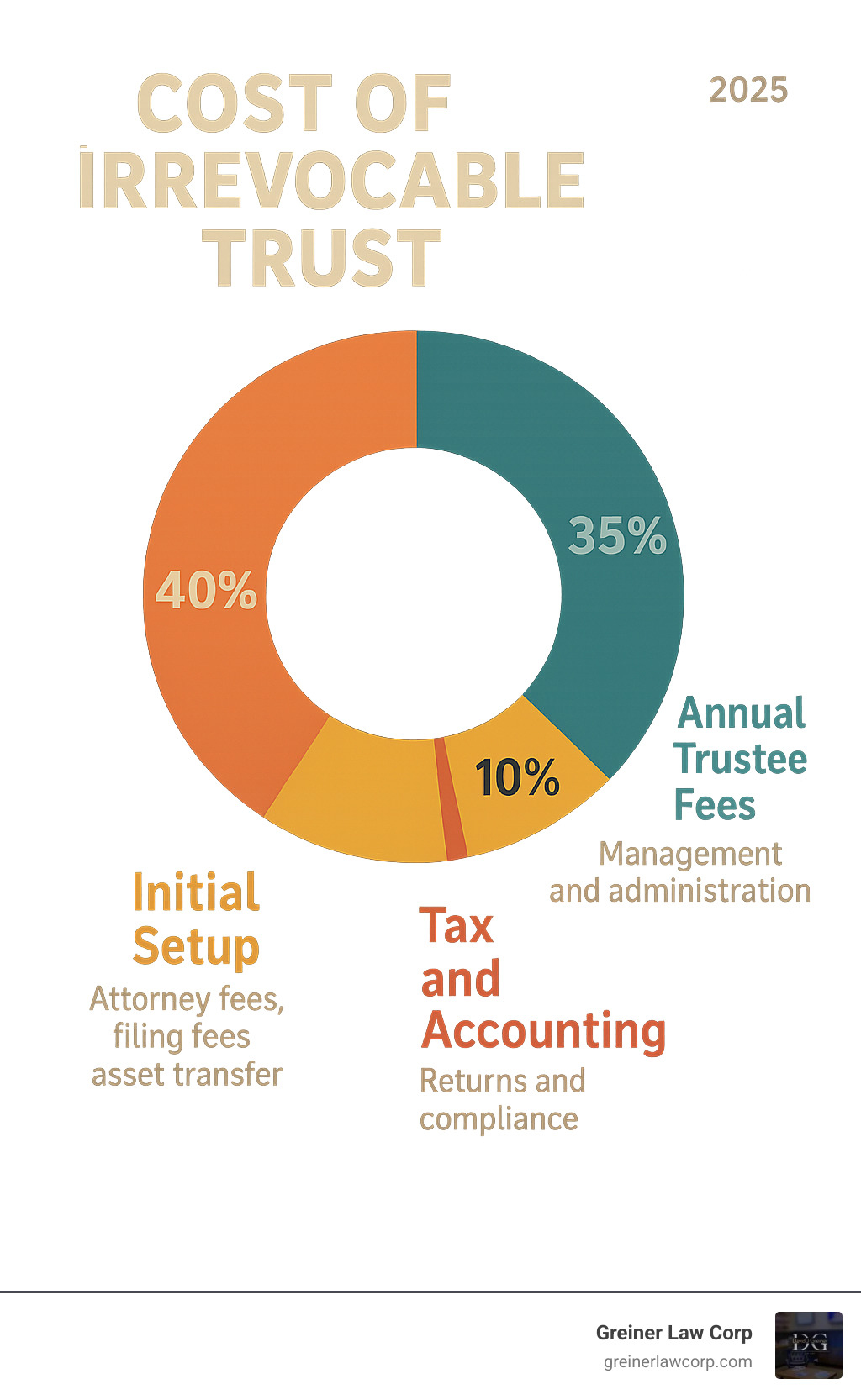
The cost of irrevocable trust setup typically ranges from $2,000 to $20,000 depending on complexity, with ongoing annual fees of 0.5% to 2% of trust assets. Here’s the quick breakdown:
Initial Setup Costs:
- Basic irrevocable trust: $2,000 – $5,000
- Complex trusts (Medicaid, Special Needs): $5,000 – $10,000+
- Offshore trusts: $5,000 – $20,000+
Annual Ongoing Costs:
- Trustee fees: 0.5% – 2% of assets
- Tax preparation: $500 – $2,500
- Legal reviews: $500 – $3,000
If you’re a business owner thinking about asset protection or estate planning, you’ve probably heard about irrevocable trusts. Unlike revocable trusts that you can change anytime, an irrevocable trust is permanent – once you set it up and fund it, you can’t easily modify or cancel it.
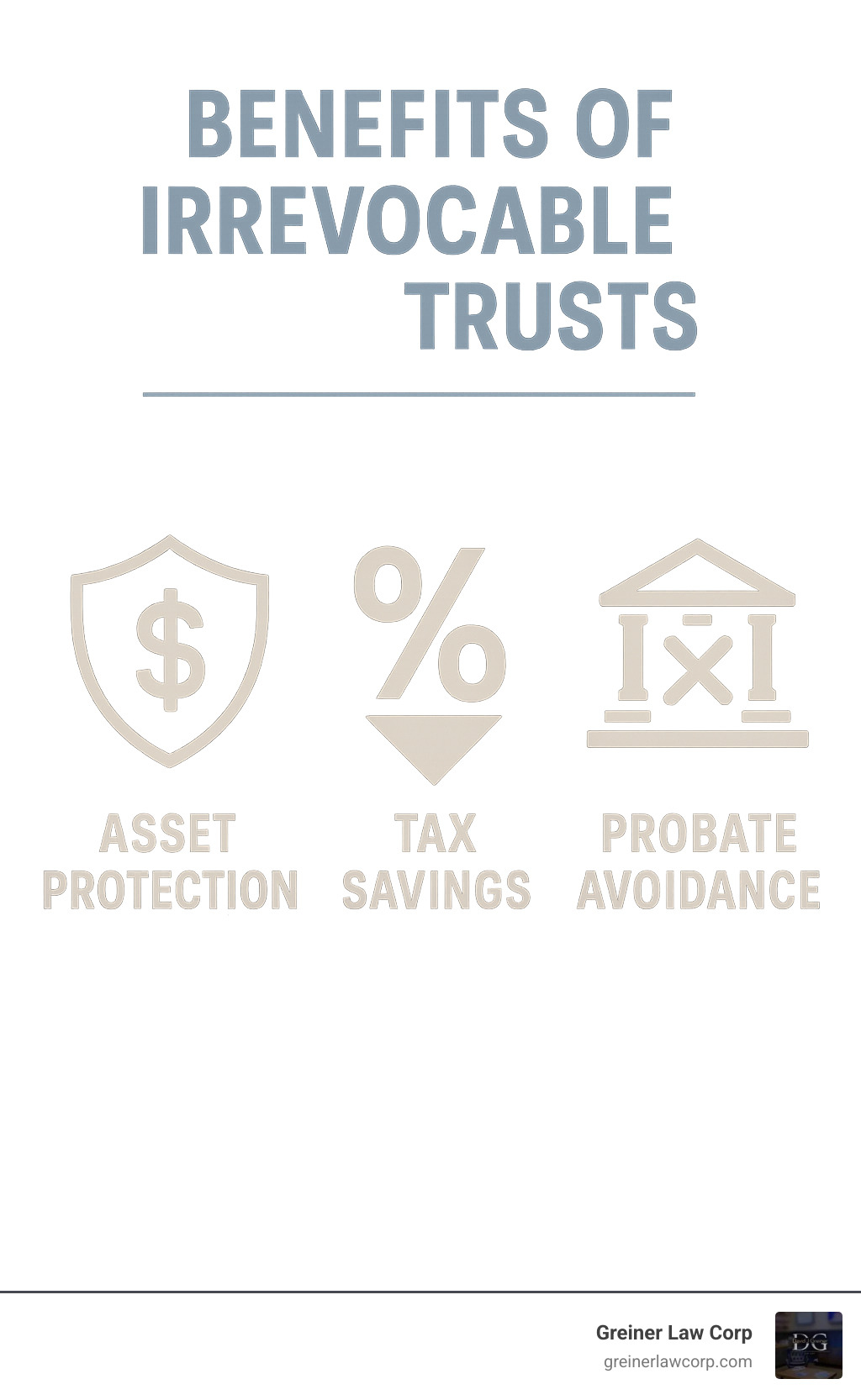
Why would anyone want something so permanent? Three big reasons:
- Asset protection – Shields your wealth from creditors and lawsuits
- Estate tax reduction – Removes assets from your taxable estate
- Government benefits – Helps qualify for Medicaid while preserving assets
The trade-off is clear: you give up control over assets in exchange for serious protection and tax benefits. But as one estate planning expert noted, “It isn’t always easy to let go of assets you’ve worked hard to earn and accumulate over your lifetime.”
I’m David Greiner, Esq., and after years of helping business owners steer complex transactions and corporate formations, I’ve seen how the cost of irrevocable trust planning fits into broader wealth protection strategies. My business-focused approach means we’ll look at these costs as an investment in your goals, not just another legal expense.
Introduction: What is an Irrevocable Trust and Why Bother?

Picture this: you’ve built a successful business, accumulated real estate, and created wealth that you want to protect. But lawsuits, taxes, and government benefit rules threaten to erode what you’ve worked so hard to build. That’s where an irrevocable trust comes in.
An irrevocable trust is essentially a permanent legal arrangement where you transfer ownership of your assets to a trust that’s managed by a trustee for your beneficiaries. Think of it as moving your valuables from your personal safe to a bank vault – once they’re in there, you can’t just walk in and take them back out.
The cost of irrevocable trust setup might seem steep at first glance, but the protection it offers can be worth every penny. Unlike keeping assets in your own name, this trust structure creates a legal barrier between you and your wealth.
Here’s what makes irrevocable trusts different from their revocable cousins. With a revocable trust, you maintain complete control – you can change beneficiaries, modify terms, or cancel the whole thing tomorrow if you want. But this flexibility comes at a cost: no asset protection and no estate tax benefits.
An irrevocable trust flips this equation. You give up control in exchange for three powerful benefits that can save you thousands (or even millions) down the road.
Asset protection is the first major advantage. Once assets are properly transferred into an irrevocable trust, they’re generally shielded from creditors, lawsuits, and business liabilities. For business owners and professionals who face higher lawsuit risks, this protection alone can justify the entire investment.
Estate tax reduction is the second key benefit. When you transfer assets to an irrevocable trust, they’re removed from your taxable estate. With federal estate tax rates reaching 40% for larger estates, this can result in substantial savings for your heirs.
Government benefits qualification rounds out the top three advantages. By reducing your countable assets, an irrevocable trust can help you qualify for Medicaid while preserving wealth for your family. This is particularly valuable for long-term care planning, though you’ll need to plan ahead since Medicaid has a five-year look-back period.
The trade-off is real – you’re giving up flexibility for protection and tax benefits. But for many families, especially those with significant assets or liability concerns, this exchange makes perfect financial sense.
The Upfront Price Tag: Initial Setup Costs for an Irrevocable Trust

Setting up an irrevocable trust is a little like buying a car—the sticker price is only part of the story. Below is a streamlined look at where your money actually goes and the ranges you should expect.
Attorney’s Fees: The Largest Expense
- Simple trust: $2,000 – $5,000
- Complex trust: $5,000 – $10,000+
Hourly rates vary by location (often $200 – $500/hr in California), but many firms, including ours, now offer flat fees so you know the cost up front.
Administrative & Filing Fees
- Notary: $10 – $50
- County recording: $50 – $200
- Misc. document prep: $200 – $500
Asset Transfer & Funding Costs
- Real-estate deed prep & recording: $200 – $500 each
- Business valuation (when needed): $2,000 – $10,000+
- Property appraisals: $300 – $3,000
Why Complexity Matters
The cost rises with additional beneficiaries, business interests, or special provisions (e.g., spendthrift or generation-skipping clauses). A single-beneficiary trust holding only marketable securities may land near $3,000 total. Add multiple properties, a family LLC, and detailed tax language and you can easily reach—or exceed—$10,000.
Bottom line: expect $2,000 – $5,000 for basic protection, and more when unique assets or custom clauses enter the picture.
The Long Game: Ongoing Maintenance and Annual Costs

Creating the trust is step one; keeping it healthy is step two. Here are the recurring expenses you should plan for.
Trustee Fees
- Professional trustee: 0.5 – 2% of assets (1% is common).
$500k trust → about $5k/yr. - Individual/family trustee: often free or a modest flat fee, but be sure they have the time and skill set.
Tax & Accounting
- IRS Form 1041 prep: $500 – $2,500 per return
- Bookkeeping / statements: $500 – $5,000+ depending on activity level
Compressed trust tax brackets make professional prep worthwhile.
Legal Check-Ups
- Annual legal review: $500 – $3,000
- Modifications (when possible): $2,000 – $10,000+
In practice, many California families see total annual costs hover around 1%–1.5% of trust assets, a figure that covers management, tax filings and compliance.
Not All Trusts Are Created Equal: How Type and Location Affect Cost

The price tag changes when you move beyond a basic family trust. Below are the ranges that matter most.
Specialized Trusts
- Medicaid Asset Protection Trust (MAPT): $5,000 – $10,000+
- Special Needs Trust (SNT): $3,000 – $7,000+ (plus $1,000 – $5,000/yr for compliance)
- Irrevocable Life Insurance Trust (ILIT): $3,000 – $6,000+ (add $250 – $1,000/yr for Crummey notices)
Domestic vs. Offshore (Quick View)
| Domestic | Offshore | |
|---|---|---|
| Setup | $3k – $5k | $5k – $20k+ |
| Annual | $1k – $3k | $2k – $5k+ |
| Protection | Good | Excellent |
| Complexity | Moderate | High |
For most California families, domestic trusts deliver ample protection without foreign-reporting headaches. Offshore structures are best reserved for very high-net-worth clients facing unusual creditor risks.
Hidden Tax Costs (Often Missed)
- Gift-tax Form 709: $500 – $2,500 per filing
- Generation-Skipping Transfer planning: +$3,000 – $10,000 legal work
- State trust income tax returns: $500 – $3,000 annually
Knowing these numbers upfront lets you—and your attorney—design a trust that fits both your goals and your budget.
Smart Savings: How to Minimize Irrevocable Trust Costs

Nobody likes paying more than necessary, especially for something as complex as an irrevocable trust. The good news? You can significantly reduce the cost of irrevocable trust setup and maintenance with smart planning strategies.
After helping dozens of business owners steer trust planning, I’ve seen how the right approach can save thousands of dollars without compromising effectiveness. It’s about working smarter, not harder.
Cost-Saving Strategies
The biggest money-saver often surprises people: choosing a cost-effective trustee. While professional trustees charge 0.5% to 2% of trust assets annually, a qualified family member might serve for free or a modest fee. On a $1 million trust, this could save $5,000 to $20,000 per year.
Of course, family trustees aren’t always the right choice. They need time, financial knowledge, and the ability to stay objective when family dynamics get complicated. But for the right family, this single decision can save more than all other strategies combined.
Bundling estate planning services is another smart move. Many attorneys offer package deals when you combine trust creation with wills, powers of attorney, and other documents. This bundling typically saves 15% to 25% compared to purchasing services separately. Think of it like buying a combo meal instead of ordering everything separately.
Before you even meet with an attorney, organize your financial documents. Gather asset statements, business valuations, and beneficiary information. Having everything ready reduces billable hours and shows your attorney you’re serious about efficiency. One client saved nearly $2,000 just by coming prepared with organized financial records.
Flat-fee arrangements often cost less than hourly billing for standard trust work. When you pay hourly, every phone call and email adds up. With flat fees, you get predictable costs and your attorney has incentive to work efficiently. Always ask about flat-fee options for routine trust creation.
Planning for tax implications early prevents surprise costs later. Understanding gift tax exclusions and generation-skipping transfer tax exemptions helps you structure trust funding to minimize additional tax filings. Each surprise tax return can cost $500 to $2,500 in preparation fees.
Keep your trust structure as simple as possible while still meeting your goals. Complex provisions sound impressive but drive up costs. Work with your attorney to achieve your objectives using the simplest effective approach. Sometimes the most neat solution is also the most affordable.
Modern technology can reduce ongoing administration costs compared to traditional manual bookkeeping. Trust administration platforms streamline reporting and reduce the time trustees spend on routine tasks, ultimately lowering your annual maintenance expenses.
The key is viewing these strategies as investments in efficiency, not corners to cut. Smart planning reduces the cost of irrevocable trust ownership while maintaining all the protection and benefits you’re seeking.
Is an Irrevocable Trust Worth the Investment?
The short answer: often, yes—if you have significant assets or liability exposure. Consider the trade-offs in plain numbers:
- Asset protection: One lawsuit can erase years of savings; annual trustee fees of 1% on $2 million cost $20k—cheap insurance by comparison.
- Estate-tax savings: At 40% top rates, moving $5 million outside your taxable estate could save $2 million—far more than decades of trust upkeep.
- Probate avoidance: California probate averages about 5% of estate value. A $800k estate might face $40k in probate costs—often more than a lifetime of modest trust maintenance.
Beyond dollars and cents, professional management and the peace of mind of a bulletproof plan can be invaluable. For clients who fit the profile—business owners, professionals, or anyone with a multimillion-dollar estate—the math almost always comes out in favor of the trust.
Frequently Asked Questions about Irrevocable Trust Costs
What is the average total cost to set up a simple irrevocable trust?
For a straightforward irrevocable trust, you’re looking at $2,000 to $5,000 for the complete initial setup. This covers the attorney fees for legal drafting, basic filing costs, and standard asset transfer expenses.
But what exactly makes a trust “simple”? It’s one with one or two beneficiaries, common assets like cash, securities, or your family residence, and standard provisions without complex customization. The distribution terms are straightforward – no fancy spendthrift clauses or generation-skipping provisions.
Think of it like ordering a basic car versus one loaded with every possible option. The basic model gets you where you need to go, but each additional feature adds to the price tag.
Can I set up an irrevocable trust myself to save money?
I get it – looking at attorney fees can make anyone consider the DIY route. While DIY trust options exist, I strongly recommend against self-preparation for irrevocable trusts. Here’s why: the word “irrevocable” means exactly what it sounds like – you generally can’t change your mind later.
Professional legal help prevents errors that could invalidate the trust’s tax benefits, compromise asset protection, create unintended tax consequences, or completely fail to achieve your planning goals. This isn’t like assembling furniture where a mistake means a wobbly table. A mistake here could cost you tens of thousands in lost benefits or failed protection.
The cost of professional preparation is typically far less than the cost of fixing DIY mistakes. As I tell my clients, you wouldn’t perform surgery on yourself to save money – estate planning deserves the same respect.
Are trustee fees tax-deductible?
Yes, trustee fees are generally deductible as administrative expenses on the trust’s tax return using IRS Form 1041. However, the deductibility depends on what the fees are actually for.
Fees for income production are generally deductible, while fees for principal preservation may not be. Distribution-related fees follow different rules entirely. It’s like business expenses – some are fully deductible, others aren’t, and some fall into gray areas.
Consult with a tax professional to understand how trustee fees affect your specific trust’s tax situation. The rules can be complex, and getting professional guidance ensures you’re maximizing legitimate deductions while staying compliant.
Conclusion: Making the Right Financial Decision for Your Legacy
The cost of irrevocable trust planning represents a significant financial commitment, but think of it as an investment in your family’s future rather than just another legal expense. When you understand the full cost picture – from that initial setup through decades of ongoing maintenance – you can make confident decisions about whether this powerful estate planning tool makes sense for your situation.
The numbers tell an important story. Initial setup costs typically range from $2,000 to $20,000+ depending on complexity, while annual maintenance usually runs 0.5% to 2% of trust assets. Specialized trusts cost more upfront but deliver targeted benefits that often justify the premium. Your geographic location and attorney’s expertise will affect pricing, but the long-term benefits frequently outweigh the investment.
Here’s what really matters: this decision ultimately comes down to your specific situation, risk tolerance, and planning goals. For high-net-worth individuals, business owners, or professionals in high-liability fields, the asset protection and tax benefits typically dwarf the costs involved.
The math often works in your favor. California probate can cost about 5% of your estate value, while federal estate taxes range from 18% to 40%. A well-structured irrevocable trust can help you avoid both – potentially saving hundreds of thousands or even millions of dollars for your heirs.
But there’s more to consider than just dollars and cents. The peace of mind that comes from knowing your assets are protected and your legacy preserved has real value that’s difficult to quantify but important to your family’s future.
For those in California navigating these complex decisions, working with a firm that takes a business-minded approach like Greiner Law Corp can help you weigh the costs and benefits to align with your risk preferences and goals. We understand that every dollar spent on legal planning should advance your business and personal objectives.
Estate planning isn’t just about legal documents – it’s about creating a comprehensive strategy that protects your wealth, minimizes taxes, and preserves your legacy for future generations. The cost of proper planning today is almost always less than the cost of problems tomorrow.
To get personalized advice on trusts and wills custom to your specific situation, explore our trust and will lawyer services. We’re here to help you steer these important decisions with clarity and confidence.


