Why Probate Letters of Administration Matter for Estate Management
Probate letters of administration are court-issued documents that legally authorize someone to manage a deceased person’s estate when they die without a valid will. Here’s a quick overview:
- Purpose: To grant legal authority for collecting assets, paying debts, and distributing property.
- When Needed: Required for intestate estates (no will), or when a will is invalid or the named executor cannot serve.
- Who Can Apply: The next of kin, following a legal order of priority (spouse, children, parents, etc.).
- Timeline: Typically 6-8 weeks to obtain if the application is filed correctly.
- Authority Granted: Allows access to bank accounts, sale of property, payment of bills, and distribution of inheritance.
When a person dies without an estate plan, their assets are essentially frozen. To manage their affairs, the court must appoint an administrator through letters of administration. This legal document is the official proof of authority needed to act on behalf of the estate. Without it, banks will not release funds, property cannot be transferred, and debts will remain unpaid.
The process involves petitioning the probate court, notifying heirs, and attending a hearing. Given the legal complexities, professional guidance is highly valuable.
I’m David Greiner, Esq., and my transactional law practice has helped many clients steer probate letters of administration. My business-focused approach prioritizes achieving your goals efficiently while managing legal risks.
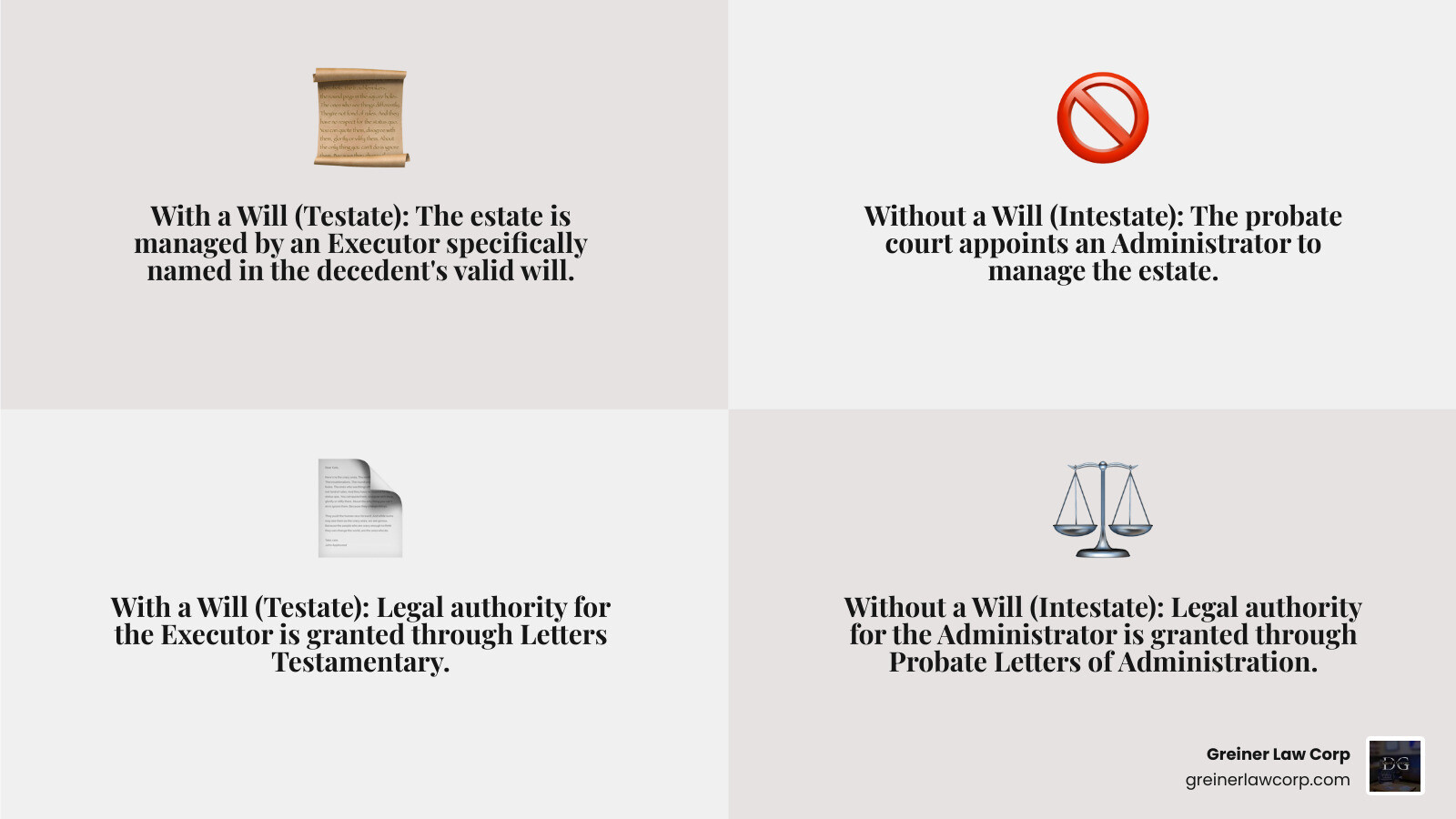
Must-know probate letters of administration terms:
Understanding the Basics: Purpose and Authority
When a loved one passes away without a will, their final affairs must be handled through a court process. Understanding probate letters of administration is the first step to managing their estate.
When Are Probate Letters of Administration Required?
If a person dies “intestate” (without a will), their assets become frozen. No one can access bank accounts or manage property until the court grants authority. Probate letters of administration are required in these key situations:
- Death Without a Valid Will: This is the most common scenario. State intestacy laws will determine how assets are distributed, but only after the court appoints an administrator to manage the process.
- An Invalid Will: A will might be deemed invalid if it wasn’t signed correctly or if the deceased lacked mental capacity. In such cases, the court treats the estate as if no will existed.
- The Named Executor is Unable to Serve: If the executor named in a will has passed away, is incapacitated, or declines the role, the court must appoint an administrator to step in.
Without these court documents, you cannot access accounts, sell property, or pay the estate’s bills. The estate remains in limbo. To learn more about your specific situation, see our guides on Is Probate Required? and When Is Probate Required?.
What is the Purpose of a Letter of Administration?
Probate letters of administration are the court’s official authorization, changing a family member into a legally recognized estate administrator. These letters grant the legal authority to:
- Manage Estate Assets: Collect and protect all property owned by the deceased, including bank accounts, investments, real estate, and personal belongings.
- Pay Debts and Final Expenses: Use estate funds to settle obligations like credit card bills, medical expenses, funeral costs, and taxes.
- Access Financial Accounts: Present the letters to banks and financial institutions to gain access to the deceased’s accounts.
- Transfer Titles: Legally change the ownership of assets like cars and real estate.
- Distribute Property: After all debts are paid, distribute the remaining assets to the rightful heirs according to state law.
This is a significant responsibility, which is why a formal court process is required. For more on this role, see What Does a Probate Attorney Do?.
Who Can Apply for Letters of Administration?
California law establishes a clear order of priority for who can apply to be the administrator. The court generally appoints the closest relative:
- Surviving spouse or registered domestic partner
- Children
- Parents
- Siblings
- Other next of kin (grandchildren, etc.)
If no family member is available or willing, a creditor or a public administrator may be appointed. The court will consider an applicant’s financial responsibility and potential conflicts of interest before granting the letters. If multiple people have equal priority (e.g., several children), they must agree on who will serve, or the court will decide. Our firm, with offices in Victorville, Riverside, San Bernardino, and Los Angeles, can help steer California’s specific intestacy laws. Learn more at Persons to be Appointed Personal Representatives of an Estate for Probate.
Letters of Administration vs. Letters Testamentary
While they sound similar, probate letters of administration and letters testamentary are issued in different circumstances. Both grant legal authority over an estate, but the key distinction is the presence of a valid will.

| Feature | Letters of Administration | Letters Testamentary |
|---|---|---|
| Presence of a Will | Issued when the deceased died without a valid will (intestate). | Issued when the deceased died with a valid will (testate). |
| Appointed Person’s Title | Administrator | Executor |
| Issuing Document | Petition for Letters of Administration | Petition for Probate of Will |
| Primary Scenario | Manages estate according to state intestacy laws. | Manages estate according to the instructions in the will. |
Key Differences Explained
The primary difference is whether the deceased died intestate (without a will) or testate (with a will).
- Probate letters of administration are issued for intestate estates. The court appoints an administrator who follows state law to distribute assets.
- Letters testamentary are issued for testate estates. The court confirms the executor named in the will, who then follows the will’s instructions.
Both documents grant the same fundamental powers to manage the estate, but the instructions they must follow differ. As defined by Cornell Law School’s Legal Information Institute, probate letters of administration are “a probate court order appointing an administrator of an intestate estate.” Learn more about the will-based process in our guide, What Does it Mean to Probate a Will?.
What if the Will is Invalid or the Executor Cannot Serve?
Complications can arise that blur the lines between these two paths.
If a will contest successfully challenges a will’s validity, the court will treat the estate as intestate, and probate letters of administration will be required. Similarly, if the named executor cannot or will not serve (a process called executor renunciation) and no backup is named, the court must appoint a successor administrator.
In some cases, a person may be appointed to administer an estate under a valid will even if they weren’t the named executor. This can lead to a hybrid document called “Letters of Administration with Will Annexed.” These situations underscore the importance of a clear estate plan. For more details, see How to Probate a Will.
The Step-by-Step Process to Obtain Probate Letters of Administration
Obtaining probate letters of administration involves a clear, multi-step process. Following these steps carefully is key to securing the legal authority needed to manage your loved one’s estate.

Step 1: File the Petition with the Probate Court
The process begins by filing a Petition for Letters of Administration with the probate court in the county where the deceased resided. For example, if they lived in San Bernardino County, you would file with the San Bernardino Superior Court. Our offices in Victorville, Riverside, San Bernardino, and Los Angeles are familiar with the local procedures of each court.
The petition is a formal request asking the judge to appoint you as the estate administrator. It requires key information about the deceased and confirmation that no will exists. You must attach a certified copy of the death certificate and pay a filing fee to open the probate case. For an overview, see our guides on the Probate Court and the Probate Court Process.
Step 2: Gather and Submit Required Documents
Thorough documentation is critical to avoid delays. The court requires a complete financial picture of the estate. Key documents include:
- Original certified death certificate (obtain multiple copies).
- The completed petition form, with a detailed list of all legal heirs (names, addresses, relationship to the deceased).
- An estimated value of the estate, including all assets (bank accounts, real estate, investments) and known debts.
- Property titles and deeds for any real estate.
- Financial statements from banks, investment firms, and retirement accounts.
Accuracy is paramount. Rushing this step is a common cause of delays, so it is better to be over-inclusive with documentation.
Step 3: Notify Heirs and Creditors
Transparency is required by law. All parties with a potential interest in the estate must be formally notified. This involves:
- Notifying Legal Heirs: A court-issued citation must be served to each person who stands to inherit under California’s intestacy laws. This gives them an opportunity to object. Heirs can sometimes sign waivers to expedite the process.
- Notifying Creditors: A notice must be published in a local newspaper. This alerts potential creditors and gives them a specific timeframe to file a claim against the estate, protecting the administrator from future claims.
This notification step ensures due process for all involved. These duties are further detailed in our guide, Executor Duties Explained.
Step 4: Attend the Court Hearing and Post Bond
The final step is the court hearing. A judge will review your petition, confirm you understand the responsibilities, and verify you are qualified for the role. If there are no objections and the paperwork is in order, the judge will approve your appointment.
Often, the court will require you to post an administrator’s bond. This is an insurance policy that protects the estate and its beneficiaries from potential errors during administration. The bond amount is based on the estate’s value. Once the bond is posted (if required), the court clerk will officially issue your probate letters of administration.
Obtain several certified copies immediately, as banks, title companies, and other institutions will require them. At this point, you have the legal authority to begin settling the estate. Our Probate Court Lawyers can guide you through this entire process.
Timelines and Costs Involved
Understanding the expected timeline and costs for obtaining probate letters of administration helps families plan accordingly. While every case is unique, here are some general guidelines.
How Long Does It Take to Get a Letter of Administration?
In a straightforward case with no complications, you can typically expect to receive letters of administration within six to eight weeks of filing the petition. However, several factors can cause significant delays:
- Application Errors: Incomplete or inaccurate paperwork is a common reason for delays, as the court will require corrections.
- Court Backlogs: Busy courts, particularly in populous areas like Los Angeles County, may have caseloads that extend the timeline.
- Contested Petitions: If a family member or other party contests your appointment as administrator, the process can be delayed for months while the court resolves the dispute.
- Complex Estates: Estates with business interests, properties in multiple states, or hard-to-value assets naturally require more time for court review.
What Are the Costs Associated with Obtaining Letters?
Managing an estate involves several necessary expenses. It’s important to budget for these costs, which are paid from the estate’s assets:
- Filing Fees: Paid to the probate court to open the case, typically a few hundred dollars in California.
- Administrator’s Bond: If required by the court, this is an insurance policy with an annual premium based on the estate’s value.
- Publication Costs: The fee for publishing the notice to creditors in a local newspaper, usually a few hundred dollars.
- Appraisal Fees: Costs for professional valuation of assets like real estate, business interests, or valuable collectibles.
- Attorney Fees: Often the largest expense, but a crucial investment. In California, probate attorney fees are set by a statutory schedule based on the estate’s gross value (e.g., 4% on the first $100,000, 3% on the next $100,000, etc.). This structure prevents costly mistakes and protects the administrator from personal liability.
- Miscellaneous Costs: Smaller expenses like certified copies, postage, and travel can add up.
For a detailed breakdown of costs, see our resources on California Probate Fees and How Much Does Probate Court Cost in California?.
Frequently Asked Questions about Letters of Administration
Families navigating the probate letters of administration process often have similar questions. Here are answers to some of the most common ones.
What can I do once I have the Letters of Administration?
Once the court issues the letters, you are officially empowered to act on behalf of the estate. Your key duties include:
- Collect Assets: Gain control of all estate property, including accessing bank accounts, investment funds, and safety deposit boxes that were previously frozen.
- Open an Estate Bank Account: Establish a dedicated bank account for the estate to keep its finances separate from your own. All estate funds flow into this account, and all expenses are paid from it.
- Pay Final Bills and Debts: Settle the deceased’s outstanding obligations, such as utility bills, credit card balances, and medical expenses, using estate funds.
- File Taxes: File the deceased’s final income tax return and any necessary estate tax returns, often with the help of a tax professional.
- Sell Assets: If necessary, you have the authority to sell property like a home or car to pay debts or to facilitate distribution. For guidance, see our resource on Probate Property Title Transfer.
- Distribute Inheritance: After all debts and expenses are paid, you will distribute the remaining assets to the legal heirs according to California’s intestacy laws.
Can I be paid for serving as the Administrator?
Yes. California law recognizes that serving as an administrator is a significant responsibility that requires time and effort. You are entitled to compensation paid from the estate.
Administrator compensation is determined by statutory fees set by the California Probate Code. The fee is calculated on a sliding scale based on the estate’s gross value:
- 4% of the first $100,000
- 3% of the next $100,000
- 2% of the next $800,000
- And so on, with decreasing percentages for larger estates.
For example, on a $300,000 estate, the statutory fee would be $9,000. The court can also approve additional compensation for extraordinary services, such as managing a business or handling litigation. These fees require court approval and are typically paid at the end of the probate process. Learn more at Who Pays Probate Attorney Fees?.
Do I need a lawyer to get Letters of Administration?
While you can technically file for probate letters of administration on your own, it is often inadvisable. The probate process is complex, and mistakes can be costly.
An attorney’s guidance is particularly valuable for:
- Complex Estates: Situations involving business interests, multiple properties, or significant debts require legal expertise.
- Legal Compliance: Probate law has strict deadlines and procedures. An attorney ensures all rules are followed, avoiding delays and potential personal liability for the administrator.
- Fiduciary Duties: As an administrator, you are legally required to act in the best interests of the estate. An attorney helps you fulfill these duties correctly.
- Family Disputes: Legal counsel is essential for mediating disagreements or representing your interests if conflicts arise among heirs.
Hiring a probate attorney is an investment in efficiency and protection. At Greiner Law Corp, our business-minded approach focuses on achieving your goals while managing risk. We can help you steer the system correctly and efficiently. For more information, visit our page on What is a Probate Lawyer?.
Conclusion
When a loved one passes away without a will, probate letters of administration are the essential legal tool that allows you to manage their final affairs. These court-issued documents grant you the authority to step into your loved one’s financial shoes, unfreezing assets and enabling you to settle the estate.
The path to obtaining these letters involves petitioning the court, notifying all interested parties, and attending a hearing. While a straightforward case may take six to eight weeks, the process is governed by strict legal rules where errors can cause significant delays and complications.
As an administrator, you take on fiduciary duties that expose you to personal liability if the estate is mishandled. You do not have to face these complexities alone.
At Greiner Law Corp, we provide the experienced legal guidance needed to steer the probate process efficiently. Our business-minded approach focuses on achieving your goals while protecting your interests. With offices in Victorville, Riverside, San Bernardino, and Los Angeles, we are ready to help families throughout Southern California.

Let us handle the legal details so you can focus on your family. Ready to move forward with confidence? Contact a California probate attorney for help and let us guide you through obtaining your probate letters of administration correctly and efficiently.


