Why Business Contract Legal Advice Matters for Your Success
Business contract legal advice is professional guidance that helps you create, review, and enforce agreements that protect your interests. Here’s where to find it:
Quick Answer: Where to Get Business Contract Legal Advice
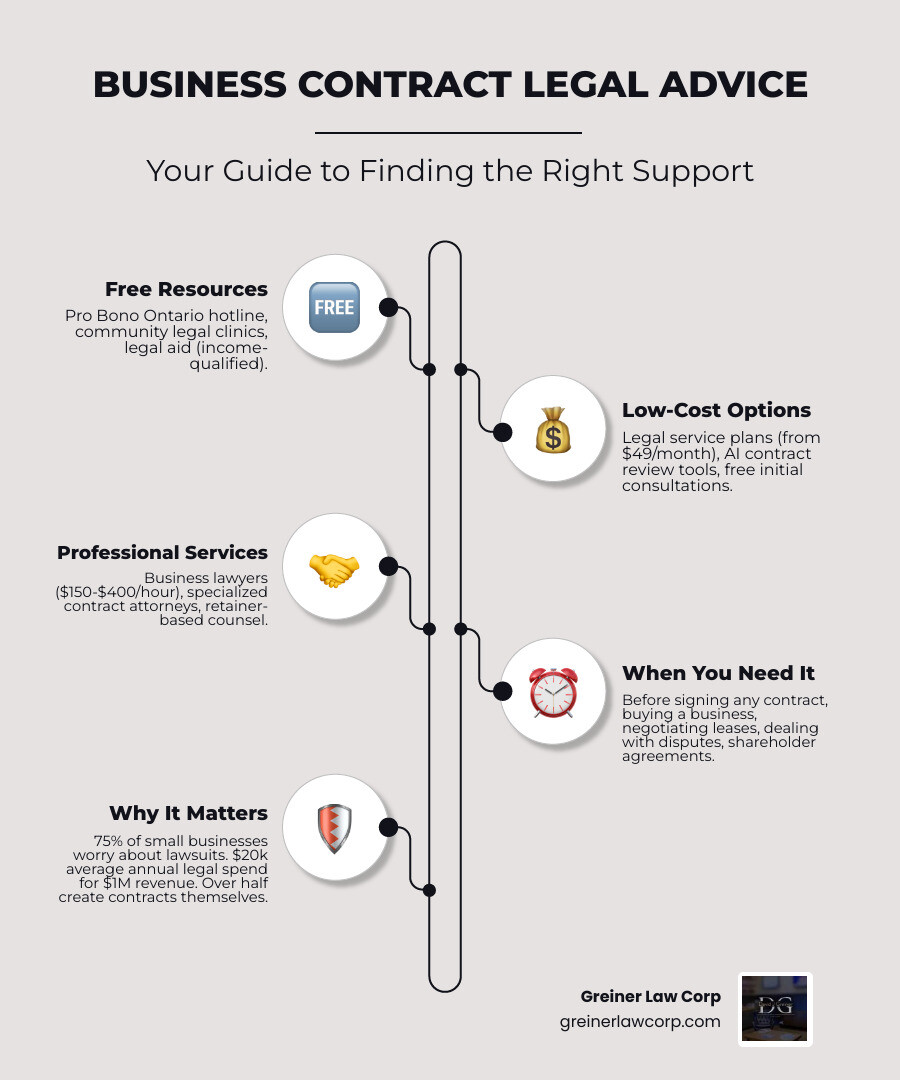
- Free Resources: California State Bar resources, community legal clinics, legal aid (income-qualified), and law society registries
- Low-Cost Options: Legal service plans starting at $49/month, AI contract review tools, and free initial consultations
- Professional Services: Business lawyers ($150-$400/hour), specialized contract attorneys, and retainer-based counsel
When You Need It: Before signing any contract, when buying a business, negotiating leases, dealing with disputes, or setting up shareholder agreements.
Every business owner faces contract decisions. Whether you’re signing a commercial lease, hiring contractors, or purchasing assets, the stakes are high. Research shows that 75% of small business owners worry about frivolous lawsuits, and those with $1 million in revenue spend an average of $20,000 annually dealing with legal issues. Yet over half of business owners still create contracts themselves.
The good news? You don’t always need expensive legal counsel. Free and low-cost resources exist, from pro bono clinics to AI-powered review tools. The key is knowing when to use them—and when to invest in professional help.
As David Greiner, Esq., I’ve spent years providing business contract legal advice to some of the region’s largest businesses, focusing on transactions, buy-sells, and corporate governance. My approach prioritizes your goals and ensures they’re achieved efficiently.
Similar topics to business contract legal advice:
Essential Elements and Legal Principles of California Contracts
When we talk about contracts, we’re essentially discussing the blueprint for our business relationships. A well-constructed contract provides legal certainty, minimizes disputes, and safeguards our interests. While some of our research might refer to other jurisdictions, the fundamental principles of a legally binding contract are universally recognized, with specific nuances applied by California law. Understanding these basics is the first step in seeking effective business contract legal advice.
At its core, a legally binding contract in California, like many other places, requires several essential elements:
- Offer: One party must make a clear and definite proposal to another, indicating their willingness to enter into an agreement under specific terms. Think of it as saying, “Here’s what I’m willing to do.”
- Acceptance: The other party must agree to the terms of the offer unconditionally. This is their way of saying, “I agree to those terms.” If they try to change the terms, that’s usually considered a counter-offer, not an acceptance.
- Consideration: Both parties must exchange something of value. This doesn’t necessarily have to be money; it can be a promise to do something, a promise not to do something, goods, or services. It’s the “what’s in it for me?” for both sides. For instance, a buyer’s promise to pay for a product is consideration, and the seller’s promise to deliver the product is consideration.
- Intention to Create Legal Relations: The parties must intend for their agreement to be legally enforceable. If we’re just making a casual promise to grab coffee, it’s unlikely we intend for that to be a binding contract. But for business dealings, this intention is usually presumed.
- Capacity: All parties entering the contract must have the legal ability to do so. This means they must be of legal age (18 in California), of sound mind, and not under duress or undue influence.
Beyond these elements, several key legal principles govern business contracts in California:
- Freedom of Contract: Generally, parties are free to agree to almost any terms they wish, as long as those terms are legal and not against public policy. This principle allows us to tailor contracts to our unique business needs.
- Privity of Contract: Only the parties directly involved in the contract can enforce it or be bound by its terms. This means a third party generally can’t sue or be sued under a contract they weren’t a part of, though there are exceptions for intended third-party beneficiaries.
- Parol Evidence Rule: This rule generally prevents parties from introducing outside evidence (like prior conversations or agreements) to contradict or modify the terms of a written contract that is intended to be the complete and final agreement. It means what’s written usually stands, so ensure your written contract is comprehensive!
- Frustration: If an unforeseen event makes it impossible or radically different for a contract to be performed, the contract may be terminated. For example, if a natural disaster destroys a supplier’s factory, making delivery impossible, the contract might be frustrated.
- Misrepresentation: If one party was induced to enter a contract based on a false statement of fact made by the other party, the misled party may have grounds to rescind (cancel) the contract.
For a deeper dive into what makes a contract solid, you can explore our Contract Guide. Understanding these principles is foundational to navigating the complex world of business agreements and making informed decisions, especially when seeking More info about business contract legal advice.
When to Seek Professional Business Contract Legal Advice
Navigating the business world means signing contracts—lots of them. While we might be tempted to handle things ourselves (and over half of business owners do!), knowing when to seek professional business contract legal advice is crucial. Proactive legal counsel can save us significant headaches and costs down the road. As the saying goes, it’s often far less expensive to retain a lawyer proactively than to hire one to fix problems after they occur.
Here are key situations where professional legal advice is not just recommended, but often essential:
- Risk of Lawsuits and Potential Legal Costs: As we’ve seen, frivolous lawsuits are a major concern for small businesses, and legal battles can be incredibly costly. A well-drafted contract is our best defense against disputes and potential litigation. If we’re facing a situation that could lead to a lawsuit, or if the financial stakes are high, a lawyer’s expertise is invaluable.
- Contract Enforcement and Dispute Resolution: What happens when a contract isn’t honored? Perhaps a customer fails to pay, or a vendor breaches their agreement. A lawyer can help us understand our rights, pursue payment, or stop a party from continuing a breach, sometimes through negotiation or mediation before resorting to costly litigation. For more on this, check out our More info about contract dispute lawyers.
- Choosing a Business Structure: Before we even sign our first business contract, we need to decide how our business will be structured (sole proprietorship, partnership, LLC, corporation). This decision impacts liability, taxes, and future operations. A lawyer can help us weigh these factors to select the best structure for our goals. Learn more about More info about business formation.
- Buying an Existing Business: This is a complex transaction involving numerous contracts, from asset purchase agreements to non-compete clauses. A comprehensive “buy and sell” agreement, drafted by a lawyer, ensures all demands, obligations, and dispute resolution methods are clearly detailed. Our guide on More info about asset purchase agreements can provide more context.
- Commercial Leases: A commercial lease is often one of the largest expenses for a small business. These agreements are notoriously complex and can have long-term implications for our operations, expansion, and even exit strategy. Legal review before signing is paramount to ensure flexibility and avoid hidden pitfalls. For detailed guidance, see More info about commercial lease contracts.
- Equity Financing and Shareholder Agreements: When seeking investment or taking on partners, clear agreements are vital. Shareholder agreements define ownership, decision-making, profit distribution, and exit strategies. A lawyer can ensure these agreements protect our interests and assess their impact on other existing contracts.
- Specific Contract Types:
- Licensing Agreements: If we’re licensing our intellectual property or using someone else’s, these contracts define rights, royalties, and usage terms.
- Franchise Agreements: These are extensive and heavily regulated, requiring careful legal review before we commit to a franchise system.
- Employment Contracts: From onboarding new team members to independent contractor agreements, these contracts protect both the business and the employee, outlining roles, compensation, confidentiality, and termination terms.
- Consulting Agreements: As we’ll discuss later, these are critical for independent contractors and their clients to define scope, IP, and compensation.
- Legal Service Plans: For ongoing, routine legal needs, a legal service plan can be a cost-effective alternative to hourly billing. These plans often offer unlimited consultations and document reviews for a fixed monthly fee, providing access to legal expertise without the shock of hourly rates.
The average lawyer in California can charge between $150-$400 per hour. While this might seem steep, a small investment in timely legal advice can prevent issues that could cost us thousands or even tens of thousands in the long run.
Utilizing Free and Low-Cost Legal Resources for Business Contract Legal Advice
We understand that not every business can afford hourly legal fees, especially startups or small businesses operating on tight budgets. Fortunately, several free and low-cost resources can provide valuable business contract legal advice and support, particularly here in California.
- Community Legal Clinics and Legal Aid: Many communities in California, including those in Los Angeles, Riverside, and San Bernardino counties, host legal clinics that offer free or low-cost legal assistance to eligible individuals and small businesses. These clinics are often staffed by volunteer attorneys who can provide initial consultations, document review, and guidance on common business legal issues. Eligibility usually depends on income and the nature of the legal issue. While resources like the U.S. Small Business Administration (SBA) provide general guidance, similar pro bono organizations and programs exist throughout California to connect businesses with legal assistance.
- Document Review and Negotiation Strategies: Even if we’re drafting a contract ourselves using a template, having a lawyer review it is crucial. Some legal clinics or legal service plans offer document review services. This can be a hybrid, cost-effective approach: we download a template, fill it out, and then have a lawyer check it for legal soundness and enforceability under California law. Lawyers can also provide invaluable insights into negotiation strategies, helping us achieve a better deal and ensure our contracts genuinely meet our needs. This proactive approach is a key part of More info about business risk management strategies.
- Legal Service Plans: As mentioned, these plans offer a subscription model for legal services, often including unlimited consultations and document reviews for a fixed monthly fee. Some plans start as low as $49/month for small businesses. While specific services vary, they can cover a wide range of needs, from drafting debt collection letters to basic contract reviews. The cost savings can be substantial; using such a plan just once can save us thousands of dollars compared to traditional hourly rates. It’s a way to have a lawyer “on call” without the constant worry of mounting bills.
Leveraging Technology for Business Contract Legal Advice
Technology offers innovative ways to access and understand business contract legal advice. While AI tools can’t replace the nuanced judgment of a human lawyer, they can certainly augment our ability to review and understand contracts efficiently.
- AI Contract Review Tools: Platforms are emerging that use artificial intelligence to analyze our contracts. These tools can:
- Detect Red Flags: Automatically identify potentially problematic clauses, unfair terms, or missing critical information.
- Break Down Key Terms: Simplify complex legal jargon into understandable language, helping us grasp the implications of specific clauses.
- Automated Templates: Provide customizable contract templates that can be custom to our specific needs, often with guidance on what information to include.
- Understanding Enforceability: Some AI tools can even offer insights into issues like the enforceability of verbal agreements or what happens if a contract is unsigned. While these tools provide valuable initial insights, we should always follow up with a human lawyer for definitive advice custom to our specific situation and California law.
- Efficiency and Cost Savings: By using AI for initial reviews, we can streamline the process and potentially reduce the time a lawyer needs to spend on a document, leading to cost savings. It’s an excellent way to get a preliminary understanding and prepare informed questions for our legal counsel.
Leveraging technology is another smart move in our overall More info about risk management in contracts strategy.
Best Practices for Drafting and Negotiating Business Agreements
Drafting and negotiating business agreements are perhaps the most critical moments for safeguarding our business interests. It’s where we define expectations, allocate risks, and set the stage for successful partnerships. Effective business contract legal advice emphasizes these best practices:
- Clarity, Conciseness, and Specificity: The golden rule of contract drafting. Avoid ambiguity! Every term, condition, and obligation should be stated in plain language, leaving no room for misinterpretation. If we can’t understand it, how can we expect others to? This includes defining key terms upfront.
- Comprehensive Scope of Work: Clearly delineate the services, goods, or deliverables being exchanged. What exactly is each party responsible for? What are the timelines and milestones? The more detailed, the better. This section holds consultants accountable for their performance and ensures they fulfill their side of the deal.
- Precise Payment Terms: Specify compensation, payment schedules, invoicing procedures, and consequences for late payments. Are there any conditions for payment release? This helps avoid disputes over money, which are unfortunately common.
- Confidentiality: If we’re sharing sensitive information (trade secrets, client lists, financial data), a robust confidentiality clause is non-negotiable. It defines what information is confidential, who can access it, and the obligations of the receiving party.
- Force Majeure: This clause addresses unforeseeable circumstances (like natural disasters, pandemics, or government actions) that prevent a party from fulfilling their contractual obligations. It outlines how the contract will proceed (or be suspended/terminated) in such events.
- Governing Law and Jurisdiction: Always specify which state’s laws will govern the contract (e.g., California law) and where any disputes will be resolved (e.g., courts in Los Angeles County, California). This avoids legal battles over which jurisdiction applies.
- Entire Agreement Clause: This crucial clause states that the written contract represents the complete and final agreement between the parties, superseding all prior discussions, understandings, or oral agreements. This helps prevent claims based on things said or promised outside the written document.
- Standard Form Contracts and Unfair Terms: Many businesses use “standard form” contracts (e.g., for employment, leases, or insurance). While convenient, these are often drafted to heavily favor the party providing them. We must read every word, including the fine print, and be wary of “unfair terms” that allow one party to avoid obligations, terminate unilaterally, or impose excessive penalties. In California, such terms can sometimes be challenged.
- Pre-Signing Checklist: Before we put pen to paper (or click to sign!):
- Have we read and understood every single clause?
- Does the contract accurately reflect what we negotiated?
- Are there any blank spaces? If so, cross them out.
- Have we initialed all changes?
- Do we have a copy for our records?
- Are we being pressured to sign? If so, take a step back and seek advice.
Understanding the difference between conditions and warranties is also vital, as it impacts the remedies available in case of a breach:
| Feature | Condition | Warranty |
|---|---|---|
| Importance | Fundamental to the contract’s main purpose. | Less fundamental, secondary to the main purpose. |
| Breach Impact | Allows the innocent party to terminate the contract and claim damages. | Typically only allows the innocent party to claim damages; contract usually continues. |
| Example | A contract for a specific product, and a different product is delivered. | A contract for a product, and a minor defect is found that doesn’t prevent its use. |
Frequently Asked Questions about Business Contracts
What are the differences between verbal and written contracts?
The primary difference lies in enforceability and proof. While many people believe only written contracts are valid, verbal agreements can be legally binding in California, as can contracts formed by our conduct. However, proving the terms of a verbal contract can be incredibly challenging. Imagine trying to convince a judge of a conversation that happened months ago! This is where documentation becomes critical.
For certain types of agreements, California law (like the Statute of Frauds) requires them to be in writing to be enforceable. Examples include contracts for the sale of real estate, agreements that cannot be performed within one year, or contracts for the sale of goods over a certain value.
Our advice? Whenever possible, put it in writing. A written contract provides clear evidence of the agreed-upon terms, reducing the likelihood of disputes and making enforcement much simpler. If we rely on verbal agreements, we should at least document discussions, emails, and quotes as evidence.
How can a business contract be legally terminated?
Contracts are meant to be honored, but sometimes, for various reasons, they need to end. Here are the common ways a business contract can be legally terminated in California:
- Completion: The most straightforward way. Both parties fulfill all their obligations, and the contract naturally concludes. We celebrate, we move on!
- Mutual Agreement: Both parties agree to end the contract, even if it hasn’t been fully performed. This should always be documented in writing to avoid future misunderstandings.
- Frustration: As discussed earlier, if an unforeseen event makes performance impossible or radically changes the contract’s purpose, it may be terminated.
- Convenience Notice: Some contracts include a “termination for convenience” clause, allowing one or both parties to end the agreement by giving a specified amount of notice, often without needing a specific reason.
- Breach of Condition: If one party fails to uphold a fundamental or essential term (a “condition”) of the contract, the other party may have the right to terminate the contract and claim damages. If the breach is of a less important term (a “warranty”), the contract usually continues, and the innocent party can only claim damages.
It’s crucial to understand the termination clauses in any contract we sign, as they outline notice periods, penalties, and what constitutes a breach.
What is a consulting agreement and its key components?
A consulting agreement is a legally binding document that details the terms of service between a client and a consultant (who typically operates as an independent contractor). It’s essential for establishing clear expectations and protecting both parties from potential disputes or misunderstandings. Think of it as the playbook for a time-bound partnership.
Key components of a consulting agreement in California often include:
- Names of Parties and Businesses: Clearly identify the client and the consultant, along with their contact information.
- Scope of Services (Scope of Work): This is vital. It precisely defines the tasks, deliverables, objectives, and any limitations of the consultant’s work. Vague goals lead to muddled outcomes, so specificity here is key.
- Compensation: Detail the fee structure (hourly, project-based, retainer), payment schedule, and any reimbursement for expenses.
- Term and Termination Terms: Specify the length of the engagement. Also, include clear termination conditions, such as notice periods, what happens in case of a breach, and any penalties.
- Independent Contractor Status: Explicitly state that the consultant is an independent contractor, not an employee. This is crucial for tax purposes and limits the client’s liability for the consultant’s actions.
- Confidentiality: A clause requiring the consultant to keep sensitive client information (trade secrets, financial data) confidential. This can be unilateral (consultant bound) or mutual (both parties bound).
- Intellectual Property (IP) Ownership: Clarify who owns any property, work product, or intellectual property created by the consultant during the engagement. This prevents future disputes over copyrights or patents.
- Non-Compete and Non-Solicitation Clauses: While non-compete clauses are heavily restricted and often unenforceable in California, non-solicitation clauses (preventing a consultant from poaching clients or employees) are more commonly used and can be enforceable if narrowly custom. These should be carefully reviewed with legal counsel.
- Governing Law and Dispute Resolution: As with any contract, specify that California law governs the agreement and outline the preferred method for resolving disputes (negotiation, mediation, arbitration, or litigation).
- Entire Agreement Clause: A clause stating that the written agreement supersedes any prior oral agreements or understandings, ensuring the written document is the final word.
A well-crafted consulting agreement ensures everyone is on the same wavelength, fostering a smoother, more productive working relationship.
Conclusion
Navigating business contracts can feel like walking through a legal minefield. But with the right business contract legal advice, we can transform potential pitfalls into stepping stones for growth and security. From understanding the essential elements of a legally binding agreement in California to knowing when to seek professional counsel, being informed is our greatest asset.
Whether we’re leveraging free legal clinics, utilizing AI tools for preliminary reviews, or investing in comprehensive legal services, the goal remains the same: to protect our business, manage our risks, and ensure our agreements are clear, fair, and enforceable.
At Greiner Law Corp, we understand the unique challenges faced by businesses in Victorville, Riverside, San Bernardino, and Los Angeles. Founded by David Greiner, our firm specializes in prioritizing your goals with a business-minded approach, ensuring you can manage your risk preferences effectively. We believe that savvy legal advice is about more than just avoiding problems—it’s about empowering your business to thrive.
For all your contractual needs, including complex transactions like More info about contracts for the sale of real estate, we’re here to provide the strategic legal partnership you deserve.


