Navigating Contract Disputes: Your Expert Guide
A contract dispute lawyer is a legal professional who specializes in helping individuals and businesses resolve disagreements arising from contracts. They work to protect your interests when a contractual agreement is broken or challenged.
What do they do?
- Interpret contracts: They understand the complex language and legal terms in agreements.
- Identify breaches: They determine if a party has failed to meet their obligations.
- Negotiate solutions: They work to settle disputes out of court through discussion.
- Represent clients: If needed, they advocate for you in mediation, arbitration, or litigation.
- Seek remedies: Their goal is to achieve fair outcomes, such as financial compensation or specific actions.
Contracts are the backbone of business, from simple agreements to complex multi-party deals. But even the best-laid plans can go awry, leading to misunderstandings, non-performance, or outright breaches. These disputes can severely impact your operations and finances, especially for small businesses. When a contract solves, professional legal guidance becomes not just helpful, but essential.
Navigating these challenges requires a clear understanding of contract law and strategic dispute resolution. This guide will walk you through contract disputes and how a specialized lawyer can safeguard your business relationships and financial health.
I’m David Greiner, Esq., and I’ve spent years helping clients with business law, real estate, and contracts. My focus as a contract dispute lawyer is on achieving your goals, not just billing hours.
The Anatomy of a Contract: Formation and Breaches
Think of a contract as a promise that the law takes seriously. It’s a legally binding agreement between two or more parties, and it doesn’t have to look like those intimidating legal documents you see in movies. Some contracts are thick stacks of paper filled with complex language, but others are surprisingly simple.
Here’s something that might surprise you: verbal agreements can be just as legally binding as written contracts. That handshake deal you made? It could hold up in court if it has the right elements. But here’s the catch – proving what was actually agreed upon becomes much trickier without documentation. That’s why we always tell our clients to get important agreements in writing.
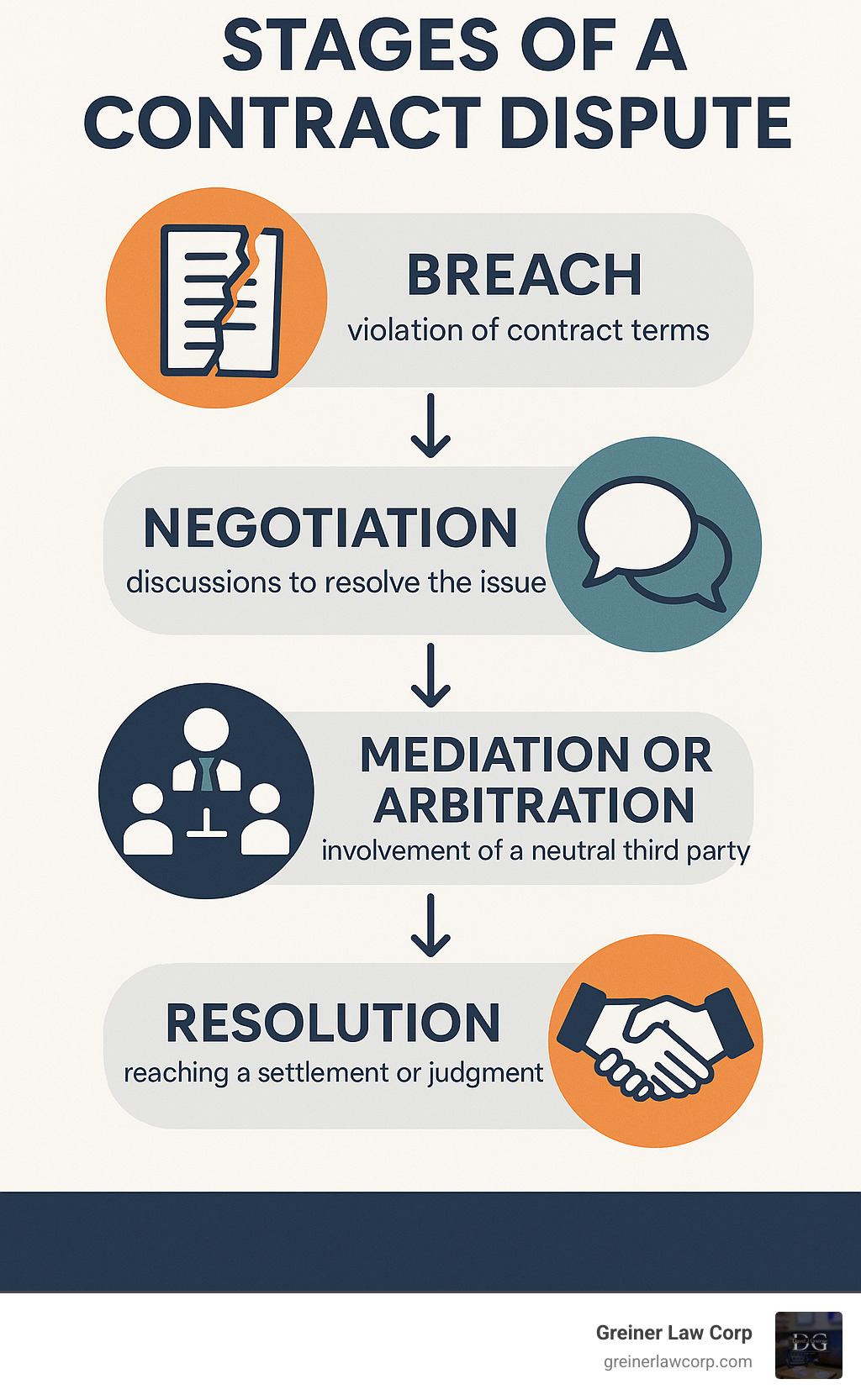
When someone fails to keep their end of the bargain, that’s called a breach of contract. It’s like breaking a promise, except this promise has legal teeth. A breach can happen in many ways – maybe someone doesn’t deliver goods on time, provides substandard work, or simply walks away from the deal entirely. Understanding what is a breach of contract is crucial for protecting your business interests.
Key Elements of a Valid Contract
Not every agreement becomes a contract in the eyes of the law. For a contract to be enforceable, it needs certain ingredients – think of them as the essential components of a recipe. Missing one, and the whole thing might fall apart.
The first ingredient is an offer – one party needs to make a clear proposal with specific terms. Then comes acceptance – the other party must agree to those exact terms. Change anything, and you’re actually making a counter-offer instead.
Next, you need consideration – this is the fancy legal term for “something of value being exchanged.” It doesn’t have to be money. It could be services, goods, or even a promise to do (or not do) something. This exchange is what makes the agreement more than just a casual conversation.
Mutuality means everyone understands what they’re getting into. Both parties need to have a clear “meeting of the minds” about the essential terms. Finally, the agreement must have a legal purpose – you can’t create a binding contract to do something illegal.
These basic vital elements of a contract form the foundation of every enforceable agreement. Without them, even the most elaborate written document might not hold up in court.
Understanding a Breach of Contract
When a valid contract exists, everyone expects the parties to follow through on their promises. Life happens, though, and sometimes people can’t or won’t meet their obligations. That’s when we start talking about breaches.
A minor breach occurs when someone fails to perform a small part of the contract, but the other party still gets most of what they bargained for. Imagine ordering custom furniture that arrives a week late but in perfect condition. You might be entitled to some compensation for the delay, but you’d still need to pay for the furniture.
A material breach is much more serious. This happens when someone fails to perform such an important part of the contract that it defeats the whole purpose of the agreement. If that furniture company delivered a completely different style and color than what you ordered, that would likely be a material breach. The non-breaching party can often cancel the contract and sue for damages.
Then there’s anticipatory breach – this is when you can see trouble coming from a mile away. Maybe the other party tells you outright they won’t perform, or their actions make it clear they’re not going to follow through. You don’t have to wait for the actual failure to perform to take legal action.
Understanding these different types of breaches is essential because they determine what remedies are available. Whether you’re dealing with a business partnership dispute or need guidance on real estate contracts explained, knowing the severity of a breach helps determine the best path forward.
As a contract dispute lawyer, I’ve seen how these distinctions can make or break a case. The good news is that with proper understanding and preparation, many contract disputes can be resolved efficiently and fairly.
Resolving Disagreements: The Role of a Contract Dispute Lawyer
When a contract falls apart, it can feel overwhelming—especially when your business’s stability and financial health hang in the balance. That’s exactly when you need a skilled contract dispute lawyer by your side. We don’t just aim to “win” your case; our goal is finding the best possible outcome for your unique situation, whether that means negotiating behind closed doors, exploring alternative dispute resolution, or taking your case to court.

The art of effective negotiation often becomes the first—and most important—step in resolving contract disputes without ever seeing the inside of a courtroom. We use proven strategies to protect your interests while doing our best to preserve valuable business relationships whenever possible. But when negotiations hit a wall, we’re fully prepared to pursue every available legal remedy to safeguard your financial well-being and enforce the agreements you’ve made.
What Does a Contract Dispute Lawyer Do?
A contract dispute lawyer becomes your dedicated legal partner when contractual challenges arise. We’re not just experts in the intricate details of contract law—we understand how these legal principles apply specifically to your real-world situation. Our role extends far beyond simply filing lawsuits when things go wrong.
Here’s how we guide you through these complex waters:
Case evaluation forms the foundation of everything we do. We thoroughly review your contract, analyze every detail of the dispute, and honestly assess both the strengths and potential weaknesses of your position. This means examining every clause, every email exchange, and every action taken by everyone involved.
Evidence gathering becomes crucial for building a strong case, whether we’re heading into negotiations or preparing for litigation. We carefully collect documents, communications like emails and text messages, financial records, and witness statements that support your position.
Legal strategy development follows naturally from our evaluation and evidence collection. We create a customized approach based on your specific goals, the nature of your dispute, and a realistic assessment of the potential costs and benefits of each available option.
Client representation means we advocate for your interests at every single stage. We clearly communicate your position, fight for your rights, and make sure you’re protected throughout the entire process.
Negotiation often provides the most efficient path to resolution. We lead or assist in direct discussions with the other party or their legal counsel, always focusing on achieving solutions that protect your interests while maintaining important business relationships whenever possible.
Litigation becomes necessary when other methods fail to resolve the dispute. We’re fully prepared to represent you in court, which involves drafting legal pleadings, conducting findy, arguing motions, and ultimately presenting your case at trial. Sometimes going to court for complex disputes becomes the only way to achieve a final resolution, especially for complex business contract breaches involving substantial legal matters.
Alternative Dispute Resolution (ADR) vs. Litigation
When contract disputes arise, you have several different paths toward resolution. The good news? Most breach-of-contract disputes can be resolved without expensive and stressful litigation. We use a range of highly effective dispute resolution techniques to settle these disagreements without needing court intervention. These methods, known as Alternative Dispute Resolution (ADR), typically prove faster, more cost-effective, and less contentious than going to court.
| Feature | Mediation | Arbitration | Litigation |
|---|---|---|---|
| Cost | Lower cost, shared expenses | Moderate cost, faster than court | Highest cost, extensive legal fees |
| Speed | Usually resolved in weeks/months | Faster than litigation | Can take years to resolve |
| Confidentiality | Completely confidential process | Generally confidential | Public court records |
| Finality | Non-binding, requires agreement | Binding decision, limited appeals | Binding with appeal rights |
Mediation represents a valuable alternative where a neutral third party helps facilitate discussions between you and the other party. The mediator doesn’t make decisions but helps guide conversations toward mutually acceptable solutions.
Arbitration involves presenting your case to a neutral arbitrator who makes a binding decision. It’s more formal than mediation but typically faster and less expensive than traditional litigation.
Litigation through the court system provides the most formal resolution process, with strict rules of evidence and procedure. While it can be time-consuming and expensive, sometimes it’s the only way to achieve justice in complex disputes.
Evidence Needed to Win a Lawsuit
Success in contract litigation depends heavily on having the right evidence to support your position. Without solid proof, even the strongest legal arguments can fall flat in court.
Valid contract proof starts everything—you need to demonstrate that a legally binding agreement actually existed between the parties. This might be a written document, but verbal agreements can also be enforceable under the right circumstances.
Performance of obligations requires showing that you held up your end of the bargain. Documentation of your completed work, delivered goods, or fulfilled services becomes essential to your case.
Proof of breach means demonstrating exactly how the other party failed to meet their contractual obligations. This often involves comparing what they promised to do against what they actually did—or failed to do.
Resulting damages must be clearly documented and quantified. You need to show not just that a breach occurred, but that it caused you specific, measurable harm. Financial records, lost opportunity documentation, and expert testimony can all play crucial roles here.
Documentation of all communications, changes to the original agreement, and the timeline of events provides the factual foundation for your case. Witness testimony from people who observed the agreement’s formation or breach can add crucial support to your position.
Understanding the Interplay Between Technical and Artistic Decisions
Technical and artistic decisions in game development are not isolated. They are deeply intertwined, with each influencing and constraining the other.
For example, a highly realistic art style (artistic decision) demands significant technical horsepower in terms of rendering, asset streaming, and memory management. Conversely, choosing a low-polygon art style (artistic decision) might open up opportunities for more complex physics simulations or larger game worlds (technical decisions).
It’s a continuous feedback loop:
- Artistic ambitions push technical boundaries.
- Technical limitations inspire creative artistic solutions.
Ignoring this interplay can lead to scope creep, missed deadlines, or a final product that doesn’t quite hit the mark.
Key Considerations for Sound Decision-Making
When you’re facing a contract dispute, whether you’re trying to prevent one or already dealing with one, making the right decisions can feel overwhelming. Just like in any complex situation, success comes down to asking the right questions and understanding what really matters most.
Think of it this way: every contract situation is unique, with its own set of circumstances, personalities, and stakes involved. What works for one business might be completely wrong for another. That’s why a good contract dispute lawyer will always start by understanding your specific situation before recommending any course of action.
What is your core business goal? This might seem obvious, but it’s surprising how often people get caught up in the legal details and lose sight of what they’re actually trying to achieve. Are you trying to preserve a valuable business relationship? Recover damages from a significant breach? Set a precedent for future dealings? Your ultimate objective should guide every decision you make.
Sometimes the “winning” legal strategy isn’t the best business strategy. For example, you might have a slam-dunk case for damages, but pursuing it could destroy a relationship with a key supplier or client. On the flip side, you might be willing to accept a smaller settlement if it means resolving the dispute quickly and getting back to business.
Who are you dealing with, and what’s at stake for them? Understanding the other party’s situation can be just as important as understanding your own. Are they a small business struggling with cash flow, or a large corporation that sees your dispute as a minor inconvenience? Are they likely to have good legal representation? Do they have a reputation to protect?
A contract dispute lawyer with experience will help you assess not just the legal merits of your case, but also the practical realities of who you’re up against. This insight can dramatically influence your strategy and expectations.
What are your resources and constraints? Let’s be honest about this one – legal disputes cost money and time. How much of both can you realistically afford to invest? What’s your business’s cash flow situation? Can you handle the distraction of a lengthy dispute, or do you need a quick resolution?
Budget and timeline constraints aren’t just practical considerations – they’re strategic ones. Sometimes the threat of expensive litigation is more powerful than actually going to court. Other times, you might need to move fast to prevent further damage to your business.
What kind of relationship do you want going forward? This is where many people get stuck. If you’re dealing with a one-time transaction gone wrong, you might be more willing to take an aggressive approach. But if this is a key business partner, supplier, or customer, you’ll want to consider how your dispute resolution approach affects future dealings.
The beauty of having options like mediation, arbitration, and litigation is that you can choose an approach that matches your relationship goals. Want to preserve the relationship? Mediation might be your best bet. Need to send a strong message? Sometimes litigation is the way to go.
What evidence do you have, and how strong is your position? This is where the rubber meets the road legally. Do you have a clear, written contract? Good documentation of the other party’s performance (or lack thereof)? Witnesses who can support your version of events?
Your contract dispute lawyer will help you honestly assess the strength of your case. Sometimes what feels like a clear-cut situation becomes more complicated when you dig into the legal details. Other times, you might have a stronger position than you initially thought.
The key is being realistic about both your strengths and weaknesses so you can make informed decisions about how to proceed.
Strategies for Making Informed Decisions
When you’re facing a contract dispute, having a solid strategy isn’t just helpful—it’s essential. The difference between a favorable outcome and a costly mistake often comes down to how well you prepare and the approach you take.
Start small and test the waters. Before diving headfirst into full litigation, consider creating what we call “vertical slices” of your case. This means focusing on one key issue or claim first, rather than throwing everything at the wall to see what sticks. Think of it like testing a recipe with a small batch before cooking for a dinner party—you want to know it works before you commit all your resources.
Learn from similar cases. Every contract dispute feels unique, but chances are, someone has faced a similar situation before. A skilled contract dispute lawyer will research comparable cases, looking at what strategies worked, what didn’t, and what pitfalls to avoid. This isn’t about copying someone else’s playbook—it’s about understanding the playing field.
Weigh your options carefully. For every major decision in your case, ask yourself: Is the potential benefit worth the cost? Sometimes pursuing every possible claim might feel satisfying, but it could drain your resources without meaningfully improving your outcome. Smart litigation means picking your battles wisely.
Keep everyone in the loop. The best results come when your legal team, business advisors, and key stakeholders all understand what’s happening and why. Your lawyer should explain not just what they’re doing, but how each decision affects your business goals. No one should be making choices in a vacuum.
Stay flexible as things develop. Contract disputes rarely unfold exactly as expected. New evidence emerges, the other party’s strategy becomes clear, or settlement opportunities arise. The key is staying adaptable while keeping your eye on the ultimate goal—protecting your business interests.
Document everything. Keep detailed records of all decisions made during your dispute, including the reasoning behind them and any alternatives you considered. This documentation becomes invaluable if the case takes unexpected turns or if you need to bring new team members up to speed quickly.
The goal isn’t to win every argument—it’s to achieve the best possible outcome for your business while managing costs and preserving important relationships where possible.
Common Pitfalls to Avoid
Even with the best intentions, contract disputes can arise from seemingly minor oversights. As a contract dispute lawyer, I’ve seen how certain patterns repeat themselves across different cases and industries. Understanding these common pitfalls can save you significant time, money, and stress down the road.
Over-scoping is perhaps the most frequent mistake I encounter. Many businesses try to accomplish too much with limited resources, creating contracts that are overly ambitious or unrealistic. This often leads to performance issues and eventual disputes when parties realize they’ve committed to something beyond their capabilities.
Another major concern is ignoring the long-term consequences of quick fixes. When businesses rush to close deals, they sometimes make hasty decisions about contract terms that seem minor at the time but create serious problems later. These shortcuts might save time initially, but they often result in costly disputes that could have been avoided with proper planning.
Inconsistent contract terms across different agreements can also create confusion and conflict. When your various contracts contain conflicting language or requirements, it becomes difficult to manage relationships and expectations effectively. This inconsistency can undermine your business relationships and create unnecessary legal complications.
Perhaps most importantly, lack of clear communication between parties during contract formation leads to misunderstandings that fester over time. When expectations aren’t clearly defined and documented, both sides may have different interpretations of their obligations. This communication breakdown often escalates into full-blown disputes that damage business relationships.
Finally, many businesses fall into the trap of blindly following industry trends without considering whether certain contract terms or structures actually fit their specific situation. Just because a particular approach works for other companies doesn’t mean it’s right for your business goals and circumstances.
The key to avoiding these pitfalls is working with experienced legal counsel who understands both the technical aspects of contract law and the practical realities of running a business.
Secure Your Agreements and Your Future
Contract disputes don’t have to derail your business or personal goals. With the right legal guidance and proactive planning, you can protect yourself from costly disagreements and resolve conflicts efficiently when they arise.
Throughout this guide, we’ve explored how contract dispute lawyers play a crucial role in safeguarding your interests. From understanding what makes a contract legally binding to navigating complex litigation, having an experienced attorney on your side makes all the difference. Whether you’re dealing with a minor breach or facing a material contract violation, professional legal representation ensures your rights are protected and your business relationships remain intact where possible.
Prevention truly is the best medicine when it comes to contract disputes. Strong contract drafting that clearly defines obligations, minimizes ambiguity, and includes dispute resolution clauses can save you significant time, money, and stress down the road. When agreements are well-crafted from the start, many potential conflicts never develop into full-blown disputes.
But when disputes do arise, litigation isn’t always the answer. Alternative dispute resolution methods like mediation and arbitration often provide faster, more cost-effective solutions while preserving important business relationships. A skilled contract dispute lawyer can guide you through these options and help you choose the best path forward.
Your business deserves protection, and that protection starts with solid legal counsel. Whether you’re drafting new agreements, reviewing existing contracts, or facing a current dispute, having an attorney who understands both the legal complexities and your business goals is invaluable.
At Greiner Law Corp, we take a business-minded approach to contract law, focusing on achieving your objectives rather than simply billing hours. We understand that every dispute is unique, and we work closely with our clients to develop strategies that protect their interests while minimizing disruption to their operations.
Don’t wait until a dispute escalates to seek legal guidance. For expert guidance on California real estate agreements, contact us today. Taking proactive steps now can save you from significant headaches and financial losses in the future.


