Why Your Business Needs an Asset Purchase Agreement Lawyer
An asset purchase agreement lawyer is essential for structuring, negotiating, and finalizing the sale of business assets while protecting your interests from hidden liabilities and contractual disputes. Their core services include:
- Drafting and customizing the asset purchase agreement for your specific transaction.
- Conducting due diligence to uncover undisclosed liabilities and verify asset ownership.
- Negotiating terms that protect you from future legal and financial risks.
- Structuring the deal to minimize tax exposure.
- Handling ancillary agreements like non-compete and non-solicitation clauses.
- Ensuring compliance with state and federal regulations.
When buying or selling business assets, the stakes are high. An asset purchase can expose you to hidden debts, tax issues, or future lawsuits if done wrong. Done right, it protects both buyer and seller. In most business transactions, an Asset Purchase Agreement is preferable to a stock purchase because it allows the buyer to acquire valuable assets while leaving unwanted liabilities behind.
The cornerstone of a successful transaction is the legal framework that defines what’s being bought, who’s responsible for what, and how both parties are protected.
I’m David Greiner, Esq., and I’ve spent years guiding clients through complex business transactions. As an asset purchase agreement lawyer, my focus is on being a business-focused advocate who prioritizes your goals—not just generating billable hours.
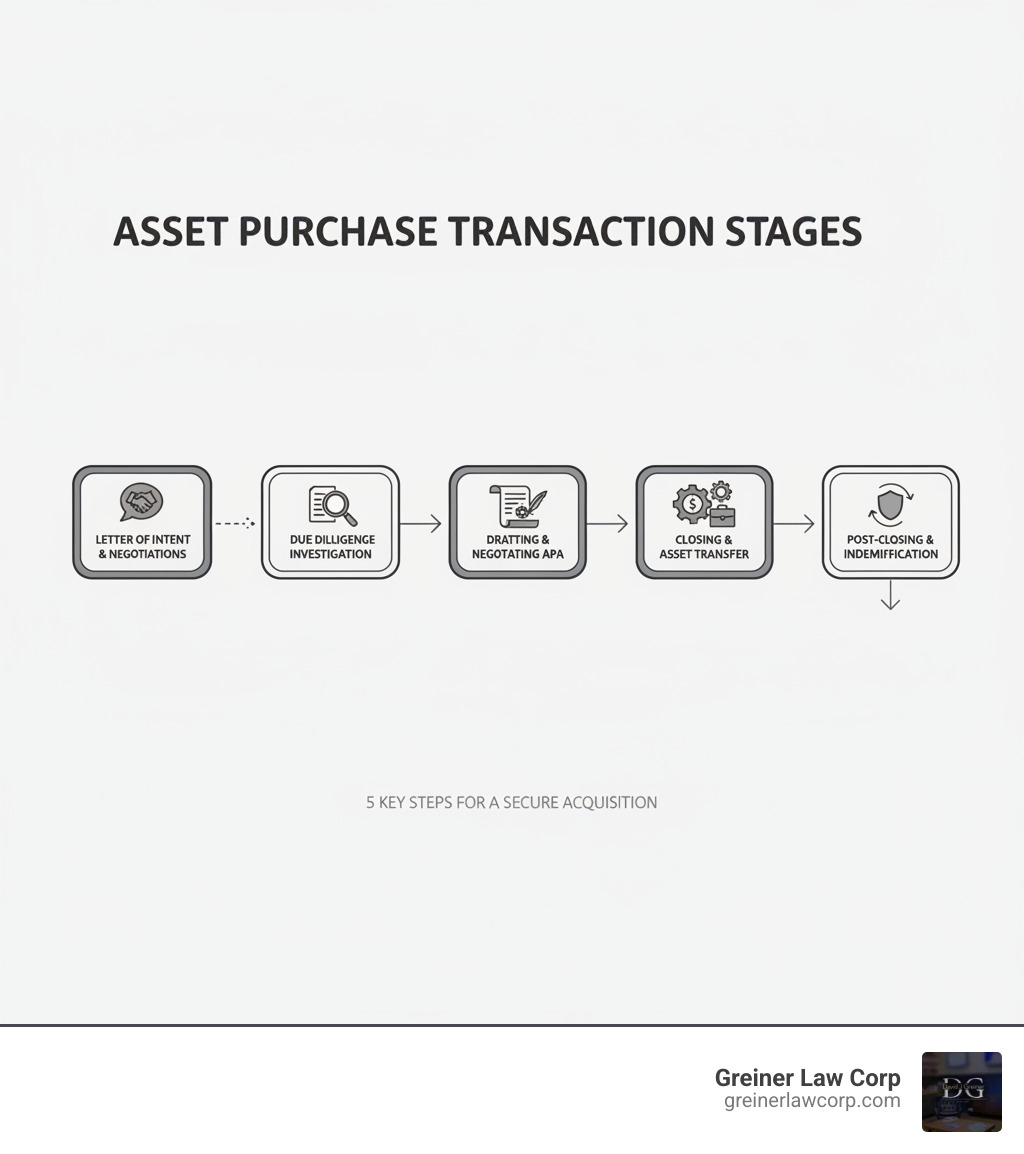
Understanding the Asset Purchase Agreement (APA)

An Asset Purchase Agreement (APA) is a contract that details how one business will buy specific assets from another. Unlike buying an entire company, an APA allows you to be selective—acquiring equipment, customer lists, and intellectual property while leaving behind old lawsuits or debts.
Its primary purpose is to create a clear roadmap for the transaction that protects both parties. A well-drafted APA prevents misunderstandings and shields you from future surprises. Key components include:
- Purchase Price: How much will be paid and when.
- Purchased and Excluded Assets: A precise list of what is and is not included in the sale.
- Representations and Warranties: Promises each side makes about the business and its assets.
- Due Diligence: The buyer’s opportunity to investigate and verify the seller’s claims.
- Liabilities and Indemnification: A clear definition of who is responsible for which debts and who pays if something goes wrong later.
- Closing Deliverables: A checklist of everything needed to complete the deal.
Asset Purchase vs. Stock Purchase: What’s the Difference?
When buying a business, you can buy its assets or its stock. The legal and financial differences are significant.
- A stock purchase means buying the entire company—including all its assets and liabilities, known and unknown.
- An asset purchase means cherry-picking specific assets and leaving the rest, including most liabilities, with the seller.
| Feature | Asset Purchase (APA) | Stock Purchase (SPA) |
|---|---|---|
| What is acquired | Specific assets (equipment, IP, customer lists, inventory) | Entire corporate entity with all assets and liabilities |
| Liability Assumption | Buyer assumes only specified liabilities; seller keeps the rest | Buyer assumes all existing and historical liabilities |
| Tax Implications | Buyer gets a stepped-up basis in assets (often favorable); seller may face double taxation if a C-corp | Buyer inherits seller’s tax basis; generally single level of tax for seller |
| Transaction Complexity | More complex due to asset-by-asset transfer and required consents | Simpler transfer, but extensive due diligence needed on liabilities |
| Transfer of Contracts | Requires explicit assignment and third-party consents | Contracts transfer automatically with the entity |
| Buyer’s Choice | Generally preferred to limit liability and get tax benefits | May prefer if target has many difficult-to-assign contracts |
| Seller’s Preference | May prefer to retain entity and simplify post-sale operations | Generally preferred to avoid double taxation and simplify process |
For most California businesses, an asset purchase offers smarter protection by limiting liability. However, a stock purchase may be better if a business has valuable contracts or licenses that are difficult to transfer.
How an APA Differs from a Merger
An APA is not a merger. In an asset purchase, two separate legal entities transact, with the buyer acquiring only specific assets. The seller’s company continues to exist, at least temporarily, and liabilities only transfer if explicitly agreed upon.
A merger combines two or more companies into a single entity. The absorbed company ceases to exist, and all its assets and liabilities transfer automatically by law. Mergers involve more corporate governance complexity and require shareholder approval, whereas an APA offers more flexibility in structuring the deal and controlling liability.
The Strategic Advantages of an Asset Purchase
In my years working with clients across Victorville, Riverside, San Bernardino, and Los Angeles, I’ve seen how a well-structured asset purchase can be the smartest move for an acquisition.
The primary advantage is selectivity. An asset purchase lets you cherry-pick the equipment, intellectual property, and customer lists you need while leaving behind unwanted inventory or problematic leases. This leads to the biggest benefit: avoiding hidden liabilities. With an APA, you generally don’t assume the seller’s undisclosed debts, pending lawsuits, or historical tax issues. Those stay with the seller.
Buyers also gain a significant tax benefit through a “tax basis step-up.” This allows you to allocate the purchase price across assets to maximize future depreciation deductions, lowering your taxable income. This control over risk is a key reason buyers prefer asset purchases.
Sellers can benefit, too. An asset sale allows you to divest a specific division or product line without dismantling your entire company. You can then wind down operations or pivot to a new venture.
However, there are disadvantages. Buyers must steer contract assignment issues, as transferring contracts and licenses often requires third-party consent, which can be difficult to obtain. For sellers, especially C-corporations, the potential for double taxation is a major concern—once at the corporate level and again upon distribution to shareholders. Sellers also remain responsible for all leftover liabilities not assumed by the buyer.
Understanding how these factors apply to your deal is where an experienced asset purchase agreement lawyer is essential. We help California clients weigh these pros and cons to structure a deal that aligns with their strategic goals while managing risk.
The Critical Role of an Asset Purchase Agreement Lawyer

One misstep in an asset purchase can expose you to hidden debts, unforeseen tax consequences, or future lawsuits. An asset purchase agreement lawyer is not just helpful—they are essential to your success.
As your strategic partner, we transform a risky transaction into a protected business move. Our work begins with drafting and negotiating agreements that fit your unique situation. A generic template cannot account for the specific risks and opportunities of your deal. We customize every contract to achieve your goals, ensuring clarity in every clause.
The due diligence process is where we often save clients the most money. We guide you through a systematic investigation of the assets, uncovering risks that could derail the transaction. This allows us to craft risk allocation strategies through representations, warranties, and indemnification clauses that protect you from future claims.
Our primary focus is protecting your interests and helping you avoid common pitfalls like vague asset descriptions or overlooked third-party consents. We ensure you don’t become another cautionary tale.
More info about our business contract services
Navigating Due Diligence and Liabilities
Due diligence is your opportunity to verify what the seller has told you and uncover what they haven’t. We investigate to unearth undisclosed liabilities, confirm the seller’s ownership of assets, and ensure they have the authority to complete the sale.
One of the most important distinctions is between assumed and excluded liabilities. The point of an asset purchase is to choose which obligations you take on. We make this distinction crystal clear in the agreement.
Indemnification clauses are your safety net, protecting you from losses caused by the other party’s breaches or pre-closing liabilities. We also structure the deal to minimize successor liability risk, where a buyer can be held responsible for a seller’s obligations even in an asset purchase.
Mastering Representations, Warranties, and Disclosures
Representations and warranties (“reps and warranties”) are promises made by the seller about the business. They serve two key purposes: as a disclosure mechanism to compel the seller to reveal important information, and as a risk allocation tool that gives you a legal remedy if a statement proves false.
Common seller warranties include their authority to enter the deal, their clear title to the assets, compliance with laws, and the absence of litigation. Special attention is given to intellectual property, ensuring the seller owns or has valid licenses for all necessary IP.
Why You Need an Asset Purchase Agreement Lawyer for Your Transaction
Handling an asset purchase without an experienced lawyer is a risk that rarely pays off. We provide value by:
- Customizing the agreement: We draft an APA that reflects your unique transaction, goals, and risk tolerance.
- Ensuring legal compliance: We steer California’s complex web of regulations to ensure your deal is valid and enforceable.
- Thinking strategically: Our business-minded approach helps optimize tax implications and facilitate future growth.
- Managing ancillary agreements: We handle crucial related documents, including the Letter of Intent (LOI), non-compete agreements, and non-solicitation agreements, to fully protect your investment.
By engaging an asset purchase agreement lawyer from Greiner Law Corp, you gain a partner committed to securing your transaction effectively and efficiently.
Key APA Clauses and Common Pitfalls

An Asset Purchase Agreement is a complex legal document where every clause matters. Getting the details right can mean the difference between a smooth acquisition and a costly legal headache.
Critical clauses include purchase price allocation, which has significant tax consequences; representations and warranties, which are the promises each party makes; covenants, which are commitments to act (or not act) before and after closing; conditions to closing, which are prerequisites for the deal to finalize; and the indemnification clause, which is your safety net for breaches or undisclosed liabilities.
For those interested in transactional best practices, the Model agreements from the American Bar Association offer valuable insights.
Defining the Deal: Assets, Liabilities, and Price
The heart of any APA is its precision. Vague descriptions create room for expensive disputes.
- Assets: Both tangible assets (equipment, inventory) and intangible assets (intellectual property, goodwill) must be identified specifically. We’ve seen deals nearly collapse because a trademark transfer was assumed but not explicitly listed.
- Liabilities: The APA must state unequivocally which liabilities the buyer is assuming and which remain with the seller. Without this clarity, buyers can find themselves responsible for the seller’s old debts.
- Purchase Price Allocation: This strategy is where smart tax planning occurs. Allocating more of the price to assets that depreciate quickly can create substantial tax benefits for the buyer. We work with your tax professionals to develop a legally defensible allocation.
Avoiding Common Mistakes with an Asset Purchase Agreement Lawyer
Even sophisticated business owners can stumble. Our job is to help you avoid these common pitfalls:
- Vague asset descriptions: Failing to clearly define every asset, especially intangibles, is a recipe for post-closing disputes.
- Inadequate due diligence: Rushing this process means you might acquire assets with hidden defects, legal issues, or inflated valuations.
- Ignoring tax consequences: The tax implications are substantial for both sides. Proper planning can prevent unexpected tax bills or capitalize on savings opportunities.
- Weak indemnification clauses: Buyers need strong provisions for recourse if a seller’s promises prove false. Sellers need negotiated limits (baskets and caps) to avoid open-ended exposure.
- Overlooking third-party consents: Many contracts, leases, and licenses require consent to be transferred. Forgetting this can render a key asset worthless to you.
- The DIY contract risk: The legal and tax complexities are too great for a template. An experienced asset purchase agreement lawyer brings strategic thinking to structure your deal for long-term success.
Frequently Asked Questions about Asset Purchase Agreements
Here are answers to the questions we hear most often from our clients in Victorville, Riverside, San Bernardino, and Los Angeles.
What is the main difference between an asset purchase and a stock purchase?
In an asset purchase, the buyer selects specific assets (like equipment and customer lists) and generally leaves liabilities behind. It’s like buying specific furniture from a house.
In a stock purchase, the buyer acquires the entire company, including all its assets and liabilities, known and unknown. It’s like buying the whole house, contents and all.
For most buyers, an asset purchase offers better protection by limiting exposure to the seller’s history.
Who typically drafts the Asset Purchase Agreement?
The buyer’s attorney usually prepares the first draft. This allows the buyer to frame the initial terms and set the starting point for negotiations. However, both parties’ lawyers will then negotiate and revise the document extensively to create a balanced final agreement that protects both sides.
What happens to the seller’s debts in an asset purchase?
Typically, the seller retains all debts and liabilities not explicitly assumed by the buyer in the APA. This is a primary advantage for the buyer.
However, the agreement must be drafted carefully by an asset purchase agreement lawyer to prevent “successor liability,” where a court could hold a buyer responsible for a seller’s debts in certain situations (e.g., if the deal looks like a disguised merger). We structure agreements to minimize this risk, ensuring that when you leave liabilities behind, they stay behind.
Secure Your Transaction with Expert Legal Guidance
An asset purchase is a pivotal moment for your business, but the legal complexities can be overwhelming. You don’t have to steer this path alone.
At Greiner Law Corp, we’ve guided countless clients across California, from Victorville to Los Angeles. We know an asset purchase isn’t just a transaction; it’s a strategic move that will define your company’s future.
That’s why we bring a business-minded approach that puts your goals first. We are your strategic partners, helping you manage risk and achieve your objectives. When you work with an experienced asset purchase agreement lawyer from our firm, you get a partner who will:
- Draft agreements that anticipate problems.
- Negotiate terms that protect your interests.
- Structure the transaction to support your long-term success.
The stakes are too high to leave to chance. Done wrong, an asset purchase can lead to hidden debts and legal battles. Done right, it sets the stage for growth.
Don’t leave this critical step to chance. Protect your business interests with expert legal counsel from Greiner Law Corp. Let’s work together to seal your deal—smartly and safely.


