Understanding Closing Costs in Real Estate Transactions
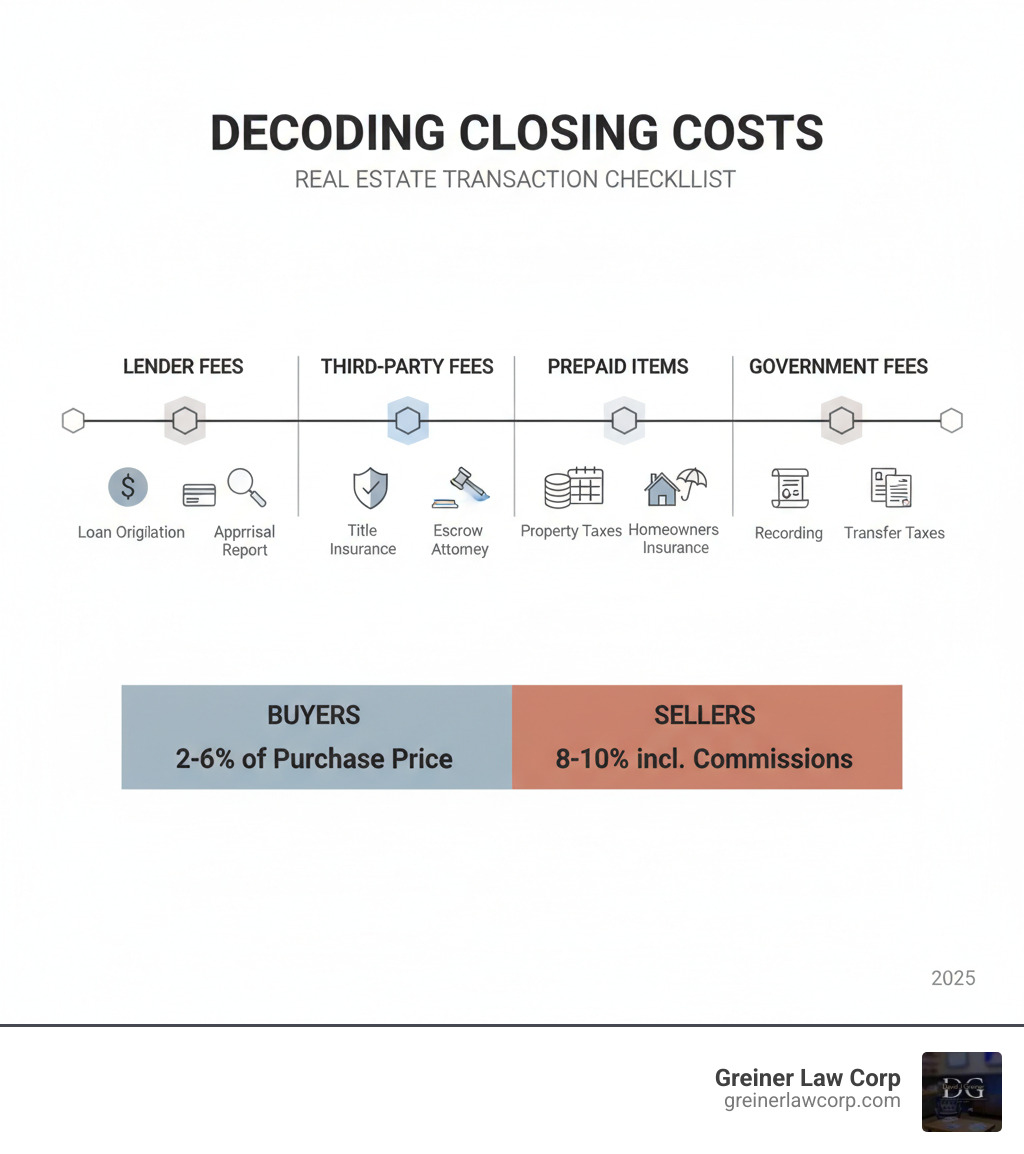
Closing costs in real estate transaction are the fees paid to finalize a property transfer. Separate from your down payment, these expenses typically range from 2% to 6% of the home’s purchase price for buyers and 8% to 10% for sellers (including agent commissions).
Key Components of Closing Costs:
- Lender fees: Loan origination, appraisal, credit report.
- Third-party fees: Title insurance, escrow, attorney fees.
- Prepaid items: Property taxes, homeowners insurance.
- Government fees: Recording fees, transfer taxes.
Understanding these expenses upfront is crucial for proper budgeting. While some costs are fixed, many are negotiable, and knowing the difference can save you thousands.
I’m David Greiner, Esq., founder of Greiner Law Corp. With years of experience in transactional and business law, I help clients steer closing costs in real estate transaction scenarios. My business-focused approach ensures you understand every fee and can manage risk effectively before you sign.
The Anatomy of Closing Costs in a Real Estate Transaction
Beyond the sticker price, closing costs in real estate transaction scenarios are the administrative and legal fees required to transfer ownership. These costs fall into four main categories: lender fees, third-party fees, prepaid items, and government fees. Understanding who typically pays for what is key, though many costs are negotiable.
| Closing Cost Category | Typical Payer (Buyer) | Typical Payer (Seller) |
|---|---|---|
| Appraisal Fee | Buyer | |
| Credit Report Fee | Buyer | |
| Loan Origination Fee | Buyer | |
| Discount Points | Buyer (optional) | |
| Title Insurance (Lender’s) | Buyer | |
| Title Insurance (Owner’s) | Negotiable (often Seller in California) | Negotiable (often Seller in California) |
| Escrow Fees | Buyer (often split 50/50 with Seller) | Seller (often split 50/50 with Buyer) |
| Private Mortgage Insurance | Buyer (if down payment < 20%) | |
| Property Taxes (Prorated) | Buyer (reimburses seller for prepaid portion) | Seller (pays up to closing date) |
| Homeowners Insurance | Buyer (first year premium) | |
| Home Inspection | Buyer (optional but recommended) | |
| Survey Fee | Buyer (if required/desired) | |
| Real Estate Agent Commissions | Seller | |
| Property Transfer Taxes | Negotiable (some local taxes) | Seller (state/local taxes) |
| Attorney Fees | Buyer and/or Seller for legal representation | Buyer and/or Seller for legal representation |
| HOA Transfer Fees | Negotiable (often Seller in California) | Negotiable (often Seller in California) |
| Recording Fees | Buyer |
A Buyer’s Checklist of Common Closing Costs
As a buyer, you’ll encounter various closing costs in real estate transaction scenarios. Here’s a quick rundown:
- Lender Fees: Expect to pay for an appraisal fee ($300-$800) to confirm the home’s value, a credit report fee (~$30), and a loan origination fee (often 1% of the loan) to process your mortgage. Discount points are optional fees paid to lower your interest rate.
- Insurance & Title: You’ll need lender’s title insurance (required) and should consider owner’s title insurance (optional but recommended) to protect against title defects. If your down payment is under 20%, you’ll also pay for Private Mortgage Insurance.
- Prepaid & Prorated Items: Be prepared to pay your first year’s homeowners insurance premium and several months of property taxes upfront. You’ll also cover prorated expenses like HOA dues.
- Third-Party & Government Fees: Escrow fees (often split with the seller), recording fees to document the sale, and attorney fees for legal oversight are common. Optional but wise costs include a home inspection ($350-$600) and a property survey.
For more on your purchase contract, see our guide to Real Estate Purchase Agreements.
A Seller’s Checklist of Common Closing Costs
Sellers also have significant closing costs in real estate transaction situations, typically 8-10% of the sale price.
- Commissions & Taxes: The largest cost is usually real estate agent commissions (traditionally 5-6%). Sellers in California also typically pay the Documentary Transfer Tax.
- Title & Escrow: Sellers often pay for the owner’s title insurance policy and split escrow fees with the buyer, though this is negotiable.
- Other Fees: Expect to pay your share of prorated property taxes, HOA transfer fees, and attorney fees for legal counsel. If you have an existing mortgage, you’ll also have payoff costs, which may include prepayment penalties.
For more on finalizing your sale, explore our resources on the Real Estate Closing Process.
The Legal and Financial Framework: Documents and Professionals
A successful closing involves a team of professionals. In California, this includes an escrow company to act as a neutral third party holding funds and documents, and a title company to verify the property’s title is clear of defects.
While not legally required in California, a real estate attorney provides invaluable protection. The financial stakes and legal complexities make professional guidance a smart investment. At Greiner Law Corp, we review contracts, scrutinize disclosures, and resolve issues before they escalate, leveraging our deep understanding of California Real Estate Law to protect you.
Understanding Your Loan Estimate and Closing Disclosure
Two documents are your roadmap to understanding closing costs in real estate transaction:
- Loan Estimate (LE): Received within three days of your mortgage application, this document details your estimated interest rate, monthly payment, and closing costs. Use it to compare offers from different lenders.
- Closing Disclosure (CD): You must receive this at least three business days before closing. This federally mandated review period is your chance to compare the final figures against your LE.
Scrutinize these documents for unexpected fees or major changes. Questioning discrepancies is smart business. For a detailed breakdown, the Closing Disclosure Explainer from the CFPB is an excellent resource.
The Critical Role of Title Insurance and a Real Estate Attorney
Title insurance is a crucial closing cost that protects you from financial loss if past issues with the property’s title—like fraud, liens, or undisclosed heirs—surface after you buy.
There are two types: lender’s title insurance (required by the mortgage company) and owner’s title insurance (optional but highly recommended to protect your equity). Unlike other policies, it protects against past events.
An experienced real estate attorney is key to managing this risk. We conduct due diligence to identify potential title problems early. At Greiner Law Corp, our business-minded approach helps you understand and mitigate risks by thoroughly reviewing all Real Estate Contracts to ensure your interests are fully protected.
Strategic Cost Management: How to Budget and Save
With smart planning, you can significantly reduce the closing costs in real estate transaction. Many fees are negotiable, and a business-minded approach can keep more money in your pocket.

Negotiating Closing Costs in Your Real Estate Transaction
Nearly everything in real estate is negotiable, including who pays for closing costs.
- Seller Concessions: Ask the seller to cover some or all of your closing costs. This is common, especially in a buyer’s market. In exchange, you might slightly increase the purchase price, allowing you to finance the costs over time.
- Limits on Contributions: Be aware of lender limits on seller contributions, which vary by loan type. Conventional loans cap contributions at 3-9% of the sales price depending on your down payment. FHA and USDA loans allow up to 6%, while VA loans cap them at 4%.
- Credits for Repairs: Instead of asking the seller to make repairs found during an inspection, request a credit toward your closing costs. This gives you cash for closing and control over the repairs.
All negotiations must be written into the purchase agreement to be binding. For help crafting these agreements, see our guide on the Real Estate Purchase Agreement.
Strategies for Reducing Your Upfront Expenses
Beyond negotiation, several proactive steps can trim your costs:
- Shop Around: You are not required to use the providers your agent or lender recommends. Compare quotes for title insurance, home inspections, and homeowners insurance to save hundreds.
- Compare Lenders: Get Loan Estimates from at least three lenders. Compare their fee structures, not just interest rates, and don’t be afraid to ask them to waive administrative fees.
- Time Your Closing: Schedule your closing for the end of the month to reduce the amount of prepaid interest you’ll owe.
- Improve Your Credit: A higher credit score can lead to a better interest rate and lower lender fees.
- Seek Assistance: Look into government programs in California cities like Los Angeles, Riverside, and San Bernardino that offer grants or low-interest loans for down payments and closing costs.
Advanced Considerations and Special Scenarios
Certain scenarios bring unique twists to closing costs in real estate transaction. The property type, loan product, and market conditions all shape your final expenses.

How Closing Costs Differ for New Construction vs. Resale
Buying a new home from a builder involves unique costs. Be wary of builder incentives that cover closing costs, as these perks may be rolled into a higher purchase price. New construction can also trigger additional transfer taxes or “builder’s fees” for lot premiums and HOA setup, many of which are negotiable. We always recommend an independent inspection, as the builder’s inspector works for them, not you. Negotiating with builders requires a different strategy, and understanding market timing can lead to significant concessions. For insights that can strengthen your position, learn more about Real Estate Law.
Understanding ‘No-Closing-Cost’ Mortgages and Other Loan Impacts
A “no-closing-cost” mortgage isn’t free; the lender either charges a higher interest rate or rolls the costs into your loan amount. This can be more expensive long-term. If you plan to stay in the home for many years, paying costs upfront is usually cheaper. If you expect to move or refinance soon, it might be a worthwhile trade-off.
Different loan types also have distinct fee structures:
- Conventional Loans: Require Private Mortgage Insurance (PMI) for down payments under 20%.
- FHA Loans: Include a large Upfront Mortgage Insurance Premium (1.75% of the loan) plus monthly premiums.
- VA Loans: Have a one-time VA Funding Fee (0.5% to 3.3%) instead of monthly mortgage insurance. Veterans with service-connected disabilities are often exempt.
Analyzing these options with legal counsel ensures you choose the path that best aligns with your financial goals.
Frequently Asked Questions about Closing Costs
What is the difference between a down payment and closing costs?
Your down payment is your initial ownership stake in the property. It goes directly toward the purchase price, building your equity and reducing your loan amount.
Closing costs in real estate transaction, however, are fees for services required to complete the purchase, such as appraisals, title insurance, and legal services. These fees do not build equity. You need separate funds for both your down payment and your closing costs, which will be itemized on your Closing Disclosure.
Are closing costs tax-deductible?
Mostly no. Most closing costs (like appraisal and attorney fees) are not immediately deductible. Instead, they are added to your home’s cost basis, which can reduce capital gains tax when you sell.
However, you can typically deduct prepaid mortgage interest, property taxes paid at closing, and sometimes discount points. The tax code is complex, so always consult a tax professional for advice specific to your situation.
How do closing costs vary by location in California?
Closing costs can vary significantly across California, affecting our clients in Victorville, Riverside, San Bernardino, and Los Angeles.
- Higher-Cost Areas: In places like Los Angeles, percentage-based fees (transfer taxes, escrow) are naturally higher due to higher property values.
- Local Transfer Taxes: These create the biggest variations. Many cities and counties add their own taxes on top of the statewide Documentary Transfer Tax, which can add thousands to a seller’s costs.
- Service Fees: Escrow and title fees also fluctuate by region. It pays to shop around.
For a local market example, see this guide: Understanding Closing Costs in San Bernardino. Understanding these regional differences is crucial for accurate budgeting.
Conclusion
Understanding closing costs in real estate transaction is the key to a smooth and successful closing. These costs are separate from your down payment, often negotiable, and require careful budgeting. Use your Loan Estimate and Closing Disclosure to scrutinize every fee and question any discrepancies.
The most successful transactions are managed with a business-minded approach. This means being prepared, shopping for services, and negotiating confidently. It also means recognizing the value of professional guidance in managing the risks inherent in such a significant financial decision. Title insurance isn’t just a fee; it’s vital protection. An attorney’s review isn’t an expense; it’s a safeguard.
At Greiner Law Corp, we guide clients from Victorville to Los Angeles through the complexities of California real estate law. We act as your strategic partners, helping you understand the risks and opportunities so you can achieve your goals. With preparation and the right professional support, you can steer your real estate transaction with confidence.


