Understanding Real Estate Investment Contracts
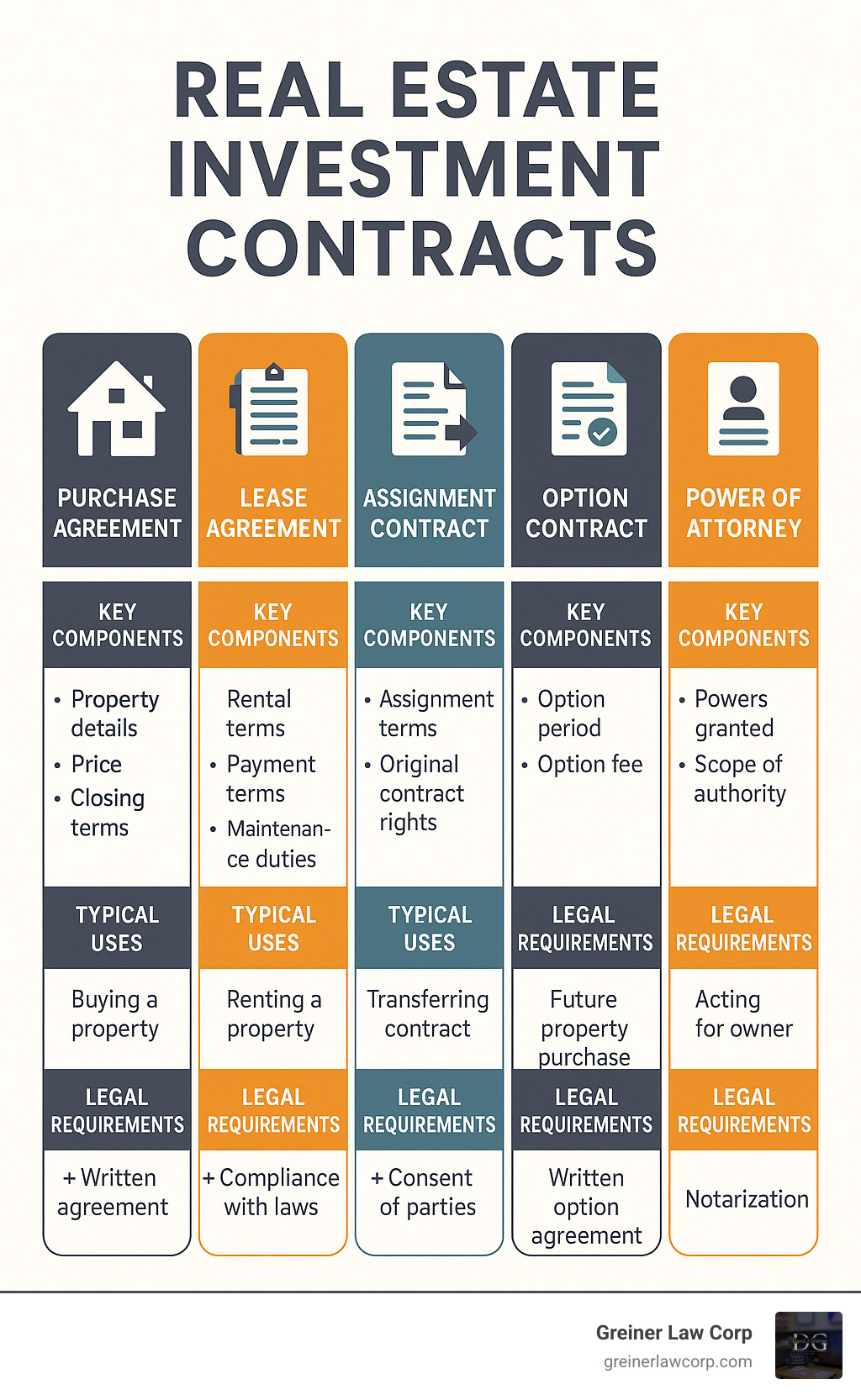
Real estate investment contracts are legally binding agreements between parties involved in property transactions that outline terms, conditions, and obligations. These contracts form the foundation of any real estate investment deal and typically include:
- Purchase agreements: Contracts between buyers and sellers for property acquisition
- Lease agreements: Documents outlining landlord-tenant terms for rental properties
- Assignment contracts: Agreements transferring contract rights to another party
- Option contracts: Arrangements securing the right to purchase property within a timeframe
- Power of attorney: Legal authorization for someone to act on the property owner’s behalf
For real estate investors, understanding these contracts isn’t just about legal compliance—it’s about protecting your investment and ensuring all parties fulfill their obligations.
Navigating real estate contracts can feel like reading a foreign language for first-time investors. These documents contain specific legal terminology, contingencies, and obligations that directly impact your investment’s success or failure.
As a business-minded investor, you need contracts that both protect your interests and facilitate your goals—not documents filled with ambiguous language that could lead to disputes down the road.
I’m David Greiner, Esq., and having served as general counsel for numerous businesses with significant real estate holdings, I’ve drafted and reviewed hundreds of real estate investment contracts to protect my clients’ interests while ensuring their business objectives remain the priority.
Real estate investment contracts terms made easy:
– contract for sale of real estate
– property settlement agreement
– real estate closing process
Real Estate Investment Contracts 101
Let’s explain what these contracts actually are. Real estate investment contracts are formal written agreements that spell out all the terms and conditions when you’re buying, selling, or otherwise dealing with property. They’re not just a good idea—they’re required by law across the United States, and they need signatures from everyone involved to be enforceable. Think of them as your safety net if things go sideways and someone doesn’t hold up their end of the bargain.
These contracts fall under what’s called the Statute of Frauds, a fancy legal term that basically means certain important agreements (like those involving real estate) must be in writing. You can’t just shake hands and call it a day when property is changing hands.
For your real estate investment contract to actually work, it needs several key ingredients:
Your contract must show that everyone intended to create legal relations—not just have a friendly chat about maybe doing business someday. All parties need to have the legal capacity to sign (sorry, no contracts with minors or those who lack mental capacity). There needs to be a clear offer from one side and a clear acceptance from the other. Something valuable must be exchanged—typically money for property rights, which lawyers call “consideration.” The terms need to be specific enough that everyone understands exactly what they’re giving and getting. And of course, it needs to spell out how and when payment will happen.
Good news for the digitally inclined: many real estate investment contracts can now be signed electronically, thanks to laws like the Electronic Signatures in Global and National Commerce Act (E-SIGN) and state-specific laws like California’s Uniform Electronic Transactions Act. Your digital signature can be just as binding as pen and paper.
What Makes a Contract Legally Binding?
For your real estate investment contract to stand up in court, it needs four essential elements:
First, there must be a clear offer and acceptance. Typically, a buyer makes an offer outlining their terms for purchasing the property. If the seller accepts without changing anything, we have a deal. But if the seller comes back with changes (like a higher price), that’s a counteroffer, not an acceptance, and the negotiation continues.
Second, there must be consideration—something valuable exchanged between parties. Usually this is money, but it could be other things of value. This consideration is what separates a legal contract from just a promise or favor.
Third, there must be a “meeting of minds”—both parties need to understand and agree to the same terms. If you think you’re buying the house with all the furniture included, but the seller thinks they’re keeping the antique dining set, you don’t have a true meeting of minds.
Finally, real estate contracts must be in writing. The Statute of Frauds, which has roots going back to 1677 in England, requires written documentation for real estate transactions to prevent fraud and misunderstandings.
Missing any of these elements could leave you with an unenforceable agreement and potentially facing a Real Estate Breach of Contract situation with limited options for remedy.
How Real Estate Investment Contracts Differ from Stock or NFT Deals
Real estate investment contracts operate in a different world compared to stocks or digital assets like NFTs:
Real estate deals are highly personalized transactions between specific parties, while stock trades happen on regulated exchanges with standardized terms. When you buy 100 shares of Apple, you get the same thing as everyone else buying Apple that day. But when you buy a Victorian home in San Francisco, that contract is unique to that specific property.

The customization level is dramatically different. Real estate contracts can be custom to include all sorts of conditions—maybe you want the seller to fix the roof before closing, or perhaps you need a contingency allowing you to back out if your financing falls through. Stock purchases don’t come with these customizable terms.
The regulatory frameworks also differ significantly. Real estate primarily falls under state property laws, while securities are governed by the Securities Act of 1933 and related federal regulations.
There’s also something called the Howey Test, established in SEC v. W.J. Howey Co, which determines whether a transaction qualifies as an “investment contract” (and thus a security). This test looks at whether there’s an investment of money in a common enterprise with profits expected primarily from others’ efforts.
Finally, transferability varies greatly. Stock ownership can change hands in seconds electronically, while real estate transfers require deed recording and often weeks or months of closing procedures.
When Are Real Estate Investment Contracts Classified as Securities?
Sometimes your real estate investment contracts might actually be considered securities under the law. Here’s when that line gets crossed:
When multiple investors pool their money together—think Real Estate Investment Trusts (REITs) or property syndications where various people contribute funds toward a single property or portfolio.
When investors are primarily passive, expecting profits to come from other people’s work. If you’re buying a rental property that a management company will completely handle while you just collect checks, this might qualify.
When there’s a “common enterprise” where the success of your investment depends heavily on the expertise of the promoter or a third party managing the property.
When the property is marketed based on potential investment returns rather than its use characteristics. If the sales pitch focuses on “guaranteed 12% returns” rather than “beautiful 3-bedroom with mountain views,” that’s a red flag.
If your real estate investment crosses into securities territory, it becomes subject to Securities and Exchange Commission (SEC) regulations, potentially requiring registration unless you qualify for an exemption. Common exemptions include Regulation D for private placements and Regulation A+ for smaller public offerings.
For California investors, this is particularly important since the state has its own securities laws (the Corporate Securities Law of 1968) that may apply alongside federal regulations. Getting this wrong can lead to significant legal headaches, so it’s worth getting proper advice before structuring complex real estate investments with multiple parties.
Understanding the fundamental nature of real estate investment contracts and when they might be classified as securities is essential to protecting your investments and staying on the right side of the law.
The Main Types of Real Estate Investment Contracts
When you’re diving into real estate investing, knowing which contract fits your strategy is like having the right key for the right door. Each type of real estate investment contract serves a unique purpose, and choosing the right one can make all the difference in your investment journey.

Purchase Agreements: The Backbone of Real Estate Investment Contracts
Think of purchase agreements as the workhorses of real estate investment contracts. They’re the documents that seal the deal when you’re buying property, spelling out exactly who’s giving what to whom and under what conditions.
Here in California, you’ll typically encounter three flavors of these agreements:
First, there are the standardized forms from the California Association of REALTORS® (CAR). These are like the comfort food of real estate contracts – familiar, reliable, and with built-in protections that keep both buyers and sellers safe.
Then you have general purchase agreements, which offer more flexibility for customization when you need something a bit more custom to your situation.
For those unique properties or complex deals (and let’s face it, some investments are wonderfully complex), you might need a fully customized property-specific agreement.
What makes a solid Real Estate Purchase Agreement tick? It needs to clearly identify the property with its legal description and address. The purchase price and how you’ll pay it must be crystal clear. Details about earnest money – how much you’re putting down to show you’re serious, who holds it, and what happens to it if things go sideways – are crucial too.
Good purchase agreements also include contingencies (those “if-then” clauses that protect you), a timeline for closing, required disclosures about the property’s condition, and of course, signatures from all parties involved.
Think of your purchase agreement as the foundation of your investment – and just like with a building, a shaky foundation leads to problems down the road.
Lease Agreements for Investment Properties
Once you own rental property, lease agreements become your new best friend. While purchase agreements help you acquire property, lease agreements govern the ongoing relationship between you and the folks paying your mortgage – your tenants.
A well-crafted lease agreement clearly spells out the length of the lease and any renewal options. It states exactly how much rent is due, when it’s due, and how it should be paid. It covers the security deposit amount and what might cause deductions when the tenant moves out.
The best lease agreements leave no room for confusion about who’s responsible for what maintenance. Is the tenant expected to change air filters and mow the lawn? Are you handling all repairs? Getting this in writing prevents those 2 AM “my toilet is running” calls when that’s something the tenant agreed to handle.
For investment properties specifically, you’ll want to pay special attention to subletting restrictions (because you want to control who’s actually living in your property), assignment prohibitions (to prevent tenants from transferring their lease to someone you haven’t vetted), property inspection rights (so you can keep an eye on your investment), and insurance requirements (protecting everyone involved).
Here in California, state law caps security deposits at two months’ rent for unfurnished units and has specific requirements for notice periods and tenant rights. Your lease needs to comply with these laws to be enforceable.
Assignment Contracts for Wholesalers
If you’ve dipped your toe into the wholesaling world, you’re probably familiar with assignment contracts. These specialized real estate investment contracts are like the middlemen of real estate – they allow you to transfer your rights under a purchase contract to someone else, usually for a fee that goes straight into your pocket.
The beauty of an Assignment Contracts Real Estate agreement is that it transfers the right to purchase without transferring the property itself. You find a good deal, get it under contract, then find an end buyer who’s willing to step into your shoes and pay you for the privilege.
For an assignment contract to work properly, you need to identify the original purchase agreement being transferred, specify the assignment fee (your profit), clarify who’s responsible for what (earnest money, closing costs, etc.), and include representations that the original contract is valid and assignable.
One important thing to remember: assignment contracts only work if the original purchase agreement allows for assignment. Some sellers specifically prohibit assignment or require their approval first, so always check before assuming you can wholesale a property.
Think of assignment contracts as the “finder’s fee” formalized into a legal document – you’re being compensated for connecting a motivated seller with an end buyer ready to close.
Option Contracts: Locking in Tomorrow’s Deal Today
Option contracts are like putting a property on layaway – you pay a little now for the right to buy it later at a price you agree on today. This type of real estate investment contract gives you tremendous flexibility while limiting your downside risk.
With an Option Contract Real Estate agreement, you pay what’s called an option premium – typically 1-5% of the property value – which is usually non-refundable. In exchange, you get the right (but not the obligation) to purchase the property at the predetermined “strike price” within a specified timeframe.
Option contracts shine in several scenarios: when you need time to secure financing or permits, when you’re eyeing property with development potential but uncertain approval timelines, in rising markets where today’s price might be a steal tomorrow, or when you’re testing new markets and want to limit your risk.
Imagine paying a $25,000 option premium for the right to purchase a $2 million property within six months. You now have time to line up your financing, complete your due diligence, or even find a buyer willing to pay more than your strike price – all without being on the hook for the full purchase amount if something goes wrong.
It’s like having an insurance policy on a great deal – you pay a premium to make sure no one else can snatch it while you get your ducks in a row.
Powers of Attorney & “Subject-To” Deals
Powers of attorney and “subject-to” agreements are the specialized tools in your real estate investment contracts toolkit – not used every day, but invaluable in the right situations.
A Power of Attorney (POA) is like having a stunt double for real estate transactions. It authorizes someone to act on behalf of a property owner, signing documents and making decisions. This can be incredibly useful when investment partners can’t attend closings, when you’re handling properties for out-of-state owners, when managing investments for someone who’s incapacitated, or when you need to streamline closings for multiple properties.
A proper POA needs to specify exactly what powers you’re granting – is it just for one specific transaction, or broader authority? How long does it last? When does it take effect? Being precise here prevents headaches later.
“Subject-To” agreements, on the other hand, are a bit like adopting someone else’s mortgage. You purchase the property while leaving the original loan in place. The seller transfers the title to you, but their name stays on the mortgage, and you agree to make the payments.
This approach can be particularly valuable when you find properties with interest rates lower than current market rates, when helping homeowners facing foreclosure (where time is of the essence), when your credit isn’t quite ready for prime time, or when you want to minimize closing costs by avoiding loan origination fees.
The key components of a “subject-to” deal include acknowledging that the original loan stays in the seller’s name, your promise to make payments on that loan, what happens if you don’t make those payments, and disclosure that the lender might have the right to call the loan due (through what’s called a “due-on-sale” clause).
Both of these contract types require careful legal navigation – they’re powerful tools, but like any power tool, you want to make sure you’re using them correctly to avoid injury to your investment portfolio.
Must-Have Clauses, Contingencies, and Profit-Sharing Terms
Well-crafted real estate investment contracts include specific clauses and contingencies that protect your interests and define how profits and losses will be shared among partners. Think of these clauses as your safety net – they can mean the difference between a smooth transaction and a costly legal battle.

Every solid investment contract should include several essential provisions. Earnest money provisions specify the good faith deposit amount, who holds it, and the conditions for getting it back. A financing contingency gives you an exit if you can’t secure reasonable loan terms. The inspection contingency allows you to thoroughly examine the property and walk away if you find deal-breaking issues.
Other crucial protections include the title contingency ensuring clean ownership can be transferred, and an appraisal contingency protecting you from overpaying if the property doesn’t appraise at the purchase price. A specific performance clause gives you the right to force completion of the contract if the other party tries to back out.
Don’t overlook default remedies that outline what happens if either party fails to perform, and an attorney fee provision detailing who pays legal costs in disputes. Many savvy investors also include mediation/arbitration requirements to avoid costly court battles, and a time-is-of-the-essence clause that makes deadlines firm and enforceable.
Contingencies That Protect Investors
Contingencies are your escape hatches in a real estate investment contract. They allow you to exit a deal without penalty when specific conditions aren’t met.
The inspection contingency is perhaps your most valuable protection. It gives you typically 7-14 days in California markets to thoroughly examine the property’s condition. If you find foundation issues, roof damage, or other costly problems, you can walk away with your earnest money or renegotiate terms.
A well-crafted financing contingency protects you if you can’t secure acceptable funding. I always recommend including specific parameters – for instance, making the deal contingent on obtaining a loan at or below 5% interest. Without this specificity, you might be stuck if rates suddenly jump.
If you’re relying on selling another property to fund your purchase, a sale-of-home contingency is essential. Similarly, an insurance contingency becomes crucial in areas prone to wildfires or floods, ensuring you can obtain affordable coverage before committing to the purchase.
Environmental issues can become expensive nightmares, which is why many of my clients include an environmental contingency protecting against findies like soil contamination or underground storage tanks. For development projects, contingencies might include obtaining specific zoning approvals or building permits necessary for your investment strategy to succeed.
Profit & Loss Distribution Models in Joint Ventures
When multiple investors partner on a deal, real estate investment contracts must clearly define how money flows. This is where many handshake deals fall apart, but thoughtful contracts create clarity from the beginning.
The simplest approach is pari-passu distribution, where returns flow proportionally to capital contributions. If you contribute 60% of the funds and your partner contributes 40%, profits and losses split accordingly. This straightforward approach works well for partnerships with similar risk tolerance and involvement.
For deals where one party provides most of the capital, a preferred return structure often makes more sense. The capital provider receives a priority return (often 8%) before other partners participate in profits. This acknowledges the capital provider’s risk while still creating upside for the operating partner.
When one partner brings sweat equity rather than cash, a promote/carried interest structure can align incentives beautifully. The operating partner receives a disproportionate share of profits after certain return thresholds are met, rewarding exceptional performance while protecting the capital partner’s initial investment.
More sophisticated deals often employ a waterfall distribution – a tiered structure that changes profit splits at different return thresholds. A typical waterfall might return all capital first, then pay an 8% preferred return, then split the next 12% return 80/20, with returns above 20% split 70/30.
Don’t forget to address capital calls – what happens if the project needs more money? Options include mandatory contributions with penalties, ownership dilution for non-participating partners, or treating additional contributions as loans with priority returns.
Dispute Resolution & Default Remedies
Even with the best intentions, disputes happen. Smart real estate investment contracts include clear paths for resolution that save time, money, and relationships.
Mediation offers a non-binding process where a neutral third party helps find common ground. Many California contracts require attempting mediation before pursuing other remedies – and for good reason. It’s typically faster, cheaper, and less adversarial than alternatives.
When mediation isn’t enough, arbitration provides a binding decision without the expense and time of court litigation. The contract should specify whether arbitration is mandatory and who bears the cost.
Your contract should clearly state which state’s laws govern the agreement and where disputes will be heard. For our California clients, we typically specify California law and venue in the county where the property is located to avoid costly travel for proceedings.
Default remedies should clearly outline consequences for non-performance. If a seller defaults, the buyer might seek specific performance (court-ordered completion of the sale), return of earnest money plus damages, or record a lis pendens (notice of pending litigation) to cloud the title while the dispute resolves.
If a buyer defaults, typical remedies include the seller retaining earnest money as liquidated damages, seeking actual damages if they exceed the earnest money, or simply releasing the property for sale to other buyers.
Standard Templates vs Custom-Drafted Real Estate Investment Contracts
The temptation to save money with standardized templates is understandable, but the old adage often proves true: “penny wise, pound foolish.”
Standard templates work well for simple, straightforward transactions. They’re cost-effective, contain industry-accepted language, provide consistency across multiple deals, and include basic protections for both parties. For a straightforward single-family home purchase, a standard form with a few modifications might serve you perfectly well.
However, custom-drafted contracts shine for complex investments. They’re custom to your specific strategy, address unique property characteristics, can include specialized profit-sharing models, and provide improved protection for complicated transactions. The upfront investment in proper legal drafting often pays dividends by preventing costly disputes or unintended consequences.
Standard forms may not adequately address unusual property conditions, complex financing arrangements, multi-phase development plans, creative profit-sharing structures, or exit strategies for partnerships. I’ve seen investors use templates for Unilateral Contract Real Estate deals only to face significant challenges when unexpected situations arose that their generic contracts didn’t address.
Even when using templates, having an attorney review the document before signing can identify gaps and suggest critical modifications to protect your interests. Think of it as insurance – a small investment upfront that can prevent major losses down the road.
Drafting, Negotiating & Staying Compliant
Creating effective real estate investment contracts involves more than just filling in blanks on a form. The process requires careful attention to drafting, negotiation strategy, and compliance with applicable laws.

Who Should Draft and Review Your Contract?
When it comes to real estate investment contracts, who handles the drafting can significantly impact your protection level and success.
For complex or high-value investments, a licensed attorney provides the greatest peace of mind. Here in California, I’ve seen how attorney-drafted contracts can save investors from costly pitfalls, especially with joint ventures, development projects, or properties with unusual characteristics. An experienced real estate attorney doesn’t just fill in templates—they craft provisions that align with your specific investment goals.
Many standard transactions begin with real estate agents preparing offers using state-approved forms. While this works for straightforward deals, agents can’t provide legal advice. I’ve worked with many clients who initially used agent-prepared contracts only to find critical gaps in their protection.
Title companies often provide basic templates but focus primarily on ensuring clear title transfer rather than protecting your investment strategy. They’re an important part of the process, but not a substitute for legal expertise.
Don’t forget to involve your CPA or tax professional in reviewing profit-sharing structures. The tax implications of how you structure your deal can dramatically impact your bottom line.
The DIY approach might seem cost-effective, but as I often tell my clients, “Downloading generic real estate investing contracts without legal review is like performing surgery after watching a YouTube tutorial—technically possible, but rarely a good idea.”
At Greiner Law Corp, we recommend a balanced approach: use standard forms for simple transactions, but engage an attorney to review and customize key provisions that directly affect your investment strategy and risk profile.
Best Practices for Negotiation & Risk Mitigation
Successful negotiation of real estate investment contracts begins long before you sit down at the closing table.
Start with comprehensive due diligence. I always advise my clients to thoroughly investigate property condition, title issues, zoning requirements, and environmental concerns before finalizing any contract. A small investment in due diligence can prevent major headaches later. Create a checklist specific to your investment type and work through it methodically.
Establish clear, realistic deadlines for each phase of the transaction. In California’s competitive markets, timing can make or break a deal. Make sure your contract specifies firm dates for due diligence completion, financing approval, and closing. Include provisions for reasonable extensions, but avoid open-ended timelines that can leave you in limbo.
Protect your earnest money by using licensed escrow companies with clearly documented release conditions. I’ve seen too many investors lose substantial deposits because their contracts didn’t adequately specify when and how funds could be released. Be especially careful with large deposits in seller’s markets.
Use well-crafted addenda and exhibits to address property-specific concerns. These supplemental documents let you customize standard contracts to fit your unique situation without rewriting the entire agreement. For example, if you’re purchasing a property with existing tenants, include an addendum specifically addressing lease transfers and security deposits.
Document everything. Keep records of all communications, contract drafts, inspection reports, and disclosures. In the event of a dispute, this documentation can prove invaluable. I recommend creating a dedicated digital folder for each transaction where all relevant documents are stored.
At Greiner Law Corp, we provide our clients with Real Estate Legal Advice California that helps them steer these complexities while staying focused on their business objectives.
State & Federal Regulatory Traps to Avoid
Even experienced investors can stumble into regulatory pitfalls when drafting real estate investment contracts. Here are some common traps I’ve helped clients steer:
Usury laws in California strictly cap interest rates on certain loans. If you’re providing seller financing or structuring creative funding arrangements, be careful not to cross these thresholds. Non-exempt lenders charging excessive rates may face severe penalties, including forfeiture of all interest. I’ve seen well-intentioned investors lose thousands by inadvertently violating these regulations.
Securities registration requirements can apply to some real estate investments, particularly syndicated deals with multiple passive investors. The line between a simple joint venture and a security offering can be surprisingly thin. Failure to properly register or qualify for exemptions can result in investor rescission rights and potential regulatory action. When in doubt, consult with a securities attorney before bringing in multiple investors.
California has extensive disclosure requirements for property sales. Sellers must provide numerous documents including Natural Hazard Disclosure Statements, Transfer Disclosure Statements, and for pre-1978 construction, Lead-Based Paint Disclosures. Missing even one required disclosure can create liability and give buyers grounds to cancel transactions.
Zoning and land use regulations can derail your investment strategy if not properly addressed in your contract. Always verify that your intended use complies with current zoning, and include contingencies for obtaining necessary permits. I’ve worked with investors who purchased properties only to find they couldn’t implement their planned use without expensive variances.
Investment strategies targeting specific demographics must be carefully structured to avoid fair housing violations. The law prohibits discrimination based on protected characteristics, and seemingly innocent marketing or tenant selection practices can create liability.
If you’re considering a 1031 exchange, your contract must accommodate the strict timelines required (45 days for identification, 180 days for closing). Missing these deadlines by even a day can disqualify the entire exchange and trigger significant tax consequences.
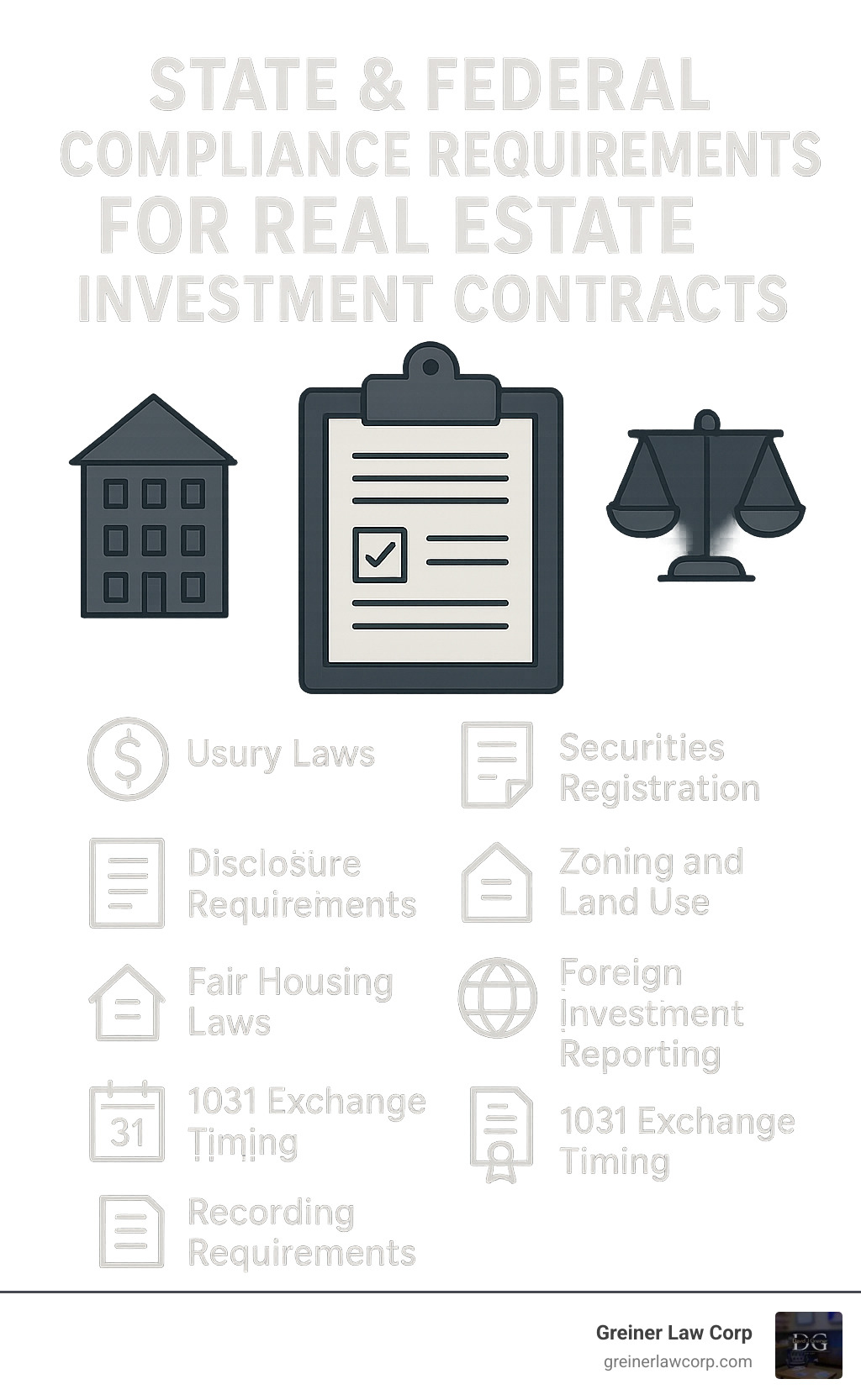
Proper document recording is essential to protect your interests against third parties. In California, this typically occurs at the county level where the property is located. Unrecorded documents may be valid between the original parties but offer little protection against subsequent purchasers or creditors.
The regulatory landscape for real estate investments is complex, but with proper guidance, you can steer it successfully while achieving your investment goals. At Greiner Law, we focus on keeping our clients compliant without losing sight of their business objectives—because the best contract is one that both protects you legally and helps you achieve your investment vision.
Frequently Asked Questions about Real Estate Investment Contracts
What is the difference between a purchase agreement, lease, assignment and power of attorney?
When you’re diving into real estate investing, understanding the different types of contracts is like learning the basic tools in your toolbox – each serves a unique purpose.
Purchase agreements are your workhorse contracts – they transfer actual ownership from the seller to you as the buyer. Think of these as the complete package deal: they spell out everything from the price you’ll pay to how you’ll finance it, what contingencies need to be met, and when you’ll close the deal. The end result? The property title moves from their name to yours.
Lease agreements, on the other hand, don’t make you an owner – they make you a landlord. These contracts establish the landlord-tenant relationship, giving someone the right to possess and use your property for a specific time period in exchange for those monthly rent checks hitting your account. You keep the title throughout the arrangement.
I often explain assignment contracts to my clients as “selling your spot in line.” These transfer your rights under an existing contract to someone else. This is the foundation of real estate wholesaling – you get a property under contract and then “assign” your right to purchase it to another buyer for a fee. The key distinction is you’re transferring contract rights, not the actual property title.
Power of attorney documents work differently altogether. They’re about delegation rather than transfer – you’re authorizing someone to act as your legal representative in real estate matters. They can sign documents and make decisions on your behalf, but they don’t get ownership or possession rights to your property.
The simplest way to remember the difference? Purchase agreements transfer title, leases transfer possession, assignments transfer contract rights, and powers of attorney transfer decision-making authority.
How do option contracts work, and when should investors use them?
Option contracts are like putting a property on hold while you decide whether to buy it. They give you the right—but importantly, not the obligation—to purchase at a preset price within a specific timeframe.
Here’s the basic process: You pay the seller a non-refundable option premium (typically between 1-5% of the property value). In exchange, they agree not to sell to anyone else during your option period. When you’re ready, you can exercise your option by notifying the seller and proceeding with the purchase at your agreed price. If you decide against it, you walk away, losing only your premium.
Option contracts shine in several scenarios that smart investors regularly encounter:
Development opportunities often require time for securing permits, zoning changes, or entitlements before you can be certain the project is viable. An option gives you this time without committing to the full purchase.
When you need to conduct deeper market testing or feasibility studies, options provide breathing room while keeping the property secured.
Complex financing arrangements sometimes take time to assemble. Perhaps you’re bringing in partners or applying for special loan programs – an option keeps the property locked down during this process.
For speculative opportunities where you anticipate significant near-term appreciation, options let you lock in today’s price while the market catches up.
When you want to limit your downside risk while maintaining exposure to potential gains, options cap your loss at the premium amount.
A real-world example I’ve seen work well: An investor client paid $25,000 for a six-month option on a $2 million commercial property. This gave her time to secure an anchor tenant and arrange financing before deciding to exercise the option – which she did, after confirming the property would be cash-flow positive from day one.
When should an investor consult a lawyer or accountant about a contract?
There’s an old saying in real estate: “An ounce of prevention is worth a pound of cure.” This couldn’t be more true when it comes to knowing when to bring in the professionals.
You should reach for the phone to call a lawyer when:
– Your transaction involves significant money (generally over $100,000)
– You’re entering into a joint venture or partnership arrangement
– The property has anything unusual about it – environmental concerns, title problems, or unusual restrictions
– You’re getting creative with financing terms
– The deal involves a 1031 exchange to defer taxes
– You’re pooling money from multiple investors in a syndication
– Your contract contains terms that seem unusual or that you don’t fully understand
– You’re investing in an unfamiliar location with different laws
– The other party has their own attorney (never bring a knife to a gunfight!)
– Your transaction crosses state lines, triggering multiple jurisdictions
Similarly, it’s time to consult an accountant when:
– You need to structure profit-sharing arrangements between partners
– You’re setting up new entities for holding real estate
– You want to plan tax-efficient exit strategies
– You need to analyze potential depreciation benefits
– You’re considering a 1031 exchange to defer capital gains
– You need professional eyes on your cash flow projections
– You’re weighing different financing options and their tax impacts
– You want to maximize potential tax deductions
– You’re planning how to handle potential capital gains
– You need guidance on navigating passive activity rules
At Greiner Law Corp, we’ve found that our most successful clients take what we call the “team approach” – bringing both legal and financial professionals to the table early in the transaction process. While this might seem like an added expense upfront, it’s almost always more affordable than trying to fix problems after contracts are signed. Think of it as insurance for your investment – a small premium paid now can prevent major losses later.
The most expensive contract is usually the one you draft yourself without professional guidance. Not because the contract itself costs more, but because of what it might cost you down the road.
Conclusion & Next Steps
The journey through real estate investment contracts reveals just how fundamental these documents are to your success as a property investor. Whether you’re working with straightforward purchase agreements or navigating the complexities of joint ventures, these contracts set the stage for everything that follows.
Throughout this guide, we’ve seen that understanding these agreements isn’t just about legal compliance—it’s about creating a solid foundation for profitable investments while protecting yourself from unnecessary risks.
When I work with clients at Greiner Law Corp, I always emphasize a few critical points about real estate investment contracts that bear repeating:
First, match your contract type to your investment strategy. A wholesaler needs different protections than a buy-and-hold investor. The right contract structure makes your business model work smoothly instead of creating friction.
Second, never underestimate the power of well-crafted contingencies. These aren’t just legal technicalities—they’re your safety nets. That inspection contingency might save you from a six-figure repair bill, while a financing contingency gives you an exit ramp if market rates suddenly spike.
Third, when partners are involved, crystal-clear profit-sharing terms prevent painful conversations later. I’ve seen decades-long friendships end over ambiguous language about who gets what and when.
Fourth, regulatory compliance isn’t optional. California’s real estate landscape is particularly regulation-heavy, and what you don’t know absolutely can hurt you. Those disclosure requirements and securities regulations exist for good reasons.
Finally, know when to bring in the professionals. The most successful investors I work with understand that strategic consultation isn’t an expense—it’s an investment that often pays for itself many times over.
At Greiner Law Corp, we pride ourselves on understanding that you’re not just looking for legal documents. You need business-minded strategies that actually help you achieve your goals while managing risk in a way that fits your personal comfort level. Our approach always starts with understanding what you’re trying to accomplish, then building legal solutions that support those objectives.
Whether you’re investing in a starter home in Victorville, a strip mall in Riverside, a development opportunity in San Bernardino, or a luxury property in Los Angeles, our team knows how to steer California’s complex real estate laws to keep your investments protected.
Ready to ensure your next investment has the solid legal foundation it deserves? Visit our page on contract for sale of real estate or reach out to schedule a consultation. We’re here to help you build a thriving real estate portfolio with contracts that don’t just protect you—they actively advance your business goals.