Why Understanding a Rent to Own Contract is Critical for Real Estate Transactions
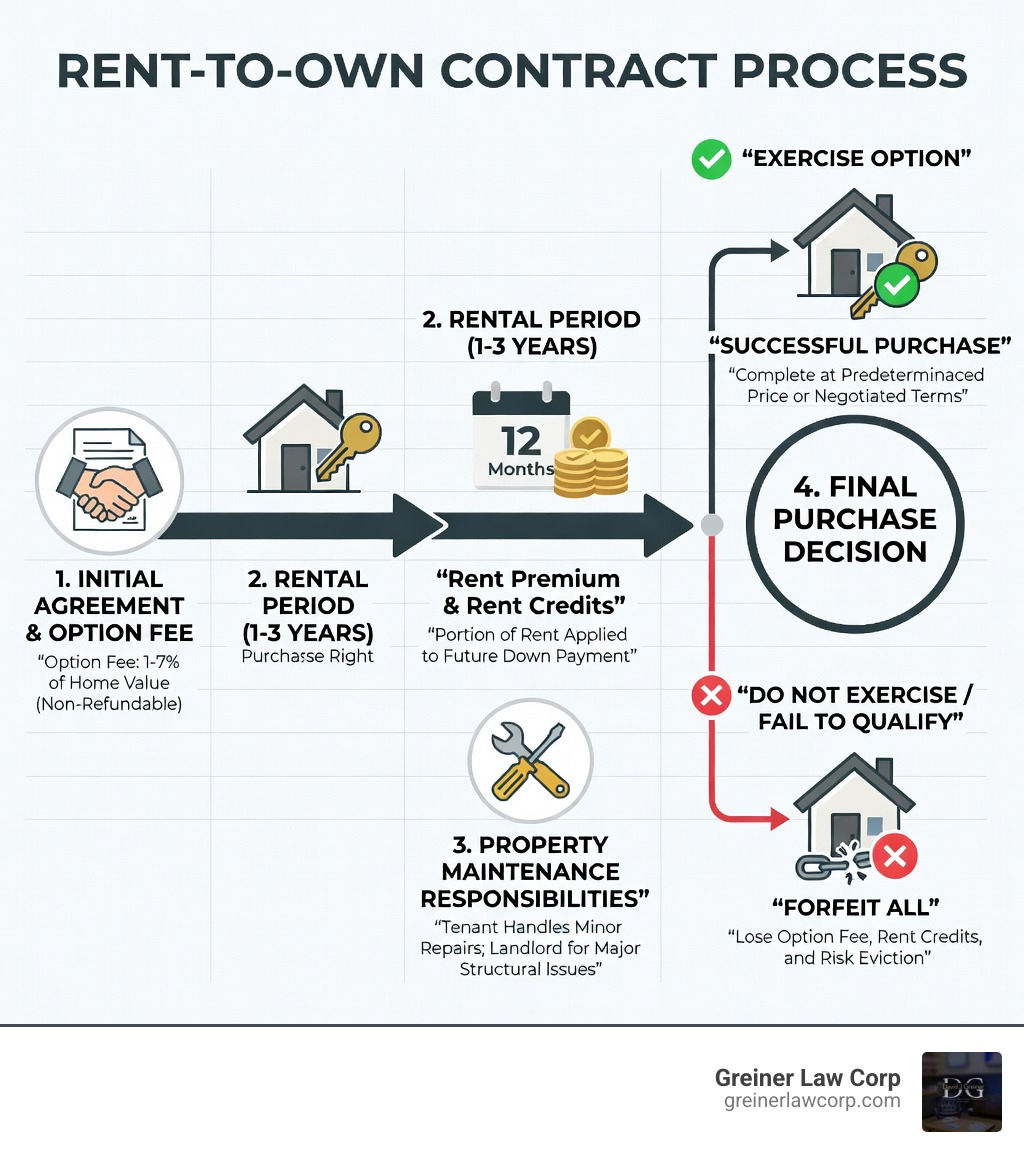
A rent to own contract is an alternative path to homeownership that combines a traditional lease with an option or obligation to purchase the property at a future date. These agreements typically involve an upfront option fee (usually 1-7% of the home's price), higher monthly rent payments with a portion credited toward the down payment, and a predetermined purchase price or future negotiation terms.
Key Components of a Rent to Own Contract:
- Option Fee - A non-refundable upfront payment of 1-7% of the home's value that secures your right to buy
- Rent Premium - Monthly payments above market rent, with a portion credited toward your future down payment
- Purchase Price - Either locked in at signing or negotiated later based on market conditions
- Contract Type - Lease-option (choice to buy) or lease-purchase (obligation to buy)
- Time Period - Typically 1-3 years, sometimes up to 7 years
These contracts appeal to buyers who cannot secure traditional financing immediately but want to work toward homeownership. However, they carry significant risks. If you fail to exercise your purchase option or default on the lease, you typically forfeit all fees and rent credits—sometimes tens of thousands of dollars. You can also face eviction with as little as 14 days' notice for missed payments, with no second chances.
The stakes are high. Research shows that few rent-to-own deals are ever completed, and costs for similar consumer agreements on tangible items often run 2-3 times higher than the product's actual value. Many agreements shift repair responsibilities to tenants contrary to standard landlord-tenant law, and some may constitute predatory lending practices depending on your state's regulations.
I'm David Greiner, Esq., and through years of transactional law practice and business leadership, I've guided clients through complex real estate contracts and buy-sell agreements with a focus on achieving their goals rather than creating obstacles. Understanding the legal nuances of a rent to own contract is essential to protecting your investment and ensuring the path to ownership doesn't become a financial trap.
Quick rent to own contract terms:
Understanding the Mechanics of a Rent to Own Contract

To navigate alternative home financing, we must first peel back the layers of how these agreements are structured. At its core, a rent to own contract is a hybrid legal instrument. It isn't just a lease, and it isn't quite a purchase agreement—it is both, running simultaneously.
Most of these arrangements consist of two distinct parts: a standard residential lease and an option to purchase. In California, where real estate values in areas like Victorville, Riverside, and San Bernardino can be high, the way these two documents interact determines your legal standing. While you are living in the home, you are technically a tenant. The title remains with the landlord. You only become an owner once you "exercise" your option and successfully close the sale.
For a deeper dive into how these documents should be structured to protect your interests, you can explore our guide on real estate contracts. It is also helpful to understand the basics of rent-to-own agreements from a consumer protection standpoint to ensure the terms you are being offered are within industry norms.
Defining the Lease-Option vs. Lease-Purchase
One of the most critical distinctions we emphasize to our clients is the difference between having a choice and having an obligation.
- Lease-Option Contract: This gives you the right to buy the home at the end of the lease term, but you are not legally forced to do so. If you decide the house isn't for you, or if you still can't get a mortgage, you can walk away (though you will lose your option fee and rent premiums).
- Lease-Purchase Contract: This is a much more binding commitment. In a lease-purchase, you are often legally obligated to buy the property at the end of the term. If you cannot complete the purchase, you could be sued for breach of contract.
How the Real Estate Process Typically Works
The lifecycle of a rent to own contract usually follows a specific timeline. It begins with the negotiation of the purchase price and the payment of the upfront option fee. Once you move in, you enter the "rental period," which typically lasts between one and three years, though some agreements in California may extend up to seven years.
During this time, you pay your monthly rent plus a "premium" that goes into an escrow account. When the term is nearing its end—usually 90 days before the expiration—you must deliver a written notice of intent to exercise the option. If you qualify for a mortgage, the accumulated credits are applied to your down payment, and the title transfer occurs just like a traditional sale. We provide a detailed breakdown of this transition in our article on rent-to-own real estate and how lease-option agreements work.
Financial Components of a Rent to Own Contract
The financial structure of a rent to own contract is significantly different from a standard rental agreement. It requires a larger upfront investment and higher monthly out-of-pocket costs. Understanding where every dollar goes is the only way to ensure you are actually building equity rather than just overpaying for a rental.
Upfront Option Fees and Rent Credits
The "Option Consideration" is the first major hurdle. In the California market, this fee is normally around 2% of the agreed-upon price, but it can range anywhere from 1% to 7%. For a $500,000 home in Riverside, a 2% fee means $10,000 paid upfront. This money is almost always non-refundable.
In addition to the fee, you will likely pay a rent premium. For example, if fair market rent is $2,500, the landlord might charge you $3,000. The extra $500 is your "rent credit." These funds should be held in a trust account. If you buy the house, that money becomes part of your down payment. If you don't buy the house, the landlord typically keeps it as liquidated damages. This is why it’s vital to ensure the landlord is actually setting these funds aside and providing you with annual statements.
Determining the Future Purchase Price
How much will the house cost in three years? There are two ways a rent to own contract handles this:
- Locked-in Price: You agree on the price the day you sign the contract. This is a gamble. If property values in Los Angeles skyrocket, you get a bargain. If the market crashes, you might be contracted to pay $600,000 for a house now worth $500,000.
- Future Appraisal: The price is determined by a professional appraisal at the time you decide to buy. This is often safer for the buyer but offers less "upside" potential.
Locking in a price without a clear understanding of market trends is one of the significant drawbacks to rent to own agreements, as you risk being unable to secure a mortgage if the bank’s appraisal comes in lower than your contracted price.
Risks, Benefits, and the Ideal Candidate
Is a rent to own contract a shortcut to the American Dream or a financial minefield? The answer depends entirely on your specific financial situation and the quality of the contract you sign.
Benefits for Prospective Homebuyers
For many in San Bernardino or Victorville, these agreements offer a "bridge" to homeownership. The primary benefit is the ability to rent to own and enjoy the advantages for buyers, such as:
- Credit Repair Time: You can live in the home while working with a credit counselor to boost your score.
- Forced Savings: The rent premium acts as a mandatory savings plan for your down payment.
- Trial Period: You get to "test drive" the neighborhood, the neighbors, and the house itself before committing to a 30-year mortgage.
- Price Protection: If you lock in a price in a rising market, you gain instant equity the day you close.
Significant Risks and Potential Drawbacks
We would be remiss if we didn't highlight the "dark side" of these deals. The statistics are sobering: a vast majority of rent-to-own tenants never actually end up buying the home. Common drawbacks to rent to own agreements include:
- Forfeiture of Funds: If you are even one day late on rent, many contracts state that your purchase option is "null and void." You lose your option fee and all rent credits.
- Maintenance Burdens: Unlike a standard lease where the landlord fixes the leaky roof, many rent to own contract terms shift all repair responsibilities to the tenant. You could spend $10,000 on a new HVAC system for a house you don't even own yet.
- Eviction Risk: In some jurisdictions, if you default, you can be evicted on 14 days' notice, losing your "equity" instantly.
- Predatory Sellers: Some sellers target "credit-challenged" buyers with no intention of ever selling, relying on the buyer to default so they can keep the option fee and find a new "tenant-buyer."
Essential Due Diligence and Legal Protections
Before you sign a rent to own contract, you must treat the process exactly as if you were buying the house today. Because, in a legal sense, you are making the most important decisions of the purchase right now.
Legal Considerations and the Role of Counsel
In California, the law can sometimes view a rent to own contract as an "equitable mortgage." This means that if you have paid a significant amount toward the purchase, a judge might rule that the landlord cannot simply evict you; they must go through a formal foreclosure process. However, relying on a judge's interpretation is a risky strategy.
It is much safer to have a professional review. Our team specializes in the California real estate contract guide, ensuring that your agreement complies with state disclosure laws. Landlords are still required to disclose known defects (like mold or lead paint), even in a rent-to-own scenario.
Necessary Due Diligence Steps Before Signing
Never sign based on a "handshake" or a template you found online. You must perform:
- A Professional Home Inspection: Do not inherit the seller's problems.
- An Appraisal: Ensure the "locked-in" price is actually fair.
- A Title Search: You must run a title search to ensure the seller actually owns the property and that there are no hidden tax liens or judgments that would prevent the sale in three years.
- Vetting the Seller: Is the seller current on their mortgage? If the landlord gets foreclosed on, your rent to own contract could be wiped out, and your option fee gone forever.
Frequently Asked Questions about a Rent to Own Contract
How do real estate agreements differ from retail rent-to-own?
It is important not to confuse a home rent to own contract with retail plans for furniture or electronics. In retail rent-to-own, the long-term costs are often 2 to 3 times higher than the product's value. While real estate rent-to-own involves higher monthly costs, the goal is to build a down payment for a real asset. Retail rent-to-own is a high-cost consumer lease; real estate rent-to-own is a structured path to property ownership.
Who is the ideal candidate for this arrangement?
The ideal candidate is someone who is 1 to 3 years away from qualifying for a mortgage. Perhaps you have a solid income but a recent bankruptcy, or you are self-employed and need a few more years of tax returns to satisfy a lender. If you are more than three years away from qualifying, the risk of the contract expiring before you are ready is too high.
What happens if I default on the lease?
In most cases, a default—such as a missed rent payment or a lease violation (like unapproved pets)—makes the purchase option null and void. The landlord retains the option fee and rent credits as "liquidated damages." You may then be evicted as a standard tenant.
Conclusion
At Greiner Law Corp, we understand that for many families in Victorville, Riverside, and Los Angeles, a rent to own contract represents a unique opportunity to secure a future in a competitive market. However, these are not "simple" agreements. They are complex legal documents that require a business-minded approach to risk management.
Whether you are looking into residential options or considering how to lease-to-own a commercial building, our priority is to ensure your contract is a ladder to success, not a trap for your hard-earned savings. David Greiner and our experienced team are here to help you navigate these waters, ensuring that your path to homeownership is legally sound and aligned with your long-term goals.
For more information on navigating California real estate law, explore our resources: