Why Business Asset Protection Should Be Your Top Priority
Protecting business assets is essential for safeguarding your hard-earned wealth from lawsuits, creditors, and financial disasters. Without proper protection, a single lawsuit or business failure can wipe out both your business and personal wealth, including your home, savings, and retirement accounts.
Quick Answer: The Essential Asset Protection Strategies
- Choose the right business structure (LLC, S Corp, or C Corp) to create legal separation.
- Maintain the corporate veil by keeping personal and business finances separate.
- Get comprehensive insurance coverage, including general liability, professional liability, and umbrella policies.
- Use trusts and proper asset titling to shield valuable assets from creditors.
- Implement strong contracts with non-compete and confidentiality clauses.
- Plan proactively—it’s often too late once a legal or debt problem already exists.
The risks are real. Lawsuits are common, and events like divorce, disasters, or data breaches can put your assets on the line. As one expert puts it: “The time to protect your business is well before a lawsuit or unpaid debt becomes a problem.”
Operating as a sole proprietorship is especially risky, as there’s no legal separation between your personal and business assets. Creditors can seize everything you own to satisfy business debts.
I’m David Greiner, Esq. My dual experience as president of Greiner Buick GMC and a transactional law attorney has shown me how proper protecting business assets planning can mean the difference between financial security and devastating loss.
Understanding the Threats to Your Business
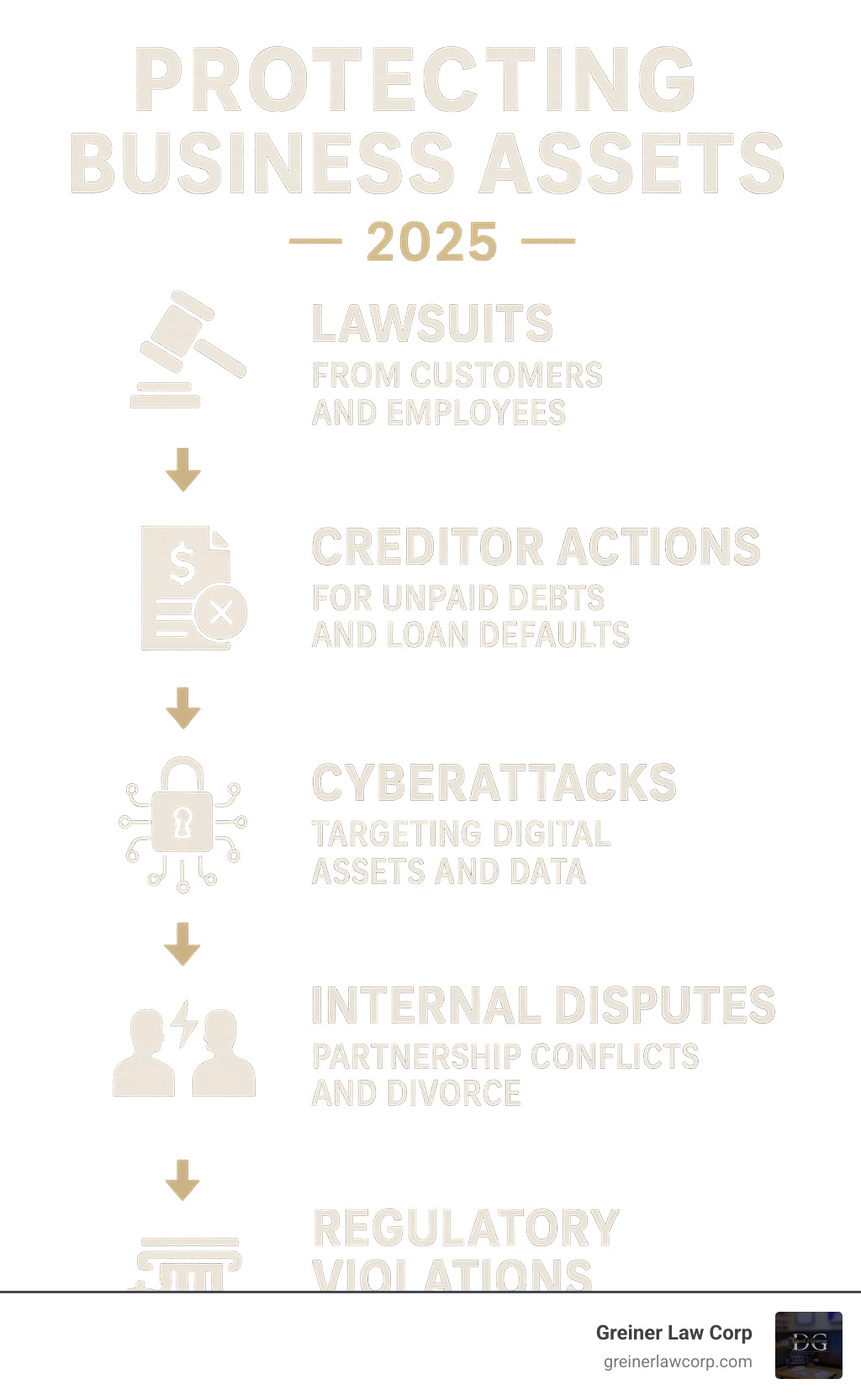
Many business owners don’t realize how vulnerable their assets are. The threats aren’t just theoretical; they can wipe out everything you’ve built. Common risks include:
- Lawsuits: Claims from customers, employees alleging wrongful termination, or competitors claiming IP theft.
- Creditor Actions: Legal action from unpaid vendors or defaulted business loans.
- Disasters and Cyberattacks: Fires, floods, and data breaches can destroy physical and digital assets.
- Internal Disputes: Conflicts between partners can drain resources through litigation.
- Personal Risks: A divorce or a personal lawsuit unrelated to your business can put company assets at risk if not properly structured.
- Regulatory Violations: Government agencies can impose business-ending fines for non-compliance.
It’s also crucial to understand the difference between internal claims and external claims. Internal claims are contained within your business entity; if your corporation is sued, only its assets are typically at risk. External claims can pierce that barrier and target your personal assets, which happens when there’s no legal separation or that separation is compromised.

Proper planning is the key to protecting yourself. For more detailed guidance, see our comprehensive Business Risk Management Strategies.
The Dangers of Sole Proprietorships and Partnerships
If you operate as a sole proprietorship or general partnership, you are taking unnecessary risks. These structures offer zero protection for your personal assets because there is no legal separation between you and your business. If your business is sued or can’t pay its debts, creditors can seize your house, car, and savings.
General partnerships are even riskier, as you are personally liable for your partner’s actions. If your partner makes a costly error, your personal assets are on the line. This unlimited personal liability means one bad day could cost you everything. These are the riskiest structures for protecting your wealth.
Personal Guarantees and Financial Risks
Even with a protective structure like an LLC, you can expose your personal assets by signing personal guarantees on business loans. When you sign one, you promise to pay the debt if the business cannot. This creates a direct path from business failure to personal financial ruin.
If your business defaults on a personally guaranteed loan, creditors can pursue your personal bank accounts, home, and investments. Pledging personal collateral, like your house, gives the lender a direct claim to that asset upon default. The credit report impact can also be severe and long-lasting. Be extremely cautious about what you personally guarantee, as you are trading asset protection for capital.
Foundational Strategies for Protecting Business Assets

To defend against threats, you must build a fortress around your wealth. Protecting business assets relies on foundational strategies that work together: the corporate veil for legal separation, strict financial separation, comprehensive insurance layers, and proactive planning.
Choosing the Right Business Structure
Your business structure is the cornerstone of your asset protection plan. The goal is to create legal separation between your personal and business finances.
- Limited Liability Company (LLC): Popular for its flexibility and strong liability protection. An LLC creates a barrier so that if the business is sued, creditors can typically only go after the LLC’s assets, not your personal wealth.
- S Corporation (S Corp): Offers similar liability protection to an LLC but with potential tax advantages by allowing profits and losses to pass through to your personal tax return, avoiding double taxation.
- C Corporation (C Corp): Provides the strongest legal separation, making it ideal for larger businesses planning to raise capital. However, it faces double taxation.
- Limited Partnership (LP): Useful for investment scenarios, this structure has general partners with unlimited liability and limited partners whose liability is restricted to their investment.
| Feature | Limited Liability Company (LLC) | S Corporation (S Corp) | Limited Partnership (LP) |
|---|---|---|---|
| Liability Protection | Limited to your investment | Limited to your investment | Limited for limited partners only |
| Tax Treatment | Pass-through (flexible options) | Pass-through, avoids double taxation | Pass-through taxation |
| Setup Complexity | Simple and straightforward | More formal requirements | Complex, needs partnership agreement |
| Management Style | Very flexible structure | Board of directors required | General partners manage everything |
| Best For | Most small to medium businesses | Profitable businesses seeking tax savings | Investment partnerships |
Choosing the right structure is vital for future growth and protection. For detailed guidance, visit our Company Formation Law page.
Maintaining the Corporate Veil to Shield Personal Wealth
Creating an LLC or corporation is only the first step. You must maintain the corporate veil—the legal barrier between your personal and business assets. If you fail to treat the business as a separate entity, a court can pierce the corporate veil, and your personal assets will be exposed.
To prevent this, follow these rules:
- Never commingle funds: Use separate bank accounts and credit cards for business and personal use. Do not pay personal bills from the business account.
- Keep proper records: Document major business decisions, hold meetings, and maintain clear financial statements to prove your business is a legitimate, separate entity.
- Ensure adequate capitalization: Your business must have enough capital to operate and meet its obligations.
- Follow corporate formalities: Sign contracts in your business’s name (e.g., “John Smith, Manager of ABC LLC”), not just your own. File annual reports on time.
For more on compliance, see our resources on What is Corporate Law?.
The Critical Role of Insurance in Protecting Business Assets
Insurance is your financial safety net. A layered approach provides the best protection:
- General Liability Insurance: Covers injuries to customers on your property or damage caused by your operations.
- Professional Liability Insurance: Essential for service-based businesses, it protects against claims of financial harm due to your professional services.
- Property Insurance: Safeguards physical assets like buildings, equipment, and inventory from fire, theft, and other disasters.
- Commercial Umbrella Policies: Provide an extra layer of liability protection above your other policies, which is crucial for defending against major claims.
- Cybersecurity Insurance: Covers costs related to data breaches and cyberattacks, such as notification, legal fees, and fines.
- Business Interruption Insurance: Replaces lost income and covers expenses if a disaster forces you to close temporarily.
- Key Person Insurance & Buy-Sell Agreements: Protect the business from financial disruption if a key owner or employee dies or leaves the business.
Advanced Legal and Financial Safeguards

Once your foundation is set, advanced strategies can create nearly impenetrable barriers around your assets. Protecting business assets at this level involves sophisticated legal and financial tools to guard against complex challenges.
Leveraging Trusts and Asset Titling
Trusts are powerful tools that allow you to benefit from assets you no longer legally own, shielding them from creditors.
- Irrevocable Trusts: These are the gold standard for asset protection. By transferring assets into an irrevocable trust, you give up ownership. Since you no longer own them, creditors cannot seize them. A trustee manages the assets according to your wishes.
- Asset Titling: How you legally own property determines its vulnerability. Tenancy by the entirety, available to married couples in some states, can protect property from a lawsuit against only one spouse. Homestead exemptions also shield a portion of your home’s equity from creditors, with protection levels varying by state.
- Strategic Separation of Assets: Place high-risk assets, like rental properties or heavy equipment, into separate LLCs. This creates “liability firewalls,” so a lawsuit related to one asset cannot threaten your other assets.
- Charging Orders: This is a key protection for LLC members. If you face a personal judgment, a creditor can only get a charging order, which gives them the right to receive distributions paid to you. They cannot seize your ownership, vote on decisions, or force the business to make payments.
Securing Your Intangible Assets and Digital Footprint
Your most valuable assets may be intangible, like your brand, customer lists, and software. They require specialized protection.
- Intellectual Property (IP): Protect your brand with trademarks, your creative works with copyrights, and your confidential business information with trade secrets. Formal registration of trademarks and copyrights strengthens your legal standing, while trade secrets require robust internal policies, like confidentiality agreements, to remain protected. The U.S. Trade Administration offers excellent resources on securing intellectual property.
- Cybersecurity Measures: Cybersecurity is essential. Use data encryption to protect information at rest and in transit. Conduct regular employee training on security best practices, as human error is a common cause of breaches. Secure your website with an SSL certificate to protect customer data and build trust.
How Contracts and Planning Mitigate Future Risks
Well-drafted contracts and proactive planning can prevent problems from escalating into crises.
- Strong Contracts: Use clear, detailed contracts with customers, suppliers, and employees to define expectations and outline dispute resolution procedures.
- Non-Compete and Confidentiality Agreements: Protect your business from departing employees taking customers or sensitive information. These must be reasonably drafted to be enforceable.
- Business Succession Planning: A clear plan for what happens if you retire, become disabled, or die is crucial for preserving business value and ensuring a smooth transition.
- Prenuptial Agreements: For business owners, a prenup is a critical tool to protect your business interests from being divided in a divorce.
These advanced strategies require careful, proactive planning. For expert help with your business contracts, explore our Business Contract Legal Advice services.
Frequently Asked Questions about Asset Protection
Business owners often have similar concerns about protecting business assets. Here are answers to some of the most common questions.
When is it too late to implement asset protection strategies?
The harsh reality is that once a lawsuit is filed or you’re already facing significant debt, your options become severely limited. Trying to move assets after a claim arises can be considered fraudulent conveyance, a legal concept that prevents people from hiding assets to avoid paying debts. Courts can reverse these transfers and may impose additional penalties.
The golden rule is to start protecting business assets proactively, when times are good. Planning ahead is always more effective and less costly than scrambling to react to a crisis.
What is the difference between internal and external claims?
Understanding this distinction is key to knowing where your risks lie.
- Internal claims target your business entity directly. Examples include a customer suing your LLC over a product defect or a vendor pursuing payment. With a proper business structure, liability is typically contained within the business, protecting your personal assets.
- External claims can break through the business’s protective barrier and reach your personal wealth. These arise from personal guarantees on loans, piercing the corporate veil due to poor record-keeping, or operating as a sole proprietorship.
A well-structured business entity acts as a firewall, keeping internal business problems from threatening your personal financial life.
How does a charging order protect an LLC?
A charging order is a powerful feature of LLCs that shields the business from a member’s personal financial problems. If an LLC member faces a personal lawsuit and judgment, the creditor’s remedy is typically limited to a charging order.
This order gives the creditor the right to receive any profit distributions made to that member, but that’s all. The creditor cannot seize the member’s ownership interest, participate in management, vote on decisions, or force the LLC to make distributions. This allows the business to continue operating without disruption, protecting the other members and the company itself. It’s a critical reason why an LLC is such an effective structure for protecting business assets.
Conclusion: Build Your Financial Fortress Today
Protecting business assets is an ongoing commitment, not a one-time task. The threats from lawsuits, creditors, and personal events are real, but you can defend against them with a proactive strategy.
By implementing the methods we’ve discussed—choosing the right legal structure, maintaining the corporate veil, securing comprehensive insurance, and using advanced tools like trusts and strong contracts—you create multiple layers of protection. This comprehensive approach turns a basic defense into a financial fortress, safeguarding your future.
The most important takeaway is to act now. Asset protection works best when implemented during calm times, not in the middle of a crisis. Waiting until a threat appears is often too late.
At Greiner Law Corp, we’ve helped California business owners build these fortresses since 2003. With a business-minded approach, we tailor strategies to your specific goals and risk tolerance from our offices in Victorville, Riverside, San Bernardino, and Los Angeles. We don’t use cookie-cutter solutions because your business is unique.
Don’t leave your hard work vulnerable. Let us help you build the financial fortress you need to grow your business with confidence.
Ready to take the next step? Learn more about securing commercial property with a lease-to-own agreement and find additional ways to protect and grow your business assets.


