Why Selling a House in Probate California Requires Expert Legal Guidance
Selling a house in probate california can be complex, but understanding the process is key. When a California property owner dies, their real estate typically goes through probate court before it can be sold or transferred.
Quick Answer: The California Probate Home Sale Process
- File probate petition and get appointed as personal representative
- Choose your path: Full Authority (IAEA) or Court-Confirmed Sale
- Get property appraised by court-appointed Probate Referee
- List property for at least 90% of appraised value
- Accept offers and complete required notifications
- Attend court hearing (if court confirmation required)
- Close escrow and distribute proceeds to beneficiaries
The process can take several months to over a year, depending on whether you have full authority under the Independent Administration of Estates Act (IAEA) or need a court-confirmed sale. IAEA authority allows a sale without a court hearing if no beneficiaries object.
Probate sales are complex due to California’s strict legal requirements and the emotional stress on grieving families. The sale price must be at least 90% of the court-appointed appraiser’s value, and buyers may face uncertainty about court confirmation.
As David Greiner, Esq., I’ve guided many clients through the complexities of selling a house in probate california. My business-focused approach prioritizes your goals while ensuring full legal compliance throughout the probate sale process.

Quick look at selling a house in probate california:
Understanding Probate and Your Role in a California Real Estate Sale
When someone passes away in California, their assets don’t automatically transfer to loved ones. Instead, a legal process called probate ensures the decedent’s estate is handled correctly: debts are paid, taxes are handled, and assets are distributed to the right people.

Real estate requires probate to legally transfer the title. Court supervision ensures the ownership change is legitimate and all interested parties are involved. For most families, the house is the largest asset, which is why California law requires this careful process.
If you’re wondering about the specific steps a house goes through during this process, our detailed guide What Happens to a House During Probate? walks you through each stage. For broader information about California probate, the state courts offer helpful resources at General information on California probate.
Who is in Charge of the Sale?
Someone needs to be the “point person” for the estate. This person is the Personal Representative. If there’s a will, this person is the Executor; without a will, the court appoints an Administrator. Both roles have the same responsibilities.
This role comes with a serious fiduciary duty. This means you must act honestly and in the best interests of the estate, its beneficiaries (named in a will), and its heirs (family who inherit without a will).
The Personal Representative has the authority to make decisions about selling a house in probate california, but they must follow California’s specific rules. It’s a big responsibility with clear legal guidelines.
For a complete breakdown of what this job entails, check out our comprehensive guide: Executor Duties Explained.
Can a House Be Sold While It Is in Probate?
Yes, absolutely! This is a common question, and the answer is yes. In fact, selling the house is often necessary to pay debts or cover probate costs. Sometimes, beneficiaries simply prefer cash over jointly owning a property. Liquidating assets for distribution is a normal part of many probate cases.
Court oversight ensures fairness, protecting beneficiaries, creditors, and buyers, even though it adds steps compared to a regular sale. California’s probate system has well-established procedures for real estate sales designed to make the process transparent, fair, and legally sound. With proper guidance, selling a house in probate california is a manageable process.
The Two Paths for Selling a House in Probate California: IAEA vs. Court Confirmation
When you’re selling a house in probate california, you have two main routes: the streamlined Independent Administration of Estates Act (IAEA) or the traditional court-confirmed sale. The path you take depends on the authority granted by the probate court and significantly impacts the timeline and complexity of the sale.
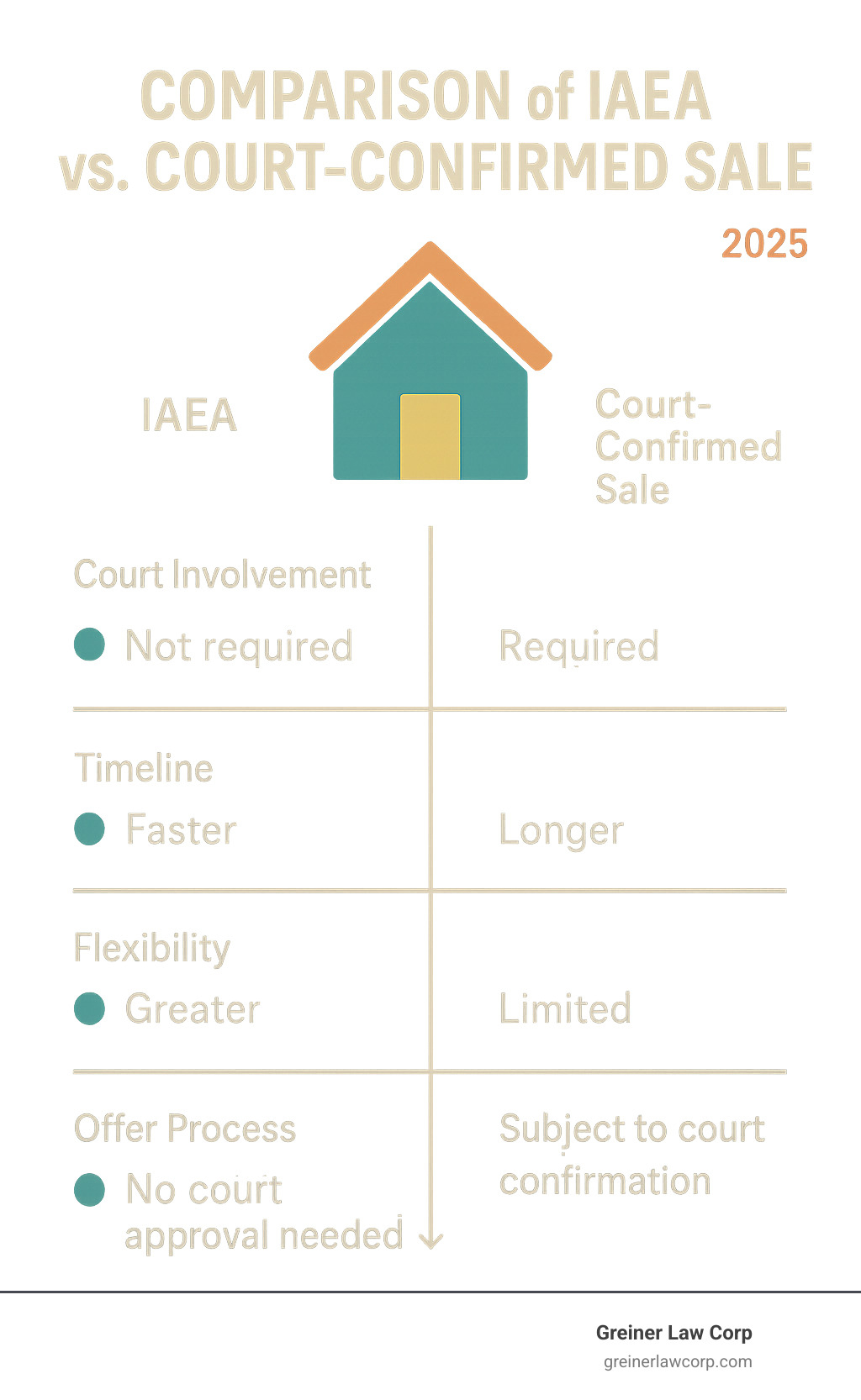
Understanding these options upfront helps us choose the most efficient path for your specific situation while staying fully compliant with California’s legal requirements. Let’s break down each approach.
Selling with Full Authority under the Independent Administration of Estates Act (IAEA)
The Independent Administration of Estates Act can make probate much less painful. When the court grants Full Authority under IAEA, you can sell the house without a court confirmation hearing, saving significant time.
However, “independent” doesn’t mean you can act in secret. You must send a Notice of Proposed Action to all interested parties, including heirs and beneficiaries. This notice details the sale terms, price, and buyer.
Interested parties have 15 days to object. If no one objects, you are free to proceed with the sale without a court hearing. Sometimes beneficiaries will sign a Waiver of Notice of Proposed Action to speed things up even more.
IAEA Full Authority offers speed and flexibility, avoiding court confirmation hearings and public auctions. This provides more certainty for buyers and makes the process feel closer to a standard real estate transaction.
If you want to dive deeper into the overall probate sale landscape, our detailed guide What is a Probate Sale? covers all the essentials.
The Traditional Court-Confirmed Sale Process
When the Personal Representative has Limited Authority or no IAEA authority, selling a house in probate california requires a court-confirmed sale. This path involves more court oversight and specific procedures.
After accepting an offer, you must file a Petition to Confirm Sale with the court, which then schedules a confirmation hearing. The hearing acts as a public auction where other buyers can make higher bids, even if you have an accepted offer. The first overbid must meet the 105% plus $500 rule—so for a $500,000 offer, the first competing bid must be at least $525,500.
If multiple people bid, the court sets increment amounts, and the property goes to the highest bidder. This process is designed to maximize the sale price for the estate.
While this process aims to get the highest price, it involves strict court rules and a longer timeline (often six months or more). The uncertainty of being outbid in court can also deter some buyers.
A Step-by-Step Guide to the Probate Sale Process
Selling a house in probate california can be broken down into clear, manageable steps. Let’s walk through the process from start to finish.

Step 1: Initiating Probate and Gaining Authority to Sell
Before selling, you need legal authority. This begins by filing a probate petition with the local superior court to be recognized as the person in charge.
The court then appoints the personal representative—an Executor (with a will) or an Administrator (without a will). This appointment gives you the legal right to act for the estate.
The most important document you’ll receive is your Letters of Testamentary or Letters of Administration. These letters are your official proof of authority, required by banks, title companies, and real estate agents to proceed.
If you’re new to this whole process, our guide What is Probate? breaks down everything you need to know about getting started.
Step 2: Preparing and Pricing the Property for Sale
Next, you must get the house ready for market. First, securing the property is key: change locks, maintain utilities, and update the insurance policy.
California requires a court-appointed Probate Referee to appraise the property. This official valuation is legally binding and sets the baseline for the sale price.
The critical 90% of appraised value rule means you generally cannot accept an offer below 90% of the referee’s valuation. This protects the estate but requires strategic pricing.
Regarding repairs, you have choices. Some estates fund repairs to boost the sale price. However, many families choose to sell “as-is”, which is faster and avoids upfront costs and family disagreements over repairs.
Step 3: Listing, Marketing, and Closing the Sale
Having the right team is crucial. A Probate Realtor understands the unique paperwork and timelines. They handle specialized listing documents and disclosures, which are more extensive than in a typical sale.
When offers come in, they are measured against the 90% rule. With Full IAEA Authority and no objections, you can proceed to closing. If you need court confirmation, you must prepare for a public hearing where others can bid.
The escrow process is similar to a standard sale but includes extra steps, like verifying your authority and coordinating with the court if confirmation is needed. The escrow company acts as a neutral third party to ensure compliance with California law.
Finally, after closing costs and debts are paid, the remaining proceeds get distributed to the heirs or beneficiaries, often marking the final stage of the probate case.
Navigating Timelines, Challenges, and Special Considerations
Selling a house in probate california involves unique timelines, challenges, and financial considerations.

Typical Timelines and Potential Delays
The timeline for selling a house in probate california varies significantly. An IAEA sale can take a few months, while court-confirmed sales often take six months or longer. The entire probate process typically lasts 9 to 18 months.
Delays are common due to court backlogs, disagreements among heirs, creditor claims, and title issues like unresolved liens or ownership history errors. Understanding these potential delays helps set realistic expectations. The financial impact of these extended timelines is substantial, which is why our article How Much Does Probate Court Cost in California? provides valuable insights into managing these costs.
Common Challenges When selling a house in probate california
The most common challenges include disagreements among heirs over the sale price or repairs. While the Personal Representative has legal authority, family disputes can cause significant stress and delays.
Property condition is another hurdle. Deciding whether to make repairs or sell “as-is” is tough, especially if the estate lacks funds or heirs disagree on the approach.
Underwater mortgages, where the home is worth less than the loan, present a difficult situation that may require negotiating a short sale with the lender.
Finally, the emotional stress of managing a sale while grieving is immense. Our goal is to handle the technical details so you can focus on your family. When disagreements escalate, a Probate Litigation Lawyer may be needed to resolve disputes.
Tax Implications and How to Avoid Probate
Inherited property receives a stepped-up basis, meaning its cost basis for tax purposes is adjusted to the fair market value at the date of death. This often minimizes or eliminates capital gains tax if the property is sold soon after inheritance.
Property tax reassessment occurs upon transfer of ownership, which can increase annual taxes. However, California offers exclusions for transfers between parents and children, which can prevent this increase.
To avoid this process in the future, a Living Trust is the most effective tool. Property in a trust bypasses probate, allowing the successor trustee to manage or sell it faster and with less expense. Our guide on Probate Property Title Transfer explains these options in detail.
Frequently Asked Questions about Selling a House in Probate California
We understand that selling a house in probate california brings up many questions. Here are straightforward answers to the most common ones.
Do all heirs have to agree to sell the property in California?
Not necessarily. The answer depends on the authority granted to the Personal Representative by the court.
With Full Authority under the IAEA, the Personal Representative can sell the property without unanimous consent after sending a “Notice of Proposed Action.” Heirs have 15 days to object. If no one objects, the sale proceeds. This prevents one heir from halting the process while protecting everyone’s right to be heard.
If an heir objects, or if the representative has only Limited Authority, the court must approve the sale, deciding if it’s in the estate’s best interest.
While unanimous agreement makes the process smoother, it is not always legally required.
What happens if the house needs major repairs the estate can’t afford?
This is a common issue, as many inherited homes need work and the estate may lack funds for repairs. You have several options.
Selling “as-is” is the most common solution. You disclose all known issues and sell the property in its current state. This usually means a lower price but avoids repair costs and management headaches, leading to a faster sale. Cash buyers and investors are often interested in these properties.
You can also negotiate with buyers who are willing to handle repairs themselves, which is factored into the offer price.
In rare cases, the Personal Representative can petition the court to finance essential repairs, though this adds time and complexity to the process.
How is the sale price of a probate home determined?
The sale price follows a specific process to protect the estate’s value.
First, a court-appointed Probate Referee appraises the property to determine its fair market value as of the date of death. This valuation is the baseline for the sale price.
Next, California’s “90% rule” mandates that the sale price must be at least 90% of the value appraised by the Probate Referee within the last year.
If the sale requires court confirmation, the final price can be higher due to an overbidding process at the hearing. The first overbid must be at least 105% of the accepted offer plus an additional $500, with subsequent bids in court-set increments. This process ensures the property sells for the highest possible price in a public setting.
Conclusion
Selling a house in probate california might seem daunting, but it’s a well-defined process. Whether using IAEA Full Authority or a court-confirmed sale, each step is logical and purposeful.
You are not alone. California’s probate system is designed to protect all parties—the estate, heirs, and creditors. The legal requirements ensure fairness and transparency.
Experienced guidance is crucial from the start. Understanding IAEA authority, the 90% rule, and court overbidding can save time and prevent mistakes.
At Greiner Law Corp, we’ve built our practice around prioritizing your goals. When David Greiner founded our firm in 2003, he established a business-minded approach to help clients manage risk and achieve their objectives, whether that’s maximizing sale price, minimizing delays, or reducing stress.
We understand the emotional weight of managing an estate while handling complex legal duties. This responsibility deserves careful, professional guidance that respects both the legal and personal significance of the process.
Every probate sale is unique, but the fundamentals are consistent. With the right strategy and legal support, selling a house in probate california becomes a manageable process.
If you’re ready to move forward with confidence and clarity, we’re here to help. Our team can guide you through every step, from initial filings to closing escrow.


