Why Probate Property Title Transfer Requires Strategic Planning
Probate property title transfer is the court-supervised process of moving real estate ownership from a deceased person to their heirs in California. Here’s a quick overview:
Key Steps for Probate Property Title Transfer:
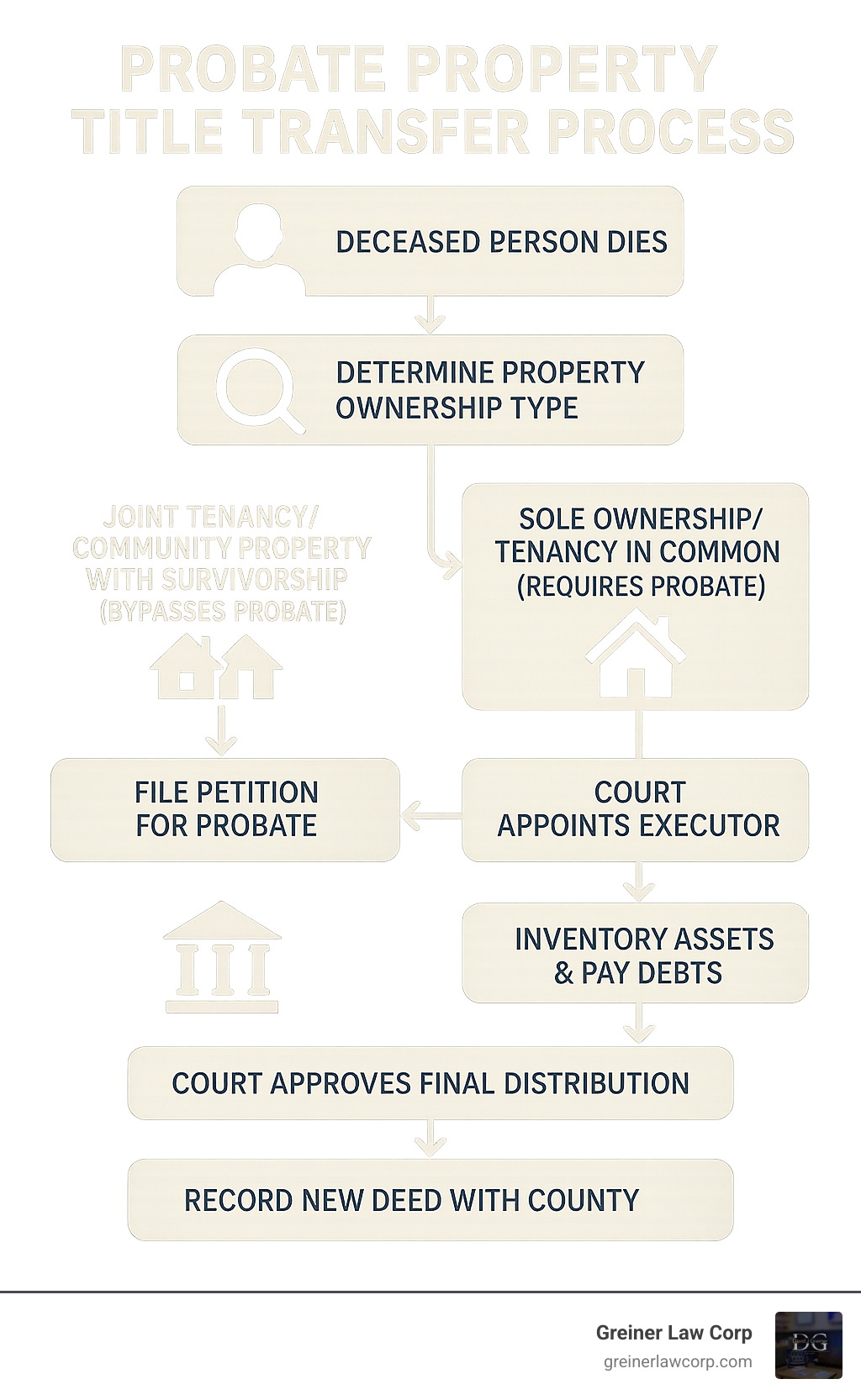
- File a Petition for Probate with the superior court
- Obtain Letters Testamentary giving you authority as executor
- Complete an Inventory and Appraisal of all estate assets
- Pay all debts and taxes owed by the estate
- File a Petition for Final Distribution with the court
- Record the court order and new deed with the County Recorder
Timeline: Most California probate cases take 12-18 months.
Cost: Expect to pay 4-7% of the estate’s gross value in fees and costs.
The legal complexities following the loss of a loved one can feel overwhelming. As one client shared, “My client tries to sell mom or dad’s house… but then, here comes the Title Company telling my client how they need to do probate.”
The good news? Not all property transfers require full probate. Joint tenancy, living trusts, and transfer-on-death deeds can bypass the court process entirely, saving time, money, and stress.
California’s probate laws create specific procedures to protect heirs and creditors. Whether you’re planning ahead or serving as an executor, understanding the process is key to making informed decisions about your family’s assets.
I’m David Greiner, Esq. For nearly a decade, I’ve guided families and business owners through complex real estate and estate matters. My business-focused approach to probate property title transfer ensures your goals are met efficiently while managing legal risks.
Understanding Property Ownership and Its Impact on Probate
Before diving into the probate property title transfer process, it’s crucial to understand how property ownership is structured in California. The way a deceased person held title to their real estate determines if probate is required.

How California Property Titles Affect Transfer After Death
In California, property can be owned in several ways, each with unique rules for transfer after death:
- Sole Ownership: When one person owns property, it usually goes through probate upon their death unless a trust or other non-probate transfer is in place.
- Joint Tenancy: This form of ownership includes a “right of survivorship.” When one owner dies, their share automatically passes to the surviving owner(s), bypassing probate. This is a key advantage for avoiding court.
- Tenancy in Common: This form does not include the right of survivorship. Co-owners hold distinct shares (e.g., 70/30). When an owner dies, their share becomes part of their estate and usually requires probate for distribution.
- Community Property: For married couples in California, assets acquired during marriage are community property. When one spouse dies, their half typically requires probate unless held with a right of survivorship or in a trust.
- Community Property with Right of Survivorship: This hybrid form allows a deceased spouse’s share to automatically transfer to the surviving spouse, avoiding probate.
Understanding these ownership types is key to effective estate planning. For a deeper dive, read our guide on Understanding the commonly used deeds for transferring real estate and the interests affected.
Here’s a quick comparison of common co-ownership structures:
| Feature | Joint Tenancy | Tenancy in Common | Community Property with Right of Survivorship |
|---|---|---|---|
| Number of Owners | Two or more | Two or more | Married couples/Registered Domestic Partners |
| Ownership Shares | Equal shares | Equal or unequal shares | Equal shares |
| Transfer on Death | Automatic to survivor(s) | Via will or intestacy | Automatic to surviving spouse/partner |
| Probate Requirement | No (usually) | Yes (usually) | No |
What is Probate and Is It Always Necessary in California?
Probate is the court-supervised process of administering a deceased person’s estate. It involves validating a will, appointing an executor, paying debts and taxes, and distributing remaining assets to the rightful heirs. While structured, probate can be long and costly.
Thankfully, it’s not always necessary in California. The law provides several ways to avoid or simplify the process. For example, California estates with a total value below a certain threshold (currently $184,500) can often use a simplified “Small Estate Affidavit” process, saving significant time and money.
To learn more, we have a detailed resource on What is Probate?. Additionally, the California Courts provide a helpful Guide to property after someone dies from the California Courts.
The Step-by-Step Guide to Probate Property Title Transfer
When property can’t bypass probate, you must steer California’s formal process. Let’s break down the probate property title transfer so you know what to expect.

Step 1: Initiating the Probate Process in Court
The process begins at the superior court in the county where the deceased lived. You will file a Petition for Probate and submit the original will, if one exists. You must also identify all legal heirs and beneficiaries. A Notice of Petition to Administer Estate is then published in a local newspaper and mailed to all heirs, giving them a chance to respond. The court sets a hearing date, and if there are no objections, the judge appoints an executor, granting them legal authority to act for the estate.
For more details, see our guide on the Probate Court Process.
Step 2: Managing the Estate’s Assets and Debts
The court issues Letters Testamentary (with a will) or Letters of Administration (no will), which are the official documents granting the executor authority. The executor’s duties include:
- Creating an Inventory and Appraisal of all assets. Real estate requires an appraisal by a court-appointed California probate referee.
- Identifying and paying creditors. Proper notification is crucial, as creditors have a limited time to file claims. Valid debts must be paid before assets are distributed.
- Filing final tax returns for the deceased and the estate.
- Maintaining the property, including mortgage, insurance, and utility payments. A house can be sold during probate, but it requires court approval. Learn more here: Can a House Be Sold During Probate?
Step 3: Obtaining Court Approval for the Transfer
After managing assets and debts, the executor files a Petition for Final Distribution. This report details all actions taken and includes a proposed distribution plan outlining who gets what. The court reviews the petition to ensure all rules were followed. If approved, the judge issues a Court Order Approving Distribution, which is the legal authorization for the probate property title transfer.
Read more about this stage in our article on What Happens to a House During Probate?.
Step 4: Executing the California probate property title transfer
With the court order, you can officially transfer the property. First, prepare a new deed based on the court’s order. Then, take a certified copy of the Order for Distribution and the new deed to the County Recorder’s Office to be recorded. This officially transfers ownership and updates public records.
You must also file a Preliminary Change of Ownership Report (PCOR), which has significant property tax implications due to Proposition 19. Once these documents are recorded, the probate property title transfer is complete, and the property belongs to its new owners.
Bypassing the Courtroom: How to Transfer Property Without Probate
Fortunately, the lengthy probate process isn’t your only option. With smart planning, you can use tools that allow property to pass directly to your loved ones, avoiding court, delays, and significant costs. These alternatives are an express lane that can save your family time and stress.

For a comprehensive look at your options, check out our guide on How to Avoid Probate.
Transferring Property with a Living Trust
A Revocable Living Trust is a private legal entity you create to hold your property, and it’s a powerful tool for avoiding the probate property title transfer process. You transfer property ownership to the trust and manage it as the trustee. You also name a successor trustee to take over after you pass away.
Funding the trust by transferring the property deed into its name is a crucial step; an unfunded trust cannot protect the asset. After your death, the successor trustee distributes the property through a private process called trust administration, which is much faster than probate and offers a significant privacy benefit.
The Power of Joint Ownership and Survivorship
The way you hold title can automatically solve the probate problem through the right of survivorship.
- Joint Tenancy with Right of Survivorship: A deceased owner’s share instantly transfers to the surviving owner(s), avoiding probate.
- Community Property with Right of Survivorship: This offers married couples the same probate-avoidance benefit while maintaining community property tax advantages.
- Spousal Property Petition: For community property without a right of survivorship, a surviving spouse can use this simplified court procedure, which is much faster and cheaper than full probate.
To clear the title, the surviving owner typically just files a death certificate and an affidavit with the County Recorder’s Office. See what other assets can skip probate in our guide on Assets That Pass Without Probate.
Using a California Transfer on Death (TOD) Deed
California’s Revocable Transfer on Death (TOD) Deed lets you name a beneficiary for your real estate, similar to a bank account. You sign and record the TOD deed while alive, but you retain full control to sell, refinance, or cancel it. The beneficiary has no rights until your death.
After you pass, the beneficiary records your death certificate, and the property transfers automatically without probate. However, TOD deeds have limitations. They are best for simple situations, apply only to certain residential properties, and lack the comprehensive benefits of a living trust.
Navigating Costs and Common Pitfalls
Understanding the financial investment and potential challenges of a probate property title transfer helps you prepare for the journey ahead.

Understanding the Costs of a California probate property title transfer
Probate expenses are paid from the estate’s assets, not your personal funds. Key costs include:
- Statutory Attorney and Executor Fees: California law sets these fees based on the estate’s gross value: 4% on the first $100,000, 3% on the next $100,000, and so on. Executors are entitled to the same fee, though family members often waive it. See our guide on California Statutory Fees for Probate.
- Court and Appraisal Fees: These include court filing fees and fees for the probate referee, who charges about 0.1% of the appraised property value.
- Other Expenses: Costs can also include bond premiums, newspaper publication fees, and property maintenance.
In total, probate costs typically range from 4% to 7% of the gross estate value. For a $500,000 estate, this can mean $20,000 to $35,000 in costs, which is why many people plan to avoid probate.
Common Challenges and How to Mitigate Them
Most probate challenges are manageable with awareness and a proper response.
- Title Issues: Problems like old liens or ownership disputes (“clouds on title”) must be resolved, often through legal action, before a transfer can occur. Learn more about Defects of Title, Competing Interest, and Quiet Title Actions.
- Family Disagreements: Disputes among heirs about selling or keeping property are common. Clear communication and mediation can prevent costly litigation.
- Property Tax Surprises: California’s Proposition 19 can lead to significant property tax increases for inherited homes. Unless an inheriting child makes it their primary residence, the property is reassessed at current market value.
- Documentation Gaps: Missing wills, deeds, or financial records can cause significant delays and increase legal fees.
- Incomplete Procedures: Failing to follow required steps, like notifying creditors or filing taxes, can invalidate the transfer and create long-term legal problems.
The best defense is proactive estate planning and experienced legal guidance to address problems quickly and keep the process on track.
Frequently Asked Questions about Property Transfers After Death
Here are answers to some of the most common questions we hear about probate property title transfer.
How long does a probate property title transfer take in California?
The timeline for a probate property title transfer in California varies, but a formal case averages 12 to 18 months. The exact duration depends on factors like court backlogs, estate complexity, heir disputes, and creditor claims. Simpler cases may be faster, while complex ones can take two years or more. The executor’s efficiency is also key.
For a more in-depth look, read our article: How Long Does Probate Take?.
Can the property be sold during the probate process?
Yes, property can be sold during probate. An executor can sell real estate to pay debts, cover expenses, or if the beneficiaries agree to the sale. However, selling property in probate has specific rules. Most sales require court confirmation unless the executor has “full authority” under the Independent Administration of Estates Act (IAEA). This process involves court approval of the sale price, notice to heirs, and a hearing where other buyers can “overbid” the original offer.
To understand the nuances, see our detailed guide: What is a Probate Sale in Real Estate?.
What happens if the deceased owned property in another state?
Owning property in another state complicates the process. The main probate (or “domiciliary” probate) occurs in California, the deceased’s home state. However, a separate, secondary process called “ancillary probate” is required in the state where the other property is located. This is because real estate is governed by the laws of its location, and a California court lacks jurisdiction.
Handling ancillary probate requires hiring a local attorney in that state. We often help clients by coordinating with local counsel to ensure a smooth process across jurisdictions.
Secure Your Legacy with Confidence
Navigating a probate property title transfer can be challenging. Understanding property ownership, the steps of probate, and probate-avoidance options is key to a smoother process. Every step, from filing the petition to recording the new deed, requires careful attention to California’s specific legal requirements.
While costs and potential challenges exist, proactive estate planning—such as using a living trust or proper titling—can significantly reduce the burden on your family.
At Greiner Law Corp, we empower you with knowledge and experienced guidance. Our business-minded approach focuses on your goals, helping you understand and manage the risks involved in property transfers. Whether you’re planning your estate or serving as an executor, understanding the process is the first step toward an efficient outcome.
For personalized help with your probate and real estate needs, we invite you to explore our probate services. We’re here to help you secure your legacy with confidence.


