Understanding the Final Financial Step in Your Home Purchase
Real estate closing costs are the fees paid to complete a home purchase or sale. Separate from your down payment, they typically range from 2% to 5% of the purchase price for buyers and 8% to 10% for sellers.
Quick Overview:
- What they are: Fees for services needed to finalize your real estate transaction
- Who pays: Both buyers and sellers
- When paid: Primarily on closing day, with some fees due earlier
- Typical amount: $6,000 to $15,000 for a $300,000 home purchase (buyer costs)
- Main categories: Lender fees, title services, taxes, and insurance
These costs cover services from lenders, title companies, and government agencies to transfer property ownership. While they can seem overwhelming, understanding them helps you budget accurately and find ways to save.
As David Greiner, Esq., I’ve guided many clients through complex real estate transactions. Understanding real estate closing costs is crucial for accurate financial planning. Proper preparation for these expenses can prevent unexpected financial burdens and ensure a smoother closing.
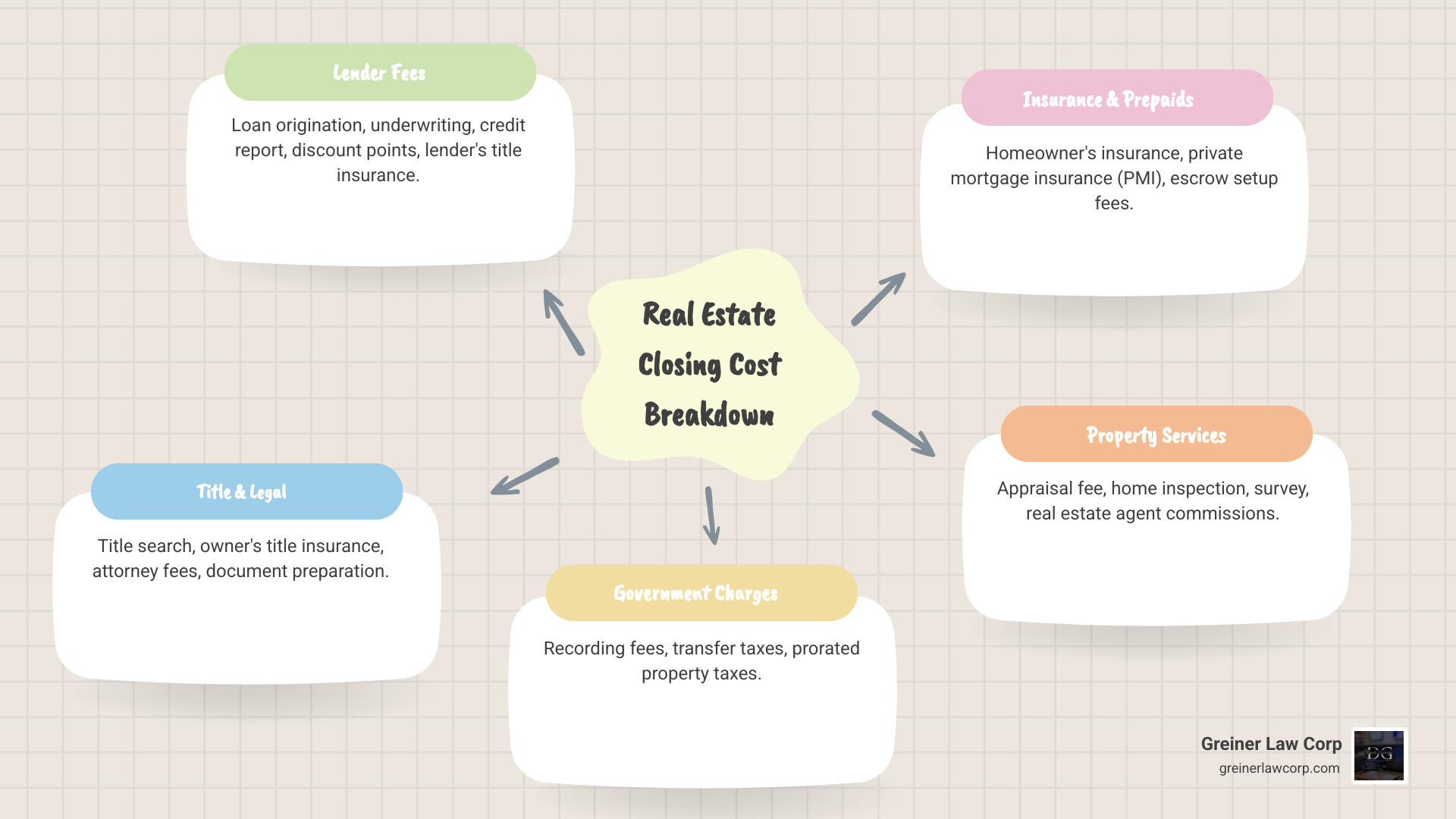
A Detailed Breakdown of Real Estate Closing Costs
You’ve found your home and your offer was accepted. Before you get the keys, you must clear the final financial hurdle: real estate closing costs. These fees cover the legal, security, and documentation services required to finalize the transaction. Every party involved—your lender, the title company, and government agencies—provides services that must be paid for. This section details the specific fees buyers and sellers can expect during the Real Estate Closing Process, helping you budget and spot any unusual charges.
Common Buyer Closing Costs
As a buyer, you’ll pay most closing costs, which fall into several categories: lender charges, title services, government fees, and prepaid expenses for your escrow account.
- Loan Origination Fee: Your lender charges this to process your mortgage application, covering underwriting and paperwork. It’s typically 0.5% to 1% of your loan amount.
- Appraisal Fee: Around $350, this fee pays a licensed appraiser to verify the home’s value for the lender. A low appraisal can be a negotiating tool.
- Credit Report Fee: A modest fee ($10-$100) for pulling your credit history to determine your interest rate.
- Title Search and Insurance: A title company searches public records to ensure the seller has clear ownership, with no hidden liens or disputes. Insurance protects you and the lender from missed issues.
- Home Inspection: For $250 to $700, an inspector checks the home’s condition, potentially saving you from costly repairs. It’s highly recommended.
- Survey Fee: Costs $400 to $1,000 to confirm property boundaries. This isn’t always required.
- Recording Fees: Around $125 in Los Angeles, Riverside, or San Bernardino County, this fee is charged by the county to officially register the deed and mortgage.
- Attorney Fees: While not required in California, many buyers hire an attorney to review documents and protect their interests. More on typical real estate attorney fees can help you understand what to expect.
Understanding Key Buyer Fees: Title Insurance and Prepaids
Two often-misunderstood costs are title insurance and prepaid items.
Lender’s title insurance is required by your mortgage company. This policy protects their investment if a title issue arises. It does not protect you. That’s why owner’s title insurance exists. This optional policy protects your equity and ownership rights for a one-time premium, typically 0.5% to 1% of the purchase price. It’s a worthwhile investment against future title defects.
Closing costs are one-time fees for services rendered. Prepaid items are recurring homeowner expenses like insurance and taxes, collected upfront by the lender to fund your escrow account.
- Homeowner’s Insurance: Lenders require you to pay the first year’s premium at closing, which can be $1,500-$3,000+ in California.
- Property Taxes: You’ll prepay several months of property taxes into your escrow account. In California, this is about 1% of the home’s assessed value annually.
Understanding this distinction helps you accurately estimate your real estate closing costs.
Common Seller Closing Costs
Sellers’ closing costs typically run 8% to 10% of the sale price.
- Real Estate Agent Commissions: The largest cost, usually 5% to 6% of the sale price, paid by the seller to cover both agents. This is often negotiable.
- Transfer Taxes: State and local government taxes on the property transfer. Varies by county and city; sellers often pay.
- Prorated Property Taxes & HOA Fees: You’ll pay your share of taxes and HOA dues for the portion of the year you owned the home.
- Seller Concessions: Amounts you agree to pay toward the buyer’s closing costs to make the deal more attractive.
- Outstanding Mortgage Balance: Not a closing cost, but the largest deduction from your proceeds.
- Attorney Fees: Some sellers hire an attorney for complex transactions.
Who Pays for Which Closing Costs?
Who pays for what depends on local custom, market conditions, and negotiations. Buyers usually pay for financing-related costs (origination, appraisal, lender’s title insurance) and their own inspection. Sellers traditionally cover agent commissions, owner’s title insurance, and transfer taxes. However, many costs are negotiable depending on the market. The table below shows a typical allocation, but “Negotiable” items can shift. This clarifies the responsibilities discussed in our guide on who pays closing costs in a real estate transaction.
| Closing Cost Item | Buyer | Seller | Negotiable |
|---|---|---|---|
| Loan Origination Fee | X | ||
| Appraisal Fee | X | X | |
| Credit Report Fee | X | ||
| Lender’s Title Insurance | X | ||
| Owner’s Title Insurance | X | X | |
| Home Inspection | X | ||
| Survey Fee | X | X | |
| Recording Fees | X | ||
| Attorney Fees | X | X | X |
| Real Estate Agent Commissions | X | ||
| Transfer Taxes | X | X | |
| Prorated Property Taxes | X | X | |
| HOA Transfer/Prorated Fees | X | X | X |
| Seller Concessions | X | ||
| Prepaid Homeowner’s Insurance | X | ||
| Initial Escrow Deposit (Taxes) | X |
Understanding these costs and who typically pays them puts you in a stronger negotiating position.
How to Reduce and Negotiate Your Closing Costs
Good news: real estate closing costs are not set in stone. With some strategy, you can often reduce what you pay by negotiating with your lender, asking the seller for help, or shopping around for services. The key is knowing which costs are flexible and when you have leverage, such as in a buyer’s market.

Negotiating Fees and Asking for Seller Concessions
Some closing costs are negotiable, while others aren’t. Government fees like recording fees and transfer taxes are fixed, though you can negotiate who pays them. In contrast, lender fees, such as the loan origination fee and underwriting fees, often have room for negotiation. Don’t be shy about asking your lender to reduce or waive certain charges, especially if you have competing offers.
Seller Concessions Explained
Asking for seller concessions is a smart strategy where the seller agrees to cover some of your closing costs. The amount is credited to you at closing, reducing the cash you need to bring. For example, a $5,000 concession on $12,000 in costs means you only need to bring $7,000.
However, there are limits. The amount a seller can contribute depends on your loan type and down payment. For conventional loans, it’s typically 3-9% of the purchase price. FHA loans allow up to 6%, and VA loans permit up to 4%. Your lender will enforce these limits, which are detailed in resources like the Fannie Mae guidelines on Interested Party Contributions.
Using Your Loan Estimate to Your Advantage
Your Loan Estimate is a powerful tool for managing real estate closing costs. Federal law requires lenders to provide this standardized document within three business days of your application. It itemizes your estimated loan terms and closing costs.
The real power comes from comparing Loan Estimates from multiple lenders. You’ll see differences in origination fees, underwriting charges, and interest rates. When comparing, look at the Annual Percentage Rate (APR), which includes many upfront costs and gives a truer picture of the loan’s total cost.
The Loan Estimate also identifies services you can “shop for,” like title insurance and surveys. Getting competitive quotes for these can save you hundreds of dollars. If any charge seems high or unclear, ask your lender for an explanation. The Consumer Financial Protection Bureau’s Loan Estimate Explainer is another excellent resource for understanding this document.
How Closing Costs Vary by Loan, Location, and Property Type
Real estate closing costs are not one-size-fits-all. They vary based on your loan type, the property’s location, and the kind of property you’re buying. Understanding these variations helps you set a realistic budget.
Differences Based on Loan Type (Conventional, FHA, VA)
Your mortgage program brings its own set of costs.
- Conventional loans: If your down payment is under 20%, you’ll pay for Private Mortgage Insurance (PMI), typically $30-$70 monthly for every $100,000 borrowed, until you reach 20% equity.
- FHA loans: Popular for low down payments (as low as 3.5%), these government-backed loans require an Upfront Mortgage Insurance Premium (MIP) of 1.75% of the loan amount, paid at closing. You’ll also pay a monthly MIP, sometimes for the life of the loan.
- VA loans: A benefit for service members and veterans, often with no down payment and no monthly mortgage insurance. They have a one-time VA Funding Fee (0.5% to 3.6% of the loan amount), though veterans receiving VA disability are typically exempt.
Geographic Variations in Closing Costs
Where you buy matters. State and local laws, especially transfer taxes, create dramatic differences. California’s average closing costs are around $7,953 with taxes, but this varies greatly between counties like Los Angeles, Riverside, and San Bernardino. According to data on average closing costs by state, costs can range from $2,500 in states like Missouri to over $13,000 in Washington D.C. Always get localized estimates.
Special Considerations: New Construction and Unique Properties
The type of property can also introduce unique fees.
- New Construction: Builders may pass certain costs to buyers, such as their attorney fees or impact fees for new infrastructure. These are often negotiable, so review your purchase agreement carefully.
- Condominiums and Co-ops: These properties, common in areas like Los Angeles, can have extra fees. Expect to pay board application fees, move-in fees, and potentially a fee for a “recognition agreement” if you have a mortgage.
Understanding the California Real Estate Law for these property types is crucial. Experienced guidance can help you steer these nuances and avoid unexpected costs.
Frequently Asked Questions about Closing Costs
Here are answers to the most common questions we hear from clients about real estate closing costs.
When are closing costs paid?
Most closing costs are due on closing day, typically paid via cashier’s check or wire transfer. However, some fees are paid upfront earlier in the process. For instance, you’ll usually pay the appraisal fee and home inspection fee at the time of service.
Are there closing costs on a cash real estate transaction?
Yes, though they are significantly lower than with a mortgage. You avoid all lender-related fees like loan origination and mortgage insurance. However, you will still pay for title insurance, county recording fees, and prorated property taxes. You’ll also have escrow fees and should still pay for a professional home inspection. While your costs might be a third of what a financed buyer pays, they are not zero. More on cash transaction fees can provide more detail.
Can closing costs be rolled into the mortgage?
Sometimes, yes. Some loan programs allow you to roll closing costs into your loan. This reduces the cash you need at closing but increases your total loan amount, meaning you’ll pay interest on those costs over the life of the loan. Another option is a “no-closing-cost loan,” where the lender offers credits to cover your costs in exchange for a higher interest rate. Neither option is inherently good or bad; it depends on your financial situation and how long you plan to stay in the home. Run the numbers with your lender to understand the long-term implications.
Finalizing Your Home Purchase
We’ve covered the essentials of real estate closing costs, from what they are to how you can reduce them. The key takeaway is that while these costs are significant, they are manageable with proper preparation. Understanding them puts you in control, allowing you to negotiate fees, shop for services, and use tools like your Loan Estimate to your advantage.
The most important steps are to budget carefully and review all documents thoroughly. Ask questions, compare lender offers, and clarify any confusing fees. This diligence protects your investment, whether you’re buying in Victorville, Los Angeles, Riverside, or San Bernardino.
For complex transactions involving new construction, co-ops, or unique properties, experienced legal guidance is invaluable. A business-minded law firm like Greiner Law Corp can help you steer California’s legal requirements and financial intricacies. We help our clients understand their options and protect their interests, allowing them to move forward with confidence.
Your closing day should be exciting, not stressful. With the right preparation, it will be. To continue exploring this topic, learn more about Closing Costs in Real Estate Transactions. If you have specific questions, we’re here to help.


