Understanding the Date of Ratification in Real Estate Contracts
The date of ratification in a real estate contract is the date when all parties have formally agreed to the terms and the signed contract has been delivered to all parties. This date serves as “day zero” for calculating all deadlines and contingencies in the transaction.
Quick Reference: Date of Ratification
- Definition: The date when a contract becomes legally binding after all parties have signed and accepted all terms
- Determined by: The date of the last signature AND delivery of the signed contract
- Importance: Starts the clock for all contingency periods (inspection, financing, appraisal)
- Documentation: Should be clearly marked in the contract’s acceptance box
The date of ratification is critical because it triggers the start of numerous time-sensitive obligations. From this date, buyers and sellers must adhere to specific timelines for inspections, loan applications, appraisals, and ultimately, closing. Misunderstanding or miscalculating this date can lead to missed deadlines, voided contracts, or even legal disputes.
Unlike the contract date (when the first party signs) or the closing date, the ratification date specifically marks when the agreement becomes legally binding. This occurs only after all parties have signed and the fully executed contract has been delivered to both sides.
I’m David Greiner, Esq., a business-focused attorney with extensive experience navigating the complexities of date of ratification in real estate contracts through my years of transactional law practice serving businesses and individuals throughout California. My approach emphasizes practical solutions that protect your interests while ensuring your real estate transactions proceed smoothly.
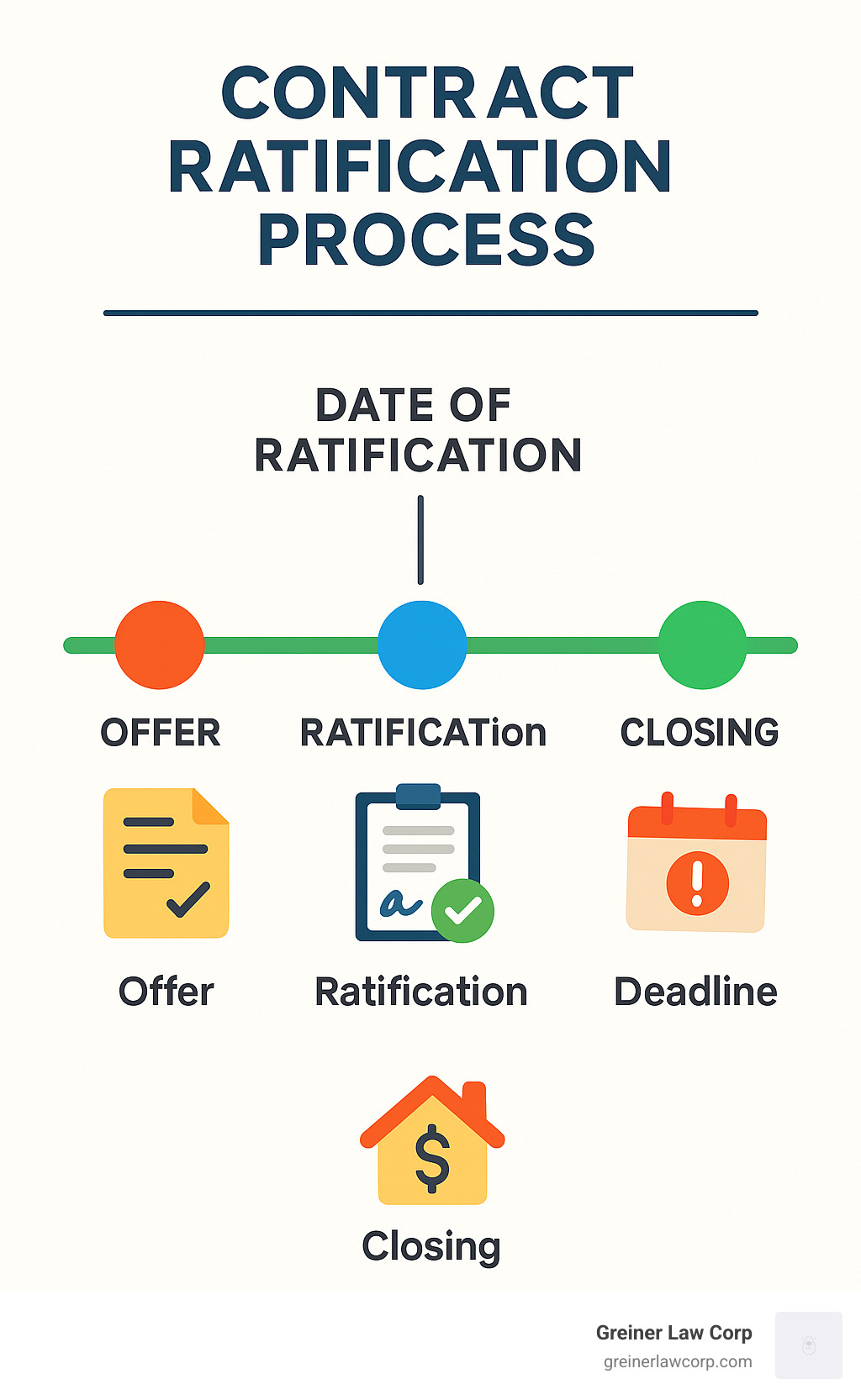
Date of ratification real estate contract word guide:
– ratification in real estate means
– what is contract ratification
Why This Guide Matters
This guide is essential for anyone involved in a real estate transaction:
- Buyers need to understand when their contingency clocks start ticking
- Sellers must know when they’re legally bound to sell their property
- Real estate agents have a professional duty to accurately track and communicate these critical dates
- Attorneys rely on precise ratification dates when resolving disputes or drafting amendments
At Greiner Law Corp, we’ve seen countless deals complicated by confusion over ratification dates. With California’s competitive real estate market, particularly in regions like Los Angeles, Riverside, San Bernardino, and Victorville, understanding these technicalities can mean the difference between a smooth transaction and a costly dispute.
What Is the “Date of Ratification” in a Real Estate Contract?
When you’re buying or selling a home, the date of ratification in a real estate contract might sound like legal jargon, but it’s actually a critical milestone that affects everything that follows. Simply put, it’s the moment when your contract springs to life and becomes legally binding.
Think of ratification as the official “handshake” in your real estate deal. It happens when both buyer and seller have agreed to identical terms and have communicated that acceptance to each other. The Northern Virginia Residential Sales Contract puts it nicely: ratification is “delivery of the final acceptance in writing by both parties.” This definition holds true whether you’re in Virginia, California, or most other states.
For ratification to occur, four things must happen: you need a complete written contract with all terms agreed upon, signatures from both the buyer and seller, clear mutual acceptance of all terms, and—this is crucial—communication or delivery of the final acceptance to the other party.
Many people confuse ratification with other important dates in the process. Here’s how they differ:
| Concept | Ratification Date | Execution Date | Effective Date | Closing Date |
|---|---|---|---|---|
| Definition | When contract becomes legally binding | When all parties sign | When obligations become enforceable | When property ownership transfers |
| Timing | Upon delivery of final acceptance | May occur before ratification | Usually same as ratification | Typically 30-60 days after ratification |
| Legal Significance | Starts all contingency periods | Confirms parties’ intent | Marks enforceability | Completes the transaction |
| Who Determines | Delivery of final signature | All required signatories | Often specified in contract | Set in original contract or amendments |
I’ve seen clients get confused about this distinction many times. As one experienced real estate professional told me recently, “Ratification occurred when the seller accepted and delivered the signed acceptance to the buyer’s agent.” The key word here is “delivered”—signing alone isn’t enough.
Counting Deadlines from the Date of Ratification Real Estate Contract
Once your contract is ratified, the clock starts ticking on numerous deadlines. Think of the date of ratification in a real estate contract as the starting gun in a race—everything is timed from this moment forward.
Your inspection period usually runs 7-14 days from ratification, giving you a short window to bring in professionals to check the property. The financing contingency typically extends 21-30 days, during which you need to secure your mortgage. Your earnest money deposit (your good-faith payment) is often due within just 1-3 days of ratification.
Other important timelines include your appraisal contingency (usually within the financing period), title review (starts immediately after ratification), final walkthrough (1-5 days before closing), and of course, your closing date (commonly 30, 45, or 60 days from ratification).
In competitive California markets, especially around Los Angeles and Riverside, we often see these timelines compressed to make offers more attractive to sellers. A buyer willing to complete inspections in 5 days instead of 10 might win the bid in a multiple-offer situation.
One common mistake I see? Assuming deadlines start when you sign the contract. If there’s a delay in delivering that signed contract to the other party, your ratification date will be later than your signature date—potentially giving you less time than you thought.
Key Parties Who Confirm the Date
Several people play important roles in establishing when ratification occurs:
The listing agent typically documents the ratification date when the seller accepts the offer. The buyer’s agent must confirm receipt of the fully executed contract to establish ratification. Your escrow officer relies on this date to set up the entire escrow timeline. And attorneys like myself may review and confirm the ratification date, especially if there’s any dispute.
Best practice is for “the Listing Firm to sign and indicate the ‘Date of Ratification’ when delivering the accepted offer.” This creates a clear record everyone can reference.
When working with a Ratified Contract, I always recommend that all parties receive written confirmation of the ratification date. This ensures everyone is working from the same timeline and helps prevent misunderstandings that could derail your transaction.
In real estate, timing is everything—and it all starts with that crucial date of ratification.
Determining the Ratification Date: Step-By-Step Timeline
Getting to that magical moment of contract ratification is a bit like a dance between buyer and seller – each step needs to happen in the right order before the music starts. Here’s how the process typically unfolds:
First, a buyer submits their written offer with hopeful anticipation. The seller then responds by accepting it outright (rare in competitive markets!), rejecting it entirely, or – most commonly – sending back a counteroffer with changes. This back-and-forth negotiation can involve multiple counteroffers until both sides finally land on terms everyone can live with.
Once there’s agreement on all terms, signatures are collected from all required parties. But here’s where many people get confused: the date of ratification real estate contract isn’t necessarily when the last person signs – it’s when that fully signed contract is actually delivered to all parties and receipt is acknowledged.
The final step is documenting this ratification date clearly in the contract itself, typically in a designated acceptance box.

In California’s real estate market, electronic signatures have become a blessing for establishing clear timestamps. Our state’s Civil Code fully recognizes e-signatures as legally binding, and electronic delivery counts as valid delivery for establishing when ratification occurs. This digital paper trail can be invaluable if questions arise later.
I’ve seen cases where a contract was signed at 11:45 PM but not emailed until the next morning – making the ratification date the following day, which shifted all contingency deadlines by a full day. These details matter!
Avoiding Disputes Around the Date of Ratification Real Estate Contract
Nothing derails a smooth transaction faster than disagreement about when the contract was actually ratified. In my years of practice, I’ve seen simple misunderstandings turn into expensive problems. Here are the best ways to keep everyone on the same timeline:
Always use clear time-stamping with your signatures – date AND time matter. When you’ve got the fully executed contract, send explicit written notice to the other party confirming ratification has occurred. Complete any designated “acceptance box” in your contract form that specifically notes the ratification date.
Keep meticulous records of delivery – whether that’s email receipts, certified mail tracking, or electronic delivery confirmations. Your future self will thank you! And when dealing with backup offers in competitive situations, be crystal clear about the ratification status of each offer.
One real estate agent I know learned this lesson the hard way: “Using DotLoop’s auto-delivery to ratify an offer cost the seller thousands.” The platform automatically delivered the signed documents before the seller had reviewed other offers, inadvertently ratifying a contract earlier than intended.
At Greiner Law Corp, we always recommend documenting the exact moment of delivery and receipt, especially when multiple offers are circling. In hot markets like Los Angeles or Riverside, where offers can arrive minutes apart, this precision isn’t just helpful – protecting your interests and avoiding disputes that could derail your transaction.
Impact on Contingencies, Deadlines & Closing
Think of the date of ratification real estate contract as the starting gun in a race. Once that date is established, the clock starts ticking on nearly everything that follows. This date isn’t just a formality—it’s the cornerstone of your entire transaction timeline.
Inspection Period
After ratification, buyers typically have a window to thoroughly check out their potential new home. In California’s markets, this inspection period usually runs 7-17 days, though in hot markets, I’ve seen buyers offer as few as 3-5 days to make their offer more attractive.
Picture this: Your contract gets ratified on June 1st with a 10-day inspection contingency. This means you have until June 11th to complete all inspections and submit any repair requests. Miss this deadline, and you might find yourself stuck with that cracked foundation or leaky roof—or having to proceed without the protection of your contingency.
Appraisal Window
Lenders aren’t just handing out money without ensuring the property is worth what you’re paying. The appraisal timeline typically runs alongside your financing contingency, with several key deadlines:
You’ll generally need to order the appraisal within about 5 days of ratification, ensure it’s completed within around 21 days, and resolve any valuation issues within 30 days. If the property doesn’t appraise for the purchase price, you’ll need time to negotiate or potentially come up with additional cash—all within the timeframe that started with your ratification date.
Loan Commitment
Your financing contingency doesn’t just say “get a loan”—it includes specific milestones that all stem from the date of ratification real estate contract:
Most contracts require you to apply for financing within 3-5 days of ratification, secure a loan commitment within 21-30 days, and provide proof to the seller at specified checkpoints. Missing these deadlines could put your earnest money at risk or even void the entire deal.
Earnest Money Deposit
Your earnest money—that good-faith deposit showing you’re serious about buying—typically comes due either with your initial offer or within 1-3 business days after ratification. In California markets, I usually see deposits ranging from 1-3% of the purchase price, though this can vary based on local practices and market conditions.
This money becomes particularly important as deadlines approach, as it’s often what you stand to lose if you miss a contingency deadline without proper cause.

Closing Date
The grand finale—your closing date—is typically calculated as a specific number of days from ratification:
Cash purchases often close quickly, around 30 days. Conventional loans typically need 30-45 days, while government-backed loans like FHA or VA might require 45-60 days to process all the additional paperwork. The important thing to remember is that this date isn’t arbitrary—it’s directly tied to your ratification date.
For a deeper dive into standard contingencies that protect buyers, the Home Inspection guide provides valuable insights worth reviewing before finalizing your contract.
How Missing a Ratification Date Can Void a Deal
I’ve seen simple miscalculations about the date of ratification real estate contract lead to major headaches and even killed deals. Here’s what can happen when dates are missed:
When buyers miss inspection deadlines, they often lose the right to request repairs or back out based on property condition. I remember one client who miscounted weekend days and missed their inspection deadline by just 24 hours—the seller refused to consider their repair requests, leaving them with $12,000 in unexpected plumbing repairs.
Missing contractual deadlines can constitute a breach, potentially allowing the other party to walk away from the deal entirely. Your earnest money could be forfeited if you fail to perform within the required timeframes. And disagreements about whether deadlines were met often lead to costly, stressful litigation.
One particularly painful example I witnessed involved a buyer’s agent who incorrectly calculated the inspection period from the contract date instead of the ratification date. By the time the buyer submitted their repair requests, the deadline had passed. The seller, sensing the buyer really wanted the home, refused to negotiate any repairs. The buyer had to choose between buying the house with known defects or potentially losing their $15,000 earnest money deposit by trying to cancel.
The lesson? When it comes to real estate transactions, dates matter—and understanding exactly when your contract was ratified is the foundation for every deadline that follows.
Pitfalls, Disputes and State Variations
Figuring out the exact date of ratification real estate contract can sometimes feel like navigating a maze. Let’s explore some of the common complications that might trip you up along the way.
Late Delivery Issues
Picture this: a seller signs your counteroffer on Monday but doesn’t actually send it until Wednesday. When does ratification happen? Wednesday—not Monday. This gap between signing and delivery catches many people by surprise.
I had a client who thought their home purchase was ratified when the seller signed on Friday, but the documents weren’t delivered until after the weekend. Those two extra days shifted all their inspection and financing deadlines, creating a scheduling scramble they weren’t prepared for.
Backdating Concerns
The temptation to backdate a contract sometimes arises, especially when deadlines are tight. However, this is a serious no-no. As one industry expert bluntly put it: “Backdating a contract is never acceptable and can even be criminal.” Always use the actual date when final acceptance and delivery occurred—your future self will thank you for the honesty.
Calendar Complications
“Wait, does the contract say calendar days or business days?” This question has saved many transactions from derailing. The difference is significant:
Calendar days include weekends and holidays—the clock keeps ticking no matter what.
Business days skip over weekends and typically exclude holidays—giving you some breathing room.
So if your contract is ratified on Friday with a 5-day deadline, you’ll have until Wednesday with calendar days, but until the following Friday with business days. That extra time can be crucial when coordinating inspections or securing financing.

Holiday Counting
Holidays add another layer of complexity to deadline calculations. Not all jurisdictions recognize the same holidays, and California has its own specific set. Your contract should specify which holidays don’t count as business days, typically including:
– Federal holidays like Memorial Day and Independence Day
– California state holidays
– Banking holidays when financial institutions are closed
I once saw a deal nearly fall apart because the parties disagreed about whether Presidents’ Day counted as a business day. The contract didn’t specify, leading to a two-day discrepancy in when the financing contingency expired.
State Form Variations
If you’re using California Association of REALTORS® (CAR) forms, you’ll notice they include a specific section for recording the ratification date. This isn’t just a formality—it’s a crucial documentation step that can prevent disputes later. Always make sure this section is completed accurately and promptly.
Minors and Voidable Contracts
Here’s an interesting twist: “A teenager signs a lease; because they are a minor, the contract is voidable until ratified.” While not common in real estate transactions, this occasionally affects young adults purchasing their first property. If you’re under 18, you might need a co-signer to create a binding contract that can’t be voided later.
Common Scenarios Triggering Disputes
Let me share some real-world situations where ratification dates commonly become contentious:
1. Competing Offers
In hot markets, sellers often review multiple offers simultaneously. This can create confusion about which offer was actually ratified first. I advise sellers to hold back sending the final signed acceptance until they’re absolutely certain it represents their best available deal. Once that document is delivered, you’ve legally committed—even if a better offer arrives minutes later.
2. Automated Platforms
Digital convenience sometimes comes with unexpected consequences. Many transaction platforms automatically deliver documents as soon as they’re signed. I’ve seen cases where “automated systems inadvertently deliver the signed acceptance, prematurely ratifying the contract and locking in less favorable terms.” Always check your platform settings to ensure you control when documents are delivered.
3. Unsigned Amendments
Verbal agreements to modify contract terms don’t count until they’re properly documented with signatures and delivery. I’ve seen countless situations where parties thought they had new terms in place, but legally, the original ratification date and terms still governed because the amendments weren’t properly executed.
For deeper insights into these nuanced situations, take a look at our guide on What is Contract Ratification?
At Greiner Law Corp, we’ve helped countless clients steer these tricky waters. The key takeaway? Be precise about documenting your date of ratification real estate contract, and when in doubt, consult with an attorney who understands the specific requirements in your jurisdiction.
Best Practices & Documentation Checklist
When it comes to the date of ratification real estate contract, a little preparation goes a long way. I’ve seen countless transactions hit snags because someone wasn’t clear about when the clock started ticking. Let’s make sure that doesn’t happen to you.
The acceptance box on your contract isn’t just another blank space to fill—it’s arguably one of the most important parts of your paperwork. This small section officially documents when your deal became binding, so take the extra moment to complete it accurately. Your future self will thank you!
“I always tell my clients to get written confirmation when they deliver the executed contract,” says David Greiner. “A simple email reply saying ‘received the fully executed contract on Tuesday at 2pm’ can prevent a world of headaches later.” This small step creates an invaluable paper trail that protects everyone involved.
In our digital age, maintaining electronic records is easier than ever. Save those emails, text messages, and electronic delivery receipts that show exactly when the contract changed hands. These digital breadcrumbs might seem insignificant now, but they can become crucial evidence if questions arise later.

Once you’ve confirmed ratification, grab your calendar immediately. Mark down every single deadline that stems from this date—inspection periods, financing contingencies, deposit due dates. I’ve found that building in personal buffers (setting your reminders 1-2 days early) provides valuable breathing room when unexpected issues pop up.
In particularly complex or high-stakes transactions, having an attorney review your contract and verify key dates is money well spent. At Greiner Law Corp, we often help clients steer these critical timing elements to ensure nothing falls through the cracks.
When multiple offers are flying around, the specific time of ratification—not just the date—can become critically important. “I had a case where two offers were ratified on the same day, but the timestamp made all the difference in determining which one was legally binding,” recalls Greiner. In competitive markets like Los Angeles or Riverside, these details matter tremendously.
Clear communication eliminates confusion. Instead of vague references, use explicit statements like: “The contract was ratified on June 15th when Mrs. Johnson received the fully executed agreement at 3:45pm.” This precision leaves no room for misinterpretation.
For deeper insights into how real estate contracts work, our comprehensive guide on Real Estate Contracts Explained breaks down everything you need to know in plain English.
Quick Checklist Before You Start Day-One Counting
Before you begin tracking those all-important deadlines from your date of ratification real estate contract, take a moment to verify these essentials:
Do you have solid proof of when the executed contract was delivered? Without this documentation, you’re building on a shaky foundation. Make sure everyone—buyers, sellers, and their representatives—explicitly agrees on the ratification date to prevent disputes down the road.
Creating a visual contingency chart or timeline helps immensely. Whether you prefer a spreadsheet, calendar app, or old-school wall calendar, mapping out all your deadlines provides clarity for everyone involved. Set those reminder alerts now, not later—most people underestimate how quickly these deadlines approach once the transaction is moving.
Finally, establish a shared folder (whether digital or physical) where all transaction documents live. This central repository ensures everyone can access critical paperwork when needed, reducing the frantic “where’s that document?” scrambles that often happen as deadlines loom.
At Greiner Law Corp, we’ve guided countless clients through the ratification process, helping them understand exactly when their contractual obligations begin. With careful attention to these documentation practices, you’ll steer your real estate transaction with confidence and clarity.
Frequently Asked Questions about the Date of Ratification
Is the ratification date always the last signature date?
No, and this is one of the most common misunderstandings in real estate transactions. While signatures are absolutely necessary for ratification, they’re only part of the equation. The date of ratification real estate contract is when the fully executed agreement has been delivered to all parties – not just when the ink dries.
Think of it this way: if a seller signs a counteroffer on Monday but their agent doesn’t email it to the buyer until Wednesday, the ratification date is Wednesday (assuming the buyer had already signed). This isn’t just a technicality – it directly impacts when your inspection period starts, when your earnest money is due, and ultimately, your closing timeline.
I’ve seen many clients get confused about this distinction, especially first-time homebuyers who mark their calendars based on when they signed, only to find they’ve lost precious days from their contingency periods.
Who writes the ratification date on the contract?
The responsibility typically falls to the agent representing the party who signs last – which in most transactions means the listing agent. After the seller signs and the contract is delivered to the buyer’s agent, the listing agent should complete the acceptance box with the proper ratification date.
Best practice, as real estate professionals often note, is for “the Listing Firm to sign and indicate the ‘Date of Ratification’ when delivering the accepted offer.” That said, local customs can vary considerably from market to market.
What matters most is that someone clearly documents this critical date. At Greiner Law Corp, we often recommend explicitly assigning this responsibility in writing to avoid any confusion down the road. When disputes arise, they frequently center around who was responsible for marking this date – a simple conversation upfront can prevent headaches later.
Can the ratification date be changed after signing?
Generally speaking, no – and for good reason. The date of ratification real estate contract isn’t something parties can negotiate or adjust; it’s a factual matter representing the moment when the contract became legally binding through mutual acceptance and delivery.
If you need to extend deadlines that were calculated from the ratification date (perhaps you need more time for inspections), the proper approach is to execute a written amendment that specifically changes those deadlines – not to alter the ratification date itself.
I once had a client who wanted to “adjust” the ratification date because they realized they wouldn’t be able to complete inspections in time. I had to explain that backdating a contract isn’t just problematic – it can be unethical and potentially fraudulent. As one legal expert bluntly puts it: “Is it OK to backdate a contract? No; backdating a contract is unethical, can be illegal, and in some jurisdictions may constitute a crime.”
There are rare situations where clarification might be needed – for instance, if there was genuine confusion about when delivery occurred due to technical issues with electronic signatures. In these limited cases, all parties should document their agreement about the correct ratification date in writing.
The ratification date isn’t arbitrary – it’s the foundation that your entire transaction timeline is built upon. Treating it with appropriate care will help ensure your real estate transaction proceeds smoothly from start to finish.
Conclusion and Next Steps
Understanding the date of ratification in real estate contracts isn’t just a legal technicality—it’s the cornerstone of your entire transaction timeline. Think of it as the starting gun in a race, setting everything else in motion.
At Greiner Law Corp, we’ve seen how misunderstandings about ratification dates can derail otherwise smooth transactions. That’s why we take a practical, business-minded approach to helping our clients steer these waters. We understand you’re not just buying or selling property—you’re making important life and business decisions that require balancing opportunity with risk.

Whether you’re a first-time homebuyer in Victorville, an experienced investor in Riverside, or managing commercial properties throughout Los Angeles or San Bernardino, getting the ratification date right matters. This single date determines when your inspection period ends, when your loan commitment is due, and ultimately, when you’ll close on the property.
I’ve found that successful clients typically do three things well when it comes to ratification dates:
First, they ensure proper documentation—getting that ratification date clearly recorded and acknowledged by all parties.
Second, they communicate proactively—making sure everyone involved in the transaction understands which date is controlling all deadlines.
Third, they build in buffers—setting personal deadlines a day or two before contractual deadlines to avoid last-minute surprises.
While technology has made signing contracts easier, it’s also created new pitfalls. Those automated delivery timestamps can inadvertently ratify contracts before you’re ready. Taking a moment to verify the exact delivery and receipt can save significant headaches down the road.
For those complex transactions—or simply for peace of mind—having an attorney review your contract before key deadlines pass can be invaluable. At Greiner Law Corp, we pride ourselves on offering practical guidance that helps you manage risk while achieving your real estate goals.
Need help navigating a California real estate transaction? We’re here to assist with everything from contract review to negotiation to dispute resolution. Our team brings decades of experience to the table, with a focus on protecting your interests while keeping transactions on track.
For more information about our real estate legal services, visit our Real Estate Lawyer Riverside page or reach out to any of our offices in Victorville, Riverside, San Bernardino, or Los Angeles. We’d be happy to help you steer your next real estate trip with confidence and clarity.


