What Is a Ratified Contract: The Foundation of Legally Binding Agreements
Have you ever shaken hands on a deal and wondered, “Is this legally binding yet?” That’s where the concept of a ratified contract comes into play.
A ratified contract is more than just a piece of paper with terms—it represents the moment when all parties have formally approved an agreement, breathing legal life into what was previously just a proposal. When both sides say “yes” to the same terms and formalize that acceptance (typically with signatures), the agreement crosses the threshold into becoming legally enforceable.
In my years of practice, I’ve seen countless clients breathe a sigh of relief when their contracts reach ratification. It’s that pivotal moment when handshakes and discussions transform into concrete legal obligations that courts will recognize and enforce.
Quick Answer: What is a ratified contract?
| Definition | A contract that becomes legally enforceable once all parties have agreed to its terms and formalized their consent |
|---|---|
| Key Elements | • Mutual agreement on all terms • Formal acceptance (signatures or implied through conduct) • Delivery of the signed document • Exchange of consideration (something of value) |
| Common Uses | • Real estate transactions • Business agreements • Employment contracts • Collective bargaining agreements |
| Legal Status | Legally binding and enforceable once ratified |
This concept is especially important in real estate transactions, where timing is everything. When you’re buying or selling property, the ratified contract marks that critical moment when both buyer and seller have agreed to all terms of the purchase agreement. This creates legal obligations for both parties, though it’s worth noting that this is still distinct from an “executed contract” where all terms have been fully performed and the deal is complete.
Think of ratification as the starting gun in a race—it sets everything in motion. Once your real estate contract is ratified, the clock starts ticking on inspections, financing contingencies, and your closing date.
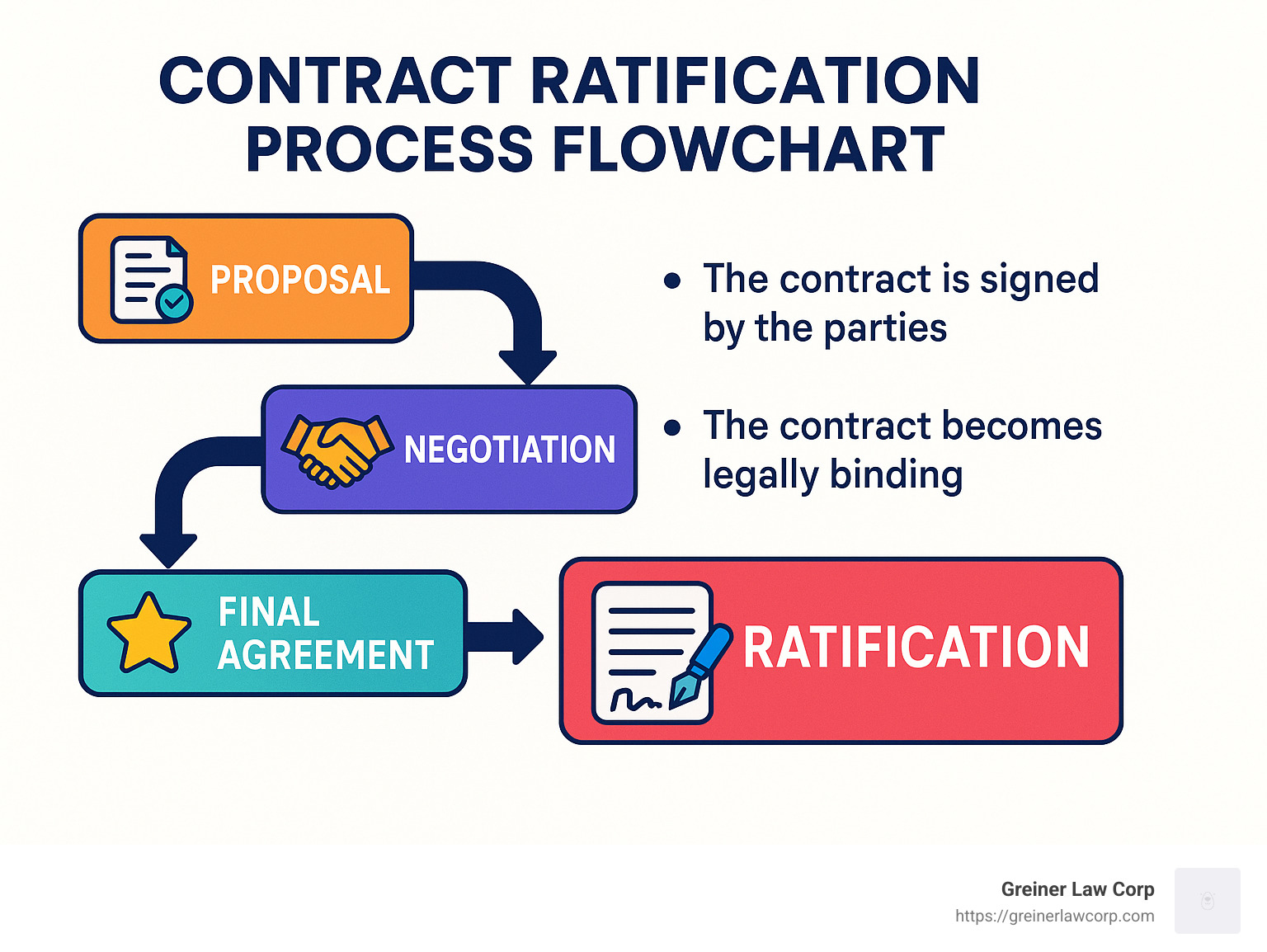
The path to ratification follows a natural progression: an offer is made, perhaps countered and negotiated, and finally accepted by all parties. Then comes the formal signing, delivery of the signed document, and typically an exchange of consideration (like earnest money in real estate deals) to seal the deal.
Why should you care about proper ratification? Because it:
- Establishes legal enforceability – Without proper ratification, you might just have a conversation, not a contract
- Triggers deadlines and contingencies – The ratification date becomes the reference point for timing requirements
- Provides legal protection – Creates clear documentation of what all parties agreed to, protecting you if disputes arise
- Creates certainty – Everyone can move forward with confidence knowing the deal is official
As a business-minded attorney, I’ve guided countless clients through the ratification process, ensuring their interests are protected while moving transactions forward efficiently. The goal isn’t just legal compliance—it’s achieving your business objectives with appropriate risk management.
Want to learn more about contract ratification? These resources may help:
– Can a company ratify a pre-incorporation contract
– Define ratification
– What is ratification
Ratified Contract Fundamentals: What It Is & Why It Matters
Ever signed a document and felt that little surge of relief when everyone finally agrees? That’s the magic of a ratified contract in action!
A ratified contract is much more than just a piece of paper with signatures. It’s the moment when a proposal transforms into a legally binding promise between parties. Think of it as the handshake that actually means something in the eyes of the law.
When working with clients in California real estate transactions, I often explain that ratification is when your agreement gets its legal superpowers. Before ratification, you’re just discussing possibilities. After? You’ve created legal obligations that both parties must honor.
The essential ingredients that make a ratified contract valid include mutual assent (everyone’s genuinely on the same page), consideration (something valuable changes hands), an effective date (when the agreement officially begins), and proper signing authority (the right people with the right permissions).
Courts have consistently recognized that ratification isn’t always about ink on paper. As noted in Bi-County Props v. Wampler, “Conduct, including an acceptance of benefits under a contract, may be sufficient to constitute a ratification binding on the party accepting the benefits as if he had signed the contract.” This means sometimes actions speak as loudly as signatures!
The ratification date is particularly crucial in real estate deals. When your purchase agreement states “inspections must be completed within 10 days of ratification,” that clock starts ticking the moment the last person signs and delivers the contract. Miss this detail, and you might find yourself scrambling to meet deadlines you didn’t realize had started.
More info about ratification services
Key Steps & Requirements for a Ratified Contract
Creating a properly ratified contract involves several key steps that build upon each other.
First comes the dance of offer and acceptance—one party proposes terms, and the other either accepts them completely or counters with changes. This back-and-forth continues until both sides reach perfect agreement.
Before signing, a thorough review is essential. I can’t tell you how many clients have thanked me for catching details they would have missed during this critical phase!
The signature phase makes it official. In real estate transactions, buyers and sellers must sign, but depending on your situation, additional signatures might be necessary. A signature represents understanding and commitment to the terms.
Delivery is often overlooked but absolutely crucial. In California real estate, your contract isn’t actually ratified until all parties receive the fully signed document. I’ve seen deals fall apart because someone assumed ratification occurred upon signing, not delivery.
For real estate purchases, the earnest money deposit follows ratification—typically 1-10% of the purchase price. This good-faith deposit demonstrates the buyer’s serious intention to complete the purchase.
Any contingencies—like financing approval, satisfactory inspections, or acceptable appraisals—must be clearly acknowledged in the contract. These are your escape hatches if certain conditions aren’t met.
Finally, everyone signing must have legal capacity—they must be adults of sound mind who understand what they’re agreeing to.
Who Must Be Involved in Ratification?
The cast of characters in the ratification process varies depending on what kind of agreement you’re creating.
Buyers and sellers are the stars of the show, particularly in real estate transactions. They’re the primary parties whose agreement forms the heart of the contract.
Real estate agents often serve as directors, orchestrating the process and ensuring all paperwork flows smoothly, though they typically aren’t signatories to the purchase agreement itself.
Attorneys like myself review contracts before ratification, helping clients understand implications and suggesting modifications to protect their interests.
After ratification, lenders jump into action for financed purchases, processing loan applications and conducting their due diligence.
Title companies verify property ownership and manage the closing process, while escrow companies hold funds and documents throughout the transaction.
Some contracts require witnesses to verify the authenticity of signatures, adding an extra layer of protection against future disputes.
I recently helped a client through their first home purchase, and they perfectly captured the post-ratification experience: “Once our contract was ratified, it felt like everything moved at lightning speed—inspectors called, the lender needed documents, and the title company reached out all within 24 hours.”
That’s the power of a ratified contract—it doesn’t just document agreement; it kickstarts action!
Ratified Contract vs. Executed, Void & Voidable Agreements
Understanding the distinction between different contract statuses is crucial when navigating legal agreements. A ratified contract differs significantly from executed, void, and voidable agreements in terms of enforceability and legal standing.

Think of contract statuses as different stages in a relationship. A ratified contract is like a marriage after the “I dos” – everyone has agreed, but there’s still a lifetime of obligations ahead. An executed contract is more like celebrating your 50th anniversary – all promises have been kept and fulfilled.
| Contract Type | Definition | Enforceability | Example |
|---|---|---|---|
| Ratified | Agreement approved by all parties | Legally binding and enforceable | A signed real estate purchase agreement |
| Executed | Contract where all obligations have been fulfilled | Completed; no further obligations | A home purchase where closing has occurred and property transferred |
| Void | Agreement that has no legal effect | Never enforceable under any circumstances | Contract for illegal activities |
| Voidable | Contract that can be cancelled by one party | Enforceable unless voided by the affected party | Contract signed by a minor |
Void contracts are essentially legal ghosts – they appear to exist but have no substance or enforceability. A contract to sell illegal drugs, for instance, can never be legally enforced, no matter how much both parties want it to be.
Voidable contracts are more like legal shape-shifters. They start out valid but can be canceled by one party under certain circumstances. As noted in Yancey v. O’Kelley, “It is also well-settled law in this State that a contract made by one during his minority may be ratified and confirmed by him after reaching majority, either expressly or impliedly by conduct.” This means that even contracts with inherent flaws can sometimes transform into fully ratified contracts.
Corporate governance provides another interesting example of ratification. The California Corporations Code § 310 allows for after-the-fact approval of directors’ or officers’ actions that might otherwise create conflicts of interest – essentially ratifying what could have been problematic agreements.
Can a Voidable Contract Become a Ratified Contract?
Yes! A voidable contract can absolutely become a ratified contract through proper ratification procedures. It’s like getting a second chance at a relationship after working through some initial problems.
I recently helped a client who finded that their business partner had misrepresented inventory values in their purchase agreement. Rather than void the contract, they chose to negotiate new terms that addressed the issue and explicitly ratified the amended agreement. The once-shaky contract became rock-solid and fully enforceable.
Several scenarios commonly lead to this voidable-to-valid change:
When a minor reaches adulthood and decides to honor a contract they made while underage, their actions (like continuing to make payments) can ratify what was previously voidable. Similarly, contracts made under duress or undue influence can be ratified once the pressure is removed if the affected party freely chooses to proceed.
Contracts with misrepresentations don’t always need to be thrown out. If you find someone wasn’t entirely truthful but decide the deal still works for you, your continued performance can ratify the agreement. And when someone acts as your agent without proper authority, you can later approve their actions, turning an unauthorized agreement into a ratified contract.
The key is clear communication and documentation. Whether through a formal written statement, signing an amendment, or through conduct that clearly shows acceptance, the intent to ratify must be unambiguous.
How Is a Ratified Contract Different from an Executed Contract?
The difference between a ratified contract and an executed contract is like the difference between planning a vacation and having returned from one. Both are real, but they represent different stages of completion.
In a ratified contract, all parties have signed on the dotted line and agreed to the terms, but the journey is just beginning. The obligations still need to be fulfilled. An executed contract, on the other hand, means everyone has done exactly what they promised to do – mission accomplished!
This distinction is particularly important in real estate. When you and a seller both sign a purchase agreement for a home in California, you have a ratified contract. But it’s not executed until closing day when you get the keys, the deed is recorded with the county, and the seller receives payment.
The period between ratification and execution is where most of the action happens. During this time, you’ll schedule home inspections, secure financing, and work through contingencies. It’s also when things can still go sideways – if your loan falls through or the inspection reveals major problems, the contract might never reach execution.
I often tell my clients that ratification is when the clock starts ticking. All those deadlines in your contract – 17 days for inspections, 21 days for loan approval – they all begin counting from the ratification date, not when you first made the offer.
Understanding these distinctions isn’t just legal nitpicking – it has real consequences for your rights and obligations. Whether you’re buying a home, starting a business partnership, or entering any significant agreement, knowing exactly where you stand in the contract lifecycle can save you from costly misunderstandings down the road.
Ratifying Contracts in Real Estate: Step-by-Step & Post-Ratification Checklist
The journey to a ratified contract in real estate follows a clear path that transforms a simple property interest into a legally binding agreement. Having guided countless clients through this process, I’ve seen how understanding each step can make all the difference.
When you’re ready to buy or sell a home, the process typically begins with an offer. The buyer submits a written proposal outlining purchase terms – including price, contingencies, and their ideal closing timeline. The seller then has three options: accept the offer as-is, reject it outright, or (most commonly) counter with modified terms.
What follows is often a dance of counteroffers as both parties negotiate to find middle ground. I remember working with a young couple in San Diego who went through four rounds of counteroffers before reaching terms everyone felt good about. This back-and-forth continues until one party accepts the other’s terms without changes – that’s when we’ve reached final acceptance.
With agreement in place, both parties sign the final contract version. The moment this fully signed document is delivered to all parties marks the official ratification date – a critical milestone that starts the clock on everything that follows. Within 1-3 business days after ratification, the buyer provides their earnest money deposit to demonstrate their commitment.

“I didn’t realize how important the ratification date was until our agent explained that all our inspection deadlines were calculated from that specific day,” shared one of our clients from Riverside recently. This date isn’t just a formality – it’s the anchor point for your entire transaction timeline.
Real Estate Contracts Explained
Detailed Ratification Process
Getting to a properly ratified contract requires attention to several key elements. Every offer and counteroffer should be documented in writing, complete with initials and dates from whoever is making the proposal. This creates a clear paper trail of the negotiation process.
Contingencies need crystal-clear language and specific timeframes. When I review contracts for clients, I make sure these contingencies have precise deadlines – typically calculated from the ratification date. For example, inspection periods usually run 7-17 days, loan applications often need to be submitted within 3-5 days, and loan commitments typically need to be secured within 21-30 days.
Good news for tech-savvy clients: electronic signatures are completely valid for California real estate contracts, thanks to the Uniform Electronic Transactions Act and the federal E-SIGN Act. However, I always advise keeping proof of when the fully signed contract was delivered to all parties. This documentation helps establish the precise ratification date if questions arise later.
What Happens After the Contract Is Ratified?
Once your contract is ratified, the real work begins! The buyer delivers their earnest money to the escrow company, typically within 1-3 business days. Then comes a flurry of activity as inspections are scheduled – from general home inspections to pest inspections, and sometimes specialized examinations for specific concerns like radon, septic systems, or wells.
The financing process kicks into high gear as the buyer formally applies for their mortgage and provides all required documentation. The lender orders an appraisal to confirm the property’s value matches the purchase price, while simultaneously, the title company conducts a thorough search to identify any liens or ownership issues.
If the property has a homeowners association, the buyer reviews all HOA documents, bylaws, and financial statements. The buyer also secures appropriate insurance coverage for their new property. As each of these conditions is satisfied, contingencies are formally removed in writing.
The final stretch includes receiving loan approval, preparing closing documents, calculating final costs, and conducting a final walkthrough of the property. At closing, all parties sign the final documents and funds are transferred. The deed is recorded with the county, officially transferring ownership, and the buyer takes possession according to the terms of the contract.
I often tell my San Bernardino clients, “The period between ratification and closing is when the real work begins. Stay organized and meet all deadlines to ensure a smooth transaction.” Missing even one deadline can create significant complications.
Amending or Cancelling a Ratified Contract
Life happens, and sometimes circumstances require changes to a ratified contract. Amendments must be in writing, signed by all original parties, clearly reference the original contract, specify exactly which terms are being modified, and affirm that all other terms remain unchanged.
I’ve helped clients amend contracts for various reasons – extending contingency deadlines when inspections took longer than expected, adjusting closing dates due to lender delays, modifying repair requirements after inspections revealed unexpected issues, or changing financing terms when better options became available.
Despite the binding nature of a ratified contract, cancellations do occur. Financing contingencies protect buyers who cannot secure a mortgage loan. Inspection contingencies allow withdrawal if significant property defects are finded. Appraisal contingencies permit cancellation if the property appraises below the purchase price. Title contingencies protect against unresolvable ownership issues. And sometimes, both parties simply agree to walk away.
When exercising a contingency to cancel, buyers need to provide written notice within the specified timeframe. The earnest money is returned according to the contract terms, and all parties sign a formal release.
California real estate contracts typically include “time-is-of-essence” clauses that emphasize the importance of meeting deadlines. Missing a contingency deadline could mean waiving important protections or even breaching the contract. I recently worked with a family who nearly lost their earnest money deposit because they missed their inspection contingency deadline by just one day – we managed to negotiate an extension, but it was a close call!
Understanding the ratified contract process gives you confidence as you steer what might be the largest transaction of your life. At Greiner Law Corp, we believe knowledge empowers our clients to make better decisions while we handle the legal complexities.
Ratification Beyond Real Estate & Common Pitfalls to Avoid
While real estate transactions are where you’ll most commonly encounter ratified contracts, the concept stretches far beyond property deals. As we’ve seen with our clients across California, understanding how ratification works in various contexts can help you steer complex legal situations with confidence.
Applications Beyond Real Estate
Think about the workplace for a moment. If a manager hires someone without proper authorization, but the company starts paying that person’s salary, the company has essentially ratified the employment contract through its actions. No formal declaration needed – the paychecks speak volumes.
In corporate settings, boards of directors frequently ratify actions taken by officers who initially exceeded their authority. California Corporations Code § 310 specifically addresses this, allowing boards to approve potentially conflicting transactions after they’ve already occurred. It’s like saying, “We know this wasn’t done by the book initially, but we’re making it official now.”
Labor agreements provide another fascinating example. When union representatives negotiate with management, the resulting agreement typically requires ratification by union membership. In the noteworthy Granite Rock Co. v. Teamsters case, the Supreme Court recognized that members could ratify a collective bargaining agreement through their conduct, even without a formal vote. Actions truly do speak louder than words.
Remember those contracts you signed before turning 18? As established in Yancey v. O’Kelley, these agreements can be ratified once you reach adulthood – either explicitly or implicitly through your behavior. If you continue making payments on that car you financed at 17, you’ve likely ratified the contract after turning 18.
Even international treaties follow similar principles to the U.S. Constitution’s ratification process from 1788, requiring formal approval procedures by participating nations before taking effect.

Common Pitfalls to Avoid
Over the years, I’ve watched clients stumble into the same contract pitfalls repeatedly. Let me share some wisdom to help you avoid these common traps:
Vague language creates endless headaches. “The work will be completed soon” means something different to everyone involved. Always insist on specific, measurable terms – “the work will be completed by July 15, 2024” leaves no room for interpretation.
Missing deadlines can be particularly costly in real estate. As I tell my San Diego clients, the moment your contract is ratified, create a calendar with every critical date highlighted. That inspection contingency won’t wait because you forgot about it!
Incomplete signatures are surprisingly common. All parties with an interest must sign, or your carefully crafted agreement might not be worth the paper it’s printed on. And remember – a contract isn’t officially ratified until the fully signed document is delivered to everyone involved. Keep proof of that delivery.
I once worked with a small business owner who was shocked to find that the “company representative” who signed their major supply agreement had no authority to bind the corporation. Always verify signing authority, especially when dealing with business entities.
“We agreed to change that verbally” are words that make attorneys cringe. Verbal modifications to written contracts are generally unenforceable. Get those changes in writing, signed by all parties.
Many clients make the mistake of assuming ratification based on partial performance. Don’t fall into this trap – formal ratification requires clear documentation, not just implied acceptance.
“The devil is in the details when it comes to contract ratification,” as I often tell my Los Angeles clients. “One missing signature or unclear term can create significant legal complications.”
Corporate & Labor Examples
Corporate settings offer particularly interesting examples of ratified contracts with unique characteristics worth exploring.
When a corporation’s officer exceeds their authority in signing an agreement, the board of directors can save the situation through ratification. This might happen through a formal board resolution, documentation in meeting minutes, or simply by the company accepting benefits from the contract. I recently guided a tech startup through this exact scenario when their eager CEO signed a major vendor agreement without proper authorization. Rather than scrapping the beneficial deal, we helped the board properly ratify it after the fact.
Labor union agreements follow their own distinctive ratification path. First comes the negotiation between union representatives and management, resulting in a tentative agreement. This is presented to union membership, who vote on whether to accept the terms. Only with majority approval is the contract ratified.
A recent example illustrates this perfectly: a 2023 labor agreement was ratified by “an overwhelming 90 percent majority” of members, securing meaningful wage increases and new workplace protections. The membership’s enthusiasm for the deal was evident in that strong approval percentage.
The landmark Granite Rock Co. v. Teamsters Supreme Court case established important precedents about exactly when and how collective bargaining agreements become enforceable. This case reminds us that ratification isn’t always a simple, clear-cut process – it can involve complex questions about timing, authority, and evidence.
Proving Ratification: Best Documentation Practices
If you ever need to prove a contract was properly ratified, you’ll be grateful you followed these documentation best practices:
Keep those signatures safe. Maintain original or certified copies of all signed documents in a secure location. Digital storage with backup is ideal – I recommend both cloud storage and local copies for critical agreements.
Document the delivery process. A contract isn’t ratified until everyone receives the fully signed version, so maintain records showing when and how this happened. Email delivery receipts, courier tracking numbers, or certified mail receipts can be invaluable.
Save your email threads. Those back-and-forth messages about contract terms might seem trivial now, but they can provide crucial context if disputes arise later. Create an organized email folder for each significant contract.
Hold onto payment receipts. Proof of earnest money deposits or other consideration provides tangible evidence that ratification occurred. These financial records often become critical evidence.
For high-value agreements, consider notarization for an additional layer of verification. The small fee is well worth the added security.
If you’re using electronic signatures (increasingly common in California), make sure to preserve the audit trail showing exactly when and by whom the document was signed. Most reputable e-signature platforms provide this feature.
For business entities, maintain evidence of signing authority such as corporate resolutions authorizing specific individuals to execute agreements on behalf of the company.
Finally, keep all amendments with the original contract, properly cross-referenced so the complete agreement history is clear.

The importance of meticulous documentation has historical precedent. The Bill of Rights ratification in 1791 required careful record-keeping across multiple states to confirm its legal adoption. Your contract might not change the course of American history, but it deserves the same level of careful documentation.
Frequently Asked Questions About Ratified Contracts
What makes a ratified contract legally binding?
You know that moment when you shake someone’s hand and say, “We’ve got a deal”? Well, that’s not quite enough for a ratified contract. For your agreement to actually stand up in court, it needs several key ingredients.
A ratified contract becomes legally binding when all parties have formally approved it and it contains these essential elements:
First, there must be a clear offer from one party and an equally clear acceptance from the other. Think of it as a legal version of “Will you?” and “I do!”
Second, something valuable needs to change hands – that’s what lawyers call consideration. It could be money, property, services, or even promises to do (or not do) something.
The purpose of your contract must be legal (no contracts for illegal activities will be enforced, no matter how well-written they are). All parties must have the legal capacity to enter agreements – meaning they’re adults of sound mind. And everyone must be on the same page without any trickery, force, or major misunderstandings.
Some contracts, especially in real estate, must be in writing to be enforceable. As one client told me after learning this the hard way, “I wish someone had told me verbal agreements aren’t worth the paper they’re written on!”
Courts have consistently held that ratification can happen through formal signatures or through actions that show you’ve accepted the contract’s terms – like accepting benefits from the agreement.
Can a ratified contract be cancelled without penalty?
Once you’ve got a ratified contract, you can’t just walk away because you’ve changed your mind – but there are legitimate escape hatches that won’t cost you.
You can cancel without penalty under these specific circumstances:
When contingencies aren’t met – like when your home inspection reveals major foundation issues in your dream house, or your mortgage application gets denied. These built-in protections are why we carefully craft contingency clauses for our clients.
If everyone agrees to tear up the contract, you can do so with a mutual release document. I’ve seen sellers and buyers agree to this when life circumstances suddenly change.
If the other party seriously breaches the contract, you may have grounds to walk away clean. And some consumer agreements (think timeshares or certain loans) come with cooling-off periods where you can change your mind.
Major disasters or truly unforeseeable circumstances – what contracts call “force majeure” events – might also allow penalty-free cancellation.
But be careful! Cancelling a ratified contract outside these situations typically comes with consequences. You might lose your earnest money deposit, face a lawsuit for specific performance (forcing you to complete the deal), owe monetary damages, or get stuck with legal fees.
As I tell my clients in Victorville, “Always understand your exit options before signing, and get any cancellation agreement in writing.” One client who ignored this advice ended up in a three-month legal battle that cost more than the contract itself!
How long does the ratification process take in real estate?

“How long will this take?” is probably the question I hear most often about ratified contracts in real estate. The answer, as with many legal matters, is: it depends.
The time from initial offer to fully ratified contract typically ranges from 2-7 days, but I’ve seen the process wrap up in hours or drag on for weeks. Why such variation?
Complex negotiations with multiple counteroffers naturally take longer than straightforward acceptances. One particularly memorable transaction involved seven counteroffers over two weeks before we reached agreement!
Technology has dramatically sped things up. With electronic signatures and digital delivery, what once took days now happens in hours. Remember when we used to drive across town to get signatures? Those days are (thankfully) behind us.
Party availability plays a huge role too. If someone’s on vacation or tied up in meetings, everything grinds to a halt. Experienced agents and attorneys know how to keep the process moving efficiently.
Market conditions also affect timing. In hot seller’s markets, decisions happen quickly – sometimes too quickly. I’ve had to remind eager clients to take a breath and actually read what they’re signing.
For a typical transaction, expect the seller to review your initial offer within 24-48 hours. If counteroffers fly back and forth, that might take 1-5 days. Final signatures usually take another 1-2 days, with delivery confirmation happening within 24 hours.
Though, that ratification is just the beginning. The journey from ratified contract to closing typically spans 30-45 days for financed purchases, or as little as 7-14 days if you’re paying cash. During this time, you’ll tackle inspections, appraisals, financing, and all the other steps needed to get to the closing table.
As one client recently shared after we closed her transaction, “The waiting was the hardest part, but having clear expectations about the timeline made it much easier to manage.”
Conclusion
A ratified contract serves as the foundation of legally binding agreements across various contexts, from real estate transactions to business partnerships. Throughout this guide, we’ve explored the essential elements that transform a tentative agreement into an enforceable contract.
When I work with clients, I often compare contract ratification to cementing a handshake. What starts as a tentative agreement becomes solid, dependable, and legally protected. This change isn’t just paperwork—it’s peace of mind.
The ratification journey we’ve covered includes several critical touchpoints:
First, we examined the fundamental requirements that make ratification valid—mutual agreement, proper signatures, consideration, and delivery. These elements aren’t just legal checkboxes; they’re the guardrails that keep your transaction on track.
We walked through the step-by-step process, particularly in real estate, where timing is everything. From that initial offer to the moment of final signature delivery, each step builds toward a secure transaction.
The distinctions between ratified, executed, void, and voidable contracts matter tremendously in practice. Understanding these differences helps you recognize exactly where you stand in your transaction journey and what protections you can count on.
Post-ratification responsibilities might seem overwhelming, but breaking them down into manageable timelines makes the process much more approachable. The ratification date starts the clock on numerous deadlines, and staying organized is key to success.
Perhaps most importantly, we highlighted common pitfalls and documentation best practices. As one of my clients recently said, “I never realized how much could go wrong until you showed me how to make it go right.”
Understanding the ratification process isn’t just about legal compliance—it’s about protecting your interests and ensuring smooth transactions. A properly ratified contract provides clear legal protections and establishes definitive rights and obligations that everyone can rely on.
At Greiner Law Corp, we take a business-minded approach to contract law. Rather than getting lost in legal jargon, we focus on your goals while helping you manage risks effectively. Our team has guided countless clients through complex contract ratification processes across California, from the busy markets of Los Angeles to the growing communities of Victorville, Riverside, and San Bernardino.
Whether you’re purchasing your dream home, establishing an important business relationship, or navigating the complexities of employment agreements, proper contract ratification creates legally binding commitments that protect what matters to you.
For personalized guidance on your specific contract needs, we invite you to reach out to our experienced legal team. We’ll help ensure your agreements aren’t just signed—they’re structured properly, written clearly, and legally enforceable when it counts.


