The Blueprint for Your Real Estate Transaction
If you’re looking for a blank California residential purchase agreement, here are the quickest ways to access one:
- California Association of REALTORS® (C.A.R.): Members can download the official RPA form through zipForm®
- Local Board of REALTORS®: Non-member access through a local real estate office
- Real Estate Professionals of California (RPI): Form 150 available as alternative template
- County Law Libraries: Public access to standard forms
- Licensed Real Estate Broker: Can provide the form as part of their service
The blank California residential purchase agreement is the foundation of every residential real estate transaction in the state. This legally binding document outlines the terms and conditions agreed upon by both buyer and seller, establishing a roadmap for one of the most significant financial transactions most people will ever make.
In California, over 90% of residential real estate transactions use standardized forms like the California Association of REALTORS® (C.A.R.) Residential Purchase Agreement. This comprehensive document has evolved from a single page to a sophisticated contract that can span 16+ pages with numerous required disclosures.
Whether you’re a first-time homebuyer or an experienced investor, understanding how to properly complete this document is crucial to protecting your interests and ensuring a smooth closing process.
I’m David Greiner, Esq., with extensive experience reviewing and drafting blank California residential purchase agreements as part of my transactional law practice where I’ve helped clients steer complex real estate transactions and business acquisitions throughout California.
Understanding the California Residential Purchase Agreement
When you first look at a blank California residential purchase agreement, it might seem overwhelming. But don’t worry – this document is actually your roadmap to a successful property purchase in the Golden State.
Think of this agreement as two important tools rolled into one: it’s both your purchase contract and your escrow instructions. This clever combination saves everyone time and reduces confusion by keeping everything in a single document.
At its heart, this agreement spells out exactly what the buyer and seller are promising each other. Most California real estate transactions use the California Association of REALTORS® (C.A.R.) Residential Purchase Agreement form, which gets updated every few years to stay current with California’s evolving real estate laws.
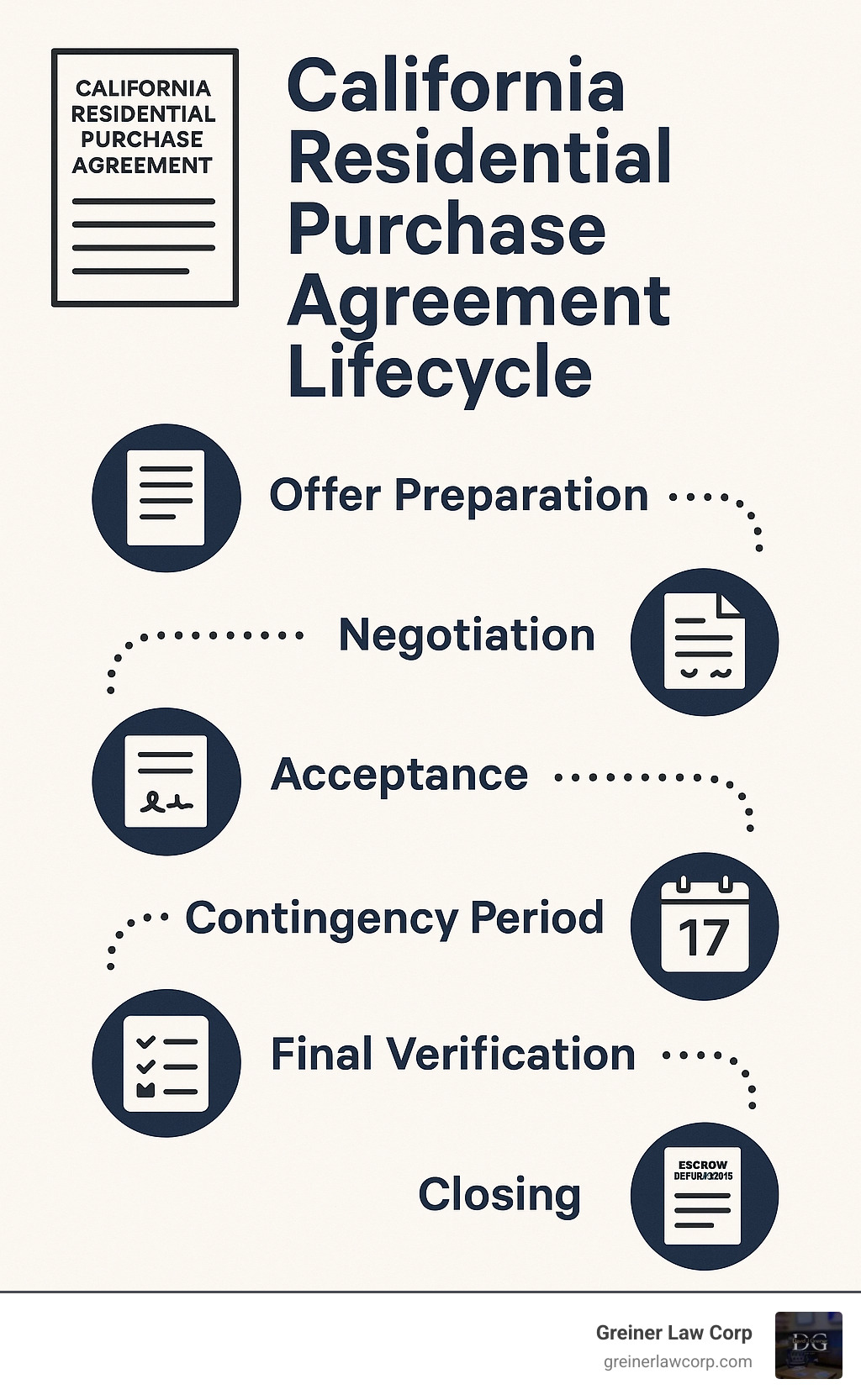
Most home purchases in California take between 30-45 days to close once everyone has signed on the dotted line. This timeline can flex depending on your financing situation and what contingencies you’ve included.
One thing that makes California special is how buyer-friendly our real estate laws are. The standard forms reflect this, with robust consumer protections built right in. These protections give buyers several potential “exit ramps” during the process if something unexpected comes up.
More info about Real Estate Contracts
When Does It Become Binding?
Your blank California residential purchase agreement transforms into a legally binding contract through a simple but specific process:
First, the buyer completes the form and submits it as their offer. The magic happens when the seller accepts all terms exactly as written and communicates this acceptance back to the buyer or their agent. This creates what’s called the “acceptance date” – a critical reference point for calculating all the deadlines in your contract.
For the contract to be valid, it needs “consideration” – typically your earnest money deposit that shows you’re serious about buying. Everyone involved must sign the agreement (and yes, electronic signatures are perfectly legal in California for real estate contracts).
While the contract becomes binding before escrow opens, starting escrow is the practical next step that gets the transaction moving with a neutral third party handling the money and paperwork.
Even after everyone signs, the agreement typically includes contingencies that allow either side to back out under certain circumstances without penalty.
Key Parties & Roles
A successful home purchase is truly a team effort. Here’s who’s involved:
Buyer: That’s you! You’ll complete the blank California residential purchase agreement with your offer details, including how much you’re willing to pay, how you’ll finance it, and what conditions need to be met.
Seller: The current owner who’ll review your offer, possibly counter it, and ultimately (hopefully!) accept it, committing to transfer the property to you under the agreed terms.
Real Estate Brokers/Agents: These professionals represent both sides, offering guidance on market conditions, negotiation strategies, and helping complete the paperwork correctly. The agreement includes specific sections about how they’ll be paid and what their responsibilities are.
Escrow Holder: This neutral third party (usually an escrow or title company) holds funds and documents, ensuring all conditions are met before completing the sale. Your purchase agreement doubles as instructions for this escrow company.
Inspectors and Other Professionals: These specialists examine the property’s condition and value during the contingency period. They’re your eyes and ears for making sure you know exactly what you’re buying.
Lender: While not directly named in the purchase agreement, your lender plays a crucial role if you’re financing the purchase, as loan approval is typically a key contingency.
By understanding each player’s role, you’ll steer the process with confidence and clarity, turning that blank California residential purchase agreement into the foundation of your successful home purchase.
Download Your Blank California Residential Purchase Agreement Form
Getting your hands on a blank California residential purchase agreement is the crucial first step before diving into any home buying or selling journey. The gold standard in the industry is the California Association of REALTORS® (C.A.R.) Residential Purchase Agreement (RPA), which gets regular updates to stay current with California’s changing real estate laws.

While the C.A.R. form dominates the market, it’s not your only option. Other organizations like the Real Estate Professionals of California (RPI) offer perfectly valid alternatives that comply with state law. To help you decide which form fits your needs best, here’s how they stack up:
| Form Source | Pros | Cons | Accessibility |
|---|---|---|---|
| C.A.R. RPA | Industry standard, regularly updated, widely accepted | Requires membership or realtor access, fee-based | Through C.A.R. members, zipForm® |
| RPI Form 150 | Comprehensive, alternative format, publicly available | Less widely recognized by some agents | RPI website, subscription |
| DIY/Generic | Free, basic framework | May miss critical California-specific provisions | Various websites, less reliable |
I should mention that while you might find free generic forms floating around online, they often skip crucial California-specific provisions and required disclosures. This can leave your transaction vulnerable to legal issues down the road – not exactly what you want when dealing with possibly the biggest purchase of your life!
Where to Find a Blank California Residential Purchase Agreement
Need an official blank California residential purchase agreement? You’ve got several reliable options:
Your best bet is working with licensed real estate professionals who already have access to official C.A.R. forms through their membership. They can provide these forms as part of their service package. At Greiner Law Corp, we can connect you with trusted agents in our network who’ll ensure you’re working with the right paperwork.
REALTOR® association offices often maintain form libraries that members can access easily. Some might even provide forms to non-members for a small fee if you ask nicely.
Don’t overlook your local county law library – these public resources typically maintain copies of standard legal forms, including real estate purchase agreements that you can reference.
There are also several authorized online services providing access to California real estate forms, though you’ll want to verify they’re current and fully compliant with state law before using them.
Real estate professionals typically use specialized software platforms like zipForm® (now part of Lone Wolf Technologies) that contain the latest versions of all C.A.R. forms, ensuring everything is up-to-date.
The C.A.R. RPA gets revised periodically, with the most recent major update in December 2022. Using an outdated form can create serious legal complications, so always make sure you’re working with the current version.
Blank California Residential Purchase Agreement vs Filled Sample
Understanding the difference between a blank California residential purchase agreement and a completed sample can save you headaches as you prepare for your transaction.
A blank form is like an empty canvas waiting for your specific transaction details. You’ll need to fill in critical information like buyer and seller identification, property address and legal description, purchase price, financing terms, deposit amount, contingency periods, closing date, and what items are included or excluded with the property. It’s essentially the framework that becomes your unique contract.
On the flip side, a filled sample shows how a completed agreement might look, which can be helpful as a reference point. But here’s the important part – never use someone else’s completed form as a template for your deal. Every real estate transaction has its own quirks and circumstances that need to be properly addressed.
Pay special attention to signature blocks – they require initials on each page and full signatures at the end to create a valid agreement. You’ll also typically find a checklist of potential addenda that might be attached based on your specific needs, such as:
- Buyer’s inspection advisory
- Wood destroying pest inspection
- Lead-based paint disclosure (for pre-1978 homes)
- Seller financing addendum
- Short sale addendum
- Trust advisory (for properties held in trust)
Getting the right form is just the beginning – knowing how to properly complete it is where the real value lies in protecting your interests in one of life’s biggest transactions.
Filling In the Blanks: Step-by-Step Guide & Timeline
Let’s face it – staring at a blank California residential purchase agreement can feel overwhelming. But filling it out doesn’t have to be complicated! Think of it as telling the story of your home purchase, one section at a time.
When I work with clients, we approach this methodically, starting with the basics. You’ll need to enter the complete property address (don’t forget that unit number if it’s a condo!) and the legal description, which you can usually find on tax records.
Next comes the exciting part – the money talk. You’ll specify your purchase price in both numbers and words (this prevents any confusion). Are you paying all cash or getting financing? This section breaks down exactly how you’ll fund your purchase.
For buyers using financing, you’ll detail your loan amount, type (conventional, FHA, VA), interest rate limits, and any points you’ll pay. This creates clarity for everyone involved.
Now for your earnest money deposit – this is your “skin in the game.” In California, this typically ranges from 1-3% of the purchase price. You’ll need to specify the amount, how you’ll pay it (check or wire transfer), and when (usually within 3 business days after acceptance).
The contingencies section is perhaps the most critical part of protecting yourself. The standard timeline in California gives you 17 days for loan approval, property appraisal, inspections, disclosure review, and title examination. These are your safety nets!
Don’t overlook your inspection rights – you’ll want to spell out exactly what kinds of inspections you plan to conduct, from general home inspections to specialized assessments like chimney or foundation inspections.
Most buyers also want a final walk-through, which typically happens within 5 days before closing. This gives you one last chance to verify the property’s condition hasn’t changed.
Finally, you’ll set your closing date (typically 30-45 days from acceptance) and add any special provisions unique to your situation. Then everyone signs and dates – and your journey to homeownership officially begins!
More info about Real Estate Purchase Agreement
Earnest Money & Escrow Handling
Your earnest money deposit is more than just a good faith gesture – it’s the financial proof that you’re serious about buying.
When working with a blank California residential purchase agreement, you’ll need to specify exactly how your deposit will be handled. Typically, you’ll deliver your deposit within 3 business days after acceptance. While there’s no legal minimum, most California buyers offer 1-3% of the purchase price.
The agreement includes an important provision called “liquidated damages” that you and the seller must separately initial. This clause caps what the seller can keep if you default (after removing contingencies) at 3% of the purchase price for 1-4 unit owner-occupied properties. This is your protection against losing more than your deposit.
Your deposit isn’t just handed to the seller – it goes into a secure trust account held by the escrow company, broker, or other authorized agent. Some agreements include provisions to increase your deposit after you remove contingencies, which can strengthen your position with the seller.
What happens if the deal falls apart? The agreement should clearly spell out how deposit disputes will be resolved. Your earnest money is generally refundable if you cancel within your contingency periods or if the seller fails to perform their obligations.
Contingency Removal Calendar
Think of contingencies as your safety exits – and timing is everything! When completing a blank California residential purchase agreement, understanding the contingency timeline is crucial.
The clock starts ticking on what we call “Day 0” – the acceptance date when all parties sign. This is your starting line.
During Days 1-7, you’ll deliver your deposit to escrow while the seller provides disclosures and reports. Meanwhile, you’ll start your inspections and loan application process. This first week sets everything in motion.
The real action happens during Days 8-17, what I call the “Critical Contingency Period.” This is when you’ll complete all your investigations, get your property appraised, advance your loan approval, review HOA documents (if applicable), and examine the preliminary title report. By Day 17, you must remove or waive your contingencies in writing – a pivotal moment in your transaction.
After Day 17, you enter the “Post-Contingency Period” where you’ll finalize your loan, the title company prepares closing documents, you’ll conduct your final walk-through, and ultimately deliver funds and sign documents to close the deal.
What if someone misses a deadline? The other party can issue a “Notice to Perform,” typically giving them 2 additional days to comply before the contract can be canceled. This keeps everyone accountable and the transaction moving forward.
Understanding this calendar helps you stay organized and protect your interests throughout the homebuying process. I always recommend marking these dates on your calendar the moment your offer is accepted!
Required Disclosures, Contingencies, and Earnest Money
When you’re working with a blank California residential purchase agreement, you’re stepping into one of the most disclosure-heavy real estate environments in the nation. California doesn’t mess around when it comes to protecting buyers – the law requires up to 17 separate disclosures depending on the property you’re purchasing.

Think of these disclosures as your property’s life story – the good, the bad, and sometimes the ugly. The Transfer Disclosure Statement (TDS) is the star of the show, detailing everything from the property’s condition to known defects and system operations. It’s essentially the seller saying, “Here’s what I know about this place – warts and all.”
Living in California means living with natural hazards, which is why the Natural Hazard Disclosure Statement (NHD) is so crucial. This document tells you if your dream home sits in a flood zone, fire hazard area, earthquake fault zone, or other potentially risky locations. Better to know before you buy than be surprised later!
For homes built before 1978, sellers must provide a Lead-Based Paint Disclosure – not the most exciting reading, but vital for your family’s health. The Megan’s Law Disclosure informs buyers about the state’s database of registered sex offenders, while the Environmental Hazards Booklet covers common environmental concerns.
If you’re buying an older home (pre-1960), you’ll also receive a Homeowner’s Guide to Earthquake Safety, along with statements confirming that water heaters and smoke detectors meet current safety standards. The standard Environmental Hazards Pamphlet is another required reading assignment in this process.
Here’s a powerful buyer protection worth remembering: If you don’t receive any of these required disclosures, you have a three-day cancellation window (five days if they were mailed) to walk away by simply providing written notice. This right gives buyers significant leverage in ensuring sellers are forthcoming with all required information.
More info about Real Estate Legal Advice California
Most Common Contingencies to Expect
Contingencies are your safety nets in a real estate transaction – escape hatches that let you exit the deal under specific circumstances. In California, several contingencies typically appear in most residential purchase agreements.
The inspection contingency is perhaps the most important, giving you the right to thoroughly investigate what you’re buying. This isn’t just a quick walk-through – it typically includes a general home inspection, pest inspection, roof check, and specialized inspections for pools, sewer lines, or other specific concerns. If something concerning turns up, you can negotiate repairs, price adjustments, or walk away entirely.
The financing contingency protects you if your loan falls through despite your best efforts. Closely related is the appraisal contingency, which lets you exit if the property doesn’t appraise for at least the purchase price – critically important in fluctuating markets.
Your title contingency allows you to review the property’s title report for deal-breaking issues like liens or easements. For those juggling two properties, the sale of buyer’s property contingency makes your purchase dependent on successfully selling your current home.
If you’re buying a condo or property in a planned development, the HOA document review contingency gives you time to examine association rules, finances, and meeting minutes before fully committing.
Most contingencies in the standard C.A.R. form expire after 17 days, though these timeframes can be negotiated. Mark these deadlines on your calendar – they’re not suggestions but critical decision points in your transaction.
Disclosure Delivery Deadlines
Timing matters tremendously in California real estate transactions, especially regarding disclosures. Sellers typically have 7 days after acceptance to deliver all required statutory disclosures and reports. This week-long window might seem generous, but gathering everything can be time-consuming.
As a buyer, you have a 3-day review period after receiving disclosures (extended to 5 days if they were mailed) to terminate the agreement if something doesn’t sit right. This cancellation requires written notice – a text or phone call won’t suffice.
The disclosure process doesn’t necessarily end after that initial delivery. If sellers find new information later in the transaction, they must promptly provide supplemental disclosures. Your cancellation rights reset with each new disclosure.
Many experienced agents recommend that sellers complete all disclosures before listing the property. This front-loading approach reduces the risk of deals falling apart mid-transaction and creates a more transparent selling process.
Smart buyers and sellers (and their agents) maintain careful records of when disclosures were delivered and received. These timestamps can become crucial if disagreements arise about whether cancellation rights have expired.
California courts strictly enforce these disclosure timelines. Missing deadlines can extend buyer cancellation rights indefinitely or potentially create liability for sellers who failed to properly disclose known issues. When in doubt about disclosure requirements for your specific situation, consulting with a real estate attorney provides valuable peace of mind.
Protect Your Deal: Common Mistakes, Cancellations, and Remedies
Even the most carefully prepared blank California residential purchase agreement can run into trouble when common pitfalls aren’t avoided. As I’ve seen countless times in my practice, small oversights can lead to major headaches down the road.
One of the most frequent issues? Missing initials or signatures. Every page of your agreement requires initials, and specific clauses like liquidated damages and arbitration provisions need separate initialing to be enforceable. It’s amazing how often a single missing initial can invalidate a key protection you thought you had.
Timing matters tremendously in California real estate. The “time is of the essence” clause isn’t just legal jargon—it means deadlines are strictly enforced. Missing a contingency removal deadline by even a day can give the other party the right to cancel your deal or demand performance.
I often remind clients that verbal agreements simply don’t count in real estate. That casual conversation where the seller promised to fix the roof? Unless it’s written down as an addendum to your blank California residential purchase agreement, it’s not enforceable. Everything must be in writing.
Other common mistakes include incomplete property descriptions (which create ambiguity about exactly what’s being purchased) and improper handling of earnest money deposits (which can violate real estate regulations and complicate disputes).
When problems do arise, your agreement typically specifies a remedy path:
Most C.A.R. forms require parties to attempt mediation before pursuing other options. This less expensive approach often resolves issues without the need for more formal proceedings. If mediation fails, the arbitration clause (if initialed by both parties) makes binding arbitration the required next step for most disputes.
For buyer defaults, the liquidated damages provision—when properly initialed—typically limits the seller’s recovery to the earnest money deposit, capped at 3% of the purchase price for residential properties. This provides clarity about financial exposure if things go wrong.
In some cases, either party may seek specific performance—asking a court to order the other party to complete the transaction rather than just pay monetary damages.

California has particularly stringent requirements regarding earthquake safety disclosures, as detailed in the Scientific research on earthquake safety guide.
Buyer & Seller Cancellation Rights
The cancellation rights in a California residential purchase agreement aren’t created equal—buyers typically have more flexibility than sellers.
As a buyer, you enjoy broad cancellation rights during contingency periods (typically those first 17 days). You can walk away for virtually any reason related to your contingencies, whether you’re unsatisfied with inspection results or unable to secure financing. Additionally, if the seller fails to provide required disclosures, you gain a 3-day cancellation window after finally receiving them (or 5 days if they were mailed).
When a seller isn’t performing their obligations, you can issue a “Demand to Close Escrow,” which typically gives them 3 days to comply before you can cancel and potentially seek remedies.
Sellers, on the other hand, have much more limited cancellation options. Your primary tool is the “Notice to Perform” if a buyer misses deadlines for removing contingencies. This notice typically gives buyers 2 days to take action before you can cancel the agreement. Similarly, if the buyer fails to close on time, you can issue a “Demand to Close Escrow.”
When deals fall apart and earnest money becomes disputed, escrow companies find themselves in a difficult position. They typically cannot release funds without either written instructions signed by both parties, a court order, or completion of the contract’s dispute resolution process. In particularly contentious situations, funds may be interpleaded with the court while the parties work through their disagreement.
How to Safeguard Your Interests
At Greiner Law Corp, we’ve developed several strategies to help protect our clients when using a blank California residential purchase agreement:
Professional review is essential, especially for high-value transactions or deals with unusual terms. Having an attorney review your completed agreement before signing can identify potential issues before they become problems.
Build in contingency buffers whenever possible. Even straightforward transactions can face unexpected delays, so negotiate slightly longer contingency periods than you think you’ll need.
Documentation matters tremendously. Maintain proof of funds or loan pre-approval if you’re buying; verify this documentation carefully if you’re selling. Document every change, repair agreement, or modification with formal written addenda, no matter how minor they seem.
Clear communication prevents countless problems. Establish preferred communication methods and expected response timeframes for all parties at the beginning of your transaction.

Track delivery of all documents carefully. Being able to prove exactly when disclosures and notices were delivered can be crucial if disputes arise later.
Always review escrow instructions thoroughly to ensure they match your purchase agreement terms. Obtain appropriate title insurance to protect against unforeseen claims, and buyers should never skip the final walk-through inspection.
Be strategic about contingency removal timing. Once you’ve removed contingencies, your ability to cancel without penalty diminishes significantly—understand this leverage shift before taking action.
These protective measures may seem like extra work, but they’re far less burdensome than dealing with a transaction gone wrong. A small investment in prevention can save tremendous headaches later.
Frequently Asked Questions about the Blank California Residential Purchase Agreement
What makes the agreement “blank” yet legally sufficient?
When you hear “blank California residential purchase agreement,” you might wonder how an unfilled form can be legally valid. Think of it as a carefully crafted blueprint waiting for your specific details.
These standardized templates contain all the legally required language, clauses, and provisions needed for a valid California real estate transaction. They’re considered “blank” simply because the transaction-specific information—the names, property address, price, and dates—haven’t been filled in yet.
What gives these forms their legal power is the extensive legal expertise behind them. The C.A.R. form, for instance, undergoes regular review by a committee of attorneys and real estate professionals who ensure it remains compliant with California’s changing real estate laws. It’s like having a team of legal experts in your corner before you even start negotiating.
Once properly completed, these forms transform into binding contracts because they contain all the essential elements the law requires: a clear offer, acceptance of that offer, consideration (usually the earnest money deposit), a legal purpose, competent parties, and mutual agreement to the terms.
How much earnest money is typical in California?
Writing that earnest money check can feel like a big step in your homebuying journey. In California, most buyers can expect to deposit between 1% and 3% of the purchase price.
For perspective, on a $500,000 home, you might put down between $5,000 and $15,000 as earnest money. If you’re purchasing a million-dollar property, that range jumps to $10,000-$30,000.
The exact amount isn’t set in stone—it’s negotiable based on several factors. In competitive seller’s markets, a larger deposit can make your offer stand out by showing you’re serious. Local customs matter too; what’s standard in San Francisco might differ from practices in San Diego. Your financial situation and the seller’s comfort level also play important roles in determining the final amount.
It’s worth noting that California law has your back here—it caps liquidated damages (what the seller can keep if you default) at 3% of the purchase price for 1-4 unit residential properties you intend to occupy.
Once agreed upon, you’ll typically deliver your earnest money to escrow within 3 business days after acceptance, where it will be safely held in a trust account until closing or cancellation.
Can I cancel if I don’t get all disclosures on time?
Absolutely—and this is one of the strongest buyer protections in California real estate law. If the seller doesn’t provide all required disclosures on time, you have a clear path to cancel the agreement if you choose.
Here’s how it works: After you actually receive the disclosures (whether on time or late), you have 3 days to review them and decide if you want to proceed. If they were mailed to you, you get 5 days. What makes this protection particularly powerful is that it applies even if you’ve already removed your inspection contingency.
To exercise this right, you’ll need to provide written notice to the seller or their agent specifying which disclosures were missing or inadequate. Once you’ve properly canceled, you’re entitled to a full refund of your blank California residential purchase agreement deposit.
This protection exists because California lawmakers recognize how crucial full disclosure is when making such a significant purchase. The required disclosures—including the Transfer Disclosure Statement, Natural Hazard Disclosure, and others—contain vital information about the property’s condition that could significantly impact your decision.
Remember though, if the seller provides the disclosures late but before you exercise your cancellation right, your 3-day window starts from when you receive them, not from when they were originally due.
Conclusion
Navigating the maze of a blank California residential purchase agreement isn’t just about filling in boxes—it’s about creating a roadmap for one of life’s biggest financial journeys. Throughout this guide, we’ve seen how this seemingly simple document serves as the foundation for transferring property worth hundreds of thousands or even millions of dollars.
When I work with clients at Greiner Law Corp, I often explain that real estate transactions exist at the intersection of legal requirements and practical business decisions. That’s why we take a business-minded approach to helping our clients steer these waters. Rather than simply identifying legal issues, we help you understand your risk preferences and make informed choices that align with your goals.
I’ve found that even the most straightforward transactions benefit from a professional review before signing. Those small details—a missed initial, an ambiguous contingency period, or an unclear repair responsibility—can create significant headaches down the road. Think of legal review as an insurance policy against future disputes.
With offices throughout Southern California—in Victorville, Riverside, San Bernardino, and Los Angeles—our team at Greiner Law Corp is uniquely positioned to understand the regional nuances of California real estate markets. What works in one community might need adjustment in another.
While standardized forms provide an excellent starting point, your transaction is unique. Your specific circumstances might benefit from additional provisions or modified terms that standard forms don’t address. This is especially true for properties with unusual features, complex ownership structures, or special financing arrangements.
More info about real-estate purchase contracts
By understanding the components, timelines, and requirements we’ve discussed, you’re already better prepared to steer your transaction with confidence. The blank California residential purchase agreement transforms from an intimidating legal document into a powerful tool that protects your interests when properly completed.
Ready to secure your next real estate deal with confidence? Contact us today to discuss how we can help ensure your transaction proceeds smoothly from offer to closing.


