When You Need to Cancel a Real Estate Deal
Real estate contract cancellation is a process that allows buyers or sellers to legally exit a purchase agreement under specific circumstances. Here’s what you need to know:
| Party | Common Legal Grounds for Cancellation | Potential Consequences |
|---|---|---|
| Buyer | • Inspection contingency • Financing contingency • Appraisal contingency • Title issues • Attorney review period | • Potential loss of earnest money • Possible legal action |
| Seller | • Buyer’s failure to meet obligations • Home sale contingency • Attorney review period • Mutual agreement | • Potential lawsuit • Specific performance order • Agent commission claims |
Signing a real estate contract is exciting, but life happens. Maybe the inspection revealed major issues, your financing fell through, or you simply had a change of heart. Whatever the reason, understanding your options for real estate contract cancellation can save you thousands of dollars and countless headaches.
While contracts are legally binding, they often contain built-in “escape hatches” called contingencies. These clauses protect both buyers and sellers by allowing them to exit the agreement under specific circumstances without penalty. The key is knowing which contingencies apply to your situation and acting within the specified timeframes.
I’m David Greiner, Esq., with experience in real estate contract cancellation and business-focused legal advocacy, having helped numerous clients steer complex transactions while serving as president of Greiner Buick GMC and now as the founder of Greiner Law Corp. My approach focuses on finding practical solutions that protect your interests while minimizing risk.
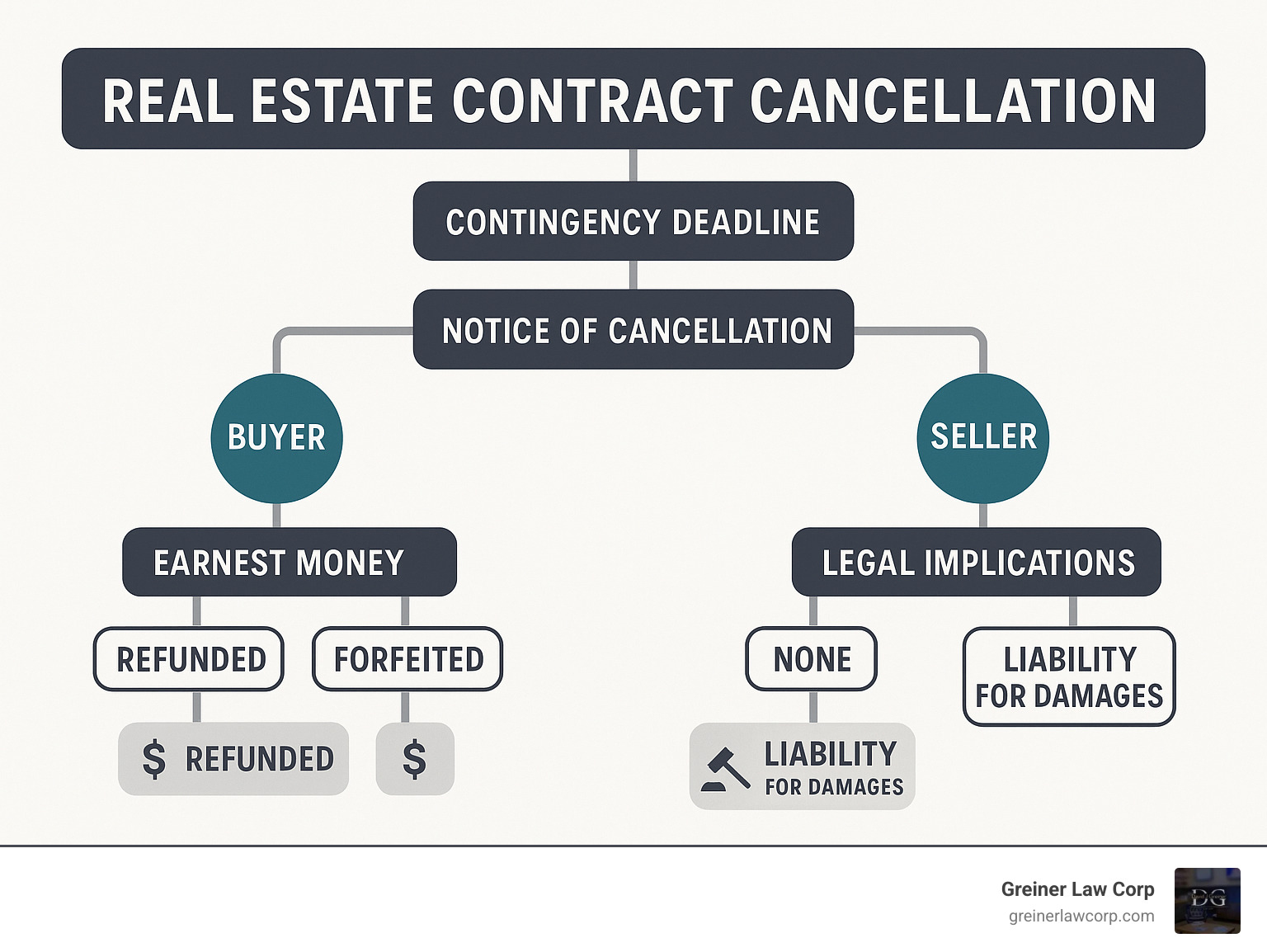
Understanding Real Estate Contracts & Contingencies
When you sign on that dotted line, what exactly are you committing to? Let’s explain real estate contracts and the safety nets built into them before we talk about how to get out of one.
A real estate purchase agreement isn’t just paperwork—it’s a legally binding promise between buyer and seller that spells out everything from the property address and purchase price to the closing date. Most importantly, it includes contingencies—those critical clauses that can be your ticket to a penalty-free exit if things go sideways.
“Think of contingencies as insurance policies built into your contract,” explains Danielle Moy, a top-rated real estate agent. “They’re designed to protect you from unforeseen circumstances that might make the transaction undesirable or impossible.”
When Does a Contract Become Legally Binding?
Your real estate contract transforms from a simple document into a binding legal agreement when three things happen:
First, all parties sign the agreement. Second, everyone receives and accepts the signed contract. And third, something of value changes hands—typically your earnest money deposit.
Once these three elements align, the contingency countdown begins. Miss these deadlines, and your escape routes start closing fast.
It’s worth noting that according to the National Association of Realtors, only about 6% of signed real estate contracts fall through each month. This small percentage highlights an important truth: most people who sign these agreements follow through to closing, making it crucial to understand your options before you need them.
Key Contingency Clauses that Can Open up an Exit
If you need to pursue real estate contract cancellation, these common contingencies might provide your legal way out:
The inspection contingency gives buyers typically 5-14 days to back out if they find significant property issues. Found a crumbling foundation or dangerous electrical system? This clause has you covered.
With a financing contingency, you’re protected if your mortgage falls through despite good-faith efforts. This usually gives you 30-45 days to secure funding before making a decision.
An appraisal contingency becomes your safety net if the property’s appraised value comes in below the purchase price—critical since lenders won’t finance above that appraised value.
The home sale contingency allows buyers to cancel if they can’t sell their current home within the specified timeframe, preventing you from owning two properties simultaneously.
A title contingency lets you walk away if unexpected liens or ownership disputes surface during the title search process.
“Buyers usually have more options to cancel than sellers,” notes Hayley Tomazic, an experienced broker. “The financial consequences of having to go back on the market are unknown for sellers, which is why their exit options are more limited.”
Cooling-Off and Attorney Review Periods
Some states offer additional layers of protection that can make real estate contract cancellation more straightforward:
Cooling-Off Periods exist in a handful of states, providing a short window (typically 3 days) during which buyers can cancel certain residential contracts without penalty. These are relatively rare for standard home purchases but more common for timeshares and specialized transactions.
The Attorney Review Period is particularly powerful in states like Illinois and New Jersey. This 3-5 day window allows either party’s attorney to cancel the contract for virtually any reason without consequences.
“The attorney review period is one of the few times a seller can walk away without consequence,” explains a real estate attorney. “It’s a powerful tool that both parties should understand before signing.”
These periods vary dramatically by state, making local expertise invaluable. For deeper insights on legal representation during closing, the Consumer Financial Protection Bureau offers helpful guidance.
Understanding your contract’s contingencies isn’t just about finding escape hatches—it’s about knowing your rights and responsibilities in what’s likely one of the biggest financial transactions of your life. For a more detailed explanation of real estate contracts, visit our guide on Real Estate Contracts Explained.
Real Estate Contract Cancellation: Legal Exit Routes & Consequences

When you’re facing a real estate contract cancellation, knowing your legal options can feel like finding a life raft in choppy waters. Let’s explore the possible exit strategies and what they might cost you down the road.
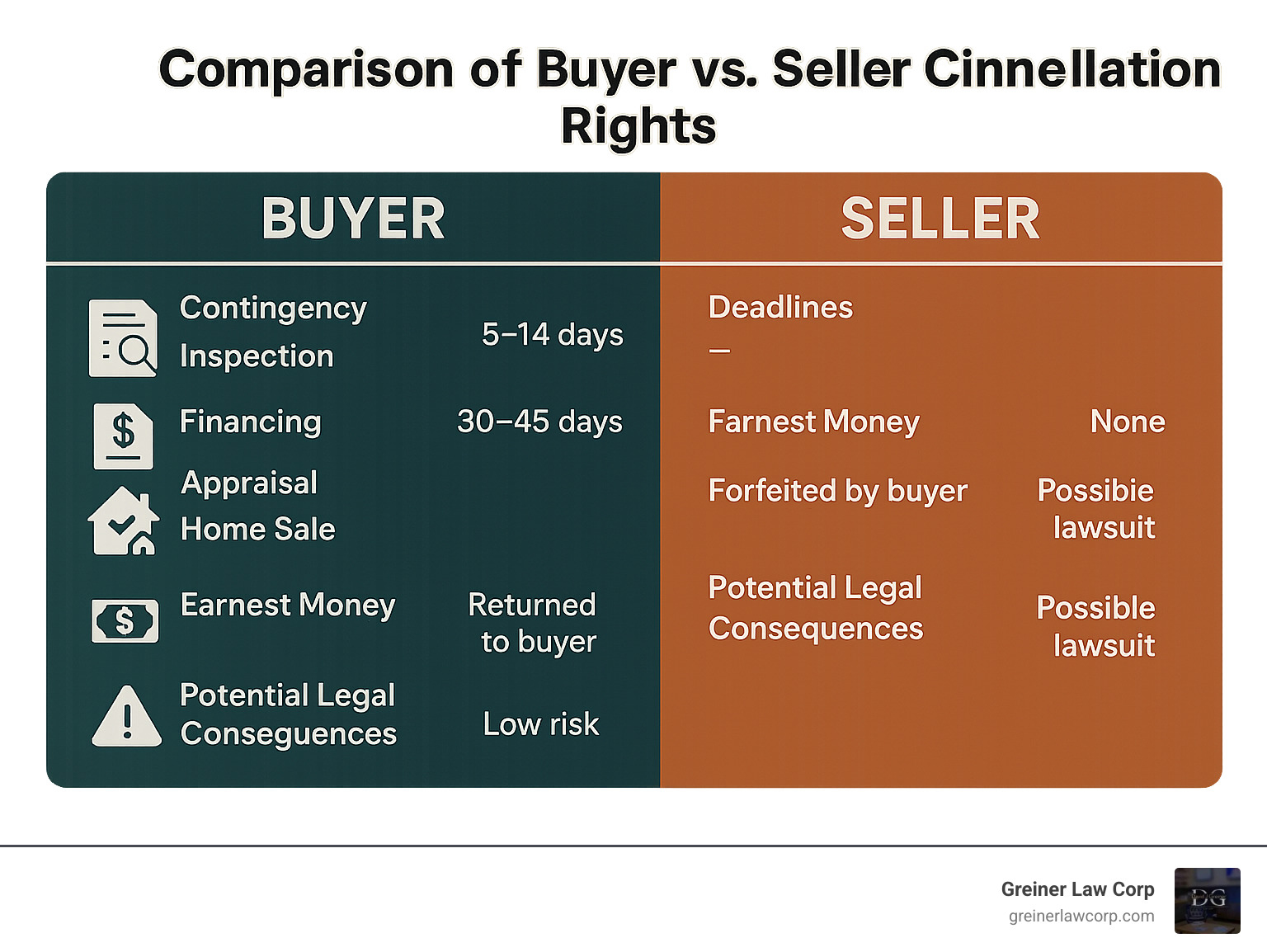
Buyer Rights for Real Estate Contract Cancellation
As a buyer, you’re in luck—the real estate playing field tends to favor your position when it comes to real estate contract cancellation. Think of contingencies as your safety nets, carefully woven into the contract to protect you.
Imagine finding out the charming Victorian you fell in love with has termite damage that would cost more than your wedding and honeymoon combined. With an inspection contingency still active, you can walk away with your earnest money intact and your future finances protected. These contingency-based cancellations are your cleanest exit strategy.
Your earnest money—typically 1-3% of the home’s purchase price—acts as both your commitment token and your potential loss. When you cancel under a valid contingency, that money should find its way back to your bank account. Without contingency protection, however, that deposit might be waving goodbye.
“I’ve seen buyers back out before dropping the earnest money when they recalculate their monthly payments or consult with family,” shares Danielle Moy, an experienced real estate agent. But her advice comes with a warning: timing is everything. Once those contingency deadlines pass, your exit door starts closing—and fast.
Seller Rights for Real Estate Contract Cancellation
If you’re selling, your cancellation options are more limited, but they do exist. Think of them as narrow pathways rather than wide-open highways.
When buyers don’t hold up their end of the bargain—perhaps missing deposit deadlines or financing milestones—you may have grounds to cancel and potentially keep their earnest money as compensation for your time and trouble. It’s like having insurance against flakey buyers.
Some savvy sellers include a “kick-out clause” (formally known as a home-sale contingency) that allows them to continue marketing the property and cancel if a better offer comes along. It’s your property’s dating insurance policy—you’re committed, but still keeping options open.
In states with attorney review periods, this brief window offers sellers a rare opportunity to exit without penalty. Similarly, if genuine title problems emerge that simply cannot be fixed, you may find yourself with a legitimate reason to cancel.
“Laws around real estate contracts tend to favor the buyer over the seller,” explains one industry expert. This imbalance means sellers need to proceed with extra caution when considering cancellation.
Mutual Consent & Rescission
Sometimes the simplest solution is also the best one. When both parties agree to walk away, the process becomes remarkably straightforward.
A mutual release form acts like a divorce agreement for your real estate relationship—it specifies how earnest money will be divided and releases both parties from further obligations. Sometimes a small financial incentive can help smooth this process; perhaps offering to cover the buyer’s inspection costs can help secure their agreement to cancel.
“Mutual agreement can be the simplest and least contentious way to cancel a contract,” notes a real estate attorney with a smile. This approach not only avoids potential lawsuits but also preserves relationships—something particularly valuable in small communities where paths frequently cross.
State-Specific & Federal Rules to Know
Real estate law varies dramatically from state to state, making local expertise not just helpful, but essential.
If you’re in California, your residential purchase agreements typically include specific contingency periods that must be observed with religious precision. Missing these deadlines by even a day can severely limit your cancellation rights.
Some states require attorneys to conduct real estate closings, while others make legal representation optional. This difference can significantly affect both the cancellation process and the protections available to you.
It’s worth noting that certain states provide statutory rights to rescind contracts under specific circumstances, such as fraud or misrepresentation. These are your legal safety valves when things go seriously wrong.
The National Association of Realtors reports that only about 6% of signed real estate contracts fall through in a typical month. This surprisingly small percentage highlights both how seriously most people take these agreements and why understanding your cancellation rights before signing is so important.
For deeper insights into contract conditions that can protect you, the Investopedia guide to real estate contract conditions offers valuable information that might save you thousands of dollars—and countless headaches—down the road.
How to Cancel a Real Estate Contract Step-by-Step

So you’ve decided to back out of your real estate deal. I get it – sometimes circumstances change, problems arise, or you simply realize the property isn’t right for you. Let’s walk through exactly how to handle real estate contract cancellation the right way to protect yourself legally and financially.
Step 1: Review Deadlines & Gather Documentation
Time is not your friend when it comes to real estate contract cancellation. The moment you’re considering backing out, grab your contract and a highlighter.
First, identify every contingency deadline in your agreement. Miss these critical dates and you might find yourself with far fewer options (and potentially kissing your earnest money goodbye). Pay special attention to those inspection periods (typically 5-14 days), financing deadlines (usually 30-45 days), and appraisal contingency dates.
Next, gather your evidence. If your inspector found termite damage that would cost $20,000 to repair, get that report in hand. If your lender denied your loan, secure that rejection letter. These documents aren’t just paperwork – they’re your protection if the other party challenges your cancellation.
“I’ve seen buyers lose thousands simply because they missed a deadline by one day,” shares a veteran real estate broker. “Those contingency dates aren’t suggestions – they’re your financial safety net.”
Step 2: Draft and Send Written Notice Correctly
When it comes to real estate contract cancellation, verbal discussions mean absolutely nothing. Everything must be in writing, and how you craft that notice matters tremendously.
Your cancellation notice should clearly reference the contract date, property address, and specifically cite which contingency clause you’re invoking. For example: “Pursuant to Paragraph 12(c) of the Purchase Agreement dated May 3, 2024, I am exercising my right to cancel this contract due to the property failing to appraise at the purchase price.”
Always send your notice via certified mail with return receipt requested – this creates proof of delivery that could be crucial later. As backup, email a copy to all parties and CC your agent or attorney. This creates a clear paper trail that’s hard to dispute.
“Even when emotions are running high, keep your cancellation notice professional and factual,” advises a real estate attorney. “This isn’t the place to vent frustrations or make accusations.”
Step 3: Handle Earnest Money & Deposits
Let’s talk about the money – often the most contentious part of real estate contract cancellation. That earnest money deposit (typically 1-3% of the purchase price) can represent thousands of dollars.
If you’re canceling under a valid contingency within the proper timeframe, you should be entitled to a full refund. However, you need to be proactive. Contact the escrow company in writing, referencing your cancellation notice and citing the specific contract provision that entitles you to your deposit back.
What if the seller disagrees? Be prepared for the escrow company to hold the funds until the dispute is resolved. This might involve mandatory mediation (often required before litigation), arbitration, or even court proceedings for larger amounts.
“The fate of earnest money isn’t always black and white,” explains a seasoned escrow officer. “I’ve seen cases where buyers and sellers negotiate a split of the deposit as a compromise when the cancellation reason falls into a gray area.”
Step 4: Negotiate Solutions or Remedies
Sometimes real estate contract cancellation isn’t your only option – or even your best one. Creative negotiation might salvage the deal in a way that works for everyone.
Found serious issues during inspection? Instead of walking away completely, consider negotiating repair credits that reduce the purchase price. Struggling with financing delays? A contract extension might be simpler than cancellation.
If both parties do agree to cancel, use a formal mutual release form that clearly states the contract is terminated, specifies how the earnest money will be distributed, and confirms neither party has further claims against the other. This clean break prevents future headaches.
“I recently had clients who were ready to cancel over a $5,000 repair issue,” shares a real estate agent. “Instead, we negotiated a $3,500 credit, and both parties walked away happy at closing. Sometimes a little flexibility beats cancellation.”
Step 5: Consult a Real Estate Attorney
When significant money is at stake or your cancellation rights aren’t crystal clear, investing in professional legal guidance is money well spent.
A knowledgeable real estate attorney can assess your specific situation, draft proper notices, and negotiate on your behalf. They’ll also be familiar with the nuances of California’s real estate laws that might affect your case.
Yes, attorney fees might seem substantial – but they’re typically a fraction of what you might lose through improper cancellation. Think of it as insurance against a much larger financial hit.
“I see too many people come to me after they’ve already made critical mistakes in the cancellation process,” notes a real estate attorney. “For a few hundred dollars upfront, I could have saved them thousands in disputed earnest money or even lawsuits.”
For more detailed guidance on canceling your specific real estate contract, you can find additional information at Greiner Law Corp’s guide to canceling real estate contracts.
Frequently Asked Questions about Real Estate Contract Cancellation
How long do I have to cancel without penalty?
When you’re looking to back out of a home purchase, timing is everything. The window for penalty-free real estate contract cancellation varies depending on which contingency you’re using:
Most buyers have about 5-14 days after signing to use their inspection contingency—perfect if you find that charming fixer-upper actually needs a new foundation. Your financing contingency typically gives you 30-45 days, while appraisal timelines usually align with your loan approval process.
“I always tell my clients to mark these dates in bold on their calendars,” says real estate agent Danielle Moy. “Most contracts include an objection period of about two weeks, but exact timing varies by state and contract terms.”
Some states offer additional protections like attorney review periods (usually 3-5 days) or option periods in Texas (anywhere from a few days to two weeks). Once these deadlines pass, though, your escape routes narrow considerably—and your earnest money faces serious risk.
What happens to my earnest money deposit?
Your earnest money—that good-faith deposit showing you’re serious about buying—hangs in the balance during real estate contract cancellation.
If you cancel within a valid contingency period (like after finding major plumbing issues during inspection), you should receive a full refund. Cancel without contingency protection, and the seller typically keeps your deposit as liquidated damages. When there’s a dispute about who deserves the money, it usually sits in escrow until you reach an agreement or a court decides.
These deposits aren’t small change either. Most range from 1-3% of the purchase price, meaning $5,000-$15,000 or more on an average American home. That’s a substantial sum that makes understanding your contract terms absolutely essential.
“I’ve seen buyers lose their entire deposit because they missed a contingency deadline by just one day,” warns a real estate attorney. “The contract language isn’t just legal formality—it’s protecting your hard-earned money.”
Can the other party sue me for canceling?
Yes, improper real estate contract cancellation can indeed lead to the courtroom, though most disputes settle before getting that far.
If you’re a buyer canceling without valid grounds, the seller might sue for specific performance (forcing you to complete the purchase), monetary damages beyond your earnest money, or costs they incurred believing the sale would go through. Similarly, if you’re a seller backing out improperly, buyers can seek specific performance, damages for their costs, or even file a lis pendens (notice of pending lawsuit) against your property that can cloud your title.
The good news? These lawsuits are relatively rare in practice. “Specific performance cases usually don’t make it to trial because parties typically negotiate a settlement, or the seller finds another buyer,” explains a seasoned real estate expert.
Most contracts require mediation before litigation, giving you a less expensive path to resolution. Still, the threat of legal action often provides powerful leverage during cancellation negotiations.
“Courts can order specific performance, forcing a seller to complete the sale if there’s no lawful exit,” notes one real estate attorney. “But in my experience, most parties prefer finding a business solution over a legal battle.”
Conclusion
Walking away from a real estate deal isn’t something most of us plan for, but life happens. Whether you’ve finded foundation issues during inspection or your financing fell through unexpectedly, real estate contract cancellation can be steerd successfully when you understand the process.
Throughout this guide, we’ve explored the various pathways to legally exit a real estate contract. The good news? You have options—but they come with important timelines and procedures that must be followed carefully.
Contingencies are your friends. These built-in protections serve as safety nets, allowing you to walk away from a deal when circumstances change. The key is understanding exactly which contingencies apply to your situation and—perhaps most importantly—their specific deadlines. Once these windows close, your options become significantly more limited.
Documentation becomes your best ally during the cancellation process. Keep meticulous records of all inspections, communications, and financing efforts. When it’s time to provide notice of cancellation, be specific about which contract provision you’re invoking, and always deliver your notice in writing through traceable methods.
While contracts are legally binding, they’re also tools created by humans to facilitate fair transactions. This means there’s often room for negotiation. Sometimes a simple conversation can lead to a mutual agreement that works for everyone involved. As we’ve seen, even when emotions run high, finding common ground can save both parties time, money, and stress.
For situations that aren’t straightforward—perhaps when earnest money is disputed or when the other party contests your right to cancel—professional guidance becomes invaluable. The cost of consulting with a qualified attorney is typically minimal compared to the financial risk of mishandling a cancellation.
Real estate transactions represent major financial and emotional investments. By approaching the cancellation process with knowledge and care, you can protect your interests while minimizing potential consequences. Most real estate professionals have seen contracts fall through before—it’s a normal part of the business, even if it feels overwhelming when you’re in the middle of it.
At Greiner Law Corp, we bring a business-minded approach to real estate challenges. We understand that each client has different goals and risk tolerances, and we tailor our guidance accordingly. Whether you’re in Victorville, Riverside, San Bernardino, or Los Angeles, we’re here to help you steer the complexities of real estate contract cancellation with confidence.
For more information about canceling a real estate contract or to discuss your specific situation, contact us today.


