What a Listing Agreement Means for Your Real Estate Transaction
What is a listing agreement? It’s a legally binding contract between you (the seller) and a real estate brokerage, giving them the right to market and sell your property. This crucial document establishes the agent’s authority, defines the terms of the sale like price and commission, and outlines the responsibilities of both parties for a typical duration of 3-6 months.
Many sellers sign this contract without fully grasping its terms, which can lead to confusion and disputes. The agreement isn’t just paperwork; it’s a critical document that protects both you and your agent by setting clear expectations for the entire transaction.
I’m David Greiner, Esq., founder of Greiner Law Corp. My years negotiating contracts as president of Greiner Buick GMC taught me how vital it is to understand agreements before signing. I bring that same business-minded approach to helping our clients steer real estate transactions with confidence.
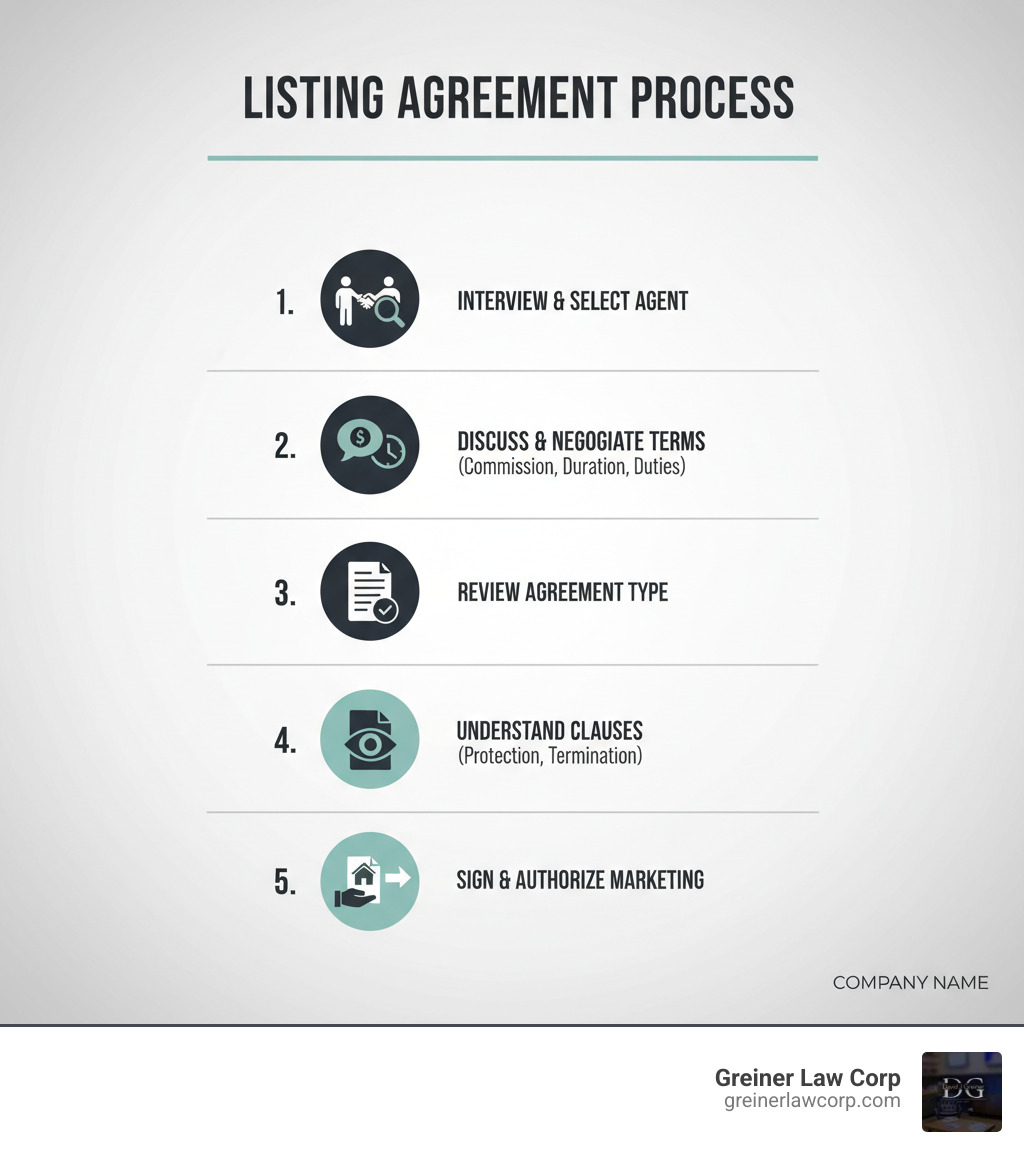
What is a Listing Agreement in Real Estate?
So, what is a listing agreement exactly? It’s a formal employment contract that gives a real estate broker the authority to act as your agent in selling your property. This legally binding document creates an official brokerage relationship, providing critical protection for everyone involved. For the seller, it ensures the agent will perform specific duties. For the brokerage, it provides the legal right to earn a commission.
In most states, including California, listing agreements must be in writing to be enforceable. This prevents misunderstandings that can lead to costly disputes. While you’ll work with an individual agent, the contract is legally between you and their brokerage, as only a licensed broker can list and sell property. The agreement is the foundation upon which the entire sale is built. For a broader look at how property sale contracts work, you might find our guide on Real Estate Contracts helpful.
The Purpose of a Listing Agreement
The listing agreement serves several vital purposes. It defines responsibilities, spelling out what your agent must do (marketing, showings, negotiations) and your obligations as the seller (providing access, maintaining the property). It outlines the marketing plan, so you know how your home will be presented to buyers. Critically, it sets the commission structure, detailing how and when the agent is paid. Finally, it provides legal recourse and a framework for resolving disputes, often through mediation or arbitration, if one party fails to meet their obligations.
Who Are the Parties to the Agreement?
Three key players are involved in a listing agreement:
- The Home Seller: As the property owner, you are the principal party granting the brokerage authority to act on your behalf.
- The Real Estate Brokerage: This is the licensed company that legally holds the listing contract and is ultimately responsible for the transaction’s oversight and compliance.
- The Real Estate Agent: This is the licensed professional who acts as your day-to-day contact and representative. They operate under the authority of the brokerage.
The Four Main Types of Listing Agreements
Choosing the right listing agreement affects agent motivation, your flexibility, and how commissions are paid. Understanding the four main types is key to making an informed choice.
| Feature / Listing Type | Exclusive Right-to-Sell | Exclusive Agency | Open Listing | Net Listing |
|---|---|---|---|---|
| Agent’s Exclusivity | Sole agent | Sole agent, but seller can sell | Multiple agents, non-exclusive | Sole agent (but controversial) |
| Commission if Seller Finds Buyer | Yes, agent still earns commission | No, seller owes no commission | No, seller owes no commission | Yes, agent earns commission (portion above set price) |
| Agent Incentive | Highest | Moderate | Lowest | High (but ethical concerns) |
| Marketing Efforts | Full marketing by agent | Full marketing by agent | Limited marketing by agents | Full marketing by agent (if legal) |
| Best For | Most sellers, fast sale | Sellers who want to try selling themselves | Sellers with unique properties, limited agent involvement | Not recommended, often illegal |

Exclusive Right-to-Sell Agreement
This is the industry standard and the most common type of listing agreement. With an exclusive right-to-sell, you agree to work with one brokerage, which earns the commission no matter who finds the buyer—your agent, another agent, or even you. This structure provides the maximum incentive for your agent to invest heavily in marketing your home (MLS listing, professional photos, open houses), as their compensation is secured upon sale. This alignment of interests typically leads to a faster sale at a better price. For more details, see our page on the Exclusive Right to Sell.
Exclusive Agency Listing
This agreement grants one brokerage the exclusive right to market your property, but with a key exception: if you find the buyer yourself, you owe no commission. This option may appeal to sellers who have potential buyers in their personal network. However, agents are often hesitant to take on this risk. The reduced incentive can lead to less aggressive marketing, potentially leaving your home on the market longer. It’s a compromise that rarely delivers the best results for sellers in our experience.
Open Listing (Non-Exclusive)
An open listing allows you to work with multiple brokerages simultaneously and also try to sell the property yourself. A commission is paid only to the agent who brings the successful buyer. If you find the buyer, no one gets paid. While this sounds flexible, it provides almost no incentive for any single agent to invest in marketing. The result is often minimal effort, a longer time on the market, and a lower final sale price. This is generally not recommended for most residential sellers.
Net Listing
A net listing is an arrangement where you set a minimum sale price you want to receive, and the agent keeps any amount above that as their commission. This creates a significant conflict of interest, as the agent’s incentive shifts from getting you the highest price to maximizing the spread above your net price. Due to these ethical problems, net listings are illegal in many states and heavily restricted in others, including California and Texas. We strongly advise sellers to avoid this type of agreement entirely.
Deconstructing the Contract: Essential Clauses and Components
Most listing agreements, like those from the California Association of REALTORS® (CAR), use standardized forms. However, “standard” doesn’t mean non-negotiable. Key clauses can and should be reviewed and discussed to fit your needs. Before signing, it’s crucial to understand these components.

What is a listing agreement’s structure for commission and price?
Two numbers define your sale: the listing price and the commission. The listing price is the initial asking price for your home. While your agent will provide a market analysis to guide you, the final decision is yours. The commission is what you pay your brokerage for their services. Commission rates are always negotiable; there is no standard or legally mandated percentage. Recent industry changes, such as the NAR settlement, have increased transparency, particularly around how buyer’s agents are compensated. Your agreement will detail the commission for your listing brokerage and how compensation is offered to a buyer’s agent. Negotiating these terms is critical, as even a small percentage change significantly impacts your net proceeds. For more on this, see our guide on Real Estate Contracts Explained.
Seller and Agent Duties and Responsibilities
A listing agreement is a two-way street. Your agent’s duties include exercising due diligence to sell your property. This means marketing (MLS, photos, ads), coordinating showings, communicating feedback, and negotiating offers in your best interest. As a REALTOR®, they are also bound by a strict Code of Ethics. Your responsibilities as the seller include providing accurate property information and disclosures, making the home available for showings, maintaining its condition, and directing all buyer inquiries to your agent. Fulfilling these mutual obligations is key to a smooth transaction.
Property Details: What’s Included and Excluded?
This section identifies the property and, just as importantly, specifies what stays and what goes. The law distinguishes between fixtures (items permanently attached, like a built-in dishwasher) and chattels (personal property, like a freestanding refrigerator). To avoid disputes, your agreement should explicitly list all included and excluded items. Be specific about appliances, window coverings, light fixtures, and even outdoor equipment. If you plan to take a sentimental chandelier, it must be listed as an exclusion. Clarity here prevents last-minute conflicts at closing.
Understanding Dual Agency
Dual agency occurs when one agent or brokerage represents both the seller and the buyer in the same transaction. While legal in California with informed consent, it changes the agent’s role from a dedicated advocate to a neutral facilitator. They can no longer advise one party on negotiation strategy without compromising their duty to the other. Both parties must be fully informed and agree in writing. While it can streamline communication, many sellers feel uncomfortable with the divided loyalty. It’s your right to decline a dual agency arrangement and insist your agent remains solely your advocate.
Navigating the Terms: Duration, Termination, and Disputes
A listing agreement defines your commitment timeline and your options if the relationship doesn’t work out. Understanding the duration, protection period, and termination clauses is essential to avoid surprises.
What is a listing agreement’s typical duration and expiration?
Every agreement has a start and end date, defining how long the brokerage has the exclusive right to sell your property. The typical duration is three to six months, but this is negotiable. In a hot seller’s market, a shorter term (60-90 days) may be appropriate. For unique or luxury properties in a slower market, a longer term of six months to a year gives the agent adequate time to find the right buyer. When the contract expires, you can renew with your agent, relist with someone new, or take the property off the market.

The Protection Period Clause
The protection period clause (or safety clause) protects the agent’s commission after the listing expires. It states that if you sell your home within a specified timeframe (e.g., 30-90 days) after expiration to a buyer who was introduced to the property by your agent, you still owe the commission. The agent must typically provide a written list of these prospective buyers. This clause ensures agents are compensated for their marketing efforts and prevents sellers from circumventing the commission by waiting out the contract.
Cancellation, Early Termination, and Dispute Resolution
If your agent isn’t performing their duties as outlined in the contract, you may have grounds for early termination. Document any failures to market the property or communicate effectively. However, simply changing your mind may incur a cancellation fee. The best approach is to request an unconditional release from the brokerage. If you can’t agree, most contracts require mediation (a neutral third party facilitates a solution) and/or arbitration (a neutral arbitrator makes a binding decision). These processes are typically faster and less costly than litigation. The NAR’s dispute resolution system is one such resource.
State-Specific Regulations
Real estate laws vary by state. In California, the California Association of REALTORS® (CAR) provides standardized forms that comply with state laws, including specific agency disclosures and termination clauses. Our California Real Estate Contract Guide offers more detail. Other states have unique rules: Texas heavily restricts net listings, New York requires a specific Agency Disclosure Form upfront, and Illinois mandates anti-discrimination clauses. This highlights the importance of working with professionals who understand local laws.
Frequently Asked Questions about Listing Agreements
Sellers often have the same practical concerns about listing agreements. Here are answers to the most common questions.
How long is a typical real estate listing contract?
Most listing contracts last for three to six months. However, the duration is negotiable. A shorter term (e.g., 90 days) might be suitable for a hot market, while a longer term (6+ months) may be necessary for a unique property or a slower market. The goal is to give the agent enough time to sell while providing you with flexibility.
Can I negotiate the terms of a listing agreement?
Yes, absolutely. Many key terms in a listing agreement are negotiable, even when using a standard form. The most important negotiation points include:
- The commission rate and structure
- The length of the contract
- The specific marketing duties of the agent
- The duration of the protection period
- Any fees for early cancellation
Always get any changes in writing and initialed by all parties. Verbal agreements are not sufficient.
What happens if my agent isn’t performing their duties?
If you feel your agent is underperforming, first review the duties outlined in your listing agreement. Then, take these steps:
- Document everything. Keep a record of unreturned calls, missed marketing commitments, or other issues.
- Communicate directly. Talk to your agent about your concerns. If that fails, escalate the issue to their managing broker, as your contract is with the brokerage.
- Request a cancellation. If the problems persist, you can request to be released from the contract based on a breach of its terms. Review the termination clause to understand any potential fees.
For more guidance on navigating these issues, our resources on Real Estate Contracts can help.
Conclusion: Signing with Confidence
By now, you should have a clear answer to what is a listing agreement and why it’s the foundation of your home sale. It’s not just paperwork—it’s the blueprint for your relationship with your real estate brokerage, defining duties, compensation, and timelines.
From understanding the different agreement types to knowing which clauses are negotiable, you are now equipped to make informed decisions. You know to scrutinize the commission structure, contract duration, protection period, and your termination rights.
At Greiner Law Corp, we apply a business-minded approach to legal matters, a perspective David Greiner honed over years of negotiating complex deals. We help clients in Victorville, Riverside, San Bernardino, and Los Angeles view their listing agreement as a business arrangement that should be structured to their advantage. While a good agent is an invaluable partner, they are not a substitute for independent legal review when your most valuable asset is on the line.
Recent industry shifts make it more important than ever to understand exactly what you’re signing. Don’t let dense legal language prevent you from protecting your financial interests. If you want to ensure your listing agreement is solid, our team is here to provide the clarity you need. Get help with your Real Estate Contracts and move forward with confidence.


