Understanding the Financial Reality of Probate
The cost to probate will typically ranges from 3% to 7% of an estate’s total value, and these expenses can add up quickly, often surprising families during the process.
Quick Cost Overview:
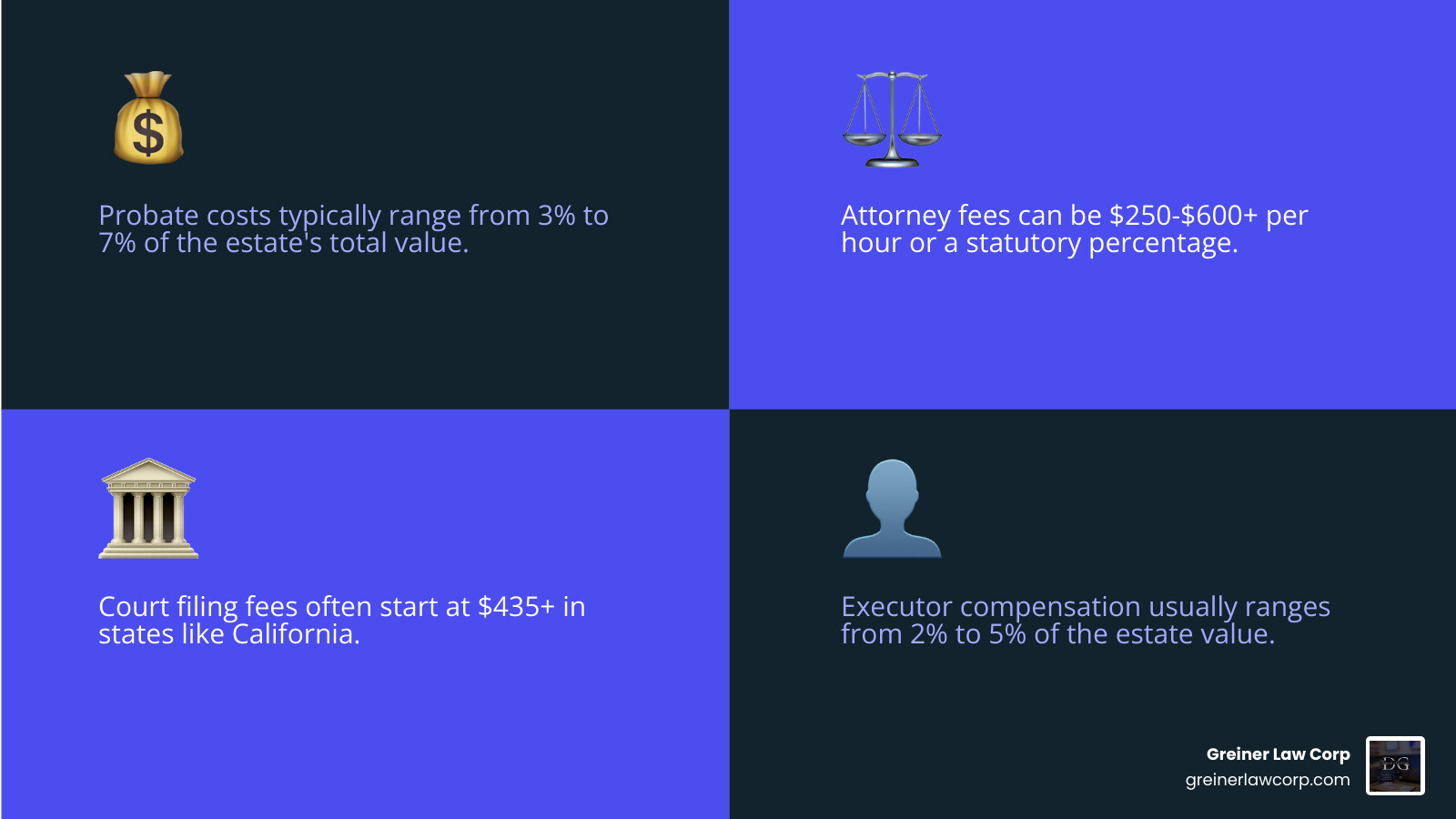
- Total Range: 3-7% of estate value
- Attorney Fees: $250-$600+ per hour (or statutory percentage)
- Court Filing Fees: $435+ in California
- Executor Compensation: 2-5% of estate value
- Average Simple Estate: $3,000-$7,000
- Complex/Contested Estate: $10,000-$20,000+
When someone passes away, their will enters probate, a court-supervised process that validates the will, pays debts, and distributes assets to beneficiaries. While this process ensures final wishes are carried out, it comes with significant costs that can surprise families during an already difficult time.
The financial burden of probate varies dramatically based on your state’s laws, the complexity of your estate, and whether disputes arise. In California, for example, attorney fees alone for a $500,000 estate can reach $13,000 due to the state’s statutory fee schedule. These costs are paid directly from the estate’s assets before any inheritance reaches your loved ones.
As David Greiner, Esq., I’ve helped numerous clients steer probate proceedings and understand the cost to probate will through my years of transactional law practice. My business-focused approach prioritizes achieving your goals while managing these expenses effectively.
Learn more about cost to probate will:
Deconstructing Probate Expenses: A Detailed Breakdown

When families ask about the cost to probate will, they’re often surprised to learn it’s not one simple fee but a collection of expenses. The total cost typically falls between 3% to 7% of an estate’s total value, though complex cases can push even higher. Let’s walk through each piece of this puzzle.
Attorney Fees: The Largest Expense
Attorney fees usually represent the biggest portion of probate costs. Probate attorneys are essential for guiding families through a maze of legal requirements, court deadlines, and complex paperwork.
Lawyers structure their fees in different ways. Some charge hourly rates that can range from $250 to $600 or more, depending on their location and experience.
Other attorneys prefer flat fees for straightforward cases. These typically start around $3,000 for simple, uncontested probate matters where there are no major complications.
Here in California, we have statutory percentage fees. The law sets attorney fees as a fixed percentage of the estate’s gross value. For a $500,000 estate, this means roughly $13,000 in attorney fees alone (4% of the first $100,000, then 3% of the next $100,000, and so on).
The key is getting a clear fee agreement upfront. A good attorney will be transparent about what you’ll pay.
You can dive deeper into this topic at How Much Does a Probate Lawyer Cost?.
Court and Administrative Fees
Court filing fees are unavoidable. In California, filing an initial petition costs around $435, though this varies by county.
Publication notices in local newspapers are also required by law to give creditors a chance to file claims against the estate. These usually run a few hundred dollars.
Certified letter costs are necessary to officially notify beneficiaries and other interested parties. Depending on the number of people to contact, this can add several hundred dollars to the total.
There are also various miscellaneous court charges, such as fees for certified copies of documents (usually $5 to $20 per copy).
For more insights on navigating the court system, check out our guide to Probate Court.
Executor Compensation and Bond Premiums
The Personal Representative (executor) is entitled to payment for their work managing the estate, which can be a significant responsibility.
Most states set statutory commission rates between 2% to 5% of the estate’s value. A will can specify different compensation, but courts often default to these standard rates if the will is silent on the matter.
In some cases, the court determines reasonable compensation based on the actual work involved, especially for complex estates.
Surety bonds act like insurance to protect the estate from mismanagement. Bond premium costs typically run 0.5% to 1% of the bond amount, though a will can waive this requirement.
Learn more about these responsibilities in our comprehensive Executor Duties Explained guide.
Miscellaneous Costs: Appraisals, Accounting, and More
Several smaller expenses can add up during probate.
Real estate appraisals are often necessary to establish the fair market value of any property, costing from a few hundred to several thousand dollars.
If the estate includes business interests, a professional business valuation may be required, which can be expensive.
Accounting fees are important for estates with complex finances. Filing the deceased’s final tax return and any necessary estate tax returns can cost several hundred to several thousand dollars.
Don’t overlook costs for property storage or basic expenses like postage for official mailings. While individually small, these costs accumulate over the months or years probate can take.
What is the Real Cost to Probate a Will? Factors That Drive the Final Bill

The overall cost to probate will isn’t a fixed number; it’s a dynamic figure influenced by several critical factors. Understanding these variables is crucial for estimating what your loved ones might face.
How State Law and Geographic Location Impact Fees
One of the most significant factors influencing probate costs is the state where the probate occurs. Each state has its own laws, fee structures, and procedural requirements.
- California’s Statutory Fee Schedule: California stands out with its statutory fee schedule for both attorneys and executors, based on the gross value of the estate. This makes costs predictable but also potentially higher for larger estates. For an estate worth $500,000, statutory fees alone could be around $13,000. This is a key aspect of California Probate Fees.
- Texas Probate Costs Comparison: In contrast, Texas offers a different landscape. For a simple, uncontested probate with a will, total average costs might range from $3,000 to $7,000. Attorney fees in Texas for such a case might be $750 to $1,500, plus about $380 in court costs. This can be significantly lower than California, especially if the will allows for “independent administration.”
- Uniform Probate Code (UPC) States: Some states have adopted the Uniform Probate Code (UPC), which aims to streamline the probate process and often results in lower attorney fees by emphasizing “reasonable” compensation rather than statutory percentages.
- State-by-State Differences: The variation is considerable. For example, Florida often has lower probate costs than Texas due to simplified procedures for smaller estates, while New York can have a wide range of costs depending on the complexity and county.
How complexity affects the cost to probate a will
The more complex an estate, the higher the cost to probate will is likely to be. Complexity translates directly into more time, legal work, and potential disputes.
| Feature | Simple, Uncontested Estate | Complex or Contested Estate |
|---|---|---|
| Attorney Fees | Flat fee or lower hourly rates; $750-$1,500 (Texas) | Higher hourly rates, percentage fees, or significant litigation fees; $10,000+ (Texas) |
| Court Involvement | Minimal supervision, routine filings | Extensive supervision, multiple hearings, potential trials |
| Duration | 6-12 months (average), 7-9 months (New York), 6 months (Connecticut minimum) | 1-3+ years, potentially much longer |
| Asset Types | Cash, bank accounts, publicly traded stocks, single home | Multiple properties, business interests, foreign assets, intellectual property, complex investments |
| Beneficiaries | Few, easily identifiable, no disputes | Many, difficult to locate, frequent disagreements, challenges to will |
| Debts/Creditors | Few, easily resolved | Numerous, disputed claims, potential lawsuits |
| Taxes | Straightforward income tax, no estate tax | Complex income/estate tax, potential audits, state-specific taxes |
- Asset Types: An estate with only cash and a bank account is far simpler to probate than one with multiple properties, business interests, or assets in different states.
- Business Interests: If the deceased owned a business, its valuation and transfer can be intricate, often requiring specialized expertise and leading to higher fees.
- Multiple Beneficiaries: A large number of beneficiaries can increase administrative work, especially if they are difficult to locate or disagree on how the estate should be handled.
The Impact of Time and Disputes
Time is money in probate. The longer a case drags on, the more expensive it becomes.
- Contested Wills: A challenge to the will’s validity (e.g., alleging undue influence) can lead to lengthy and costly litigation, significantly increasing attorney fees.
- Beneficiary Disputes: Disagreements among beneficiaries regarding asset distribution or executor actions can escalate into legal battles, driving up the overall cost to probate will.
- Creditor Claims: If there are many creditors, or if their claims against the estate are disputed, this can prolong the process and add to legal fees.
- How Delays Increase Expenses: Every extra month means more attorney hours and administrative work. A modest estate might take six to twenty-four months to settle, but complex estates can take much longer. In Connecticut, interest at 0.5% per month accrues on unpaid fees if the process is delayed.
Understanding the typical timeline can help manage expectations. For more information, see How Long Does Probate Take?.
Probating an Estate Without a Will (Intestacy)
Dying without a valid will (intestate) almost always results in a more complicated and expensive probate process.
- Administrator Appointment: The court must appoint an administrator to manage the estate, which can involve additional hearings and legal procedures.
- Heirship Proceedings: Without a will, state intestacy laws dictate asset distribution. This often requires a “determination of heirship” proceeding to legally identify all heirs, which can be costly if the family tree is complex.
- Increased Legal Complexity: The absence of a will means more legal work to interpret and apply state laws, often resulting in higher attorney fees. In Texas, a simple intestate estate may cost $2,500 to $3,000, while a complex one could exceed $6,500.
- Higher Potential Costs: The added steps and potential for disagreements among heirs invariably lead to a higher overall cost when there is no will.
Strategic Estate Planning: How to Minimize Probate Costs

With smart planning, you can dramatically reduce or even eliminate the high cost to probate will for your loved ones. Think of it as a gift you give your family during one of their most difficult times.
Avoiding Probate Altogether: Trusts and Beneficiary Designations
The most powerful strategy for reducing probate costs is to keep your assets out of probate entirely. When assets don’t go through probate, there are no probate fees.
Revocable living trusts are the gold standard for probate avoidance. When you create a trust and transfer assets into it, your successor trustee can distribute them directly to beneficiaries without court involvement. This means no probate attorney fees, court costs, or lengthy delays.
Joint tenancy with right of survivorship is another powerful tool. When you own property jointly this way, the surviving owner automatically inherits the property, bypassing probate. This is common for married couples who own a home or bank accounts together.
Payable-on-Death (POD) accounts and Transfer-on-Death (TOD) deeds offer similar benefits. These simple designations on bank accounts or real estate deeds ensure your assets transfer directly to your chosen beneficiaries.
Life insurance beneficiaries and retirement account designations also pass outside of probate automatically, as long as the beneficiary information is current. Simply updating these forms can save families thousands.
Our Estate Planning Lawyer services can help you determine which combination of these tools works best for your situation.
Simplified Procedures for Small Estates
Even when probate is unavoidable, you may qualify for streamlined procedures that reduce time and costs. States recognize that smaller estates shouldn’t face the same burden as larger ones.
Small estate affidavits are available in many states for the smallest estates. In Texas, if an estate is worth $75,000 or less (excluding the homestead), heirs can use a sworn statement to claim assets without court proceedings.
Summary administration is a middle ground for slightly larger estates. California allows summary procedures for estates under $166,250, which can cost between $1,500 to $3,000 instead of the much higher fees of full probate. This is a substantial savings for beneficiaries.
It’s key to understand your state’s specific thresholds, as they vary widely. These simplified procedures mean fewer court appearances, less paperwork, and lower legal fees, getting assets to your family faster.
The Role of a Probate Attorney in Managing Expenses
Hiring a skilled probate attorney can actually save money. When probate is necessary, the right legal guidance prevents expensive mistakes and keeps the process moving efficiently.
Navigating procedures efficiently is where an experienced attorney pays off. They know the local court rules and deadlines, avoiding delays that multiply costs.
Preventing costly errors is equally important. Incorrect filings, missed deadlines, or improper creditor notices can lead to penalties or litigation that cost more than the attorney’s fees.
A good probate attorney also excels at negotiating with creditors and resolving disputes early. They can often negotiate reductions on claims against the estate and mediate family disagreements before they escalate into expensive court battles.
The cost to probate will becomes more manageable with professional guidance. Proper legal representation can significantly cut probate costs by keeping the process on track and avoiding common pitfalls.
Learn more about what to expect from Probate Lawyer Services: What to Expect and How to Prepare.
Frequently Asked Questions about Probate Costs
When families face the probate process, the financial aspects can feel overwhelming. Let’s address the most common concerns.
Who pays for the probate fees?
Beneficiaries do not need to pay for probate costs out of their own pockets. The cost to probate will is handled entirely by the deceased person’s estate.
Before any inheritance is distributed, the estate pays for its own expenses, including attorney fees, court filing costs, executor compensation, and other administrative charges. The executor is responsible for using the estate’s funds to pay all legitimate expenses.
While this reduces the total amount available for inheritance, it protects family members from having to cover these costs personally. In the rare case that an estate is insolvent (lacks sufficient assets), beneficiaries are typically not required to make up the difference.
For more detailed information about this topic, check out our guide on Who Pays Probate Attorney Fees?.
Understanding the average cost to probate a will: Can I get an estimate upfront?
While every estate is unique, getting a realistic cost estimate upfront is possible and highly recommended.
An initial consultation with a probate attorney is the best starting point. An attorney can review the estate’s value, assets, and potential complications to provide a much more accurate estimate than a general guideline.
Transparency in fee agreements is crucial. A reputable attorney will provide a written agreement that outlines their charges, whether hourly, flat fee, or statutory. This agreement should also explain what additional costs might arise.
In states like California with statutory fee schedules, calculating the maximum attorney and executor fees is straightforward. For other fee structures, your attorney should explain the factors that could affect the final cost.
Complexity matters significantly when estimating costs. An estate with a single bank account will cost far less to probate than one with multiple properties, business interests, or family disputes. Your attorney will factor these elements into their estimate.
Are legal fees for probate tax-deductible?
The tax implications of probate can be complex, but there is often some good news for estates.
Legal fees paid for estate administration can typically be deducted on the estate’s federal income tax return (Form 1041). This includes fees paid to attorneys, executors, and accountants for services necessary to settle the estate.
The IRS has specific rules about what qualifies as a deductible administrative expense. Generally, these are costs incurred to collect assets, pay debts, and distribute property to beneficiaries. The expenses must be necessary for proper estate administration.
However, tax laws are complex and change frequently. We always recommend consulting with a qualified tax professional or an attorney specializing in estate taxes to understand how these rules apply to your specific situation.
The potential tax benefits won’t eliminate the cost to probate will, but they can help reduce the overall financial impact on the estate.
For more comprehensive information about this topic, explore our article on Are Estate Legal Fees Tax Deductible?.
Conclusion: Investing in a Smooth Estate Transition
Planning for the future means understanding what your loved ones will face. The cost to probate will typically ranges from 3% to 7% of your estate’s value, but these expenses don’t have to be an overwhelming burden.
The key costs—attorney fees, court charges, executor compensation, and administrative expenses—all serve to protect your final wishes. While these costs can add up, especially in states like California with statutory fee schedules, understanding them allows you to plan accordingly.
What matters most is taking action now. The difference between a well-planned estate and one that stumbles through probate can be thousands of dollars and months of stress for your family. Tools like revocable living trusts, proper beneficiary designations, and joint ownership can dramatically reduce or even eliminate probate costs.
Even when probate is necessary, the right legal guidance makes all the difference. An experienced attorney doesn’t just add to your costs; they actively work to minimize them by preventing expensive mistakes and navigating the process efficiently.
At Greiner Law Corp, we’ve spent over two decades helping California families protect their legacies. Our business-minded approach means we focus on your goals while managing the practical realities of estate planning. Whether you’re in Victorville, Riverside, San Bernardino, or Los Angeles, we understand that every dollar saved in probate costs is another dollar that goes to the people you care about most.
Think of comprehensive estate planning as an investment. The time and money you spend today creating a solid plan can save your family significantly more tomorrow. Your legacy deserves that protection.
Ready to take the next step? Learn more about our probate services and find how we can help you create a plan that works for your unique situation.


