
Why Understanding Contract Cancellation Matters for Your Business
How to cancel a contract depends on several factors: the type of contract, the reason for cancellation, and applicable laws. Here's the quick answer:
Most Common Ways to Cancel a Contract:
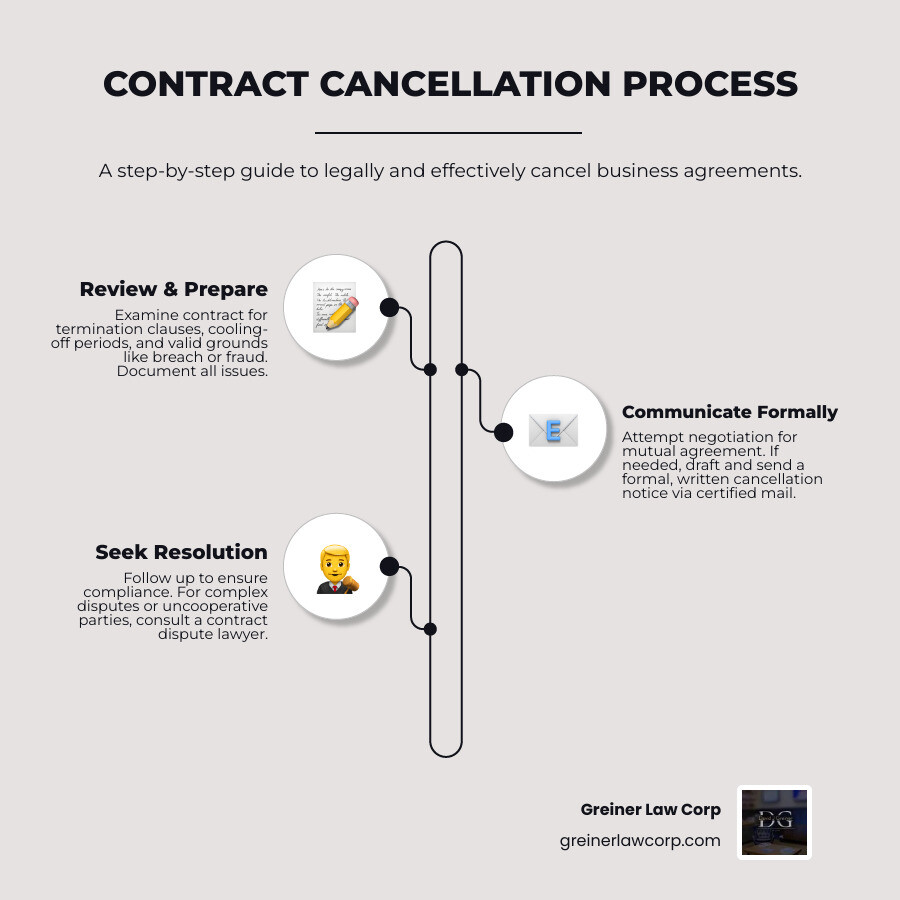
- Review your contract for termination clauses and cooling-off periods
- Provide written notice to the other party (typically 30 days in advance)
- Use valid legal grounds such as breach, fraud, impossibility, or mutual agreement
- Follow required procedures including certified mail and documentation
- Seek legal counsel for high-value or complex agreements
Quick Reference by Situation:
- Door-to-door sales over $25: 3-day cooling-off period (FTC Rule, designed to prevent high-pressure sales).
- Gym memberships under $1,500: 5-day cancellation window (in many states, protecting consumers from long-term commitments they regret).
- New car service contracts: 60-day cancellation period (often with pro-rated refunds).
- Home solicitation contracts: 10-day cooling-off period in California (providing extra protection for significant home-related decisions).
Picture this: you've just signed a business agreement that seemed perfect at the time. The promises were grand, the terms seemed fair, and you were excited about the partnership. Now, weeks or months later, the reality is a stark contrast. The other party isn't just underperforming; they're consistently missing deadlines, the quality of work is subpar, or they've misrepresented their capabilities entirely. Suddenly, that 'perfect' contract feels like a cage, draining your resources and hindering your growth.
You're not alone. Many business owners face this exact situation, feeling trapped by legal obligations they no longer want or need. The good news? Contracts aren't always permanent, and understanding your options can save you thousands of dollars and countless headaches.
The challenge is that contract cancellation isn't as simple as walking away. Improper cancellation can lead to devastating consequences, including costly lawsuits, significant financial penalties, and irreparable damage to your business relationships. Breaking a contract without valid legal grounds could mean you're on the hook for the entire contract value—even for services you never received—plus the other party's legal fees. It's a high-stakes situation where a wrong move can have long-lasting repercussions.
But there's also a path forward. Whether you're dealing with a vendor who's failed to deliver, a service provider who misrepresented their capabilities, or simply a contract with a built-in cancellation clause, you have options. The key is knowing which ones apply to your situation and following the proper procedures.
As David Greiner, Esq., I've spent years guiding business owners through complex contract issues, from business formation to buy-sell agreements. Understanding how to cancel a contract properly is essential to protecting your business interests while minimizing legal risk.
Understanding the Basics of Contract Cancellation
Let's start with the foundation. A contract is simply a legally binding agreement between two or more parties—essentially a promise that the law will enforce. Each party commits to fulfilling certain obligations, and when everyone follows through, everything works smoothly.
But here's the reality: life doesn't always go according to plan. Markets shift, businesses evolve, and sometimes the agreement that made perfect sense six months ago no longer serves your interests. That's when understanding how to cancel a contract becomes crucial for protecting your business.
Now, contracts come in different forms. They can be written or verbal, though I'll be honest with you—proving the terms of a verbal agreement in court is like trying to nail jelly to a wall. It's possible, but unnecessarily difficult and expensive. Furthermore, a legal principle known as the Statute of Frauds requires certain types of agreements to be in writing to be enforceable. This typically includes contracts for the sale of real estate, agreements that cannot be performed within one year, and contracts for the sale of goods above a certain value. This is why we always recommend putting important agreements in writing. It provides a clear record of the terms and saves everyone headaches down the road.
Before we explore your options, let's clarify some terminology that often gets mixed up. People frequently use "cancellation," "termination," and "rescission" interchangeably at the dinner table, but in the legal world, these terms have distinct meanings with very different consequences. Understanding these differences isn't just legal nitpicking—it's fundamental to knowing your rights and obligations.
If you're wondering whether your current situation might qualify as a violation of your agreement, learning What is a Breach of Contract? is an excellent starting point.
Key Differences: Cancellation vs. Termination
While both contract cancellation and contract termination bring a contract to an end, they operate under different conditions and carry different legal weight. Think of it this way: cancellation is like using an eraser, while termination is like drawing a line under the final entry.
When you cancel a contract, you're essentially rewinding the clock. The goal is to restore everyone to their original position, as if the contract never existed. Any money that changed hands gets returned (minus some reasonable expenses). It's a complete do-over. This typically happens when there's fraud, misrepresentation, or another fundamental flaw that makes the contract invalid from the start, such as one party lacking the legal capacity to agree.
Termination works differently. It ends the contract going forward but acknowledges that the contract existed and was valid up to that point. Some obligations might continue even after termination—things like confidentiality clauses, non-compete agreements, or dispute resolution procedures often survive. When a contract is properly terminated, you're released from future performance, but you can't usually undo what's already been done. The contract's termination clause will often dictate how final payments are handled and what happens to any work product or intellectual property created during the agreement.
Here's a practical example: Imagine you hired a marketing agency that promised specific results through legitimate tactics. If they completely fabricated their credentials and experience, that's grounds for cancellation—you'd want your money back and the contract erased. But if they simply underperformed despite honest efforts, and your contract includes a termination clause, you'd terminate the agreement and stop future payments without necessarily recouping what you've already paid.
A material breach by the other party can justify termination, freeing you from further obligations without penalty. A minor breach, on the other hand, might not give you that same freedom. The severity matters.
Then there's rescission, which is similar to cancellation but is a more formal legal remedy that often requires mutual agreement or court intervention to declare the contract void and return everyone to their pre-contract status.
Understanding which approach applies to your situation determines your next steps and what outcomes you can reasonably expect. Getting this wrong can cost you significantly, which is why proper guidance matters when you're facing a contract you need to exit.
When is a Contract Legally Binding?
Not every agreement you make is legally enforceable. For a contract to be binding, it needs four essential elements working together. Missing even one of these can make your contract unenforceable—which might be good news if you're trying to get out of a bad deal, or terrible news if you're trying to hold someone else accountable.
First, you need offer and acceptance. One party makes a clear, definite proposal (the offer), and the other party accepts it without changing the terms. This is often called the 'mirror image rule'—the acceptance must be an exact reflection of the offer. If the other party responds with different terms, that's not an acceptance; it's a rejection and a new counteroffer, which then must be accepted by the original party.
Second, there must be consideration—something of value exchanged between the parties. This is the 'what's in it for me?' part of the deal. It could be money, services, goods, or even a promise to do (or not do) something. The key is that it must be 'bargained-for,' meaning both parties are giving something up as part of the agreement. You can't have a binding contract where only one party benefits without giving anything in return (which would be considered a gift).
Third, all parties must have legal capacity. This means they're adults (typically 18 or older) of sound mind who aren't under duress, undue influence, or severe intoxication. Contracts signed by minors or someone who lacks the mental capacity to understand the agreement can often be voided by that party, making the contract voidable, not automatically void.
Finally, the contract must have a lawful purpose. You can't create an enforceable contract to do something illegal or against public policy. A contract to engage in unlawful activity is void from the start and has no legal effect.
Real estate contracts add extra layers of complexity with specific requirements and timelines. If you're dealing with property agreements, our guide on Real Estate Contracts Explained breaks down what you need to know.
When all four elements are present, you've got a legally binding agreement. Understanding this foundation helps you evaluate whether your contract is solid—or whether there might be grounds to challenge its validity entirely.