Your business may have started with a simple idea. A weekend landscaping route in Victorville. A bookkeeping service run from a spare bedroom. A small real estate investment project with one property and a plan to buy another when the timing is right.
Then the first serious question shows up. A customer wants a formal contract. A lender asks who owns the business. A partner wants in. Someone tells you to “just get an LLC,” and someone else says a corporation saves taxes. At that point, the issue stops being abstract. Your business needs a legal structure that matches how you plan to operate.
That choice affects who gets sued if something goes wrong, how money is taxed, how ownership is documented, and how easy it is to grow. In California, it also affects what you file, what you pay, and what you have to maintain year after year. A business structure for small business isn't just paperwork. It's the frame that holds the business together when money, risk, employees, and property all start moving at once.
Your Business Idea Needs a Legal Home
A lot of founders wait too long to deal with structure because the early phase feels informal. Money comes in under a personal name. Expenses go on a personal card. A friend helps with jobs and gets paid casually. It works until the business becomes real enough that loose ends turn into legal exposure.

When the side hustle stops being casual
Consider a common High Desert pattern. Someone starts by doing mobile auto work, hauling, online retail, consulting, or notary services after hours. The first few customers come through referrals. Then revenue becomes steady enough that the owner starts buying equipment, signing recurring client work, or thinking about hiring help.
That is usually the moment when the founder asks the right question. Not “How do I file something?” but “What am I exposing myself to if I keep operating like this?”
A legal structure is the business’s home address in the law. It tells the state, the IRS, lenders, vendors, courts, and business partners what this thing is. Without that legal home, the owner and the business are often treated as the same person in all the ways that matter most when a dispute arises.
The first real trade-off
Early structure decisions usually come down to two competing goals:
- Keep it simple: Founders want low cost, low friction, and fast startup.
- Protect against risk: Once contracts, customers, vehicles, tools, property, or employees are involved, the owner usually wants separation between business trouble and personal assets.
The right structure rarely feels glamorous. It feels clear, boring, and durable.
That’s a good sign.
In practice, I tell new entrepreneurs to think of structure as a foundation choice. You can renovate later, but changing the foundation after the walls are up is harder and more expensive than starting with the right frame. That’s true whether you're opening a local service company in Victorville or reviewing international deal models such as the UAE Commercial Companies Law, which also shows how ownership, control, and liability rules shape business operations from day one.
What usually goes wrong
Founders tend to make one of two mistakes.
- They do nothing: They assume a good idea and a bank account are enough.
- They overbuild too early: They choose a complex entity because it sounds impressive, even though the business is still one person testing a market.
A sound business structure for small business sits between those extremes. It should protect what needs protection and stay flexible enough for the next stage.
Understanding the Four Main Business Structures
Most small businesses fit into four legal buckets. Each works. Each creates different consequences. The easiest way to understand them is to treat them like different vehicles built for different roads.
According to small business formation data for 2025, 81.9% of the 36.2 million U.S. small businesses were non-employer firms, which helps explain why sole proprietorships and single-member LLCs are so common for people starting lean.
For a closer look at entity choice in practice, this overview of business entity selection is useful when you're comparing early-stage options.
Sole proprietorship
A sole proprietorship is a bicycle. It’s fast to get moving and easy to maintain. But it leaves the rider exposed.
If you start doing business in your own name, and you haven't formed a separate entity with the state, this is often your default structure. There is no legal separation between you and the business. Income is reported through your personal return. You control everything.
That simplicity is the appeal. It’s also the danger.
If the business owes money, causes damage, or gets sued, your personal assets are generally in the line of fire because legally there is no real wall between owner and business.
Usually fits: a very early solo operator testing demand with limited risk exposure.
Partnership
A partnership is a two-seater car. It gets two or more people moving in the same direction, but if the steering arrangement isn't clear, the ride gets rough quickly.
When two or more people run a business together for profit, a partnership can arise even without polished paperwork. That surprises many founders. They assume they are “just working together,” when the law may see a partnership.
Partnerships can be workable, but they need careful agreements about:
- Ownership percentages
- Who contributes cash, labor, or equipment
- How profits and losses are divided
- What happens if one partner leaves
- Who can bind the business to contracts or debt
Without a written agreement, business disputes become fact disputes. Those are expensive.
Limited Liability Company
An LLC is an armored SUV. It gives much better protection while staying flexible enough for rough roads.
For many California small businesses, the LLC is the practical middle ground. It creates a separate legal entity, which means the business can own property, sign contracts, and take on obligations in its own name. The owner or owners are called members.
The key appeal is liability protection. The LLC is designed to shield personal assets from business debts and claims, assuming the owners respect the entity and operate it properly. It also offers flexible taxation and internal management.
This is why LLCs are often a strong fit for:
- Solo founders who want personal asset protection
- Married couples running a business together
- Service businesses with contract exposure
- Real estate holding ventures
- Small companies that want less formality than a corporation
Corporation
A corporation is a city bus. It carries more people, follows more rules, and is often built for bigger routes.
A corporation is a separate legal entity with shareholders, directors, and officers. It comes with more formal governance. Minutes, bylaws, stock, and ongoing procedures matter more here than in an LLC.
There are two broad tax paths people usually mean when they say “corporation”:
- C corporation
- S corporation election
The underlying legal entity may be a corporation, while the tax treatment differs. Some LLCs can also elect S corporation tax treatment, which confuses people because legal structure and tax status are related but not identical.
A corporation often makes sense when ownership will expand, formal investment is likely, or the founders need a structure investors already understand.
For many small founders, the corporation is not the right first move. But for businesses planning to raise outside capital, issue equity, or build a more formal ownership system, it may become the right one later.
How Business Structures Compare on Key Factors
The right entity choice usually turns on five issues. Liability. Taxes. Control. Funding. Administrative burden. Founders often focus on one and ignore the rest, which is how they end up with a structure that looks good on paper but doesn’t fit daily operations.
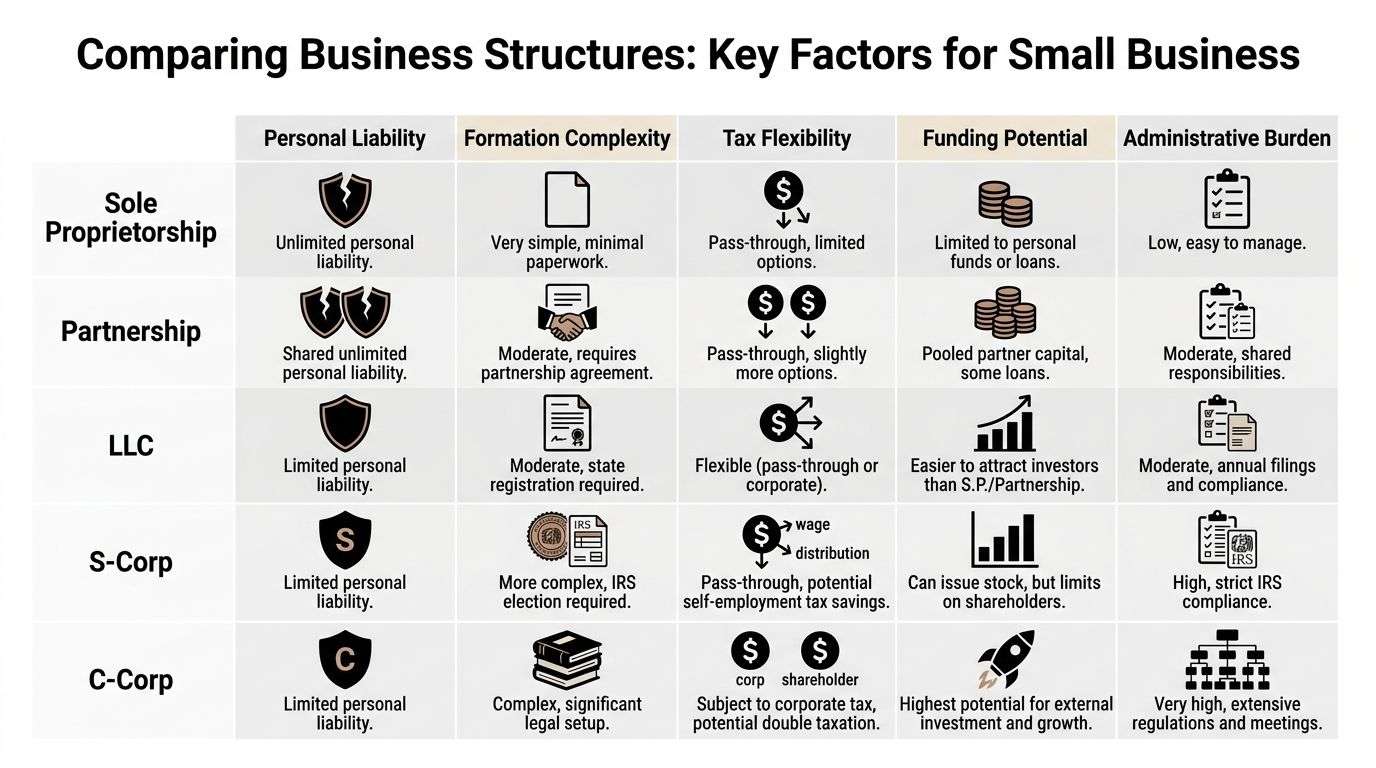
Business Structure Comparison Chart
| Feature | Sole Proprietorship | Partnership | LLC | S Corporation | C Corporation |
|---|---|---|---|---|---|
| Personal liability | Owner generally exposed personally | Partners may be exposed depending on structure and conduct | Liability shield if formed and maintained properly | Liability shield if corporate formalities are followed | Liability shield if corporate formalities are followed |
| Formation complexity | Lowest | Moderate, especially if documented properly | Moderate | Higher, because corporate setup and tax election both matter | Highest |
| Tax treatment | Pass-through | Pass-through | Often pass-through, with flexibility | Pass-through under election rules | Corporate taxation |
| Funding potential | Usually limited to owner funds, loans, or personal guarantees | Better than solo, but often relationship-driven | Often workable for small investors and members | Can support more formal ownership planning | Usually strongest fit for outside investment |
| Administrative burden | Low | Moderate | Moderate | High | Very high |
Liability is the first filter
Liability protection should be the first serious screen for any business structure for small business. If the business signs contracts, interacts with the public, holds inventory, employs people, leases space, or owns vehicles or real estate, personal exposure matters.
A sole proprietorship offers no built-in wall between personal and business liability. A general partnership can be just as risky, and in some situations more dangerous, because one partner’s decisions can create problems for the other.
An LLC or corporation is meant to create separation.
Practical rule: If a business mistake could threaten your home equity, savings, or nonbusiness property, a sole proprietorship is often too thin a structure.
That protection is not automatic magic. Owners still need contracts in the entity’s name, separate accounts, clean records, and conduct consistent with a real business. But the structure gives you a legal wall to work with.
The tax side also matters. According to guidance on choosing business structure, choosing an LLC instead of a sole proprietorship can reduce effective tax burdens by 15-20% for entities under $500K revenue, and failure to structure properly can result in a 25% higher litigation risk where personal assets are targeted.
Taxes are important, but they shouldn't choose the entity alone
Tax discussions often dominate these conversations because people hear fragments like “S corps save taxes” or “LLCs are pass-through.” Both ideas can be true in the right context. Neither should drive the entire legal decision by itself.
For many small owners, the practical tax question is this: do you want income to pass through to your personal return, or are you prepared for the layered treatment associated with a C corporation?
That’s why many first-time founders like LLCs. They often combine liability protection with pass-through taxation. But tax status can be adjusted in some cases without rebuilding the whole legal framework. That’s one reason a flexible structure can be valuable early.
If you're trying to think through an equivalent choice in another system, this comparison of sole trader or limited company is helpful because it frames the same underlying trade-off between simplicity and legal separation.
Management and control often decide partner disputes
A structure should fit the way decisions will get made.
If one owner will run everything and another will contribute capital, that needs to be written down. If two siblings are buying commercial property together through a company, they need rules for deadlock, buyout, and authority before the first disagreement arrives. If three friends launch a contracting business and one stops working after six months, the entity documents need to answer what happens next.
An LLC operating agreement is often where that gets solved. Corporate bylaws and shareholder agreements can do the same job in a corporate setting, but the style of governance is different and usually more formal.
Funding can force a structure change
Some entities are easier to understand for investors and lenders.
Banks frequently ask who owns the company, who can sign, whether authority is documented, and whether the entity is in good standing. Informal businesses struggle here. So do partnerships with loose arrangements and no real governing agreement.
Investors also care about clean ownership. They want to know:
- Who owns what
- Whether equity can be issued
- How transfers work
- What happens if an owner dies or exits
A founder who expects to remain solo may not need a corporation on day one. A founder planning to bring in multiple investors often needs to think further ahead.
If capital is coming from anyone other than you, structure starts affecting not just risk, but credibility and deal mechanics.
Administrative burden is real and ongoing
The wrong entity can create a mismatch between the business and its upkeep.
A sole proprietorship is easy to start. It may also be too exposed. A corporation may offer strong structure for growth. It may also demand governance habits the owner won't realistically maintain. LLCs usually sit in the middle, but they still require disciplined handling.
Founders should be brutally honest. If you know you won't keep minutes, resolutions, ownership records, and formal procedures, don't choose a structure that depends heavily on those practices unless your lawyer and accountant are setting up a system you'll follow.
The best business structure for small business is often the one that you can both maintain and grow into.
Filing in California A Local Perspective
California doesn't let you treat entity choice as a one-time form and move on. Once you form an LLC or corporation here, the state expects ongoing compliance. That has budget consequences, and local owners in Victorville often feel those costs more sharply because many are starting lean.
If you're forming locally, this guide to forming an LLC in California is a practical starting point for the state-level filing path.
State filing is only the beginning
In California, filing the formation document is the opening step, not the whole job.
An LLC generally begins with Articles of Organization. A corporation starts with Articles of Incorporation. After that, owners still need to handle internal governing documents, tax registrations, business licenses, contracts in the correct entity name, and an operating setup that matches the legal form.
California also imposes a recurring reality many founders underestimate: the $800 annual franchise tax applies to LLCs and corporations regardless of income. For a startup, that isn't a theory. It's a line item.
Then come the required information filings and maintenance obligations. Missing those deadlines can create penalties, suspended status, and headaches with banks, lenders, counterparties, and licensing bodies.
Why local context matters in Victorville and the High Desert
High Desert businesses often don't fit the profile assumed by generic startup blogs. Many are home-based, family-run, service-heavy, or tied to real estate, construction, transportation, logistics, or local professional work. Those businesses need practical answers about cash flow, ownership, insurance, and risk, not just a generic “form an LLC” slogan.
That matters even more for founders with limited access to professional guidance. A 2025 report on underserved entrepreneurs noted that rural businesses, including those in areas like Victorville’s High Desert, often face formation barriers tied to capital and legal access, with 70%+ of rural firms underserved in capital access.
Common California filing mistakes
A few problems appear repeatedly:
- Using the entity name inconsistently: The contract says one thing, the invoice says another, and the bank account is under a personal name.
- Skipping governance documents: Owners file with the state but never adopt an operating agreement or bylaws.
- Ignoring ongoing compliance: The entity gets formed, then annual obligations get missed.
- Buying property too early in the wrong name: Real estate gets acquired personally before the ownership and liability plan is thought through.
For California businesses, the filing decision isn't just about choosing a label. It's about whether the business can stay active, documented, and usable when a lease, escrow, lender package, or dispute puts the paperwork under a microscope.
A Practical Checklist for Choosing Your Structure
Most founders don't need more theory. They need a working checklist. The better question isn't “Which entity is best in general?” It's “Which entity still fits when this business looks different a year from now?”

Ask what you're protecting
If the business will have customers, contracts, vehicles, equipment, inventory, tenants, or property, liability moves to the front of the line. A sole proprietorship may feel easy, but easy isn't the same as safe.
If the business is still an experiment with minimal exposure, simplicity may win for a short period. If the business already touches assets or legal obligations, a liability-shielding entity usually deserves serious attention.
Ask who will own it
One owner and multiple owners are different legal worlds.
A solo founder can often make decisions quickly and adapt. The minute a second person comes in, questions multiply. Are both owners working? Is one investing only? Can one sell an interest without the other’s consent? What if one wants out?
Use these prompts:
- One owner with full control: Often points toward a sole proprietorship in a very early phase or an LLC for protection.
- Two or more active owners: Usually calls for a written ownership structure immediately.
- Silent investor involved: Pushes the business toward cleaner documentation and more formal governance.
Ask how you expect the business to grow
Growth triggers re-evaluation. Structure should fit not only where the business is now, but where pressure is likely to show up next.
Think in concrete terms:
Hiring employees
Once payroll, supervision, and workplace policies enter the picture, informal operation becomes much harder to defend.Raising money
Outside capital demands clear ownership, transfer rules, and signing authority.Buying real estate
The title-holding entity affects liability, financing, management, and future transfers.Adding business lines
A contractor who begins with repair work and later adds retail materials, fleet vehicles, or property holdings may need a revised structure.
Choose for the next stage, not just the next week.
Ask how much administrative discipline you can maintain
Some founders are excellent operators and poor record-keepers. That matters.
If you want a corporation, you need to be prepared for a more formal process. If you want a simpler maintenance path with strong practical protection, an LLC is often easier to live with. If you want no formal upkeep, understand what you are giving up in exchange.
A useful self-check is to ask whether you'll consistently do these things:
- Keep business and personal money separate
- Sign contracts in the entity’s name
- Maintain ownership records
- Update filings when required
If the answer is no, fix the process or choose a structure that aligns better with how you operate.
Taking Action and Knowing When to Get Legal Counsel
Choosing an entity is one step. Implementing it correctly is the step that keeps the structure from collapsing under stress.

What action looks like after the decision
After selecting a business structure for small business, the owner still needs to do the work that makes the entity real in practice.
That usually includes:
- Filing the correct formation document
- Preparing governing documents such as an operating agreement or bylaws
- Getting tax registration in order
- Opening accounts in the business name
- Using the entity name consistently in contracts and invoices
- Reviewing insurance, licenses, and local permit needs
Those steps sound administrative. They are legal protection steps.
The points where DIY becomes risky
Some formations are straightforward enough to handle with a lawyer reviewing the result. Others should not be improvised.
Legal counsel becomes much more important if any of the following are true:
- You are starting the business with another owner: Profit splits, decision rights, deadlock, exit rights, and buyout rules should not be left vague.
- You are buying or holding real estate in the business: Title, lender requirements, lease structures, and liability planning need to align.
- You are expecting investor money: Clean ownership and transfer rules matter immediately.
- You want succession planning built in: If the owner dies or becomes incapacitated, the entity documents should work with the estate plan.
- You are a licensed professional: California may limit or shape what entity forms are available.
If you need help with formation documents, entity planning, or ownership terms, a business formation lawyer can handle the legal setup and draft the governing documents that generic filing services usually skip.
Structure doesn't stop at formation
The lifecycle issue matters here. The right structure at startup may become the wrong structure when the business adds people, property, or outside money.
Once a company grows beyond a handful of moving parts, internal organization matters too. According to small company structure guidance from Stripe, adopting a functional organizational structure can improve operational efficiency by 30-40% after legal formation by assigning clear ownership by discipline, such as sales, operations, or transaction work.
That matters in the world. A founder who once handled every customer, invoice, and vendor personally eventually needs role clarity. Otherwise, the entity may be legally sound while the operation becomes chaotic.
Form the entity early enough to protect the business. Revisit the structure early enough to protect the growth.
Used properly, legal counsel isn't there just to file papers. It's there to help the business survive the moments when ownership, money, property, and risk all become more complicated at the same time.
Frequently Asked Questions About Business Structures
Can I change my business structure later
Yes. Many businesses do.
A sole proprietor may form an LLC once contracts, liability exposure, or property ownership become more serious. An LLC may later elect different tax treatment or convert as growth changes the business. The key issue isn't whether change is possible. It is whether contracts, licenses, tax treatment, bank accounts, and ownership records are all transitioned correctly.
Changing structure is usually easier before the business has multiple owners, debt, or significant assets.
What is an S corporation election
An S corporation election is a tax election, not a separate everyday business label in the way people often think of one. A corporation can elect S status, and in some cases an LLC can elect to be taxed that way as well.
People usually consider it when they want pass-through treatment with a different compensation structure than a default LLC tax setup. This is an area where legal and tax advice should be coordinated because the election affects payroll, documentation, and compliance.
Are there special California rules for licensed professionals
Yes. California does not treat every profession the same way.
Lawyers, doctors, architects, accountants, and other licensed professionals may face entity restrictions or profession-specific rules that don't apply to a standard retail or consulting business. That means an article or video aimed at “small businesses” can be incomplete for professional practices.
If your work depends on a professional license, the entity should be reviewed with those licensing rules in mind before filing.
Does my spouse automatically become my business partner
No. Marriage by itself does not automatically create a business partnership.
Ownership depends on how the business is formed, titled, funded, operated, and documented. But spouses who work together often blur the lines unintentionally. If one spouse contributes money, another manages operations, and both assume they share ownership, the documents need to say exactly what that means.
This is especially important when the business owns real estate, supports family income, or will eventually pass through an estate plan.
Do I need an operating agreement if I am the only owner
In most cases, yes. A single-member LLC still benefits from a written operating agreement.
It shows that the entity is being treated as a real legal structure, clarifies management authority, and helps support separation between the owner and the company. It also becomes useful when a bank, buyer, insurer, escrow officer, or court asks for internal authority documents.
If you're weighing a business structure for small business in California, especially in Victorville or the High Desert, David J. Greiner Law Corp can help you evaluate the entity choice, prepare formation and governing documents, and align the business structure with real estate, ownership, and succession planning concerns.