Why Business Entity Selection Impacts Everything
Business entity selection is the foundation that shapes your company’s legal protection, tax obligations, and growth potential. The structure you choose influences everything from day-to-day operations to your ability to raise capital and eventually exit your business.
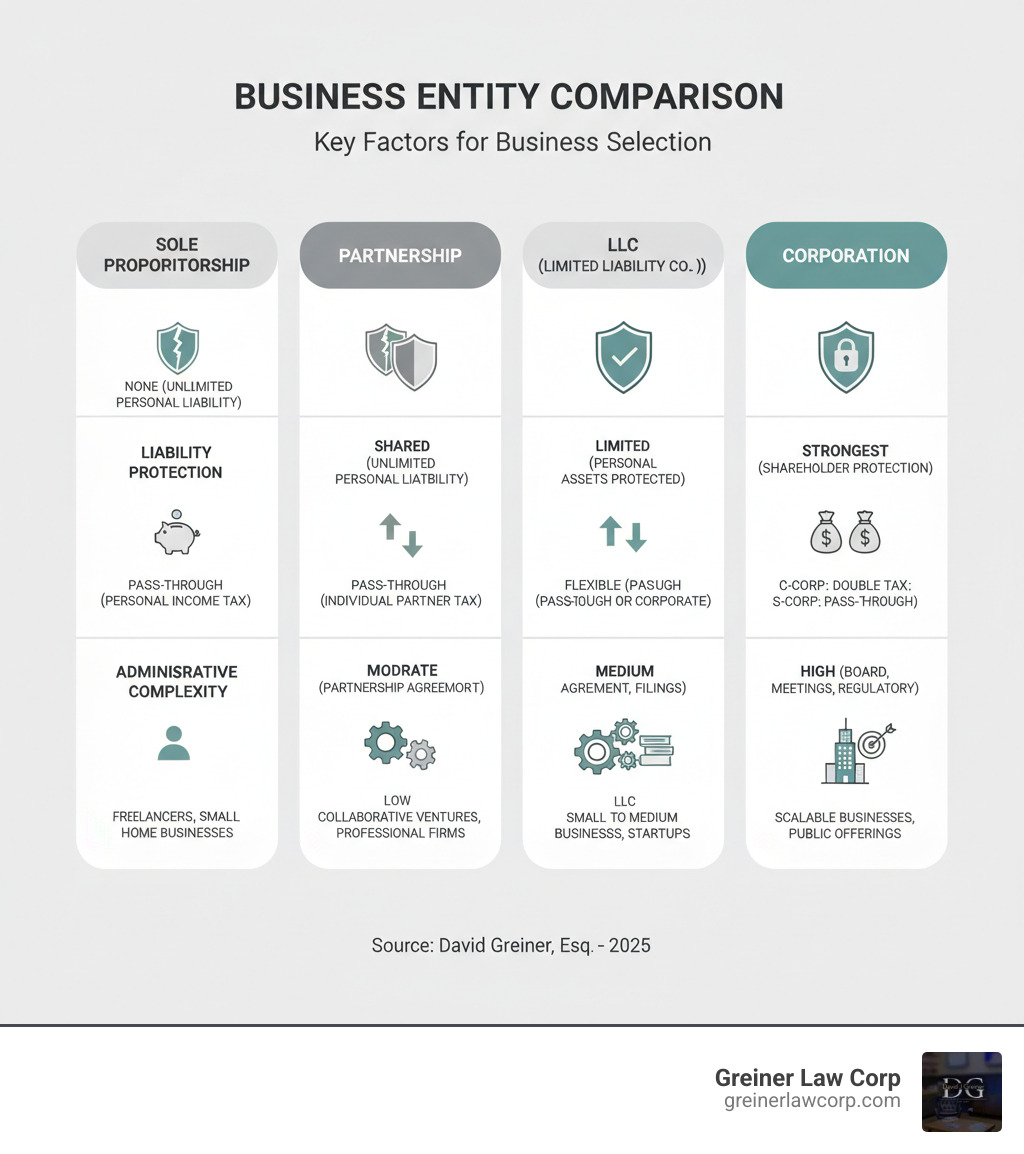
Quick Answer: The Main Business Entity Options
- Sole Proprietorship: Simplest structure, no legal separation, unlimited personal liability
- Partnership: Two or more owners, shared liability and profits, pass-through taxation
- LLC: Liability protection with flexible taxation, popular for small businesses
- Corporation: Strongest legal protection, can be C Corp (double taxation) or S Corp (pass-through)
Many entrepreneurs mistakenly default to “incorporating” without understanding their full range of options. This isn’t just paperwork—it’s a strategic decision that affects your personal assets, tax bill, and business flexibility for years to come.
As David Greiner, Esq., my experience in transactional law has shown that the right business entity selection can save entrepreneurs thousands in taxes and protect their personal wealth from business risks.
The Building Blocks: Understanding the Primary Business Entities
Choosing a business structure is like picking the foundation for a house. Understanding these fundamental options is your first step toward making a smart decision that protects your assets and sets you up for success. Let’s walk through the main players in business entity selection.
Sole Proprietorship
If you start doing business as an individual without filing any formation paperwork, you are a sole proprietorship. It’s the default and simplest structure.
Key features include:
- No legal separation: You and the business are one and the same.
- Unlimited personal liability: Your personal assets (house, car, savings) are at risk if the business incurs debt or is sued. This is the primary reason entrepreneurs choose other structures.
- Pass-through taxation: Business income and expenses are reported on your personal tax return using Schedule C. You are also responsible for self-employment taxes via Schedule SE.
For a deeper comparison, see our guide: Confused by Sole Proprietorship vs. LLC? We Break It Down.
Partnership (General & Limited)
When two or more people go into business together without forming another entity, they create a partnership.
- General Partnerships (GPs) are the default for multiple owners. All partners typically share in management, profits, and losses. Crucially, all partners face unlimited personal liability for business debts, including those created by other partners.
- Limited Partnerships (LPs) have at least one general partner with unlimited liability who manages the business, and one or more limited partners whose liability is capped at their investment.
- Limited Liability Partnerships (LLPs) are usually for licensed professionals (lawyers, accountants), protecting partners from the negligence of their colleagues.
All partnerships use pass-through taxation, filing an informational return (Form 1065), with profits passing to partners to report on their personal returns. A written partnership agreement is essential to define roles, profit splits, and exit procedures. For more, see this general partnership resource.
Limited Liability Company (LLC)
The LLC is a popular hybrid structure, offering the personal liability protection of a corporation with the tax flexibility of a partnership.
An LLC is a separate legal entity, creating a shield between your business debts and your personal assets. This protection is a primary benefit for most small business owners.
Key features include:
- Flexible taxation: By default, single-member LLCs are taxed like sole proprietorships, and multi-member LLCs like partnerships. They can also elect to be taxed as a corporation.
- Flexible management: Can be managed by all owners (members) or by appointed managers.
- Fewer formalities: Compared to corporations, LLCs have fewer mandatory meetings and record-keeping requirements. An operating agreement is vital to outline governance and ownership rules.
Learn more at What is an LLC Business? and our Ultimate Guide to Creating an LLC in California.
Corporation (C Corp vs. S Corp)
Corporations are the most formal structure, offering the strongest liability protection. A corporation is a completely separate legal entity from its owners (shareholders), governed by a Board of Directors.
- C Corporations are the standard corporate structure. They can have unlimited shareholders and multiple classes of stock, making them ideal for raising capital. However, they face double taxation: the corporation pays tax on its profits, and shareholders pay tax again on dividends.
- S Corporations are a tax election, not a legal structure. An eligible corporation can elect S Corp status to gain pass-through taxation, avoiding the double taxation of C Corps. Profits and losses pass directly to shareholders’ personal tax returns. S Corps have strict rules, including a limit of 100 shareholders (who must be U.S. citizens/residents) and only one class of stock.
Both C and S Corps require strict formalities like regular board meetings and detailed minutes. For more, explore What is Corporate Law? and the California S-Corp Requirements.
The Core Factors in Your Business Entity Selection
Choosing an entity isn’t about finding the “best” one, but the one that’s best for you. Your decision in business entity selection should be guided by your risk tolerance, growth plans, and tax situation. Let’s break down the three major factors.
Personal Liability: Protecting Your Personal Assets
This is often the most critical factor. The wrong structure can put your personal wealth at risk.
Unlimited liability (sole proprietorships, general partnerships) means there is no legal separation between you and your business. If the business is sued or incurs debt, creditors can pursue your personal assets like your home, car, and savings.
Limited liability (LLCs, corporations) creates a legal wall between your business and personal finances. In most cases, your personal assets are protected from business debts and lawsuits. Your risk is generally limited to the amount you’ve invested in the company.
However, this protection isn’t absolute. Courts can pierce the corporate veil and hold you personally liable if you fail to treat the business as a separate entity (e.g., by mixing personal and business funds). Proper risk management is key. Our Business Risk Management Ultimate Guide can show you how to build layers of protection.
Taxation: Pass-Through vs. Double Taxation
Your entity choice directly impacts your tax bill. The two main approaches are pass-through taxation and corporate taxation.
Pass-through taxation is used by sole proprietorships, partnerships, LLCs, and S corporations. Business profits and losses “pass through” to the owners’ personal tax returns, and the business itself does not pay income tax. This avoids double taxation. However, owners in these entities often pay self-employment tax (Social Security and Medicare) on their earnings.
Corporate taxation applies to C corporations. The business pays tax on its profits at the corporate level. When those profits are distributed to shareholders as dividends, the shareholders pay tax on them again. This is known as double taxation. While this sounds negative, C corporations can retain earnings for growth and are preferred by many investors.
An S Corp election offers a hybrid approach, providing the pass-through benefits of an LLC while potentially reducing self-employment taxes for owners who can take a portion of their income as distributions rather than salary. For eligibility, see the SBA’s guide on business structures.
| Entity Type | Tax Form Filed | Pass-Through? | Double Taxation Risk? | Self-Employment Tax? |
|---|---|---|---|---|
| Sole Proprietorship | Schedule C on 1040 | Yes | No | Yes (on all profits) |
| Partnership | Form 1065 | Yes | No | Yes (for active partners) |
| LLC (default) | None/Form 1065 | Yes | No | Yes (for active members) |
| C Corporation | Form 1120 | No | Yes | No (salary/dividends taxed differently) |
| S Corporation | Form 1120-S | Yes | No | Yes (on salary, not distributions) |
Administrative & Compliance Burdens
Your entity choice determines your administrative workload. Simpler structures require less paperwork, while more complex ones demand formal compliance.
- Sole proprietorships and general partnerships are the simplest, with minimal startup filings and ongoing compliance.
- LLCs offer a balance. They require filing Articles of Organization with the state and often an annual report. An operating agreement is crucial for defining rules but is typically an internal document.
- Corporations have the highest administrative burden. They require bylaws, regular board meetings with documented meeting minutes, and annual filings. Failing to meet these formalities can risk your liability protection.
Staying compliant is essential for maintaining the legal shield your entity provides. Our guide on How to Ensure Regulatory Compliance for Small Businesses can help you build effective systems.
Strategic Considerations for Growth and Exit
Your business entity selection should align with your long-term goals. Thinking about growth, investment, and your eventual exit from day one can save you significant time and money.

Fueling Growth: Raising Capital and Attracting Investors
If you plan to seek outside funding, your entity choice is critical. Venture capital (VC) funds and angel investors overwhelmingly prefer to invest in C Corporations. There are several reasons:
- Stock Structure: C Corps can issue different classes of stock (e.g., preferred stock for investors, common stock for founders), which allows for the complex terms VCs require.
- Investor Restrictions: Many investment funds are legally prohibited from investing in pass-through entities like LLCs due to tax complications.
- QSBS Treatment: Stock in a qualifying C Corp may be eligible for Qualified Small Business Stock (QSBS) treatment, which can offer a 100% capital gains exclusion upon sale—a massive tax benefit for early investors. Our QSBS Overview explains if your business might qualify.
Structuring Management Incentives
Attracting top talent often requires offering equity. Your entity determines how you can do this.
- Corporations can offer traditional stock options, including Incentive Stock Options (ISOs), which have favorable tax treatment and are familiar to employees in the tech industry.
- LLCs cannot issue stock options. Instead, they can grant profit interests or membership units, which give employees a share of future appreciation. While flexible, these are often less understood than stock options.
Properly structuring these incentives is a complex legal task. Our Business Contract Legal Advice can help ensure your equity plans are legally sound.
Planning Your Exit: How Your Entity Affects Your End Game
Every owner will eventually exit their business. Your entity structure impacts how this happens and the tax consequences.
- Stock Sale vs. Asset Sale: A business can be sold via a stock sale (selling the ownership shares) or an asset sale (selling the company’s individual assets). Buyers often prefer asset sales to avoid inheriting hidden liabilities, while sellers prefer stock sales for their favorable capital gains tax treatment.
- Tax Implications: C Corps face a potential double taxation issue in an asset sale. Pass-through entities (LLCs, S Corps) are generally more tax-efficient at exit, as the gain on the sale is typically taxed only once at the owner’s level.
- Family Succession: LLCs offer great flexibility for transferring ownership to the next generation through customized operating agreements. Corporations also work but tend to be more formal.
Choosing the right entity from the start avoids costly and complex conversions later. Thinking about your exit strategy now is a key part of your initial business entity selection.
Advanced Considerations: Specialized Structures and Locations
Beyond the basics, specialized entities and jurisdictional factors can play a major role in your business entity selection, especially for businesses with unique goals.
Hybrid & Specialized Structures
Sometimes, a standard entity doesn’t fit. Specialized options include:
- Benefit Corporations (B-Corps): For-profit corporations legally required to balance profit with a positive impact on society and the environment.
- Non-profits: Organizations formed for charitable, educational, or scientific purposes. They can be tax-exempt but cannot distribute profits to owners.
- Professional Corporations (PC) or PLLCs: Required in many states for licensed professionals like doctors and lawyers. They offer liability protection for business debts but not for an individual’s own malpractice.
- Close Corporations: A simplified corporate structure for businesses with a small number of shareholders, often allowing for less formal governance.
State vs. Federal Law: The Delaware Advantage and Multi-State Operations
Your business is formed under state law, which governs its internal operations. You can form your entity in any state, not just where you operate.
- The Delaware Advantage: Many businesses, especially those seeking venture capital, incorporate in Delaware. Its highly developed and predictable corporate law, handled by a specialized Court of Chancery, is a major draw for investors.
- Foreign Qualification: If you form your business in one state (like Delaware) but operate in another (like California), you must register as a “foreign” entity in the state where you operate. This ensures compliance with local taxes and regulations. The California Secretary of State has resources for this process.
- State-Specific Taxes: Tax laws vary by state. California, for example, imposes an annual franchise tax on LLCs and corporations, regardless of income.
Industry-Specific Choices for your business entity selection
Your industry often points toward an ideal structure:
- Real Estate Holdings: LLCs are favored for their liability protection against premises claims and the pass-through tax treatment of rental income and depreciation.
- Tech Startups: C Corporations are the standard due to the preferences of venture capitalists and the ability to offer stock options to attract talent.
- Professional Services: Doctors, lawyers, and accountants often must form a Professional Corporation (PC) or Professional LLC (PLLC) as required by state licensing boards.
- Consulting Firms: A single-member LLC is a great start. As profits grow, electing S Corp tax status can offer potential savings on self-employment taxes.
- E-commerce Businesses: An LLC is highly recommended to shield personal assets from product liability claims and other online business risks.
Frequently Asked Questions about Business Entity Selection
Navigating business entity selection can be confusing. Here are answers to some of the most common questions we hear at Greiner Law Corp.
Which business entity is best for a one-person business?
For a solo entrepreneur, the choice is typically between a sole proprietorship and a single-member LLC.
- A Sole Proprietorship is the simplest path, requiring no formation paperwork. However, it offers no liability protection, putting your personal assets at risk.
- A single-member LLC is usually the recommended choice. It requires state filing and a fee, but it provides a crucial liability shield that separates your personal assets from your business debts. It offers the same pass-through taxation as a sole proprietorship, providing protection without adding tax complexity.
Can I change my business entity type later on?
Yes, your initial business entity selection is not set in stone. Businesses often evolve their structure as they grow. For example, an LLC might convert to a C Corporation to attract venture capital, or a profitable LLC might elect S Corp taxation to save on self-employment taxes.
However, converting from one entity to another is a complex legal and tax event. It can trigger unexpected tax liabilities if not handled correctly. It is essential to plan any conversion with experienced legal and tax professionals to ensure a smooth and efficient transition.
What is the main difference between an S Corp and an LLC?
This is a common point of confusion because they are different concepts:
- An LLC is a legal structure formed under state law. It provides liability protection and has a flexible management structure.
- An S Corp is a tax election made with the IRS. It dictates how a business is taxed.
An eligible LLC (or corporation) can elect to be taxed as an S Corporation. The main benefit is potential savings on self-employment taxes. With a standard LLC, all profits are subject to self-employment tax. With an S Corp election, the owner must take a “reasonable salary” (subject to payroll taxes), but any additional profits can be taken as distributions that are not subject to self-employment tax.
This tax savings comes with trade-offs, including stricter ownership rules (e.g., no more than 100 shareholders, no foreign owners) and more administrative formalities.
Conclusion: Make a Strategic Choice, Not a Default One
Your business entity selection is more than a startup task—it’s the legal and financial foundation of your company. This decision impacts your personal liability, tax obligations, and ability to grow.
There is no single “best” entity. The right choice depends on your specific goals, industry, and risk tolerance. A sole proprietorship offers simplicity but exposes your personal assets. An LLC provides protection and flexibility. A C Corporation is built for raising capital but comes with double taxation and administrative complexity.
The key factors—liability, taxation, administration, and growth potential—translate into real-world consequences. An informed decision from the start saves the cost and complexity of changing your structure later.
At Greiner Law Corp, we understand that behind every entity choice is an entrepreneur with a unique vision. Our business-minded approach helps you understand how the law can serve your goals and manage your risk effectively.

Your business deserves a structure that protects you, optimizes your taxes, and positions you for success. Don’t leave this critical decision to chance.
Ready to build your business on a solid legal foundation? Explore our Business Formation Services to get started.


