Why Business Risk Management is Essential for Every Business Owner
Business risk management is the systematic process of identifying, analyzing, and controlling potential threats that could harm your business operations, finances, or reputation. Here’s what every business owner needs to know:
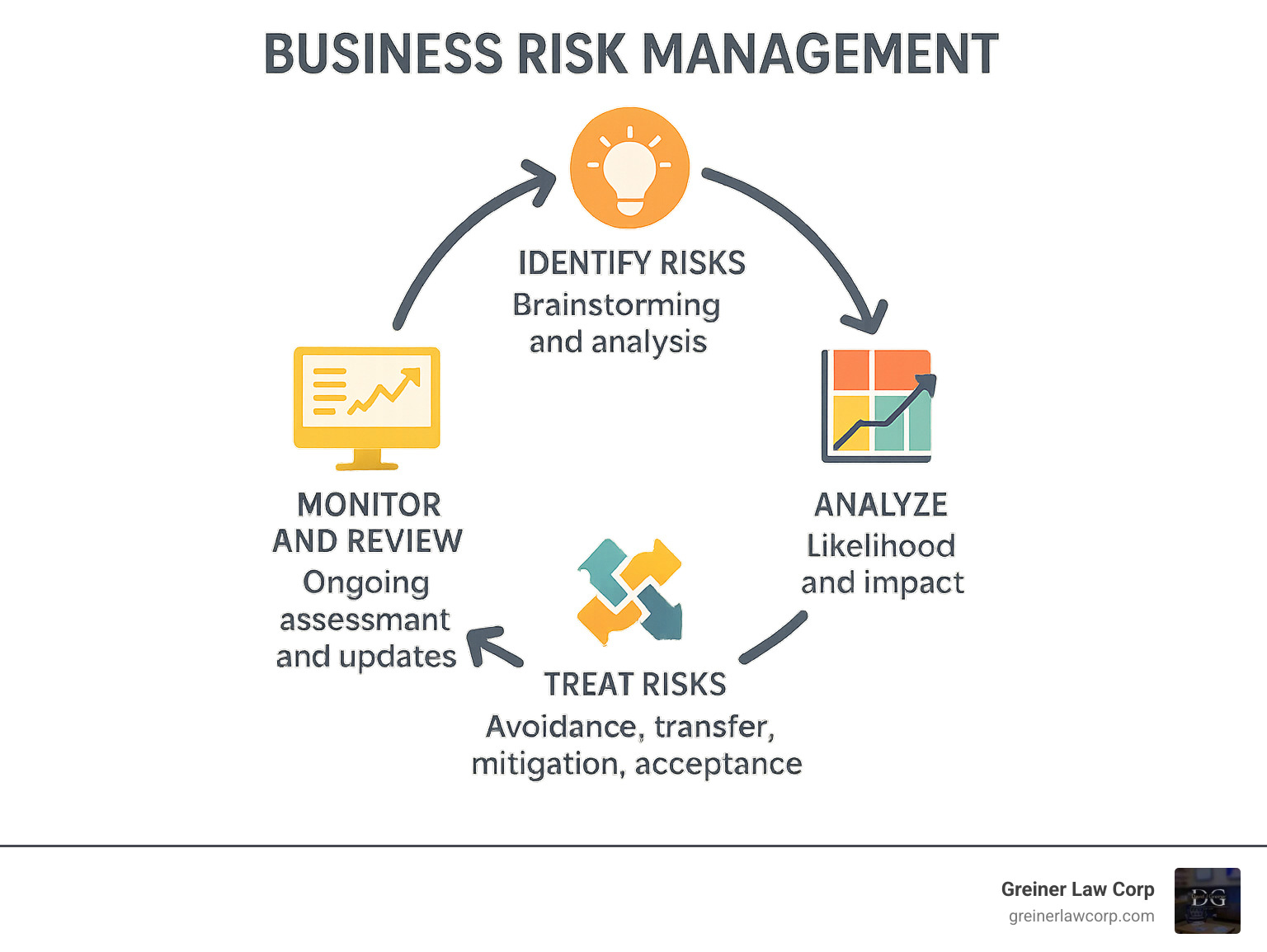
Key Components of Business Risk Management:
- Risk Identification – Spotting potential threats before they occur
- Risk Analysis – Evaluating the likelihood and impact of each risk
- Risk Treatment – Implementing strategies to avoid, reduce, transfer, or accept risks
- Risk Monitoring – Continuously reviewing and updating your approach
Common Business Risks Include:
- Strategic risks (market changes, competition)
- Financial risks (cash flow, credit)
- Operational risks (equipment failure, supply chain)
- Compliance risks (regulations, legal requirements)
- Reputational risks (negative publicity, customer complaints)
- Security risks (cybersecurity, data breaches)
Risk is unavoidable in every industry, but effective management turns uncertainty into competitive advantage. Organizations that accept strategic risk management are five times more likely to deliver stakeholder confidence and better business outcomes, according to PwC’s Global Risk Survey.
The stakes are higher than ever. With 600 million cyberattacks happening daily and 70% of organizations experiencing at least two critical risk events in the past year, proactive risk management isn’t optional – it’s essential for survival.
I’m David Greiner, Esq., and during my years as president of Greiner Buick GMC, I learned how effective business risk management protects operations and drives growth. Now, as a business attorney, I help clients steer complex risks through strategic legal guidance and practical solutions.
Understanding the Landscape: What is Risk and Why Does It Matter?
A key supplier goes out of business, a cyberattack hits your systems, or new regulations change your industry. These sudden events are where business risk management becomes your lifeline.
At its core, business risk management is about understanding potential threats and opportunities to steer your business with confidence. A business risk is any threat to your organization’s profits, goals, or safety, covering everything from economic shifts to equipment failures. However, risk isn’t always the villain; it can also represent opportunity. Launching a new product, entering a new market, or investing in technology are all calculated risks. Smart business owners don’t eliminate all risk—that would kill growth. Instead, they learn to understand, measure, and make informed decisions about which risks are worth taking.
This approach is vital for any business, from a tech startup in San Francisco to a family restaurant in Riverside. Effective risk management helps you anticipate problems, prevent costly disruptions, and move from reacting to crises to proactively shaping your business’s future.
Why Business Risk Management is Crucial for Success
The ability to bounce back from challenges often comes down to business risk management. It’s about building a resilient business that can thrive in uncertainty.
The numbers are compelling: according to PwC’s Global Risk Survey, organizations with strong strategic risk management are five times more likely to build stakeholder confidence and two times more likely to see faster revenue growth. A well-managed company inspires trust.
Your reputation is also at stake. A single incident can destroy years of hard work. Delta Airlines’ 2016 computer outage cost an estimated $150 million and damaged its reputation, an outcome that could have been mitigated with better risk planning.
The financial stakes are growing. Workplace misconduct cost U.S. businesses over $20 billion in 2021, and corporate fines have risen dramatically. Volkswagen’s emissions scandal, for example, resulted in $25 billion in U.S. penalties. These examples highlight the severe cost of failing to manage risk.
Understanding the legal landscape is crucial for protecting your business. For comprehensive guidance on navigating business legal requirements, explore our resources on Business Law.
Common Categories of Business Risks
Business risks come in many forms, but most fall into several common categories.
Strategic risks emerge from fundamental business choices, like picking the wrong target market, failing to innovate, or misjudging customer needs.
Financial risks revolve around money, including cash flow problems, debt management, unexpected cost increases, and investment losses.
Operational risks are day-to-day threats that disrupt business, such as equipment breakdowns, supply chain problems, employee issues, or system failures.
Compliance risks involve legal or regulatory penalties from failing to follow laws and industry standards, like GDPR or CCPA, which can result in massive fines.
Reputational risks threaten your brand image and customer trust through bad press, negative social media, or product recalls. A negative story can spread globally in hours.
Security risks, particularly cybersecurity threats, are a major danger. Microsoft estimates there are 600 million cyberattacks happening every day. Global losses from cybercrime are projected to reach $10.5 trillion, with the average cost of a data breach for an American company hitting $9.36 million.
Quality risks occur when products or services fail to meet customer standards, leading to recalls, warranty claims, and damage to brand loyalty.
Understanding these risk categories is the first step in building a comprehensive business risk management strategy that protects your business while positioning it for growth.
The Core Business Risk Management Process
Think of business risk management as your organization’s navigation system, constantly adapting to guide your business through uncertainty. It’s not a one-time checklist but an ongoing cycle that keeps your company resilient.

This systematic approach moves from identifying what could go wrong to continuously monitoring how well your strategies are working, building a safety net that also catches opportunities.
Step 1: Identify Potential Risks
This is where you hunt down every possible threat or opportunity. The key is to cast a wide net, as the most damaging risks are often the ones you never considered.
- Brainstorming sessions work best when you include diverse voices from all levels of your company.
- SWOT analysis provides a structured way to examine strengths, weaknesses, opportunities, and threats—the last two are goldmines for risk identification.
- Stakeholder consultation with customers and suppliers can reveal blind spots, like material shortages or shifting industry trends.
- Internal research involves digging into your own data, like incident reports and financial statements. External research keeps you updated on broader industry and economic shifts.
For a deeper dive, this guide on Assessing your business for risks is a helpful resource. The goal is to identify the risks that could significantly impact your business.
Step 2: Analyze and Evaluate Risks
Next, determine which risks deserve your immediate attention. Not every risk is created equal, so prioritization is key.
Evaluate each risk by asking two questions: How likely is this to happen? and How bad would it be if it did?

A risk matrix helps visualize this analysis by plotting likelihood against impact. Multiplying these values gives a risk score, highlighting high-priority threats. This process moves you from gut feelings toward objective prioritization.
Everything is documented in a risk register—your risk management headquarters. This living document tracks each identified risk, its category, score, and planned response, creating a roadmap for your resources.
Step 3: Treat the Risk – Mitigation Strategies
Here, you decide what to do about each risk. The best approach often combines several proven strategies.
- Risk avoidance: Deciding not to engage in a risky activity, like avoiding international expansion if currency risks are too high.
- Risk retention: Consciously accepting a risk, typically when the potential impact is small or mitigation is too costly.
- Risk spreading: Diversifying to avoid putting all your eggs in one basket, such as using multiple suppliers or serving different customer bases.
- Risk transfer: Shifting the financial burden to another party, usually through insurance or well-drafted contracts.
- Loss prevention and reduction: Implementing measures to make risks less likely or less damaging, like employee safety training or cybersecurity protocols.
At Greiner Law Corp, we help businesses strengthen their risk management through solid legal frameworks. Our expertise in Business Risk Management Strategies and Risk Management in Contracts ensures your legal agreements support your overall risk strategy.
Step 4: Monitor and Review
A risk management plan is a living document that must be kept up-to-date to be effective.
- Regular updates to your risk register should happen at least quarterly. New risks emerge, old ones fade, and the business landscape shifts.
- Key Risk Indicators (KRIs) act as early warning signals, like a spike in customer complaints indicating a quality issue.
- When incidents occur, use them as learning opportunities. Root cause analysis helps you understand why something happened, preventing future occurrences.
The key is staying adaptable. Your risk management plan must evolve with your business. For ongoing improvement, explore resources on Improving your risk management skills. The goal isn’t perfection—it’s continuous improvement.
Building an Actionable Risk Management Plan
Moving from theory to a practical plan is where business risk management proves its value. Your plan is an emergency preparedness kit for your business, turning analysis into something your team can use.
A plan that works requires leadership buy-in, dedicated resources (time and money), and must be actionable for your team and budget. The best plan is one you can actually execute, not an overly complex framework that sits on a shelf.
Essential Components of an Effective Plan
When we help California businesses develop their business risk management plans, we focus on building something practical that fits their reality. An effective plan includes these core components:
- Objectives and scope: Clearly define what you are trying to protect so everyone knows what success looks like.
- Roles and responsibilities: Establish who is accountable for specific risks. In a small business, one person may wear multiple hats, but clarity is essential.
- Stakeholder communication plan: Map out how you will inform your team, investors, and partners about risks and incidents before a crisis hits.
- Control implementation details: Get specific about your safeguards. Document your policies, backup procedures, vendor screening processes, and safety protocols.
- Contingency plans: Develop “what if” scenarios for your biggest risks, such as a main supplier disappearing or a system failure. You need a clear action plan. This business continuity plan template can help you start.
Navigating Legal and Compliance Problems
Legal and compliance risks are complex and can have devastating consequences. The regulatory landscape, especially for data privacy and consumer protection, is constantly evolving, and the days of “we’ll figure it out as we go” are over.
Data privacy regulations like the EU’s GDPR and California’s CCPA have serious teeth:
| Feature | General Data Protection Regulation (GDPR) | California Consumer Privacy Act (CCPA) |
|---|---|---|
| Scope | Applies to entities processing personal data of EU residents, regardless of the entity’s location. | Applies to for-profit entities doing business in California that meet certain thresholds. |
| Key Rights | Right to access, rectification, erasure, restrict processing, data portability, object. | Right to know, delete, opt-out of sale, non-discrimination. |
| Consent | Requires clear, affirmative consent for data processing. | Less strict consent requirements; focuses on opt-out for data sale. |
| Penalties | Up to €20 million or 4% of annual global turnover, whichever is higher. | Up to $7,500 per intentional violation; $2,500 per unintentional violation; private right of action for data breaches. |
Beyond these major regulations, your business faces industry-specific requirements (e.g., HIPAA for healthcare) and contractual obligations. Every agreement you sign allocates risk and responsibility.
This is where our expertise at Greiner Law Corp becomes invaluable. We help businesses proactively integrate their legal obligations into their business risk management strategy. Instead of treating compliance as a separate headache, we make it part of your overall risk framework.
Our approach focuses on regulatory requirements through regular reviews of your business practices. We provide guidance on How to Ensure Regulatory Compliance for Small Businesses, making this complex world more manageable.
When it comes to contractual obligations, our Business Contract Legal Advice ensures your agreements protect your interests and support your risk management goals rather than creating new vulnerabilities.
Frequently Asked Questions about Business Risk Management
Over my years helping business owners in California, from Los Angeles startups to established Victorville enterprises, I’ve noticed the same questions about business risk management come up again and again. Here are the answers to the most common ones.
What are the most common risk management frameworks?
You don’t have to reinvent the wheel. Proven frameworks can guide your efforts. The best choice depends on your industry, size, and complexity.
- ISO 31000 is a globally recognized and flexible framework that provides principles and guidelines for any organization. The ISO 31000 Family adapts to your specific situation.
- NIST Risk Management Framework is excellent for businesses focused on cybersecurity and protecting digital assets.
- COSO Enterprise Risk Management helps integrate risk management into your overall business strategy and performance goals.
I help clients determine which approach makes the most sense for their specific circumstances.
How does risk management apply to a small business?
This question usually comes from entrepreneurs who think risk management is only for large corporations. The opposite is true: small businesses often need it more because they have fewer resources to absorb unexpected hits. For a small business, losing its only IT person or biggest client can be a crisis.
Effective risk management for a small business involves practical steps:
- Securing adequate insurance for liability, property, and business interruption.
- Maintaining good financial records as an early warning system for cash flow problems.
- Ensuring workplace safety to protect employees and the bottom line by following OSHA standards.
- Protecting customer data with basic security to comply with laws like California’s CCPA.
- Having simple contingency plans for critical situations, like a supplier failure or system crash.
Small business risk management doesn’t have to be complicated to be effective. Focusing on the basics puts you far ahead of the competition.
Can risk management really create opportunities?
Yes. Skeptics see risk management as just an expense, but companies that truly understand risk are the ones that grow fastest and strongest.
When you clearly understand the risks of a new venture, you can make informed decisions with confidence while competitors are paralyzed by uncertainty. This also leads to resource optimization—by preventing crises, you free up time and money to invest in growth and innovation.
You can drive innovation within safe boundaries, encouraging creativity without reckless decisions. Netflix provides a perfect example. It managed the risk of declining physical media by innovating with its streaming service, changing an entire industry. They didn’t avoid risk—they managed it strategically.
Mastering risk management provides a competitive advantage, allowing you to adapt quickly and seize opportunities others miss. It’s about building the confidence to pursue bigger goals while keeping your downside protected.
Conclusion: Turning Risk into Your Competitive Advantage
As we’ve explored, business risk management is far more than just a defensive strategy to avoid potential pitfalls. It’s a powerful, dynamic process that, when implemented thoughtfully, becomes a cornerstone of long-term success, resilience, and even innovation.

By systematically identifying, analyzing, treating, and monitoring risks, we empower our businesses to:
- Protect our hard-earned reputation and financial stability, safeguarding against costly incidents and regulatory penalties.
- Operate with greater efficiency and foresight, minimizing disruptions and optimizing resource allocation.
- Make proactive, informed decisions, confidently pursuing new opportunities rather than merely reacting to challenges.
- Foster a risk-aware culture throughout the organization, where everyone understands their role in contributing to overall business health.
The world is full of uncertainties, but with a robust business risk management framework in place, your business can not only survive but thrive. It’s about cultivating a mindset where risk isn’t something to fear, but something to understand, manage, and ultimately, leverage for growth.
At Greiner Law Corp, we’re committed to helping businesses in California build this resilience. From establishing strong legal foundations to advising on strategic decisions, we ensure our clients can manage their risk preferences effectively, turning potential threats into competitive advantages.
Secure your business’s future by exploring your commercial real estate options and more. We’re here to help you steer every step of your entrepreneurial journey.