Why Understanding Commercial Lease Agreements Is Critical for Your Business
Understanding commercial lease agreements is essential. These contracts have fewer tenant protections than residential leases, involve higher financial stakes, and can bind your business for years. Key points include:
- Commercial leases lack consumer protection laws that govern residential rentals
- Lease terms typically run 5-10 years or longer
- Nearly every clause is negotiable
- You may be personally liable if the lease isn’t structured correctly
- Operating costs can be passed to tenants through various lease structures
- Default penalties are severe and can include personal guarantees and costly litigation
A commercial lease is a major commitment, and the success of your business could ride on its terms. Unlike residential tenants, commercial tenants in most states have only what’s written in the lease document. There’s no safety net or standard form ensuring fairness.
Landlords and their lawyers write these agreements to favor their own interests. That’s why careful review, negotiation, and legal counsel are business necessities.
This guide breaks down everything you need to know: lease types, critical clauses, hidden costs, and your rights and responsibilities. We’ll explain industry jargon and give you the tools to negotiate better terms.
I’m David Greiner, Esq., and I’ve spent years advising businesses on understanding commercial lease agreements. My goal is to help you approach your lease not as a standard form, but as a negotiable contract that serves your company’s interests.
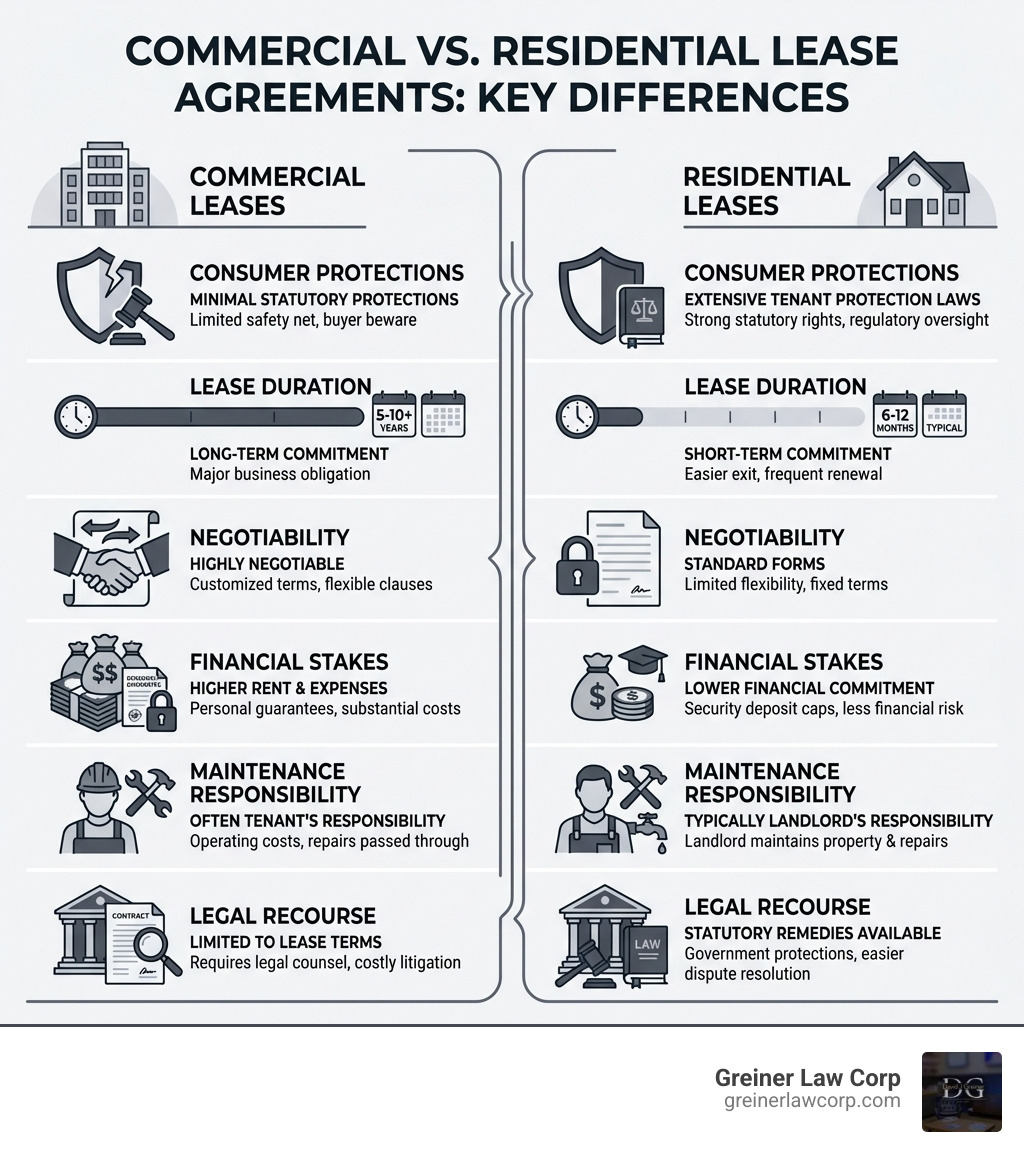
Infographic Details: A side-by-side comparison showing Commercial Leases vs Residential Leases with the following key differences: Consumer Protections (Minimal statutory protections vs Extensive tenant protection laws), Lease Duration (5-10+ years vs 6-12 months typical), Negotiability (Highly negotiable, customized terms vs Standard forms, limited flexibility), Financial Stakes (Higher rent, operating expenses, personal guarantees vs Lower financial commitment, security deposit caps), Maintenance Responsibility (Often tenant’s responsibility vs Typically landlord’s responsibility), and Legal Recourse (Limited to lease terms, requires legal counsel vs Statutory remedies available).
Understanding commercial lease agreements terms simplified:
The Great Divide: Commercial vs. Residential Leases
The differences between commercial and residential leases are significant, especially for businesses in California. While both are contracts for occupying property, their legal frameworks are worlds apart. Many clients mistakenly assume commercial leases offer protections similar to residential ones.
- Fewer Tenant Protections: This is the most crucial distinction. Commercial leases lack the consumer protection laws that govern residential agreements. In California, this means fewer regulations on rent control, evictions, or landlord repair duties. Your rights are almost exclusively defined by the lease itself.
- Longer Lease Terms: Commercial leases often last for five, seven, or even 10 years, reflecting the significant investment businesses make in a physical space.
- Higher Financial Commitment: The financial stakes are much higher. Beyond base rent, tenants often cover other expenses, and security deposits can be substantial.
- Greater Negotiation Flexibility: Commercial leases are highly negotiable. Unlike standard residential forms, they are often customized. This is an opportunity to negotiate favorable terms, but you must be diligent.
- Customized Agreements: No two commercial leases are identical. This customization means boilerplate language can contain hidden pitfalls. A robust Business Risk Management Strategies approach is invaluable here.
- Business-to-Business Contract: A commercial lease is a B2B contract, giving both parties more freedom but placing a greater burden on the tenant to understand and advocate for their interests.
The complexity of understanding commercial lease agreements cannot be overstated. Given the high stakes and long-term nature, we advise clients across Victorville, Riverside, San Bernardino, and Los Angeles to approach these documents with professional guidance.
Decoding the Dollars: Common Types of Commercial Leases
When understanding commercial lease agreements, deciphering how rent and additional expenses are calculated is paramount. Your total payment is a dynamic figure influenced by the lease type and how operating expenses—Common Area Maintenance (CAM), property taxes, and building insurance—are handled. How these costs are split between landlord and tenant defines the lease type.
| Lease Type | Base Rent | Operating Expenses (Taxes, Insurance, CAM) | Tenant Pros | Tenant Cons |
|---|---|---|---|---|
| Gross Lease | Fixed, all-inclusive | Landlord pays | Predictable, simple budgeting | Higher base rent, no control over landlord’s expenses |
| Modified Gross | Fixed | Tenant pays some or portion of increases | More predictable than Net, can negotiate caps | Less predictable than Gross, potential for variable costs |
| Single Net (N) | Lower | Tenant pays property taxes | Lower base rent, some control over taxes | Responsible for taxes, landlord pays insurance/CAM |
| Double Net (NN) | Lower | Tenant pays property taxes & insurance | Lower base rent, more transparency on costs | Responsible for taxes & insurance, landlord pays CAM |
| Triple Net (NNN) | Lowest | Tenant pays all | Lowest base rent, maximum control, transparency | Highest responsibility, variable costs, significant financial risk |
Gross Lease (Full-Service Lease)
A Gross Lease is the most straightforward. You pay a single, fixed monthly rent, and the landlord covers all operating expenses.
- Tenant Pros: Predictable costs make budgeting simple.
- Tenant Cons: The base rent is higher to cover the landlord’s costs, and you have no control over those expenses.
Net Leases (N, NN, NNN)
Net leases have a lower base rent because the tenant pays for some or all other expenses.
- Single Net Lease (N Lease): The tenant pays base rent plus a pro-rata share of property taxes.
- Double Net Lease (NN Lease): The tenant pays base rent, property taxes, and property insurance. As noted, In a double net lease (NN Lease), you cover property taxes and insurance premiums.
- Triple Net Lease (NNN Lease): This is the most common net lease. The tenant pays base rent plus a pro-rata share of property taxes, insurance, and all CAM expenses. In an absolute NNN lease, the tenant is responsible for all building expenses, akin to ownership.
Understanding commercial lease agreements of the net variety means preparing for variable costs that require careful budgeting.
Modified Gross Lease (MG)
A Modified Gross Lease is a hybrid model. The tenant pays a fixed base rent, which may include some operating expenses, but then pays a share of increases in other expenses over a “base year” amount. This lease is a compromise that requires careful negotiation to define which expenses are shared.
Percentage Lease
Common in retail, a Percentage Lease includes a lower base rent plus a percentage of the tenant’s gross sales above a certain “breakpoint.” This structure aligns the landlord’s and tenant’s success, as the landlord is incentivized to maintain a prime location that drives foot traffic.
Anatomy of a Lease: A Tenant’s Guide to Understanding Commercial Lease Agreements

This section breaks down the critical clauses that form the backbone of your agreement. Understanding commercial lease agreements means diving into the details, as these clauses define your rights, responsibilities, and liabilities.
The Parties, The Premises, and The Price
Getting these foundational elements right is critical.
- Correct Legal Entity Name: Ensure the lease is in your company’s full legal name (e.g., LLC or corporation) to protect your personal assets. This is a key reason for Forming an LLC in California. Using your personal name could make you personally liable.
- Usable vs. Rentable Square Footage: Clarify if rent is based on usable square footage (your exclusive space) or rentable square footage (usable space plus a share of common areas). This “load factor” can add 7-20% to your cost.
- Rent Calculation: Understand all costs beyond base rent, including additional rent for operating expenses and potential rent escalations.
- Security Deposit: Commercial deposits can be substantial. Negotiate the amount and the terms for its return.
Lease Term, Renewals, and Rent Escalation
The duration and future costs are critical for long-term planning.
- Commencement Date vs. Move-in Date: Be precise about start dates to avoid paying rent before you can access the space or operate your business.
- Lease Duration: A longer term offers stability, while a shorter term with renewal options provides flexibility.
- Renewal Options: Negotiate a clear renewal option specifying the term length and how the new rent will be calculated (e.g., fixed increase, Fair Market Value, or tied to CPI).
- Rent Escalation Clauses: Understand how rent will increase over time. Negotiate caps on annual increases where possible to maintain budget predictability.
A Tenant’s Guide to Understanding Commercial Lease Agreements and Permitted Use
These clauses define what you can and cannot do in your space.
- ‘Use’ Clause Restrictions: This clause specifies how you can use the premises. Negotiate for broad language (e.g., “retail sales” instead of “sales of artisanal candles”) to allow for future business flexibility.
- ‘Exclusive’ Clause Benefits: This clause prevents the landlord from leasing to a direct competitor in the same complex, giving you a significant competitive advantage.
Improvements, Alterations, and Maintenance Responsibilities
- Tenant Improvement (TI) Allowance: This is money from the landlord for build-outs. Negotiate the amount, what it covers, and the disbursement timeline.
- Turnkey Improvements: The landlord performs all renovations before you move in, reducing your upfront costs.
- Landlord vs. Tenant Maintenance Duties: The lease must clearly define who repairs what. Landlords typically handle the building’s structure, while tenants manage their interior space. Always clarify HVAC responsibility, as repairs can be costly.
- Americans with Disabilities Act (ADA) Compliance: The lease should state who is responsible for any modifications needed to comply with ADA requirements.
Flexibility and Exit Strategies: Subletting, Assignment, and Default
- Sublease vs. Assignment: Subleasing lets you rent your space to another tenant while you remain liable. Assignment transfers your lease to a new tenant. Negotiate for the right to do both, ensuring the landlord cannot unreasonably withhold consent.
- Default Penalties: Understand what constitutes a default and its severe penalties, which can include accelerated rent, eviction, and personal liability.
- Early Termination Clause: This clause allows you to end the lease prematurely, often with a penalty. While hard to get, it can be a lifesaver. We can help you understand How to Cancel a Contract if needed, but negotiating this clause upfront is ideal.
Protecting Your Business: Insurance, Liability, and Legal Counsel

This section covers essential steps to mitigate risk. When understanding commercial lease agreements, protecting your business is about foreseeing problems and shielding yourself from liability.
Insurance and Indemnification Clauses
Insurance is your financial safety net.
- General Liability Insurance: Required for tenants, this protects your business from claims of injury or property damage on your premises.
- Commercial Property Insurance: While the landlord insures the building, you need to insure your business’s contents, inventory, and equipment.
- Waiver of Subrogation: This common clause prevents insurers from suing the other party after a paid claim, reducing lawsuits between landlord and tenant.
- Indemnification Obligations: This clause assigns responsibility for legal liabilities. Review it carefully, as it can shift significant risk to you.
- Find an agent to discuss coverage: Have a knowledgeable insurance agent review your lease to ensure you have adequate coverage. You can find an agent to discuss coverage who understands commercial policies.
The Importance of Understanding Commercial Lease Agreements Before Signing
Signing a commercial lease is a monumental step with major legal and financial implications.
- Binding Legal Document: Once signed, a commercial lease is a binding contract governed by its written terms, with few statutory protections for tenants.
- Personal Guarantees: Landlords often require a personal guarantee, making you personally liable if your business defaults. We help clients negotiate “good guy guarantees” to limit this liability and protect personal assets.
- Long-Term Financial Implications: Analyze the total cost beyond base rent, including operating expenses, utilities, and improvements, to ensure the lease is sustainable. Our team provides Business Contract Legal Advice for these complex commitments.
When to Seek a Real Estate Attorney
Given the high stakes, legal counsel is often a necessity.
- Complex Clauses: An attorney can translate legal jargon and identify potential pitfalls.
- High-Value Leases: For significant financial commitments, the cost of legal review is a wise investment.
- Unfavorable Terms: An attorney can help you negotiate more tenant-friendly terms, such as termination options or caps on expenses.
- Dispute Negotiation: An attorney can negotiate on your behalf to protect your interests in a dispute.
Our team specializes in Real Estate Law and understands California’s commercial lease nuances, ensuring your lease aligns with your business goals.
Frequently Asked Questions about Commercial Leases
What is the biggest difference between a commercial and residential lease?
The biggest difference is the level of tenant protection and negotiability. Commercial leases lack the extensive consumer protection laws found in residential leasing. They are also highly negotiable, meaning your rights and obligations are almost entirely based on the written contract you sign.
Can I negotiate the terms of a commercial lease?
Absolutely, and you should. Nearly every term in a commercial lease is negotiable, from rent and term length to maintenance and use clauses. Landlord forms are written to favor them, so it’s crucial to advocate for your business and make a counter-offer.
Who pays for repairs in a commercial property?
This depends entirely on the lease. In a Gross Lease, the landlord typically pays for most repairs. In Net Leases (N, NN, NNN), the tenant takes on increasing responsibility for costs, which often includes repairs. The “Maintenance and Repairs” clause in your agreement will specify the exact obligations.
Conclusion
Navigating commercial leases requires knowledge and a proactive approach to secure a contract that supports your business. Understanding commercial lease agreements involves strategic planning, diligent negotiation, and robust risk management.
Key takeaways from our journey together:
- Commercial leases are different from residential ones, offering fewer protections.
- Choose your lease type wisely, understanding its financial impact.
- Scrutinize every clause, from the premises description to exit strategies.
- Protect your business with proper insurance and a clear understanding of liability.
- Don’t go it alone. The complexity often requires expert legal counsel.
At Greiner Law Corp, we use a business-minded approach to ensure your lease aligns with your company’s goals and risk tolerance. We help clients in Victorville, Los Angeles, Riverside, and San Bernardino manage their risk preferences effectively.
A well-negotiated commercial lease is a foundation for your business’s future. Let us help you lay that foundation with confidence.
Ready to secure your business’s future? Navigate your Commercial Real Estate Lease Contract with confidence by contacting us today.


