Understanding Probate Listings in California
A probate listing california meaning refers to a real estate property being sold through the court-supervised probate process after the owner has died. This process ensures proper transfer of the deceased person’s assets to beneficiaries or heirs.
What is a Probate Listing in California?
– Property listed for sale as part of a deceased person’s estate
– Requires court oversight and approval in most cases
– Often sold “as-is” with limited disclosures
– Usually requires a 10% deposit from buyers
– Can take 9-18 months to complete the sale process
– May sell below market value due to estate liquidation priorities
When someone passes away in California, their property must go through probate if the estate’s value exceeds $184,500 (as of 2024) and the property wasn’t placed in a trust or jointly owned with right of survivorship. The court appoints a personal representative—either an executor named in the will or an administrator if there is no will—who oversees the sale process.
Probate listings differ from traditional real estate sales because they involve court supervision, potential overbidding at confirmation hearings, and fewer seller disclosures.
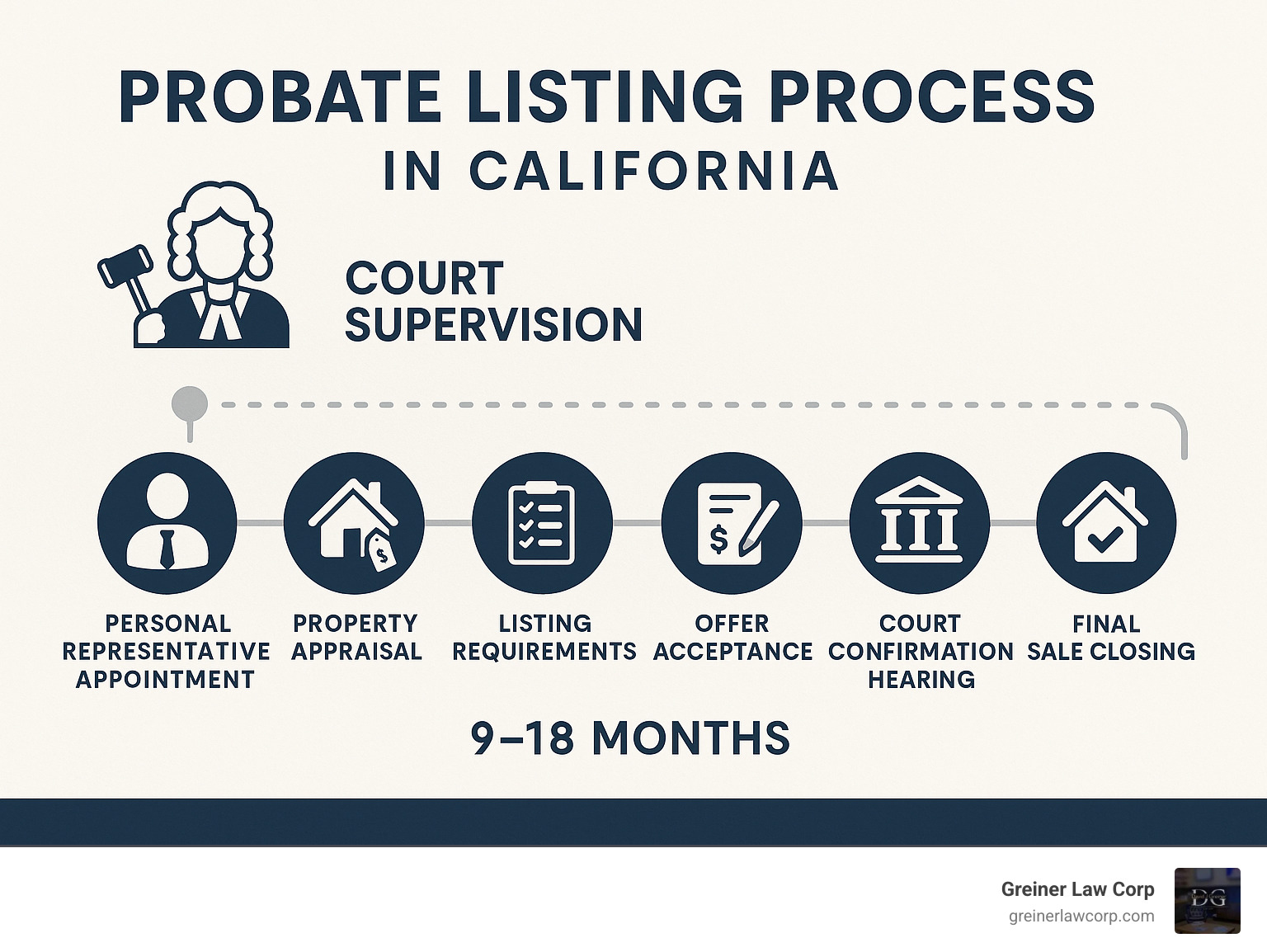
Probate Listing California Meaning—Core Definition
When you hear the term probate listing california meaning, we’re talking about a property being sold as part of someone’s estate after they’ve passed away. Think of it as a home sale with an extra layer of legal oversight—the court is involved to make sure everything happens by the book.
In everyday terms, a probate listing happens when the person managing a deceased person’s estate (called the personal representative) decides it’s time to sell the property. Maybe they need to pay off the estate’s debts, or perhaps they’re converting the home to cash to distribute to heirs.
California has specific rules about which estates need to go through probate. Generally, if the total value of the estate exceeds $184,500 (as of 2024), formal probate is required. This valuation isn’t just a ballpark figure—the court appoints a probate referee who provides an official appraisal that becomes part of the court record.
Probate listing california meaning in legal context
Looking at the legal side, a probate listing california meaning is firmly rooted in California’s Probate Code. When someone passes away without leaving a will (called dying “intestate”), California Probate Code §8461 lays out who gets first dibs on managing the estate:
Your spouse or domestic partner comes first, followed by children, then grandchildren, parents, siblings, and other relatives according to how intestate succession works.
The Superior Court where the deceased person lived or owned property oversees the whole process. They issue official documents—”Letters Testamentary” if there was a will naming an executor, or “Letters of Administration” if there wasn’t—that give the personal representative the legal authority to sell the property.
Scientific research on probate sales shows these court-supervised transactions create a unique market dynamic compared to regular home sales.
Probate listing california meaning in real estate practice
In the real estate world, you can spot a probate listing california meaning right away by looking at the listing details. Real estate agents must identify these properties in the Multiple Listing Service (MLS) with specific remarks like “Probate Sale,” “Court Confirmation Required,” or “Subject to Court Approval.”
Probate properties in California are almost always sold “as-is.” The personal representative isn’t going to fix that leaky roof or update the 1970s kitchen before selling—their job is to preserve the estate’s assets.
Another distinctive feature is the deposit requirement. While traditional home purchases might ask for a 1-3% earnest money deposit, probate sales require buyers to put down 10%, usually as a cashier’s check.
You’ll often notice these properties priced below market value—typically 10-15% lower than similar non-probate homes in the area. This pricing helps speed up the sale and often attracts multiple offers.
More info about probate listings
Probate vs. Traditional Real Estate Sales
When you’re exploring the probate listing California meaning, understand how these sales differ from the typical home buying process. Think of probate sales as playing by a different rulebook—one with more steps, longer timelines, and unique challenges.
| Feature | Probate Sale | Traditional Sale |
|---|---|---|
| Timeline | 9-18 months | 30-60 days |
| Court Approval | Required in most cases | Not required |
| Deposit | 10% minimum | 1-3% typical |
| Contingencies | Limited or none | Common (financing, inspection) |
| Disclosures | Exempt from TDS, limited | Full disclosure requirements |
| Pricing | Often below market | At or above market |
| Overbidding | Possible at court confirmation | Not applicable |
| Financing | Cash preferred, conventional possible | All types accepted |
| Condition | As-is, limited inspections | Negotiable repairs |
The most striking difference is patience—you’ll need plenty of it. While traditional home sales wrap up in a month or two, probate sales typically stretch between 9-18 months from start to finish.
Court supervision creates another layer of complexity. Unlike traditional sales where buyers and sellers hash out details directly, probate sales require judicial blessing on the transaction. This court involvement introduces the wild card of potential overbidding, where your “accepted” offer might not actually secure the property.
Buyers also face stricter financial requirements, including that hefty 10% deposit (versus the typical 1-3% in traditional sales). And while traditional buyers enjoy robust consumer protections and disclosure requirements, probate properties come with fewer guarantees and are almost always sold “as-is.”
Independent Administration of Estates Act (IAEA)
The probate listing California meaning gets a bit sunnier when the IAEA enters the picture. Think of this act as the express lane through probate—when a personal representative receives “full authority” under the IAEA, they can sell property without direct court confirmation, potentially shaving months off the timeline.
Here’s how it works: instead of waiting for a court hearing, the representative sends a “Notice of Proposed Action” to all heirs and beneficiaries. This notice outlines the property details and proposed sale terms. The recipients have 15 days to raise objections. If everyone stays quiet, the sale proceeds without a court appearance.
This authority eliminates the uncertainty of court confirmation hearings and the possibility of last-minute overbidders swooping in. For buyers, purchasing from an estate with IAEA authority feels more like a conventional transaction with fewer surprises.
What is a Probate Sale in Real Estate?
Court-confirmed probate sales
When full IAEA authority isn’t granted, the probate listing California meaning involves the more complex court confirmation process. After accepting an initial offer, the personal representative files a “Report of Sale and Petition for Order Confirming Sale of Real Property” (form DE-260) with the probate court.
The court then schedules a confirmation hearing, typically 30-45 days out. This is where things get interesting—and potentially heartbreaking for the initial buyer. At the hearing, the original offer becomes merely the starting bid. Other interested buyers can show up and submit higher offers through an overbidding formula.
The first overbid must follow a specific calculation: 10% of the first $10,000 plus 5% of the remaining balance of the original offer, plus $500. For example:
For a $500,000 initial accepted offer, the minimum overbid would need to be at least $526,000:
– 10% of $10,000 = $1,000
– 5% of $490,000 = $24,500
– Plus $500
– Total: $526,000
If multiple bidders appear, the judge essentially becomes an auctioneer, conducting a mini-auction right in the courtroom. The highest bidder wins the property (subject to court approval).
California Probate Sale Process Step-by-Step
When you’re trying to understand what probate listing california meaning truly encompasses, it helps to see the entire journey from start to finish. Let’s walk through the probate process that leads to a property being listed and sold in California:
Petition for Probate (DE-111): Everything begins when someone files a petition with the probate court, asking to be named as the personal representative who’ll handle the deceased person’s affairs.
Notice and Publication: The court requires that all heirs and beneficiaries receive legal notice about what’s happening. A notice must also appear in a local newspaper where the deceased person lived.
Appointment: The court officially appoints someone to handle the estate—either the executor named in the will or an administrator if there wasn’t a will—and issues formal Letters Testamentary or Letters of Administration.
Inventory and Appraisal (DE-160): The personal representative must create a complete inventory of everything the deceased owned and have these assets professionally appraised by a probate referee.
Creditor Claims (DE-157): Anyone the deceased person owed money to must be notified and given time to submit their claims against the estate.
Decision to Sell Property: Often, the personal representative determines that selling real property makes the most sense—whether to pay outstanding debts, cover taxes, or distribute assets to heirs.
Listing and Marketing: The property enters the market, typically with a real estate agent who specializes in probate sales.
Offer Acceptance: When a buyer makes an acceptable offer, the personal representative can accept it—though it remains subject to court confirmation unless they have full IAEA authority.
Court Confirmation: If required, a court hearing takes place where the sale is either confirmed as is, or an overbidding auction occurs right there in the courtroom.
Closing: After court confirmation (or after the IAEA notice period expires without objections), escrow closes and the property officially transfers to its new owner.
Distribution: The proceeds from the sale go toward paying the estate’s debts, with remaining funds distributed to heirs according to the will or California’s intestate succession laws.

Listing & Marketing Requirements
The probate listing california meaning takes on special significance when it comes to marketing these properties. Before a probate home can be listed, it needs an official valuation from a court-appointed probate referee who determines its fair market value. This appraisal becomes part of the official Inventory and Appraisal (form DE-160) filed with the court.
Pricing strategy for probate properties often follows a different path than traditional sales. While the referee’s appraisal provides an important baseline, many personal representatives choose to price probate homes slightly below market value. This strategic pricing tends to attract multiple offers and can speed up the sale process.
When you see a probate property in the MLS, it should be clearly identified as such. Look for remarks like “Probate Sale—Court Confirmation Required” or “Subject to Court Approval” in the listing.
Offers, Deposits & Overbids
A key part of understanding probate listing california meaning is grasping the distinctive offer and deposit requirements. In California, when you make an offer on a probate property, offers must include a deposit of at least 10% of the purchase price, typically as a cashier’s check made payable to the estate.
This 10% requirement represents a significant jump from the typical 1-3% earnest money deposit in traditional transactions. The estate holds this deposit until either the sale closes successfully or it’s refunded if you get outbid at the confirmation hearing.
The overbidding process that happens in court follows specific mathematical rules. If you want to outbid someone at a confirmation hearing, your “first overbid” must exceed the original accepted offer by at least 10% of the first $10,000, plus 5% of any amount over $10,000, plus $500.
Scientific research on bidding behavior suggests that the auction-like atmosphere of these confirmation hearings can actually drive final prices higher than initially accepted offers.
Pros, Cons, and Best Practices for Buyers & Sellers
When it comes to understanding the probate listing california meaning, it’s all about weighing what you gain against what you might sacrifice. These unique properties present a fascinating mix of opportunities and challenges for everyone involved.
For buyers, probate properties often shine as diamonds in the rough. They typically sell for 10-15% below market value, which can mean significant savings in California’s competitive real estate market. You’ll often face less competition than with traditional listings, as many buyers shy away from the complexities of probate.
However, the “as-is” condition of these properties means you might be inheriting someone else’s deferred maintenance or outdated features. The limited disclosures can feel like buying a mystery box – you’re not always sure what you’re getting. And that 10% deposit? It’s substantially higher than traditional sales, tying up significant funds during the extended escrow period.
For personal representatives managing estates, probate sales offer the protection of court oversight, reducing liability concerns. The structured process provides clear guidelines to follow, and the potential for price increases through overbidding at confirmation hearings can benefit the estate’s bottom line.

The golden rule for everyone involved? Work with professionals who specialize in probate. Seek out real estate agents with CPRES (Certified Probate Real Estate Specialist) designation and attorneys who eat, sleep and breathe probate law.
How Buyers Protect Themselves
Smart buyers approaching a property with a probate listing california meaning take specific steps to safeguard their interests and minimize risks.
First and foremost, thorough home inspections are non-negotiable, even though the property is sold “as-is.” Understanding exactly what you’re buying helps you calculate renovation costs and set a realistic maximum bid.
Detailed title research is your best friend in probate purchases. Uncovering liens, encumbrances, or cloudy title issues early prevents nasty surprises that could derail your purchase months down the road.
Financial preparation means having resources beyond just that 10% deposit. Probate purchases frequently need substantial renovation budgets, and traditional lenders sometimes get skittish about these properties.
Attending the confirmation hearing in person shows you’re serious and allows you to participate in any overbidding. I’ve witnessed buyers who skipped the hearing lose properties they’d waited months to purchase.
When buying from an estate with IAEA authority, negotiate for contingencies similar to traditional sales. These transactions allow more flexible terms than court-confirmed sales.
How Do Probate Real Estate Sales Work?
How Sellers/Executors Maximize Value
Personal representatives handling estates with properties under the probate listing california meaning have a fiduciary duty to maximize value while efficiently administering the estate.
While major renovations rarely make financial sense for estates, basic property preparation delivers tremendous bang for your buck. Simple cleaning, decluttering, and minor cosmetic fixes can dramatically impact buyer perception and offer prices.
Working closely with your probate referee ensures an accurate appraisal, which serves as the foundation for your pricing strategy.
Strategic pricing slightly below market value often attracts multiple offers, potentially leading to higher final prices through competition or overbidding.
If you’ve been granted full authority under the IAEA, leverage this flexibility to negotiate more favorable terms while still fulfilling your fiduciary duties.
Hiring an agent with specific experience in probate sales makes a world of difference. These specialists understand the legal requirements, marketing approaches, and buyer expectations unique to probate properties.
Frequently Asked Questions about Probate Listings in California
When is probate required for real estate in California?
If you’re wondering about probate listing California meaning in terms of when it’s actually required, the answer depends on how the property was owned and the total estate value.
Probate generally becomes necessary when a property was solely in the deceased person’s name—not held in joint tenancy or as community property with right of survivorship. The process is also typically required when the property wasn’t placed in a living trust and when the total estate value exceeds $184,500 (as of 2024).
Good news for smaller estates though! California offers simplified procedures under Probate Code §13100-13116 that allow property transfers without full probate when the estate falls below that threshold value.
Certain ownership structures automatically bypass probate regardless of value. Property held in joint tenancy passes directly to surviving joint tenants, community property with right of survivorship transfers to the surviving spouse, and assets in a living trust follow the trust’s instructions.
Who manages the sale—executor or administrator?
When it comes to the probate listing California meaning in practice, the sale is handled by the estate’s personal representative, who comes in two flavors:
An executor is appointed when the deceased left a valid will naming someone for this role. Think of them as the person the deceased personally selected to handle their affairs.
An administrator steps in when there’s no will, when the will doesn’t name an executor, or when the named person can’t or won’t serve. The court appoints administrators following a priority order established in Probate Code §8461—typically starting with the surviving spouse or domestic partner, then children, grandchildren, and continuing down the family tree.
Both executors and administrators share the same legal powers and responsibilities for selling estate property. They must act in the estate’s best interest, follow court procedures, obtain necessary approvals, and properly account for all proceeds from the sale.
How long does a probate sale usually take?
When discussing probate listing California meaning, timeline questions always come up. The honest answer? It takes longer than most people expect.
The overall probate process typically spans 9-18 months from filing the initial petition to final distribution. Breaking this down further: expect 2-4 months from the representative’s appointment until the property gets listed, followed by a 1-3 month marketing period until an offer is accepted.
If court confirmation is required, add another 30-45 days from offer acceptance to the hearing date. After confirmation, closing typically takes 2-4 weeks—similar to traditional real estate transactions at this stage.

Conclusion
Navigating probate listing california meaning can feel like learning a new language at first. But now you have a roadmap through this unique corner of California real estate – whether you’re a buyer hunting for that diamond in the rough, an heir to an estate, or a personal representative shouldering important responsibilities.
These special transactions blend real estate practices, court procedures, and estate law into something that’s truly its own animal. It’s a specialized area where having the right knowledge makes all the difference between smooth sailing and stormy seas.
California’s probate process might seem intimidating, but remember – it follows established steps designed to protect everyone involved: creditors who are owed money, heirs who deserve their inheritance, and the estate itself. Understanding the timeline (those 9-18 months can feel long!), specific requirements like the 10% deposit, and potential challenges helps everyone steer these waters more confidently.
At Greiner Law Corp, we’ve guided countless clients through probate real estate transactions across California, from our offices in Victorville, Riverside, San Bernardino, and Los Angeles. We take a practical, business-minded approach that helps clients clearly see their options and manage risks effectively.
Bookmark this guide as your reference for future probate transactions. This landscape isn’t static – California regularly updates statutory thresholds and procedures, making ongoing education and professional guidance invaluable resources.
The probate process doesn’t have to be overwhelming. With the right information and support, you can approach these unique transactions with confidence, knowing exactly what to expect at each step of the journey.


