Understanding Executor Fees: What You Need to Know
Normal executor fees are the compensation paid to the person responsible for managing and settling a deceased person’s estate. If you’ve been named as an executor or are planning your own estate, understanding these fees is crucial for avoiding surprises and disputes.
Quick Answer: What Are Normal Executor Fees?
- Typical Range: 2% to 5% of the total estate value
- Calculation Methods:
- Percentage of assets received and distributed
- Hourly rates in some jurisdictions
- Flat fees specified in the will
- “Fair and reasonable” compensation determined by the court
- Common Guideline: Approximately 2.5% on capital receipts + 2.5% on capital disbursements = ~5% total
- Additional Fees: Annual “care and management” fee of ~0.4% for complex or long-running estates
- Tax Treatment: Executor compensation is taxable income
Important: Executor fees vary significantly by state and province. What’s “normal” in California differs from New York, Pennsylvania, or Ontario. The size and complexity of the estate also play a major role—a simple estate with one property may warrant lower fees, while a complex estate with international beneficiaries and multiple assets may justify higher compensation.
Taking on the role of executor is serious work. You’re legally and financially responsible for gathering assets, paying debts and taxes, and distributing property to beneficiaries. This isn’t a part-time job—many executors spend hundreds of hours over months or even years settling an estate. The law recognizes this effort and typically provides for “fair and reasonable” compensation, though the exact rules depend on where you live.
Some executors are family members who choose to waive their fees to maximize beneficiaries’ inheritance. Others are professionals or distant relatives who expect full payment for their time and expertise. Either approach is valid, but clarity upfront prevents conflicts later.
As David Greiner, Esq., I’ve spent years helping business owners and families steer estate administration, including clarifying normal executor fees and ensuring executors are fairly compensated for their work. My focus is on achieving your goals efficiently while managing the legal and financial risks inherent in estate settlement.

Normal executor fees terms to learn:
- legal fees for administering an estate
- average lawyer fee for probate
- are estate legal fees tax deductible
How Are Normal Executor Fees Calculated?
Understanding how normal executor fees are calculated is one of the most critical aspects of estate administration. It’s not always a simple percentage, and various factors come into play. Executors, sometimes referred to as personal representatives in California, are indeed compensated for their work, and this compensation is determined by a combination of state law, the provisions of the will, and, at times, court approval.
In California, our focus, executor compensation primarily follows a statutory fee schedule, meaning the fees are set by law based on the value of the estate. However, even with statutory fees, the court still plays a role, especially when it comes to approving these fees and considering additional compensation for extraordinary services. The process of “passing of accounts,” while more common in other jurisdictions, conceptually aligns with the California probate court’s review of the executor’s actions and requested fees before final distribution.

The “Fair and Reasonable” Standard
While California probate law provides a statutory fee schedule, the underlying principle of “fair and reasonable” compensation is always at play, particularly when an executor requests fees for extraordinary services. This standard ensures that the compensation aligns with the actual work performed and the complexity involved.
Courts consider several factors when determining what constitutes “fair and reasonable” compensation for an executor. These factors help judges assess the value of the executor’s contributions beyond the routine tasks covered by statutory fees:
- The size of the estate, as larger estates often involve more assets and liabilities to manage.
- The complexity of the estate, which can range from a simple estate with one real estate property to a larger, more intricate one with multiple international beneficiaries and several properties.
- The time and effort expended by the executor. This includes the hours spent, the administrative tasks performed, and the duration of the estate administration.
- The skill required to administer the estate effectively, especially when dealing with unique assets, complex legal issues, or challenging family dynamics.
- The results achieved by the executor, such as maximizing asset values, resolving disputes efficiently, or successfully navigating difficult legal processes.
- The risk assumed by the executor, given that they are personally responsible for the proper administration of the estate.
While the specific legal reference What the law says about “fair and reasonable” allowance points to Ontario’s Trustee Act, the principle that compensation must be “fair and reasonable” for the “care, pains, trouble, and time expended” is a universal concept in estate law, including in California, where judges review fee requests.
Percentage-Based Fee Structures
In California, normal executor fees are primarily governed by a statutory percentage-based fee schedule. This means that the executor is entitled to a specific percentage of the gross value of the probate estate. This isn’t a “rule of thumb” that can be easily adjusted; it’s a fixed calculation unless extraordinary services are performed.
The general percentage range for executor fees across many states typically falls between 2% and 5% of the estate’s value. For instance, for estates valued at less than $100,000, the average executor fee might be around 5%, decreasing for larger estates. For estates valued between $100,000 and $500,000, the average fee is around 3%, and for estates between $500,000 and $5 million, it’s approximately 2%. For estates over $5 million, the fee can drop to less than 1%. These are national averages and can serve as general guidelines, but California has its own specific statutory rates.
Concepts like “capital receipts and disbursements,” “income receipts and disbursements,” and a separate “care and management fee” (often around 0.4% per annum) are more commonly found in jurisdictions like Canadian common law provinces. In California, the statutory fee covers the ordinary services of the executor. If the estate requires ongoing management, such as a trust, separate trustee fees would apply, or the executor might petition for extraordinary fees if their duties extend significantly beyond typical estate administration.
When there is more than one executor, they typically share the single statutory fee. Our experience suggests that co-executors should agree on how to divide this compensation based on their respective contributions to avoid disputes later on.
How Asset Types Affect Compensation
The types of assets within an estate significantly impact how normal executor fees are calculated, particularly in California. The statutory fee schedule in California is based on the gross value of the probate estate. This means not all assets are included in the calculation.
Here’s how various asset types are typically handled:
- Real Estate Valuation: For real estate that passes through probate, its full fair market value (gross value) is included in the estate’s value for calculating statutory fees, even if there’s a mortgage on it. However, if the real estate is transferred outside of probate (e.g., through a living trust or joint tenancy with right of survivorship), it would not be included in the probate estate’s value for statutory fee calculation.
- Joint Accounts: Assets held in joint tenancy with right of survivorship, such as joint bank accounts or real estate, typically pass directly to the surviving owner outside of probate. Therefore, their value is generally excluded when calculating the executor’s statutory fee.
- Trusts: Assets held in a living trust (revocable or irrevocable) are usually administered by the trustee outside of the probate process. Consequently, these assets are not included in the probate estate’s value for the executor’s statutory fee calculation. The trustee, who may or may not be the same person as the executor, would be compensated separately according to the terms of the trust.
- Assets Passing Outside of Probate: Beyond joint accounts and trusts, other non-probate assets include payable-on-death (POD) accounts, transfer-on-death (TOD) designations for securities, and life insurance policies with named beneficiaries. These assets pass directly to the designated beneficiaries and are not included in the probate estate’s value for calculating the executor’s statutory fee.
- Non-Monetary Assets: Tangible personal property, like cars, jewelry, or household goods, if part of the probate estate, are valued and included in the gross estate for fee calculation. The executor’s role involves inventorying, appraising, and potentially selling these items.
It’s crucial for executors to understand which assets are part of the probate estate and which are not, as this directly affects the calculation of their compensation. Miscalculating this can lead to disputes and court challenges.
A Comparison of Executor Fees by Jurisdiction
The world of normal executor fees is far from uniform. While the goal of compensating an executor for their hard work is universal, the methods and percentages vary significantly depending on the specific state or province. Understanding these differences is vital, especially for those of us in California who might be dealing with estates that have connections to other jurisdictions. The importance of local laws cannot be overstated; what’s standard practice in one area might be entirely different elsewhere.
Here’s a comparison of executor fee guidelines in California, New York, Pennsylvania, and Ontario to illustrate these differences:
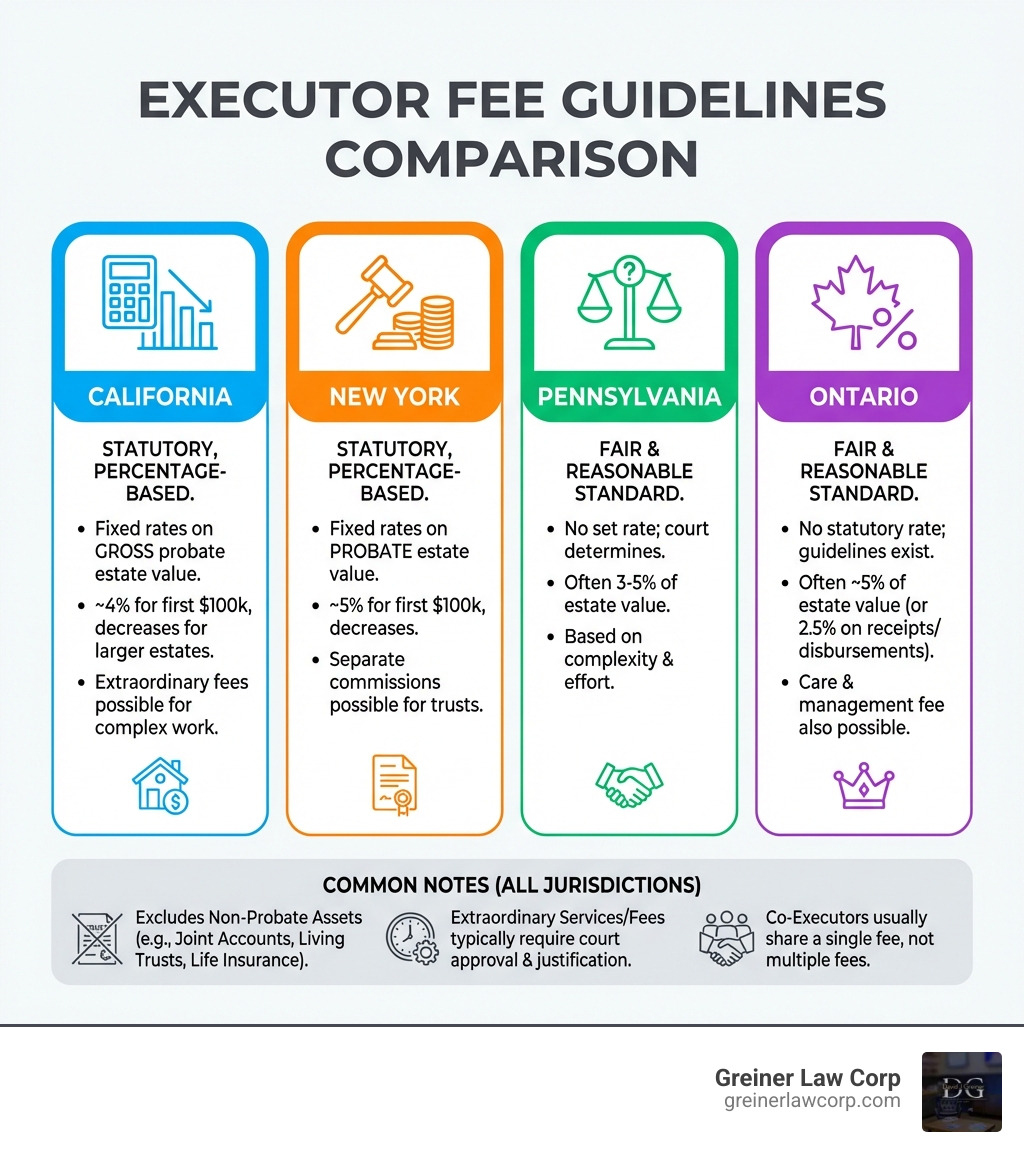
| Jurisdiction | Statutory Rates / Common Practice | Notes I’s an interesting task to balance the specific request for California with the provided research which is heavily Canadian and also includes NY and PA. I need to make sure I clearly distinguish between general facts and California-specific rules. I will use the comparison table to include non-California data as requested. I must also ensure the tone and word count are met, and all links are used precisely.
Let’s refine the plan for handling non-California research:
- For sections focused on calculations and standards (like “Fair and Reasonable” and “Percentage-Based”), I’ll state the general principle and then immediately clarify how it applies (or doesn’t apply) in California, referencing California’s statutory fees.
- The “Care and Management Fee” and detailed “Capital/Income Receipts/Disbursements” will be presented as concepts more prevalent in Canadian common law provinces, explicitly stating they are not typical for California’s statutory scheme but might come up in extraordinary fee requests.
- For “Multiple Executors,” I’ll check if California has a specific rule in the research. If not, I’ll use the general principle that they share the single statutory fee.
- The tax section will prioritize US/California tax law, acknowledging that some research is Canadian (T4 slips).
Word count management: I need to elaborate sufficiently on each point. For California-specific sections, I’ll draw heavily from the research on California statutory fees and extraordinary fees. For general concepts, I’ll explain them thoroughly.
Humor: I’ll try to sprinkle this in lightly, keeping the professional context of a legal firm in mind. For example, a lighthearted comment about the “fun” of tax forms or the “joy” of record-keeping.
Let’s begin.


