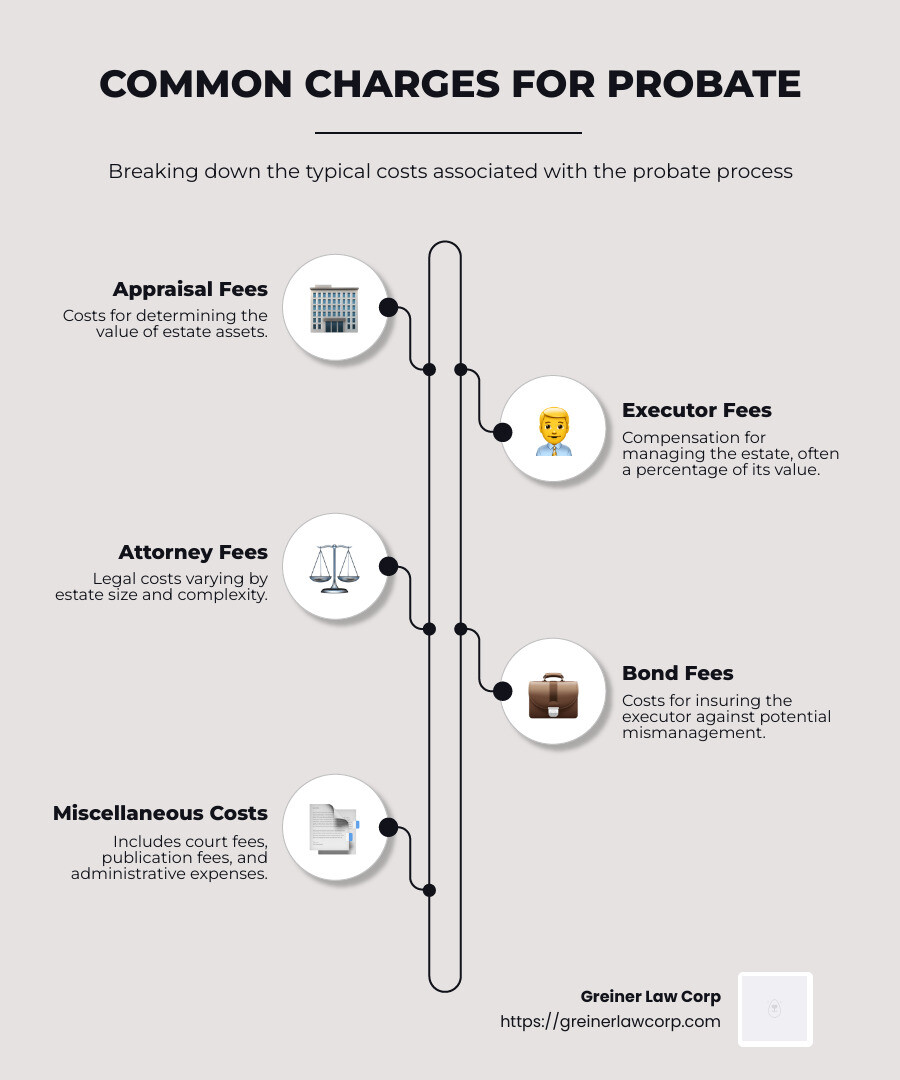
When dealing with the death of a loved one, understanding charges for probate can be vital. These charges can include a range of expenses and fees:
- Appraisal Fees: Costs associated with determining the value of real estate and personal property.
- Executor Fees: Compensation for the person managing the estate, often a percentage of the estate’s value.
- Attorney Fees: Legal costs that can fluctuate based on the estate’s size and complexity.
- Miscellaneous Costs: Includes court fees, publication fees, and other associated administrative expenses.
Navigating the probate process is essential for asset distribution and effective estate planning. Probate ensures that a deceased individual’s wishes, as stated in their will, are carried out smoothly and legally. In cases where there’s no will, probate becomes even more critical in handling asset division according to state laws. However, the probate process can be complex, time-consuming, and public, encouraging many to consider alternatives like creating trusts or updating property titling to avoid some probate-associated challenges.
I’m David Greiner, Esq. As an attorney with experience in business law and estate management, I’ve helped numerous clients steer the intricacies of costs related to probate. Understanding charges for probate is crucial for ensuring a seamless transition of your assets to your intended beneficiaries.
Understanding Probate
Probate is a legal process that happens after someone passes away. It involves the court system to ensure that a deceased person’s assets are distributed correctly and their debts are paid off. Think of it as a way to officially “close out” someone’s financial life.
What is Probate?
Probate is the court-supervised process of authenticating a deceased person’s will, if one exists, and managing their estate. If there’s no will, the court follows state laws to distribute the assets. This process is essential for making sure the deceased’s wishes are respected or, in the absence of a will, that their assets are divided according to state law.
Asset Distribution
One of the main goals of probate is to distribute the deceased’s assets. This includes everything from real estate and bank accounts to personal belongings. The probate court ensures that these assets go to the right beneficiaries as per the will or, if there isn’t one, according to state intestacy laws.
The Court Process
The court process for probate begins when the executor (named in the will) or a family member files a petition for probate. Here are the basic steps:
Filing the Petition: The executor files the will and a copy of the death certificate with the probate court.
Validating the Will: The court checks if the will is valid and legal.
Appointing an Executor or Administrator: The court officially appoints the executor named in the will or an administrator if no will exists.
Inventory of Assets: The executor lists all assets of the deceased, including property, investments, and personal items.
Paying Debts and Taxes: The estate pays any debts or taxes owed by the deceased.
Distribution of Assets: Finally, the remaining assets are distributed to the beneficiaries as per the will or state law.

Understanding this process helps in planning your estate and can prevent unnecessary delays and expenses. It’s also vital to know how charges for probate can impact your estate, which we’ll cover in the next section.
Charges for Probate: What to Expect
Probate costs can add up quickly, affecting the amount your beneficiaries ultimately receive. Here’s a breakdown of what you might encounter and how you can minimize these expenses.
Factors Influencing Probate Costs
Estate Size and Complexity
The larger and more complex an estate, the more it will cost to probate. Estates with multiple properties, investments, or business interests require more work. This means more time and expertise from legal and financial professionals, which translates to higher fees.
Legal Fees
Hiring a probate attorney can make the process smoother, but it comes at a price. Legal fees can vary widely depending on the attorney’s experience, the estate’s complexity, and the location. In some states, attorneys can charge a percentage of the estate’s value, while others may bill hourly or offer flat rates.
Executor Fees
The executor, or personal representative, is entitled to a fee for their services. This fee is usually a percentage of the estate’s value and can reduce the amount available for beneficiaries. Executors are responsible for managing the estate, including paying debts and distributing assets.
Contested Wills
If someone contests the will, expect costs to rise. Legal battles over a will can be lengthy and expensive, involving court fees and additional attorney costs. This can significantly drain the estate’s resources, leaving less for beneficiaries.
Avoiding Probate Costs
There are strategic ways to reduce or even avoid probate costs:
Trust Creation
Setting up a trust is one of the most effective ways to avoid probate. Assets in a trust pass directly to beneficiaries without going through the probate process. While setting up a trust involves upfront costs, it can save money and time in the long run.
Strategic Titling
Jointly titling property can help avoid probate. For example, if you own a home with your spouse, titling it as “joint tenancy with right of survivorship” ensures it automatically passes to them upon your death.
Beneficiary Updates
Regularly updating beneficiaries on accounts like life insurance and retirement plans can prevent assets from going through probate. Ensuring these accounts have named beneficiaries means they transfer directly to the intended recipients.
By understanding these factors and taking proactive steps, you can help manage and reduce the charges for probate. Next, we’ll explore how probate fees vary by state, focusing on New York and California.
Probate Fees by State
Probate fees can vary significantly depending on the state, and understanding these differences can help you plan better. In this section, we’ll focus on probate fees in New York and California, two states where Greiner Law Corp has locations.
Probate Fees in New York
In New York, probate can be costly, and several factors contribute to this. Court fees and attorney fees are the primary expenses you’ll encounter. The court fees alone can range from $50 to $1,200, depending on the estate’s size.
Attorney fees in New York are typically charged hourly, with rates between $350 and $600 per hour. For simpler estates, some attorneys might offer a flat fee starting around $3,000. These costs can add up, especially if the estate is complex or if there are disputes among heirs.
For smaller estates valued under $30,000, New York offers a summary probate procedure, which is a simplified process that can help reduce costs and time.
Executor compensation is another aspect to consider. In New York, executors can receive compensation based on a statutory percentage of the estate’s value, ranging from two to five percent. This compensation is meant to cover the executor’s efforts in managing and distributing the estate.
Probate Fees in California
California’s probate fees are structured differently, with statutory fees playing a significant role. These fees are calculated based on the estate’s gross value, not the net value. Here’s a quick breakdown:
- 4% of the first $100,000
- 3% of the next $100,000
- 2% of the next $800,000
- 1% of the next $9 million
- 0.5% of the next $15 million
For example, an estate valued at $1.5 million would incur $28,000 in statutory fees for both the executor and the attorney, totaling $56,000 in fees.
Additional costs include filing fees, which are typically $435 for both the initial petition and the final distribution. There may also be appraisal fees, publication fees, and extraordinary fees for services like litigation or tax preparation.
A probate fee calculator can be helpful in estimating these costs, but consulting a probate lawyer will provide a more accurate picture.
To minimize probate costs, consider creating a trust. Assets held in a trust bypass the probate process, saving time and money. Trusts also offer privacy, as probate is a public process.
Understanding the charges for probate in these states can help you make informed decisions about estate planning. Next, we’ll dive into frequently asked questions about probate fees.
Frequently Asked Questions about Probate Fees
What is the Average Cost of Probate in the US?
Probate costs in the United States can vary widely, typically ranging from 3% to 7% of the estate’s total value. For an estate worth $500,000, this means the probate process could cost between $15,000 and $35,000. These costs include court fees, attorney fees, and executor compensation.
Legal fees are a significant part of probate costs. In some states, attorneys charge a flat fee or an hourly rate, while others use a percentage of the estate’s value. For instance, in California, statutory fees are based on the estate’s gross value, leading to higher costs for larger estates.
Uncontested wills, where there are no disputes among heirs, generally incur lower costs. However, if there are disagreements, costs can escalate quickly due to additional legal proceedings.
How Long Does Probate Take?
The duration of probate varies based on several factors, including the estate’s complexity and state-specific procedures. On average, probate can take anywhere from six months to a year. However, complex estates with multiple assets or legal disputes can extend the process to several years.
State differences also play a role. For example, some states offer expedited procedures for smaller estates, reducing the time and cost involved. In California, for example, estates valued below a certain threshold may qualify for a simplified probate process.
Who Pays Probate Fees?
Probate fees are typically paid out of the estate’s assets, not by the beneficiaries or the executor. This means the estate’s value is reduced by these costs before distribution to heirs.
The executor of the estate is responsible for managing the estate during probate and ensuring all fees are paid. Executors are entitled to compensation for their efforts, often a percentage of the estate’s value. This compensation varies by state but generally ranges from 2% to 5%.
Legal fees are also paid from the estate. It’s crucial for executors to understand these responsibilities to avoid any personal financial liability.
Understanding these charges for probate can help you steer the process more effectively. Next, we’ll explore more about the probate process and how Greiner Law Corp can assist you.
Conclusion
At Greiner Law Corp, we understand that navigating the probate process can be daunting. Our client-focused approach ensures that you are supported every step of the way. Our team, led by David Greiner, is dedicated to making the process as smooth and cost-effective as possible.
Risk management is at the heart of our services. We help clients make informed decisions that align with their goals and comfort levels. By clearly explaining the risks and potential outcomes, we empower you to choose the best path forward.
Probate can be complex, but you don’t have to tackle it alone. With locations across California, including Victorville, Riverside, San Bernardino, and Los Angeles, we are well-positioned to provide local expertise and personalized service.
For more information on how we can assist you with probate and other legal matters, visit our Probate Law Service Page. Our commitment is to help you manage probate costs effectively while ensuring your loved ones receive what you intend.
Navigating probate doesn’t have to be overwhelming. With our expert guidance, you can move forward with confidence and clarity.


