Why Business Goal Alignment is Critical to Your Success
Business goal alignment is the practice of ensuring every person, team, and department works toward the same strategic objectives. It creates a unified direction where individual efforts contribute directly to company-wide success by cascading goals from the top down, communicating priorities clearly, and tracking progress with measurable results.
The impact is dramatic. Research shows that highly aligned companies grow revenue 58% faster and are 72% more profitable than misaligned ones. Yet the challenge is real—85% of employees are disengaged, often because they don’t see how their daily tasks connect to broader business goals.
Think of goal alignment as your organization’s strategic GPS. Without it, departments may work hard but pull in conflicting directions. With it, you create a cohesive unit where marketing, sales, operations, and leadership move together toward a shared destination.
I’m David Greiner, Esq., and during my years as president of Greiner Buick GMC, achieving business goal alignment was essential to our top performance. Now, through Greiner Law Corp, I help business owners build the legal and strategic foundations that make lasting alignment possible.
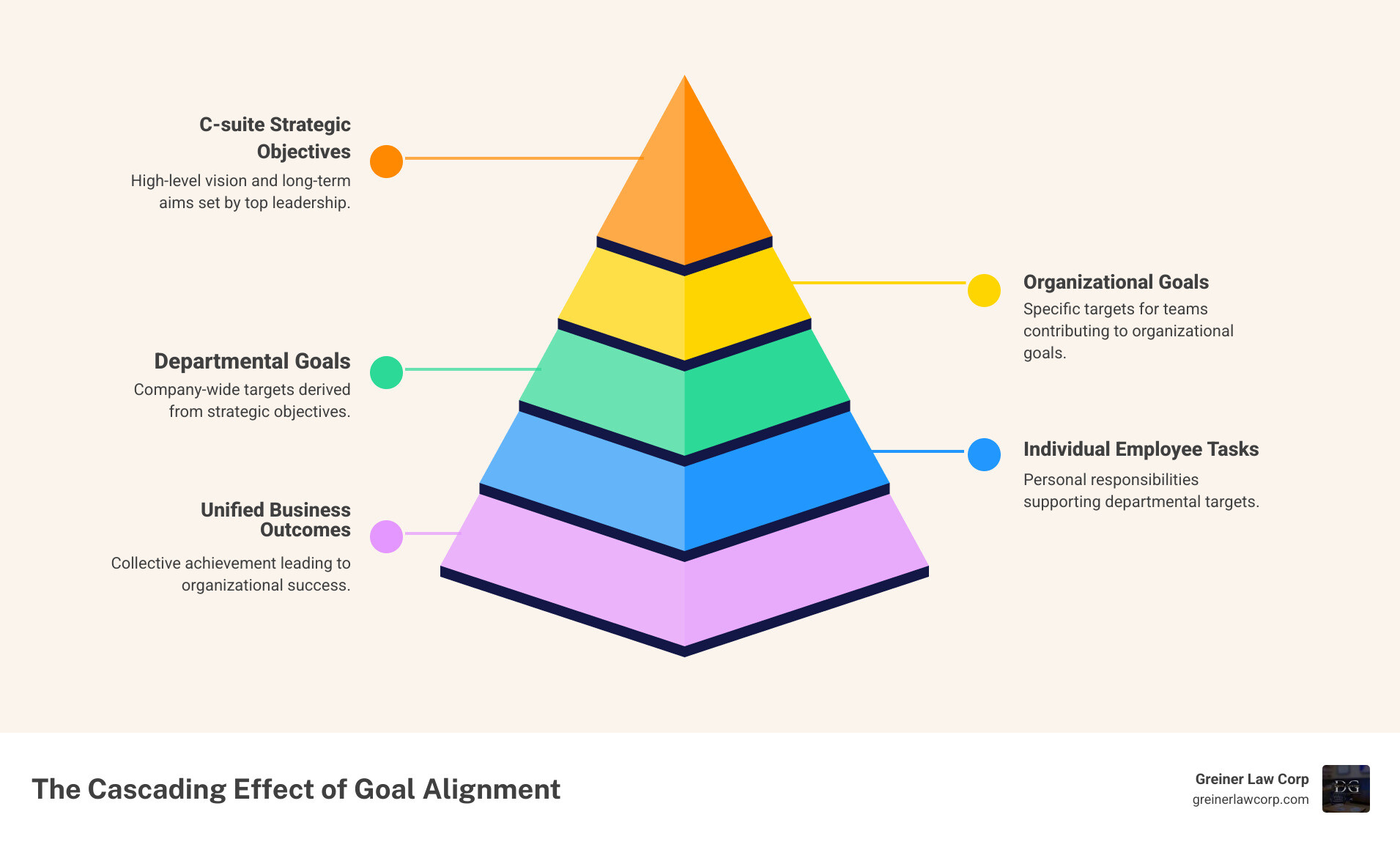
The Foundation: Why Goal Alignment is Your Business Superpower

Imagine your talented team working not just hard, but together toward a single, clear purpose. That’s the power of business goal alignment. It transforms individual efforts into a true competitive force.
When your team understands the company’s vision, resources stop being wasted on low-impact projects. Decision-making accelerates, and departmental silos break down as teams unite on a shared mission. Research from The Economist Intelligence Unit confirms this, finding that strategic alignment can explain up to 80% of the difference in performance between organizations.
With everyone pulling in the same direction, you can pivot faster, reduce redundant work, and foster natural collaboration. This isn’t just about efficiency—it’s about building a genuine competitive advantage.
The Impact on Employee Engagement and Motivation
People want their work to matter. They crave a connection between their daily tasks and a meaningful purpose. Unfortunately, many organizations fail to provide this clarity. Gallup data shows that fewer than half of employees know what’s expected of them, leading to widespread disengagement.
The solution is alignment. When employees see how their contributions support company success, they’re 3.5 times more likely to be engaged. This engagement boosts productivity, retention, and morale. Effective performance management is key; in strong systems, 91% of employee goals link to business priorities, and 92% of employees say regular feedback improves their performance.
When people understand their value, motivation and resilience grow. These outcomes are vital for strengthening your Business Risk Management Strategies.
The Link Between Strategic and Cultural Alignment
A brilliant strategy is useless if your company culture doesn’t support it. Strategic alignment directs work toward shared goals, while cultural alignment ensures your company’s values and behaviors reinforce that direction. When both are in sync, you create a sustainable, powerful organization.
Consider Toyota’s culture of “Kaizen” (continuous improvement). It’s not just a process; it’s a deeply ingrained mindset that competitors can’t easily replicate. This illustrates how culture can be a strategic advantage. Your culture either reinforces your strategy or undermines it. Values like transparency and accountability encourage aligned decisions without constant oversight.
Leaders must model desired behaviors and consistently articulate company values. This integrated approach strengthens your entire Corporate Law framework by harmonizing internal governance with your strategic vision. Aligning culture and strategy builds a business that can adapt, innovate, and thrive long-term.
The Blueprint: How to Analyze and Plan for Alignment

Achieving business goal alignment requires a blueprint. Just as you wouldn’t build a house without one, you need a strategic roadmap to guide your organization. This ongoing process involves understanding where you are, defining where you want to go, and mapping the path between them.
The journey begins with fundamentals: clarify your vision and mission, conduct a SWOT analysis (strengths, weaknesses, opportunities, threats), and identify your critical success factors. From there, translate these insights into concrete goals, break them into departmental objectives, establish Key Performance Indicators (KPIs), and outline your major strategic initiatives. This foundational work is crucial, whether you’re launching with Business Formation or restructuring an existing company.
Key Components of an Aligned Strategic Plan
An aligned strategic plan is a living guide for decision-making. Its key components include:
- Vision and Mission Statements: Your “why” and “where,” providing ultimate context and direction.
- SWOT Analysis: An honest assessment of your Strengths, Weaknesses, Opportunities, and Threats to ground your plan in reality.
- Critical Success Factors (CSFs): The 3-5 areas where excellence is non-negotiable, guiding your investments of time and resources.
- Financial and Non-Financial Goals: A balanced set of objectives covering profitability, customer satisfaction, innovation, and employee development.
- Departmental Objectives: Cascading goals that connect each team’s targets to the company’s bigger picture.
- Key Performance Indicators (KPIs): Meaningful metrics that track progress toward your goals, not just vanity numbers.
- Major Strategic Initiatives: The specific projects and programs designed to move the needle.
Steps to Analyze Your Current State of Alignment
Before fixing alignment issues, you must diagnose them. This organizational health check involves several steps:
- Review strategic documents: Scrutinize plans and roadmaps for consistency. Do they tell a unified story or reveal conflicting objectives?
- Interview leadership and stakeholders: Talk to managers and team leaders at all levels. Do they understand the company’s goals? Can they connect their team’s work to the mission?
- Evaluate departmental workflows: Observe daily activities. Do they support current strategic goals, or are teams stuck on outdated priorities?
- Audit current KPIs and metrics: Are you tracking what truly matters for strategic success, or just measuring what’s easy?
- Gather employee feedback: Use surveys and conversations to get a bottom-up perspective. Frontline employees often see disconnects that leaders miss.
This systematic analysis identifies where your efforts are fragmented and is a crucial part of an effective Business Risk Management Ultimate Guide.
Putting It in Motion: A Step-by-Step Guide to Achieving Business Goal Alignment

Having a strategic plan is one thing; making it come alive across your organization is where the real work begins. This is the moment we transform our blueprint into daily actions, where every team member understands not just what they’re doing, but why it matters.
Step 1: Communicate the Strategic Plan Effectively
A brilliant strategy is worthless if no one understands it. Effective communication is non-negotiable.
Communicate early, often, and through multiple channels: use company-wide town halls, follow up with team meetings for department-specific context, and provide visual roadmaps or newsletters. Leaders must consistently champion the plan in their decisions and discussions, creating a constant drumbeat of messaging.
Communication must be a two-way street. Create feedback loops through open forums and encourage questions to build ownership. A shocking 60% of companies lack a long-term communication strategy, creating a major barrier to alignment.
Crucially, connect the strategy to daily work. Explain how each team’s efforts contribute to overarching goals. When people see their direct impact on the company’s success, their engagement soars. This principle of clarity is also vital in Business Contract Legal Advice, where clear terms ensure success.
Step 2: Link Individual Goals to Company Objectives
This step transforms alignment from theory into practice. When people see a direct line from their tasks to the company’s mission, motivation and purpose soar.
Use cascading goals, breaking high-level company objectives into departmental, team, and individual responsibilities. Frameworks like OKRs (Objectives and Key Results) are highly effective. An Objective is an ambitious goal (e.g., “Become the market leader”), while Key Results are the measurable milestones to get there (e.g., “Increase market share to 25%”).
Ensure every goal is SMART (Specific, Measurable, Achievable, Relevant, Time-bound). A vague goal like “improve service” is useless; “reduce average response time to 12 hours by Q3” is actionable.
Regular manager check-ins are crucial for coaching, removing obstacles, and keeping goals aligned with shifting priorities. Performance management software can streamline this process, helping to link individual work to strategic priorities. As research shows, how effective goal-setting motivates employees is clearly visible in their performance when goals are clear and connected.
Step 3: Monitor, Measure, and Adjust
A strategy must be agile. Business goal alignment requires continuous monitoring and adjustment to steer a changing business world.
Implement real-time goal tracking and KPI dashboards to create transparency and allow everyone to see progress. This helps identify bottlenecks early and keeps the focus on strategic performance.
Conduct Quarterly Business Reviews (QBRs) to analyze performance data, identify gaps, and make strategic adjustments. High-performing companies are three times more likely to use data analytics to guide these decisions. Agility is wisdom; if a strategy isn’t working, change it.
Finally, celebrate wins to reinforce successful behaviors and remind people their contributions matter. The data is clear: alignment is transformative, making projects more successful and learning programs nearly nine times more effective. This principle of continuous adjustment is central to all business operations, including Business Risk Management Strategies.
Frequently Asked Questions about Business Goal Alignment
What are the most common challenges to achieving goal alignment?
Achieving business goal alignment has several common challenges:
- Siloed departments: When teams focus only on their own metrics, they can work at cross-purposes, wasting resources and creating confusion.
- Poor communication from leadership: If the strategic vision isn’t shared clearly and consistently, employees are left guessing. Fewer than half of employees strongly agree they know what’s expected of them.
- Lack of clear strategy: A vague or constantly shifting strategy provides no stable “north star” for employees to align with, leading to frustration.
- Resistance to change: People naturally resist new processes or systems, which can slow down or derail alignment initiatives.
- Inadequate technology: Trying to manage alignment with outdated tools like spreadsheets leads to errors, delays, and a lack of visibility.
Recognizing these obstacles is the first step to overcoming them with strong leadership, persistent effort, and the right processes.
How does goal alignment improve decision-making?
Business goal alignment transforms decision-making from a guessing game into a clear evaluation process. It provides objective criteria to prioritize projects and allocate resources effectively.
With alignment, you can:
- Prioritize effectively: Assess opportunities against strategic objectives. If a project doesn’t move you closer to your goals, it’s deprioritized. This helps avoid “pet projects” that lack strategic value.
- Allocate resources efficiently: Channel your budget, time, and technology toward initiatives with the highest strategic return, concentrating your efforts for maximum impact.
- Accelerate decision cycles: Empower team members at all levels to make confident choices without constant executive approval, as the criteria for success are clear.
- Reduce risk: By focusing on strategically aligned projects, you minimize the risk of pursuing dead-end initiatives and increase the likelihood of delivering business benefits.
What role does technology play in business goal alignment?
In today’s environment, technology is essential for business goal alignment. The right tools make a complex process transparent and efficient.
- Performance management and OKR software: These platforms link individual and team goals directly to company objectives, providing real-time visibility into progress and promoting transparency.
- Analytics and dashboards: Business intelligence tools offer clear, visual tracking of KPIs, allowing leaders to monitor performance against strategic goals at a glance.
- Collaboration platforms: Tools for project management and team messaging break down silos, keeping everyone informed and connected for natural coordination.
- Learning management systems (LMS): Aligning training with business objectives makes L&D programs significantly more effective.
This tech ecosystem fosters transparency, automates reporting, and connects every task to your company’s goals. For businesses building strong foundations, like the work we do at Greiner Law Corp, the right tech infrastructure is as vital as the right legal structure.
Conclusion: Unifying Your Team for Lasting Success
Business goal alignment is not a corporate buzzword; it’s a fundamental necessity for any organization that wants to thrive. It’s the strategic GPS that unifies your team, providing clarity, purpose, and momentum. The benefits are clear: faster growth, higher profitability, and dramatically improved employee engagement.
Alignment is not a one-time project but a continuous journey of communication, monitoring, and adjustment. The work is worth it. Creating an environment where every team member understands the mission and their role in it builds a resilient, high-performing organization.
During my years leading Greiner Buick GMC, I learned that operational excellence and strategic alignment go hand in hand. Now, at Greiner Law Corp, I apply that business-minded perspective to help owners build the legal foundations that make lasting alignment possible.
A strong legal structure is part of your business strategy. Whether forming a business, drafting contracts, or managing risk, your legal framework should reinforce your strategic objectives. We help build that foundation with a clear focus on your goals.
Ready to position your business for aligned, sustainable success? We’re here to support you with expert legal counsel that understands business realities. For more information, visit our Business Attorney Victorville CA page, or explore our comprehensive Victorville business law services. Let’s build something great together.


