
What You'll Pay: Understanding Probate Attorney Fees
Typical attorney fees for estate settlement vary widely based on several factors, but here's what you need to know upfront:
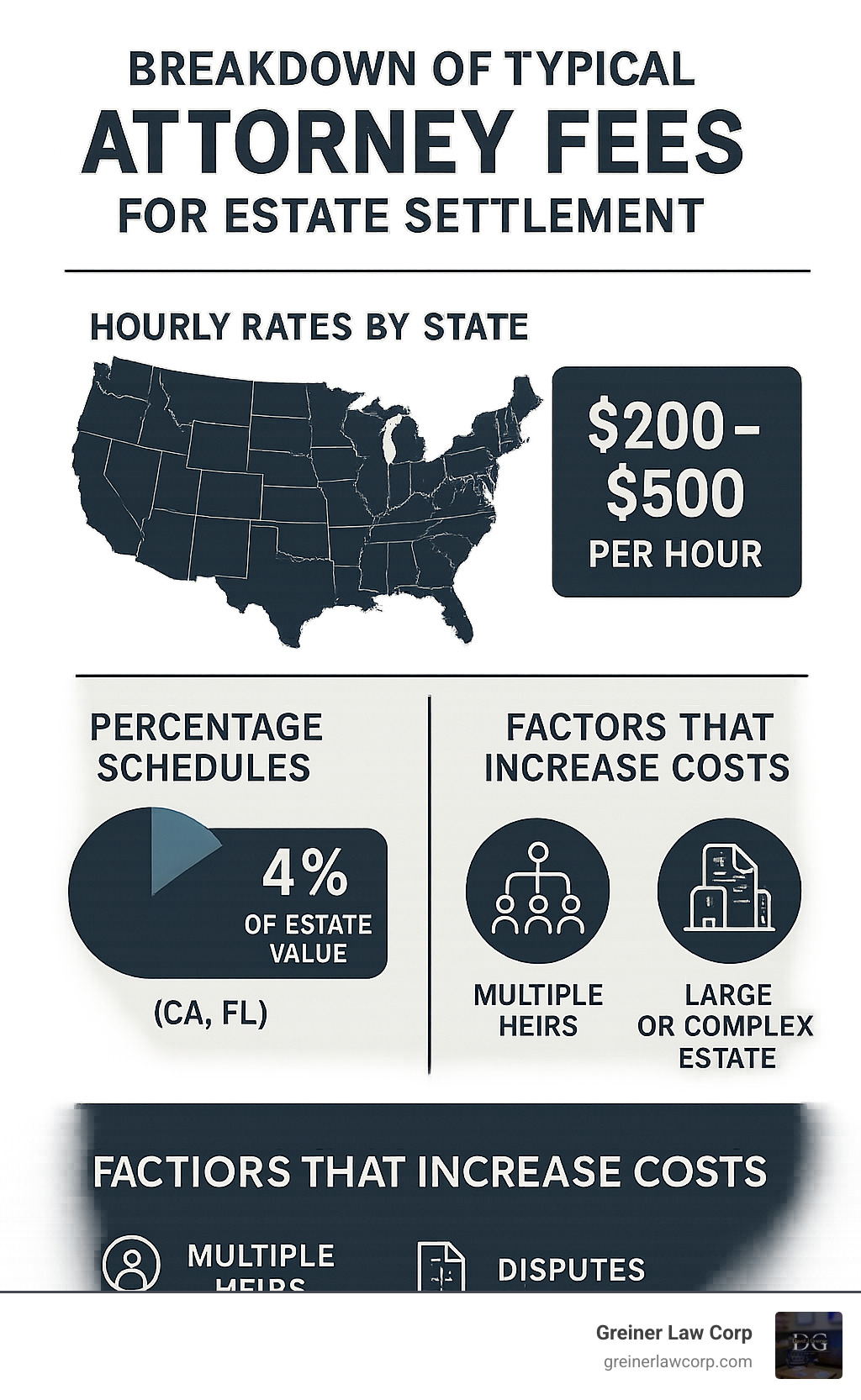
Fee Structure Typical Range Best For Hourly Rate $200-$500 per hour Complex estates, unpredictable cases Flat Fee $3,500-$7,000 for simple estates Straightforward, uncontested probates Percentage 4% of first $100K, scaling down States with statutory schedules (CA, FL)Our survey data shows:
- 34% of estates paid under $2,500 in total legal fees
- 20% paid between $2,500-$5,000
- 23% paid between $5,000-$10,000
- 23% paid over $10,000
When a loved one passes away, dealing with legal fees is probably the last thing you want to think about. Yet understanding what attorneys typically charge for estate settlement is crucial for executors and beneficiaries alike. The probate process—the court-supervised distribution of a deceased person's assets—often requires legal assistance, and those costs come directly from the estate's funds before any distributions to heirs.
Typical attorney fees for estate settlement aren't one-size-fits-all. They depend on your location, estate complexity, and the fee structure your attorney uses. Smaller, straightforward estates in less expensive regions might cost as little as $2,500 in total legal fees, while complex estates worth over $1 million could incur $10,000 or more.
I'm David Greiner, Esq., and after years of helping clients steer estate settlements, I've seen how typical attorney fees for estate settlement can impact families during an already difficult time. My approach focuses on transparent fee structures and practical solutions that prioritize your goals rather than maximizing billable hours.
How Estate Settlement & Probate Really Work
When someone passes away, their affairs don't simply resolve themselves. Probate is the legal process that ties up all those loose ends, and understanding it helps explain what you're actually paying for when you hire an attorney.
Think of probate as the official "wrapping up" of a person's legal and financial affairs. It involves:
- Proving the will is valid (or determining who inherits if there's no will)
- Creating a complete inventory of everything the person owned
- Paying off any debts and taxes they owed
- Distributing what's left to the rightful heirs
The executor (sometimes called a personal representative) stands at the center of this process. If you've been named executor, you're essentially the estate's manager until everything is properly settled.

Most people are surprised to learn that probate typically takes 6-24 months to complete. This isn't because attorneys are dragging their feet—it's because the process has many required steps, waiting periods, and potential complications.
As executor, you'll need to file court paperwork, notify everyone who might have claims against the estate, manage assets (sometimes for months or years), file several tax returns, and eventually distribute everything correctly. Make a mistake, and you could be personally liable. This is why most executors—especially first-timers—find professional guidance invaluable.
The Attorney's Job From Day 1 to Final Distribution
A probate attorney doesn't just file papers—they serve as your guide, protector, and problem-solver throughout the entire journey.
When you first meet, your attorney will help gather the necessary documents and file the initial petition with the court. This critical first step officially opens the probate case and seeks your appointment as executor.
Once you're appointed, your attorney helps you steer asset management. Should you sell the house now or wait? How should retirement accounts be handled? What about that small business interest? Typical attorney fees for estate settlement cover this ongoing advice that prevents costly mistakes.
Your lawyer will also handle creditor notifications and reviews any claims made against the estate. They'll help prepare estate tax returns (if needed) and the deceased's final personal tax return—both areas where errors can trigger audits or penalties.
As the process moves toward conclusion, your attorney prepares the distribution plan, ensuring everyone receives exactly what they're legally entitled to. They'll create the final accounting that shows the court and beneficiaries exactly how everything was handled, then file the closing documents that officially wrap up the case.
Throughout this journey, if disputes arise—perhaps a family member contests the will or a creditor makes an unreasonable claim—your attorney handles these complications so you don't have to face them alone.
Want to learn more about what these services cost? Check out our detailed guide on Attorney Fees for Estate Administration.
Typical Attorney Fees for Estate Settlement: Fee Structures & National Averages
Let's talk about the money side of things—I know it's probably not what you want to focus on during a difficult time, but understanding what you might pay is important. Typical attorney fees for estate settlement come in several flavors, each with their own advantages and potential drawbacks.

Hourly vs. Flat vs. Percentage—typical attorney fees for estate settlement explained
When I sit down with families to discuss fees, I find most are surprised by the options available. The most common approach—used by about 60% of probate attorneys according to our research—is hourly billing. Your attorney tracks their time (typically in six-minute increments) and bills accordingly. Hourly rates generally run between $200-$500, depending on your location and your attorney's experience level.
The benefit? You only pay for actual time spent on your case. The downside? Those brief phone calls and quick emails add up, and the final total can be unpredictable. I always suggest asking for regular billing statements and requesting a good-faith estimate of total hours before you begin.
About a third of probate attorneys (32% in our survey) offer flat fees for routine estate administration. This means one predetermined amount—typically between $3,500-$7,000 for straightforward estates—covers the entire probate process. Many families appreciate the predictability this provides; no surprise bills arriving in the mail. Just make sure you get in writing exactly what services are included and what circumstances might trigger additional fees.
Less common but still worth understanding are percentage-based fees, which about 8% of estates use. This approach is most prevalent in states with statutory fee schedules like California and Florida. Typically, the attorney receives something like 4% of the first $100,000 of estate value, with decreasing percentages for higher amounts.
While this structure creates a clear calculation and incentivizes your attorney to maximize estate value, it often results in higher overall fees, especially for valuable but straightforward estates. Remember too that these percentages apply to the estate's gross value, not equity—so a $500,000 house with a $400,000 mortgage still counts as $500,000 for fee purposes.
In rare cases, particularly with litigation over estate assets or will contests, attorneys might work on contingency—typically 30-40% of any recovery. The upside is you pay nothing if unsuccessful, but successful recovery can mean substantial attorney fees.
National Benchmarks for typical attorney fees for estate settlement
Looking at the bigger picture, the 2023 report from Clio shows average hourly rates for wills and estate attorneys vary dramatically by location. The lowest average was $201 in Indiana, while Washington D.C. topped the chart at $448. Nationally, most attorneys fall somewhere between $250-$310 per hour.
Estate size significantly impacts total legal costs too. Our survey found that for estates under $1 million, only 18% paid more than $10,000 in legal fees. That percentage doubles to 36% for estates valued over $1 million.
The good news? Most executors (34%) reported paying less than $2,500 in total legal fees, while another 20% paid between $2,500 and $5,000. That means over half of all estates settle with legal fees under $5,000—often much less than people fear.
For the most current research on attorney rates across the country, you might want to check out the Latest research on attorney rates from Clio's legal trends report.
These are just benchmarks. Your situation may be unique, and at Greiner Law, we believe in transparent conversations about fees from day one, so you're never caught off guard.
What Drives the Final Bill? Key Cost Factors & Extra Expenses
Ever wonder why some estates pay thousands in legal fees while others pay tens of thousands? The truth is, typical attorney fees for estate settlement vary dramatically based on several key factors that might not be obvious at first glance.
Estate Complexity
Not all estates are created equal. When I sit down with clients across our conference table, one of the first things we discuss is complexity—because this is the biggest driver of your final bill.
Simple estates with one home, a few bank accounts, and clear beneficiaries naturally cost less than complicated ones. Your costs will likely climb if your loved one's estate includes:
- Multiple beneficiaries or heirs (especially those who don't get along)
- Assets scattered across different states (each potentially requiring its own probate)
- Business ownership interests (these require special valuation and handling)
- A contested will or family members threatening litigation
- Unusual assets like cryptocurrency, intellectual property, or valuable collectibles
- Tax complications that require specialized knowledge
Think of it like home construction—a simple ranch house costs less than a custom-designed mansion with specialty features. The more moving parts, the more attorney time required.
Geographic Location
Location impacts legal fees just as it does real estate prices. An attorney in downtown Los Angeles typically charges significantly more than one in Victorville—even for identical services. This isn't just about prestige; it reflects the different costs of running a practice in these areas.
Having served clients throughout San Bernardino, Riverside, and Los Angeles counties, I've seen how rates can vary by 30-40% between urban centers and suburban communities for the same quality of service.
Attorney Experience
When it comes to legal services, the old saying "you get what you pay for" often rings true. More experienced attorneys generally command higher hourly rates but may complete work more efficiently.
I've seen many cases where a senior attorney at $400/hour accomplished in one hour what would have taken a junior attorney at $250/hour two hours to complete—making the more "expensive" option actually more economical in the end.

Additional Expenses
Legal fees are just one piece of the estate settlement puzzle. Your estate will likely face several other necessary expenses:
Court filing fees run about $435 in California just to open a probate case. You'll also pay $100-$200 for publication fees (legal notices in local newspapers), appraisal fees (typically 0.1% of asset value), and accounting fees for tax preparation.
Don't forget executor compensation—in California, executors are entitled to the same statutory fee schedule as attorneys, though many family member executors waive this fee.
Hidden & "Extraordinary" Charges to Watch For
Here's where things can get tricky. Many states with statutory fee schedules (like California) allow additional "extraordinary fees" for services beyond routine administration. These extras can significantly impact your bottom line.
Watch for charges related to:
Will contests or litigation – Any legal battles dramatically increase costs
Tax audits or disputes – Dealing with the IRS requires specialized knowledge
Sale of real property – Preparing, marketing, and closing property sales takes time
Operating a business – Keeping a deceased's business running requires ongoing attention
Handling unusual assets – Digital assets, intellectual property, or foreign investments
In California, these extraordinary services are typically billed hourly on top of the statutory percentage. The best protection? Ask your attorney upfront to identify potential extraordinary services for your specific situation.
Who Pays, When & How
Good news—individual executors or beneficiaries don't personally pay attorney fees (unless they choose to). The estate itself bears these costs before final distribution to heirs.
The typical payment timeline works like this:
First, your attorney may request a retainer upfront to begin work. Then, interim payments might be made during administration with court approval. Finally, the court must approve all fees before final distribution.
If you, as executor, advance legal fees from your own pocket, don't worry—you're entitled to reimbursement from the estate. However, it's important to understand that neither attorneys nor executors can be compensated until the court approves and confirms the estate has sufficient assets to cover these expenses.
For more detailed information about legal fees for administering an estate, check out our comprehensive guide on legal fees for administering an estate.
State-By-State Snapshots & Statutory Schedules
When it comes to typical attorney fees for estate settlement, where you live makes a huge difference. Each state has its own approach to probate fees, and understanding your local rules can save you thousands.
Let me walk you through how some key states handle these fees – you might be surprised at the differences!
California & Florida Tiered Percentages—Case Study on $500K Estate
In California, the Probate Code (§ 10810) lays out a clear percentage schedule that most attorneys follow:
- 4% on the first $100,000
- 3% on the next $100,000
- 2% on the next $800,000
- 1% on the next $9 million
- 0.5% on the next $15 million
- "Reasonable amount" for anything above $25 million
Let's see what this means in real dollars. For a $500,000 estate in California, you'd be looking at:
- $4,000 for the first $100,000 (at 4%)
- $3,000 for the next $100,000 (at 3%)
- $6,000 for the remaining $300,000 (at 2%)
- Total: $13,000
Head over to Florida, and the math changes. Their statutory schedule (§ 733.6171) works like this:
- 3% of the first $1 million
- 2.5% of the next $4 million
- 2% of the next $5 million
- 1.5% of amounts above $10 million
That same $500,000 estate in Florida would cost you $15,000 (flat 3% of the entire amount). That's $2,000 more than California – enough to make a difference to beneficiaries!
Here's something many people don't realize: in both states, these percentages are presumed "reasonable" fees, but they're not set in stone. Attorneys must disclose that these fees are negotiable – a fact that can save you money if you know to ask.
Pennsylvania takes a different approach with their "Johnson Estate" guidelines. They're similar to California's sliding scale but aren't actually written into law. Instead, courts use them as a benchmark for determining what's reasonable.
Meanwhile, Oregon has no statutory schedule at all. Simple probates typically run $2,000-$5,000 there. Oregon also offers a streamlined small-estate affidavit process for estates under $275,000, which can significantly reduce legal costs.

If you're wondering which states use percentage-based fee schedules, the list includes California, Florida, Arkansas, Iowa, Missouri, Montana, and Wyoming. In other states, hourly billing tends to be more common.
These statutory fees are based on the estate's gross value, not equity. That means a house worth $500,000 with a $400,000 mortgage still counts as $500,000 for fee calculation purposes – something that can dramatically impact the final bill.
Understanding your state's approach to typical attorney fees for estate settlement gives you power – power to negotiate effectively and know when you're being charged fairly.
Cutting Costs: Negotiation & Probate-Avoidance Strategies
Let's face it—legal fees can take a significant bite out of an estate. The good news? You have more control over these costs than you might think. I've helped hundreds of families reduce their typical attorney fees for estate settlement with some straightforward approaches that don't require confrontation or awkwardness.
Negotiating With Lawyers Without Burning Bridges
Most attorneys understand that families are cost-conscious during estate settlement. In my experience, a respectful conversation about fees often leads to mutually beneficial arrangements.
Start by shopping around—our research shows 58% of probate attorneys offer free initial consultations. Use these meetings to not only assess their expertise but also their flexibility on fees.
When you find an attorney you connect with, don't be shy about asking for different fee options. Many of my clients have successfully requested a blended approach—perhaps a flat fee for routine matters with hourly billing only for unexpected complications.
Setting hourly caps can provide peace of mind when working with hourly billing. I often suggest clients request a "not-to-exceed" amount for standard services, with the understanding that genuine complications might require additional approval.
One of my favorite money-saving strategies is clearly defining the scope of legal services. Many executors can handle certain tasks themselves—like gathering documents or communicating with beneficiaries—while leaving the technical legal work to the attorney. Just be sure to document who's responsible for what to avoid misunderstandings.
For transparency's sake, request detailed, itemized billing statements that clearly describe each task. This not only helps you understand what you're paying for but also encourages efficient work on the attorney's part.
Even in California and other states with statutory percentage fees, these amounts are presumptively reasonable, not mandatory. You can—and should—still negotiate if the estate is relatively straightforward.
Probate-Avoidance Moves That Slash Attorney Fees
The most effective way to reduce typical attorney fees for estate settlement is to avoid probate entirely. At Greiner Law Corp, we help clients implement several strategies that can dramatically reduce or eliminate probate costs:
Revocable living trusts are perhaps the most comprehensive solution. Assets properly transferred to a trust bypass probate completely, saving thousands in legal fees while maintaining privacy and speeding up asset distribution. Yes, creating a trust costs money upfront, but the long-term savings are substantial.
Joint ownership offers a simple solution for married couples and others who own property together. When titled as "joint tenants with right of survivorship," property automatically transfers to the surviving owner without probate. Just be careful about adding non-spouse joint owners, as this can create unintended tax consequences.
Your retirement accounts, life insurance, and many financial accounts can bypass probate entirely with properly completed beneficiary designations. I always remind clients to review these designations regularly, especially after major life events like marriage, divorce, or the birth of children.
For California homeowners, transfer-on-death deeds provide a simple way to transfer real property directly to beneficiaries without probate. They're relatively inexpensive to create but offer significant savings when the time comes.
Similarly, payable-on-death accounts allow bank accounts to transfer automatically to designated beneficiaries. It takes just a few minutes to set up with your bank but can save weeks or months of probate proceedings.
For smaller estates, California offers a simplified procedure for estates under $166,250 (as of 2023). This streamlined process can potentially eliminate the need for full probate and dramatically reduce legal fees.
The key is planning ahead. I've seen too many families struggle with high probate costs that could have been avoided with some forward-thinking estate planning. At Greiner Law Corp, we specialize in helping clients implement these cost-saving strategies before they're needed, ensuring a smoother, less expensive transition when the time comes.
More info about How Much Does an Estate Lawyer Cost?
Frequently Asked Questions about Typical Attorney Fees for Estate Settlement
I've noticed these questions come up time and again when families are navigating estate settlement. Let's tackle the most common concerns about typical attorney fees for estate settlement that might be on your mind:
How much will my estate pay if there's no conflict?
When everything goes smoothly—no family disputes, no contested will, no complex assets—your costs will generally fall into predictable ranges. For a straightforward estate with no drama, you can expect:
In California, you'll likely pay the statutory percentages (which comes to about $13,000 for a $500,000 estate). If you're outside California with an attorney billing hourly, expect somewhere between $3,500-$7,000 for simple estates. Many attorneys also offer flat fee arrangements ranging from $2,500-$5,000 for uncomplicated matters.
The good news? The majority of estates fall into this "no conflict" category, which is why over half of estates wrap up with total legal fees under $5,000.
Can I negotiate statutory fees?
Absolutely! This is one of the best-kept secrets in probate. Even in states like California with those statutory fee schedules, those amounts are simply what's considered "reasonable"—not what you must pay.
You have options: you might request an hourly arrangement instead of percentages, negotiate a flat fee for specific services, or even discuss a reduced percentage. Many attorneys are willing to work with you, especially for straightforward estates where the statutory amount might seem disproportionate to the work involved.
Don't be shy about having this conversation early. Most attorneys appreciate clients who are upfront about budget concerns.
Do attorney fees reduce estate or income taxes?
Yes, there's a silver lining here! Attorney fees for estate administration are generally deductible on the estate's income tax return (Form 1041) as an administrative expense. This can provide meaningful tax savings.
For larger estates that need to file a federal estate tax return (Form 706), these fees can also reduce the taxable estate value. And if you're an executor who includes executor fees in your personal income, related attorney fees may be deductible against that income.
I always recommend consulting with a tax professional about your specific situation, as tax laws change and individual circumstances vary widely.
Who pays for the probate lawyer?
The estate itself pays these costs—not you as the executor or the beneficiaries personally. However, someone (often the executor) may need to advance costs initially and then seek reimbursement from the estate assets later.
It's worth noting that attorneys and executors typically cannot receive their full fees until the court approves them and confirms the estate has sufficient assets to pay them. This is an important protection built into the probate system.
How long does probate take and how does this affect fees?
Probate typically takes 6-24 months from start to finish. And yes, longer probates generally mean higher fees, especially with hourly billing arrangements.
Several factors can extend the timeline (and therefore increase costs): estate complexity, disputes among heirs, tax complications, real estate sales, and business interests all tend to add months to the process and dollars to the final bill.
Understanding this relationship between time and cost can help you make strategic decisions about which battles are worth fighting and which complications are worth resolving quickly to keep fees manageable.
At Greiner Law Corp, we believe in transparency about these timing issues from day one, so you can make informed decisions throughout the process.
Conclusion
Understanding typical attorney fees for estate settlement isn't just about numbers—it's about navigating one of life's most challenging transitions with confidence and clarity. Whether you're facing a $3,500 flat fee for a simple estate or a percentage-based fee approaching $15,000 for a larger one, knowledge truly is power during this process.
I've seen how fee awareness transforms the executor experience. Rather than feeling at the mercy of an unpredictable legal system, informed executors can make strategic decisions, negotiate effectively, and even implement probate-avoidance strategies that dramatically reduce costs.
At Greiner Law Corp, we believe in pulling back the curtain on legal fees. Since 2003, we've been guiding families across San Bernardino, Riverside, and Los Angeles counties with a straightforward approach that prioritizes your goals—not our billable hours. Our business-minded perspective means we help you weigh costs against benefits at every turn, ensuring you can manage both the legal process and its financial impact.
The smartest approach to probate costs is often preventive. A thoughtfully structured estate plan—perhaps including trusts, beneficiary designations, or transfer-on-death deeds—can significantly reduce or completely eliminate probate expenses for your loved ones. Think of it as your final gift to them: a smooth transition without unnecessary legal problems or expenses.
While the dollars matter, there's something even more valuable at stake. The peace of mind that comes from knowing you're handling things correctly—that beneficiaries will receive their inheritances without needless delays or complications—is ultimately what we're all after. Typical attorney fees for estate settlement are simply the price of that assurance.
For personalized guidance on navigating estate settlement or creating a plan that minimizes future probate costs, reach out to us at Greiner Law Corp. We're committed to providing practical solutions custom to your specific situation, priorities, and yes—your budget too.