
Understanding the True Financial Impact of Professional Executors
The cost of solicitor acting as executor typically ranges from 1.5% to 2.5% of the estate value, but actual fees vary based on estate complexity and charging structure.
Quick Fee Overview: - Standard Rate: 1.5% of gross estate (excluding property) + 0.75% of property value - Typical Range: £4,800 to £7,200 for straightforward estates - Fee Cap: Maximum 4% of gross estate plus 20% VAT for estates over £250,000 - Payment: Fees are paid from the estate at administration end - VAT: 20% VAT applies to all solicitor executor fees
Understanding these costs upfront helps you make informed decisions about estate administration.
The role of a solicitor as executor goes beyond simple legal work. They take full responsibility for managing the deceased's affairs, from collecting assets to paying debts and distributing inheritance. This comprehensive service comes with corresponding fees that reflect both time invested and estate value.
A £500,000 estate could incur executor fees of £7,500 to £12,500 - money that would otherwise go to your heirs.
I'm David Greiner, Esq., and through my transactional law practice, I've helped numerous clients steer estate planning complexities and understand the true cost of solicitor acting as executor. My business-focused approach ensures clients achieve their goals while managing costs effectively.

Explore more about cost of solicitor acting as executor: - cost of making a will with a solicitor - typical attorney fees for estate settlement - typical real estate attorney fees
Understanding the Role and Responsibilities of a Solicitor Executor
Think of a solicitor executor as the professional quarterback of estate administration. When you appoint a solicitor as executor, you're hiring someone who knows all the plays and can handle pressure when things get complicated.
Unlike family volunteers, a solicitor executor brings professional expertise combined with legal accountability. This expertise comes with a price tag that impacts the cost of solicitor acting as executor.
The role is comprehensive and demanding. Your solicitor executor will locate assets, notify beneficiaries and creditors, pay debts and taxes, obtain the Grant of Probate, and distribute everything according to your will's terms. This typically takes 6-12 months for straightforward estates, during which they bear personal liability for mistakes.
The fiduciary duty is crucial. Your solicitor executor must act in beneficiaries' best interests, manage estate assets with care, and maintain detailed records of every decision and transaction.
What Does It Mean to Appoint a Solicitor as Executor?
When you name a solicitor as executor in your will, you're giving them legal authority to handle all your affairs after you pass away. This must be explicitly stated during will drafting.
Once appointed, your solicitor executor gains the same legal powers as any family member would have. The difference? They know exactly how to use those powers effectively, understanding probate procedures, tax obligations, and how to steer potential disputes.
Important: if you want your solicitor to charge fees for acting as executor, you need a charging clause in your will. Without this explicit permission, they can only recover reasonable expenses - no fees for their time and expertise.
Professional vs Lay Executors – Key Differences
The gap between professional and lay executors is like the difference between a seasoned pilot and someone who's read a flying manual.
Expertise and experience represent the most obvious advantage. Professional executors have handled dozens of estates, while family members are usually learning on the job.
Personal liability protection is crucial. Solicitors carry professional indemnity insurance, while family executor mistakes come out of personal assets.
The time commitment often surprises people. Estate administration requires focused attention over many months. Professional executors can dedicate necessary time, while family members struggle to balance executor duties with regular lives.
Charging structure: professional executors typically charge 1.5-2.5% of estate value, while lay executors usually serve without compensation.
Impartiality can be invaluable when family tensions arise. Professional executors don't have emotional baggage - they follow the will and the law.
When Is a Solicitor Executor a Smart Choice?
Some estates practically demand professional management. Complex estates with multiple properties, business interests, or international assets benefit from professional expertise.
Property portfolios present particular challenges. Managing valuations, rental income, tenants, and sales requires both legal knowledge and practical experience.
Family disputes are another red flag for professional executors. When beneficiaries don't get along, having a neutral professional prevents expensive litigation.
We typically recommend solicitor executors for estates exceeding £1 million, situations involving inheritance tax liabilities, or cases where no suitable family member is available.
How Are Solicitor Executor Fees Calculated?

Understanding how the cost of solicitor acting as executor is calculated combines three main elements: hourly rates for time spent, a value element based on estate worth, and a responsibility fee reflecting fiduciary duties.
Most solicitors charge £175 to £300 per hour depending on experience and location. The value element runs 1.5% to 2.5% of the estate's gross value. VAT at 20% gets added to all fees, with fee caps around 4% of gross estate for larger estates.
Fee Structure Time-Based Percentage-Based Hybrid Model Calculation £175-£300/hour 1.5-2.5% of estate Time + Value element Typical Cost £2,000-£6,000 £7,500-£12,500 (£500k estate) £4,800-£7,200 Best For Simple estates Large estates Most estates Predictability Low High MediumThe Law Society provides guidelines that help standardize fees across the profession, though there's still room for negotiation on larger estates.
More info about solicitor fees
The Formula: Time Spent + Value Element + Responsibility
The Law Society suggests a responsibility fee of 1.5% of the gross estate (excluding property values) plus 0.75% of property values. For sole executors or those with significant responsibility, rates might increase to 2.25% and 1.125% respectively.
Property attracts different rates because it requires specialized knowledge for valuation, marketing, and sale, plus ongoing responsibilities like insurance and maintenance.
The time element covers actual hours spent. Most straightforward estates need 10 to 25 hours of professional time, but complex cases can easily double or triple this.
The responsibility component acknowledges that managing larger estates involves greater potential liability, even when actual work is similar.
Are Fees in Addition to Legal Probate Costs?
This question trips up many people. The answer depends on how your solicitor structures their services.
When a solicitor acts as executor, they wear two hats: executor responsibility for entire estate administration, and legal services for specific tasks like probate applications and tax returns.
Some solicitors charge separate fees for each role, while others offer combined fee structures eliminating overlap. Get clarity upfront about what you're paying for.
Disbursements - court fees, property valuations, newspaper notices - are always separate costs typically running £1,000 to £3,000 for most estates.
Ask your solicitor to explain exactly what executor fees cover versus legal fees to avoid duplication.
Typical Cost of Solicitor Acting as Executor in the UK & Alternatives

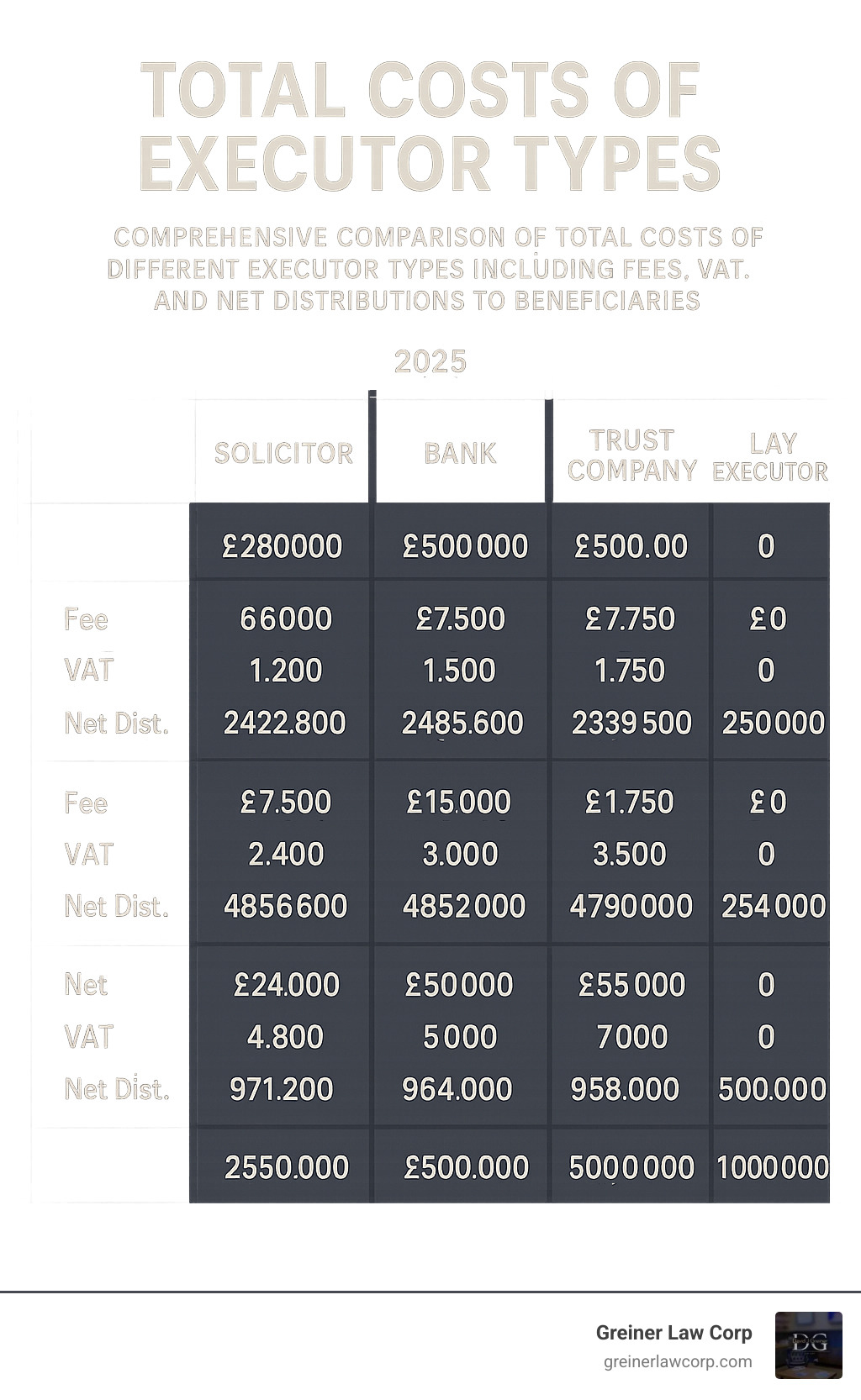
The cost of solicitor acting as executor typically ranges from 1.5% to 2.5% of your estate's total value, plus 20% VAT.
For typical straightforward estates, total costs range from £4,800 to £7,200 including VAT. The UK government caps fees at 4% of gross estate plus VAT for estates over £250,000.
Banks often charge 2-4% of estate value but frequently outsource actual work to solicitors anyway - you pay premium prices for middleman service.
Fixed-fee arrangements are becoming popular for smaller estates. Some solicitors offer DIY probate support where they guide you rather than taking full executor responsibility, saving thousands.
Average "Cost of Solicitor Acting as Executor" for Small, Medium & Large Estates
For a £100,000 estate: about £1,500 in executor fees (1.5%) plus £300 VAT. Total cost: £1,800 (1.8% of estate).
Medium-sized estates around £500,000: £300,000 in property attracts 0.75% fee (£2,250), while £200,000 other assets get 1.5% (£3,000). Add £1,050 VAT for total £6,300 - about 1.26% of estate value.
Large estates of £1,000,000: typically face 1.5% charge, resulting in £15,000 fees plus £3,000 VAT. Total £18,000 cost represents 1.8% of estate.
Notice how percentage-based fees create huge cost differences even when actual work might be similar.
Comparing the "Cost of Solicitor Acting as Executor" With Bank, Trust Company, Lay Executor
Solicitors charge 1.5-2.5% but provide professional expertise, personal service, and SRA regulation.
Banks charge 2-4% - sometimes double solicitor rates - while often outsourcing work to solicitors anyway.
Trust companies charge 1-3% and specialize in complex estates, offering corporate continuity but might be overkill for straightforward cases.
Lay executors typically don't charge fees but carry personal liability for mistakes and may lack necessary expertise.
Consumer protection varies significantly. Solicitors and banks carry professional indemnity insurance, while lay executors bear personal liability. Trust companies offer strongest financial backing, but solicitors provide the best balance of expertise, cost, and personal service for most estates.
Ways to Control, Negotiate or Challenge Solicitor Executor Costs
You have more control over the cost of solicitor acting as executor than you might think, whether planning ahead or already in probate.
Smart planning starts with your will. Include specific language about executor fees through a well-crafted charging clause that sets clear boundaries and expectations.
During estate administration, transparency becomes crucial. Beneficiaries have the right to see detailed invoices showing exactly what work was done and how long it took. Don't hesitate to ask for regular cost updates.
More info about Solicitors Executors Costs
Can Beneficiaries Limit or Dispute the Fees?
Yes, beneficiaries can challenge executor fees, but all adult beneficiaries with full mental capacity must agree.
Common grounds for challenging fees include charges seeming unreasonable for work performed, missing proper authority to charge (no charging clause), or executor not acting in beneficiaries' best interests.
Consider mediation first - it's usually faster, cheaper, and less stressful than litigation. Many professional bodies offer specialized mediation for fee disputes.
If mediation fails, petition the probate court to review fees. Courts apply a "reasonableness" test, examining estate complexity, time needed, results achieved, and local market rates.
Reality check: challenging executor fees isn't always worthwhile. Legal costs of disputing fees can sometimes exceed potential savings, especially for smaller estates.
Circumstances Leading to Higher or Lower Fees
Higher fees typically apply for foreign assets requiring international expertise, active business interests needing ongoing management, or family disputes leading to litigation.
Lower fees might be negotiated for straightforward estates with minimal assets, cooperative beneficiaries, and easily identified assets. Some solicitors offer fixed-fee arrangements for simple estates.
Get clear explanations upfront. Reputable solicitors should explain why your estate might cost more or less than standard rates, documenting specific circumstances justifying variations.
The cheapest option isn't always best value. Sometimes paying slightly higher fees for experienced, efficient service saves money long-term by avoiding costly mistakes or delays.
Pros, Cons & Decision Checklist Before Appointing a Solicitor Executor

Choosing whether to appoint a solicitor as executor balances professional expertise against financial impact. The cost of solicitor acting as executor plays a major role, but it's not just about money.
A solicitor brings specialized training and experience, but this expertise comes at a premium that can significantly reduce what beneficiaries ultimately receive.
Appointing a solicitor offers genuine peace of mind. You know the job will get done correctly, on time, with proper legal backing. Professional executors provide reassurance while families focus on grieving and healing.
The impartiality factor becomes crucial with complicated family dynamics. Professional executors steer disputes without taking sides, make decisions based on legal requirements rather than emotions, and maintain relationships that might otherwise be damaged.
However, the financial reality is significant. That 1.5-2.5% fee might seem reasonable until calculated against actual estate value. A £400,000 estate could lose £6,000-£10,000 to executor fees alone.
Professional executors typically complete estate administration in 6-12 months, while family members often struggle for years with complex procedures.
On the flip side, solicitors may lack the personal touch that family executors provide, missing knowledge of personal preferences and family significance of certain items.
Tax Implications of Paying Solicitor Executor Fees
Executor fees are fully deductible as estate administration expenses for inheritance tax purposes, reducing your estate's taxable value and potentially saving inheritance tax.
For estates near the £325,000 inheritance tax threshold, executor fees might push the estate below the taxable limit - spending money to save money.
The VAT component is less favorable. That 20% VAT on executor fees can't be reclaimed, effectively increasing total cost. A £6,000 executor fee becomes £7,200 after VAT.
Timing matters for tax optimization. Fees paid during estate administration reduce inheritance tax calculation, while fees paid after final distribution might not qualify for the same benefits.
Alternative Options if You Decide Against a Solicitor Executor
Family member executors often serve without fees, bringing personal knowledge and emotional investment. The trade-off is potential inexperience and time burden during grief.
Professional administrators from specialized probate companies offer middle-ground solutions - professional expertise at lower costs than traditional solicitors.
Joint appointments provide interesting compromise, pairing family members with professionals to balance personal knowledge with technical expertise.
Some choose to start with family executors and hire professional help only when needed, controlling costs while ensuring expert assistance for complex issues.
Match your choice to specific circumstances. Simple estates with cooperative families might not need professional executors, while complex situations often justify additional cost for professional management.
More info about Who Pays Probate Attorney Fees?
Frequently Asked Questions about Solicitor Executor Fees
When considering the cost of solicitor acting as executor, clients often have specific questions about how fees work in practice. Let me address the most common concerns I encounter in my practice.
What is a charging clause and why does it matter?
A charging clause might sound like legal jargon, but it's actually one of the most important provisions in your will if you're appointing a solicitor as executor. Think of it as your written permission slip that allows the solicitor to charge professional fees for their work.
Without this clause, your solicitor executor faces a significant problem - they can only claim basic expenses like postage and phone calls, not compensation for their time and expertise. This creates an obvious issue: few solicitors will accept executor appointments without proper charging authority.
The clause should clearly state that the executor may charge professional fees at normal commercial rates. Recent case law, including Da Silva v Heselton [2022], emphasizes that charging clauses must clearly connect the executor's professional work to actual estate administration tasks.
When I draft wills for clients, I always ensure the charging clause is comprehensive yet clear. It protects both the solicitor executor and the estate by establishing fee expectations upfront, preventing disputes later when emotions may be running high.
Are solicitor executor fees subject to VAT?
Yes, and this is where the cost of solicitor acting as executor can catch people off guard. All solicitor executor fees are subject to 20% VAT in the UK, and this VAT cannot be reclaimed by the estate.
This means if your solicitor quotes executor fees of £6,000, the actual cost to the estate will be £7,200 including VAT. That extra £1,200 comes directly out of what would otherwise go to beneficiaries.
Some solicitors quote fees inclusive of VAT, while others add it on top of their base rates. Always ask whether quoted fees include or exclude VAT to avoid unpleasant surprises during estate administration. This simple question can save significant confusion and help you make accurate cost comparisons.
The VAT treatment differs from some other estate expenses, making it a real additional cost that affects the final distribution to beneficiaries.
When and how are the fees paid from the estate?
The timing of fee payment follows a logical sequence that protects both the estate and the solicitor executor. Solicitor executor fees are typically paid from estate assets at the end of the administration process, after all debts and taxes have been settled but before the final distribution to beneficiaries.
This timing makes practical sense - it ensures the estate has sufficient funds available to pay the fees while giving the solicitor executor confidence they'll be compensated for their work. The fees are deducted from the estate's assets, reducing the amount available for distribution.
In lengthy administration cases, some solicitors may request interim payments during the process. However, this requires careful documentation and often beneficiary consent to avoid potential disputes. Most executors prefer to wait until completion to avoid complications.
The payment comes directly from estate funds, not from beneficiaries' personal resources. This means the cost of solicitor acting as executor effectively reduces each beneficiary's inheritance proportionally, rather than creating a separate bill they need to pay.
Conclusion
Understanding the cost of solicitor acting as executor is a decision that can save your family thousands of dollars and countless headaches. While fees typically range from 1.5% to 2.5% of estate value, you're paying for peace of mind and professional expertise when your loved ones need it most.
A £500,000 estate might incur £6,300 in executor fees, but that investment could prevent costly mistakes, family disputes, and months of stress for beneficiaries. The question isn't just about cost - it's about value.
The decision balances professional expertise against associated costs. For estates with multiple properties, business interests, or potential family conflicts, professional fees often represent excellent value. You're investing in someone who carries insurance, knows the law, and can handle disputes without emotional involvement.
At Greiner Law Corp, we've helped clients across Victorville, Riverside, San Bernardino, and Los Angeles steer these decisions since 2003. Our business-minded approach focuses on your specific goals and helps you understand risk preferences before making this important choice.
After two decades in practice: every estate is different. Simple estates with cooperative families might not need professional executors. But if you have property in multiple states, own a business, or worry about family disagreements, that professional fee could be the best money your estate ever spends.
Whether planning your estate now or dealing with current probate, this decision significantly impacts beneficiaries long after you're gone. Consider the full picture - not just upfront cost, but potential savings in time, stress, and family harmony.
Making an informed choice about executor appointment protects the people you care about most. Sometimes that means spending more to ensure everything goes smoothly.