Understanding Partition Actions in Los Angeles
When you need a real estate partition attorney Los Angeles, it’s usually because co-ownership of property has hit a roadblock. These legal professionals specialize in resolving disputes between property owners who can’t agree on how to manage or sell their shared asset.
Here’s why you might need one:
- You want to sell, but other co-owners don’t.
- You want to buy out a co-owner, but can’t agree on terms.
- You need to divide a property fairly after a relationship ends.
- Your financial interests in a co-owned property are at risk.
Co-owning property in Los Angeles can be beneficial. But sometimes, disagreements arise that leave co-owners in a deadlock. Whether it’s an inherited home, a joint investment, or property shared with an ex-partner, these situations often require a legal solution to move forward.
I’m David Greiner, Esq. With experience in real estate and business law, including buy-sells and corporate governance, I understand the intricacies that often necessitate a real estate partition attorney Los Angeles. My focus is always on achieving your goals.
Real estate partition attorney los angeles helpful reading:
- boutique real estate law firm los angeles
- commercial real estate lawyer los angeles
- housing lawyer los angeles
A partition action is a legal process designed to divide co-owned property among owners who cannot agree on its use or disposition. Think of it as a legal “divorce” for real estate. This action is typically filed in Superior Court and serves as a crucial avenue to resolve conflicts that arise when co-owners reach an impasse.
In California, the right to partition is considered nearly absolute. This means that, with very few exceptions, any co-owner of a property has the legal right to force its sale or division, even if other co-owners disagree. This fundamental principle is rooted in California Code of Civil Procedure Section 872.210. It ensures that no one is perpetually trapped in an unwanted co-ownership arrangement.
For a partition action to be necessary, co-owners must be unable to reach a voluntary agreement. This could involve disagreements over selling the property, how to divide it, or even how to manage its expenses. Most co-owned properties in Los Angeles and throughout California are held either as joint tenancy or tenancy in common. Both forms of ownership are generally subject to partition actions, providing a legal remedy for owners in either situation.
- Joint Tenancy: Co-owners have equal, undivided interests in the property, and the right of survivorship (meaning a deceased owner’s share passes to the surviving co-owners).
- Tenancy in Common: Co-owners can have unequal shares, and there is no right of survivorship (meaning a deceased owner’s share passes to their heirs).
While community property, typically held by married couples, is generally excluded from partition actions unless already distributed to former marital partners in a divorce, other co-ownership structures fall squarely within the scope of partition law. Our goal, as your real estate partition attorney Los Angeles, is to help you understand these nuances and steer the legal landscape effectively.
For more information on ending co-ownership, you can visit our page on Terminating Co-Ownership of Real Estate: Partition Actions.
The Three Types of Partition in California
When a co-owner initiates a partition action in California, the court will typically consider three primary methods for dividing the property or its proceeds:
- Partition by Sale: This is by far the most common type of partition action, especially in urban areas like Los Angeles. If the property cannot be physically divided without causing great prejudice to the owners (e.g., a single-family home), the court will order the property to be sold, and the proceeds will be divided among the co-owners according to their respective interests and any equitable adjustments. This method is often preferred for high-value or luxury properties.
- Partition in Kind: This involves the physical division of the property into separate parcels, with each co-owner becoming the sole owner of a distinct portion. While historically the preferred method, it’s rarely feasible in modern real estate, particularly in densely populated areas like Los Angeles, where lot sizes, zoning laws, and the nature of the property (like a single-family home or commercial building) make physical division impractical or impossible.
- Partition by Appraisal: In this scenario, one co-owner buys out the interests of the other co-owners based on a fair market value determined by an appraisal. This can be a faster and more private resolution if all parties agree to this method, but it requires the buying co-owner to have the financial means to complete the buyout.
Here’s a quick comparison of these three methods:
| Method | Best For ** Real Estate Partition Attorney Los Angeles: Your Trusted Partner
At Greiner Law Corp, we understand that navigating property co-ownership disputes can be challenging. Our mission is to provide clear, effective legal solutions that protect your interests and achieve the best possible outcome. With offices across California, including Los Angeles, we are well-positioned to serve your real estate legal needs.
Who Can File a Partition Action and When to Seek Counsel

Here’s something that might surprise you: in California, almost any co-owner can file a partition action. It doesn’t matter if you own 1% or 99% of the property – the law gives you the same fundamental right to force a division or sale.
This “absolute right” to partition applies to most forms of co-ownership. Whether you’re a joint tenant, tenant in common, or hold property through certain partnership agreements, you have this powerful legal tool at your disposal. The main exceptions? If you’ve signed a valid written agreement waiving this right, or if you’re married and the property is community property (which gets handled in divorce proceedings instead).
Now, just because you can file doesn’t mean you should rush to court. I always tell clients to try working things out first. Sometimes a straightforward conversation over coffee can save everyone thousands in legal fees. But when negotiations hit a wall, or you’re dealing with a co-owner who won’t even return your calls, that’s when you need a real estate partition attorney Los Angeles.
The key is timing. Don’t wait until tensions escalate or opportunities slip away. Early consultation helps you understand your options and develop a strategy. Think of it as getting a roadmap before you start driving – much better than trying to figure out directions while you’re lost.
For a deeper dive into different ownership structures, check out our guide on Understanding Tenants in Common on a Deed.
Common Scenarios Requiring a Partition
Life has a way of complicating even the best-laid plans. Here are the situations where we most often see co-owners needing legal help to untangle their property interests.
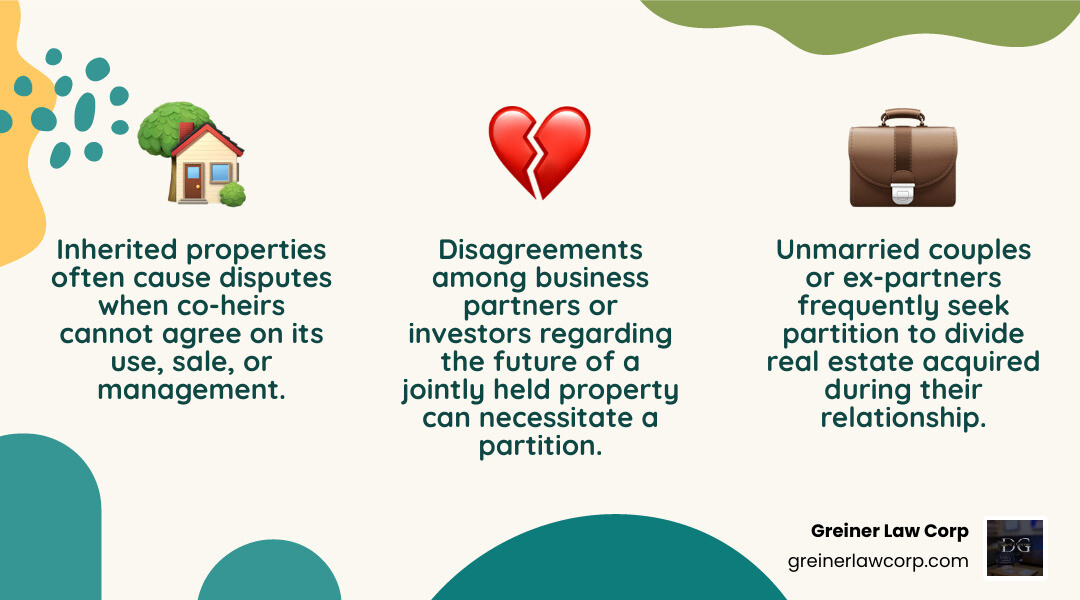
Inherited property disputes among heirs top our list. Picture this: three siblings inherit mom’s house. Sarah wants to move in and raise her kids there. Mike needs cash for his business and wants to sell immediately. Jennifer thinks they should rent it out for steady income. Sound familiar? When family members can’t agree on what to do with inherited property, emotions run high and compromise becomes nearly impossible. California’s Uniform Partition of Heirs Property Act now provides some additional protections for these situations, including buyout opportunities at appraised values.
Unmarried couples or ex-partners face their own unique challenges. When love fades but the mortgage remains, jointly owned property can become a battlefield. One person wants to sell and move on, while the other can’t afford to buy them out or refuses to let go. We’ve seen these situations drag on for years when people try to handle them without legal guidance.
Disagreements between business partners or investors often catch people off guard. Friends who pooled money to buy rental property might find they have very different ideas about management, renovations, or when to sell. What seemed like a great partnership can turn into a source of constant conflict when financial goals diverge.
Finally, there’s the straightforward scenario where one co-owner simply wants to cash out. Maybe retirement is calling, or a new business opportunity requires capital. If the other owners can’t or won’t buy out their share, and nobody wants to sell the whole property, a partition action becomes the most practical solution.
Each of these situations shares a common thread: good people who can’t find common ground. That’s where legal intervention becomes not just helpful, but necessary to protect everyone’s interests and find a fair resolution.
The Role of a Real Estate Partition Attorney in Los Angeles

So, you’ve got a property dispute on your hands, and things feel a bit stuck. It’s perfectly normal to feel overwhelmed! This is where a fantastic real estate partition attorney Los Angeles steps in. Think of us not just as legal experts, but as your dedicated guide and strategic partner through what can be a tricky process.
Our role is all about helping you find the clearest path forward. First off, we’ll offer expert legal guidance, diving deep into your unique ownership situation. We’ll explain your rights, especially that “absolute right” to partition in California, and talk through any potential bumps in the road. No legal jargon, just clear, simple answers.
Often, the best solution doesn’t even involve a courtroom. We’re skilled at facilitating negotiation with your co-owners. We’ll explore options like buyouts or a smooth, negotiated sale, always with a business-minded approach. Our goal is to find a settlement that aligns with your goals and helps you manage your risk, saving everyone time and money. It’s amazing how many partition cases can be settled out of court!
But if talks don’t lead to a handshake, don’t worry, we’re ready for action. We provide strong litigation support, prepared to go to court and fight for your rights. This means drafting all the necessary legal papers and representing you every step of the way. We focus on strategic litigation to keep things moving forward efficiently, even in tough situations.
Throughout the process, we’re dedicated to protecting your property interests. This includes making sure the property gets a fair valuation and, if it sells, ensuring you get the best possible market price. We’ll also carefully track all financial contributions – like mortgage payments, taxes, and improvements – to make sure everything is accounted for. And our ultimate aim? To maximize your financial outcome, ensuring you receive every penny you’re due. We understand the stress these disputes cause, and we work hard for a swift, positive resolution.
At Greiner Law Corp, we blend our expertise in real estate, probate, business formation, and contract law to give you a truly comprehensive strategy. Our unique approach means we always keep your goals and risk preferences at the forefront, tackling even the most complex co-ownership issues with precision.
Curious about California’s wider property laws? You can explore more through More about California’s real property laws.
Navigating the Legal Process with a Real Estate Partition Attorney in Los Angeles
Okay, so what does the actual legal journey look like? With a seasoned real estate partition attorney Los Angeles by your side, navigating the California court system becomes much clearer. Here’s a breakdown of the key steps:
The action officially begins when one co-owner (the plaintiff) starts by filing the complaint for partition with the Superior Court. This document outlines the property, the co-ownership interests, and the request for partition. Right after that, we’ll typically record a Lis Pendens with the county recorder’s office. Think of this as a public “heads up” that there’s a lawsuit affecting the property. It helps prevent any surprises, like someone trying to sell or refinance it behind your back.
Next, we ensure all other co-owners and anyone else with a stake in the property, like a bank, are formally served with notice. This gives them their chance to respond to the complaint. The court then takes a look at everything. If they agree that you have the right to partition – which is usually the case in California – they’ll issue an “interlocutory judgment.” This is a fancy way of saying the court confirms your right to divide the property and decides how it should be divided, often by sale.
If the property needs to be sold, the court will often appoint a partition referee. This person is a neutral third party, like a project manager for the sale. They’ll work under the court’s supervision, hiring real estate agents, overseeing marketing, and generally making sure the sale process is fair and efficient. They’re there to take the burden off your shoulders!
A crucial step is property valuation. We’ll make sure a fair market appraisal is done. This is super important whether someone is buying out another owner or if the property is being sold on the open market. And before any money changes hands, there’s a careful accounting for costs and reimbursements. This means figuring out who paid for what – mortgage payments, property taxes, necessary repairs, or even improvements that boosted the property’s value. Sometimes, a co-owner who lived there exclusively might need to pay fair rent. It can get detailed, but we’ll make sure everything is tracked properly.
Finally, once the property is sold and all the bills (like legal fees and referee fees) are settled, the remaining money is distributed to the co-owners exactly as the court orders. This whole process is designed to ensure everyone gets their fair share, even if they couldn’t agree beforehand. Our expertise in Civil Litigation ensures we’re ready for every twist and turn.
Understanding Costs with a Real Estate Partition Attorney in Los Angeles
Now, let’s talk about the practical side: costs. It’s the big question for many clients, and it’s completely understandable to want to know what to expect. While every case is unique, we can give you a general idea.
A typical partition action in California usually falls within the range of $5,000 to $12,000. Of course, for more complex situations, like those involving very high-value properties or particularly stubborn co-owners, the costs could go higher than that. The total cost usually covers a few key areas.
The biggest part is often attorney fees. While you generally pay for your own lawyer, California law allows courts to adjust who pays what for common benefits. So, sometimes, if the action helps everyone, the court might spread the attorney fees among all owners. If one party causes unnecessary delays, they might even be asked to cover a larger portion of the expenses.
You might also have referee fees if the court appoints someone to manage the sale. Then there are standard court costs, like filing fees. And don’t forget fees for things like appraisals to get an accurate property value. The good news is, sometimes, these fees and costs can actually be paid directly from the money received when the property sells. This can really help ease the immediate financial pressure.
As for how long it all takes, the timeline can vary. A smooth case with cooperative parties might wrap up in just a few months. But if there are lots of disagreements or other legal issues involved, it could take a year or even two. In Los Angeles, most partition actions tend to resolve within approximately 7 to 12 months, often through a buyout or a mutually agreed-upon sale. Our goal is always to work efficiently to get you the best possible outcome without unnecessary delays or expenses.
Frequently Asked Questions about Los Angeles Partition Actions
We get it. Dealing with co-owned property, especially when disagreements pop up, can feel like a real headache. It’s confusing, often emotional, and definitely stressful. That’s why we’re here to help clear things up. As your trusted real estate partition attorney Los Angeles, we often hear the same questions. Let’s explore some of the most common ones:
Can I be forced to sell a house I inherited with my siblings?
Oh, the family home! It holds so many memories, but sometimes, different ideas about its future can cause a real rift. The short answer is, yes, in most cases, you can be forced to sell it. California law is quite clear: any co-owner, no matter how small their ownership percentage, has what’s called an “absolute right” to partition.
Think of it this way: if you and your siblings can’t agree on what to do with the inherited property – maybe one wants to live there, another wants to rent it out, and you just want to cash out – a partition action is the legal way to get a court to step in and resolve that deadlock. The court’s main goal is to find a fair solution when co-owners just can’t see eye-to-eye.
What happens if one co-owner lives on the property and refuses to leave?
This is a very common and often frustrating situation, especially in cases involving inherited homes or properties bought by former partners. If one co-owner has been living in the property and simply won’t cooperate with a sale or a buyout, don’t worry. The court still has the power to order the property sold through a partition action.
But there’s more to it! To ensure fairness for everyone, the court can also require the co-owner living on the property to pay what’s called fair market rent to the other co-owners for the time they had exclusive use of the property. This amount can then be subtracted from their share of the sale proceeds when the property finally sells. It’s all about making sure everyone gets their fair shake.
Can a partition action be stopped?
This is a tough one, because the simple answer is: it’s extremely difficult to stop a partition action once it’s been filed. “Absolute right” we talked about? In California, it means that unless there’s a very specific reason, the court will almost certainly allow the partition to move forward.
The strongest defense you could possibly have is proving there’s a valid, written agreement between all co-owners that explicitly states they’ve waived their right to partition the property. But proving such an agreement can be a real challenge, especially if it was just a verbal understanding. Other potential arguments, like claiming the person filing the action acted fraudulently or that the partition would cause extreme hardship, are generally very hard to prove in court.
The court’s main focus is to prevent any co-owner from being unfairly stuck in an ownership situation they no longer want to be in. So, while it’s not impossible to challenge, successfully stopping a partition action is a rare feat.
Conclusion
Facing a property dispute can feel incredibly overwhelming, almost like you’re stuck between a rock and a hard place. Especially here in Los Angeles, where real estate is such a big deal, these kinds of disagreements can add a lot of stress. But here’s the good news: you don’t have to go through it alone. Knowing your legal options and having the right team by your side can truly change everything. A partition action, though it sounds formal, is actually a really effective way to sort things out, protect what’s yours, and get back on track with your financial future.
That’s where we come in, at Greiner Law Corp. We believe legal help should always be about you and your goals. We’re not just about legal jargon; we take a truly business-minded approach to make sure the solution fits your specific needs and comfort level with risk. So, whether you’re trying to figure out what to do with an inherited family home, untangle a business partnership that didn’t quite work out, or just need to sell your part of a property, our team is ready to walk you through it. Our main aim? To get you a quick and positive result, so you can move forward peacefully.
Don’t let these property disagreements steal your peace of mind or your financial well-being any longer. The very best first step you can take is to chat with an experienced real estate partition attorney Los Angeles. We can help you understand all your choices and clear a path towards a much better outcome.
For expert guidance on all your real estate law needs, we invite you to explore our services further: Find expert guidance for your real estate law needs.


