The Final Hurdle in Your California Home Journey
California closing costs are the fees paid by buyers and sellers to finalize a real estate transaction. These costs, which include loan origination fees, title insurance, transfer taxes, and realtor commissions, are paid on top of the home’s purchase price.
Quick Cost Breakdown:
| Party | Typical Range | What’s Included |
|---|---|---|
| Buyers | 2-5% of purchase price | Loan fees, appraisal, title insurance, escrow, prepaid taxes |
| Sellers | 5-10% of sale price | Realtor commissions, transfer taxes, title insurance, prorated taxes |
Example: On California’s median home price of $886,560, buyers can expect to pay $17,731-$44,328 in closing costs, while sellers may pay $44,328-$88,656.
These fees often catch people off guard, but understanding what you’ll owe at closing is critical for preventing surprises and negotiating effectively. While some costs are fixed by law, others are negotiable depending on market conditions.
As David Greiner, Esq., I’ve guided clients through countless real estate transactions in the High Desert region. My experience as a transactional lawyer and president of Greiner Buick GMC provides a business-focused approach that prioritizes your goals and ensures you understand every line item before you sign.
How Much Are California Closing Costs on Average?
In California, buyers typically pay 2-5% of the purchase price in closing costs, while sellers face 5-10% of the sale price. Given that California real estate prices are roughly double the national average, these percentages translate into significant sums.
For example, on a median-priced home of $886,560 (July 2024), a buyer’s closing costs could range from $17,731 to $44,328. Sellers face even higher costs, from $44,328 to $88,656, largely due to realtor commissions. Even a seemingly modest 1% for basic fees can amount to nearly $9,000 on a median-priced home, highlighting the importance of budgeting for these expenses from day one.

To see pricing trends in your specific county, the California Association of Realtors maintains Current Sales & Price Statistics.
Regional Cost Variations
Closing costs vary significantly across California’s diverse real estate markets. In Los Angeles, where the median home price is around $1,050,000, buyer closing costs can range from $21,000 to $52,500. The San Francisco Bay Area sees even higher costs due to property values.
Conversely, more affordable markets like the Central Valley and the High Desert region (including Victorville and San Bernardino County) have lower closing costs in dollar terms, though the percentage ranges are similar. These regional differences are driven by local property values and local transfer taxes, which some cities add on top of the state rate.
Estimating Your Specific California Closing Costs
Your actual costs will depend on several key factors:
- Loan Amount: Lender fees, like origination fees, are often a percentage of your loan. A larger loan means higher fees.
- Down Payment Size: A down payment of less than 20% typically requires Private Mortgage Insurance (PMI), which adds to your costs either upfront or in your monthly payment.
- Property Type: Condos and townhouses often have Homeowners Association (HOA) fees, which may include prorated dues and transfer fees at closing.
A closing cost calculator, offered by many lenders and real estate sites, is the best way to get a personalized estimate. However, remember these are estimates. Always get a detailed breakdown from your lender and escrow company early in the process to avoid surprises.
Who Pays for What? A Buyer vs. Seller Breakdown
While there are customs for who pays which California closing costs, nearly everything is negotiable. Market conditions and leverage determine who pays for what. An escrow company acts as a neutral third party, ensuring all funds are handled correctly.

Sellers usually pay more overall due to real estate commissions, but in a buyer’s market, they might cover some buyer expenses to close the deal. In a seller’s market, buyers may have to shoulder more costs.
Common Closing Costs for California Buyers
As a buyer, your costs are mostly related to your mortgage and taking ownership.
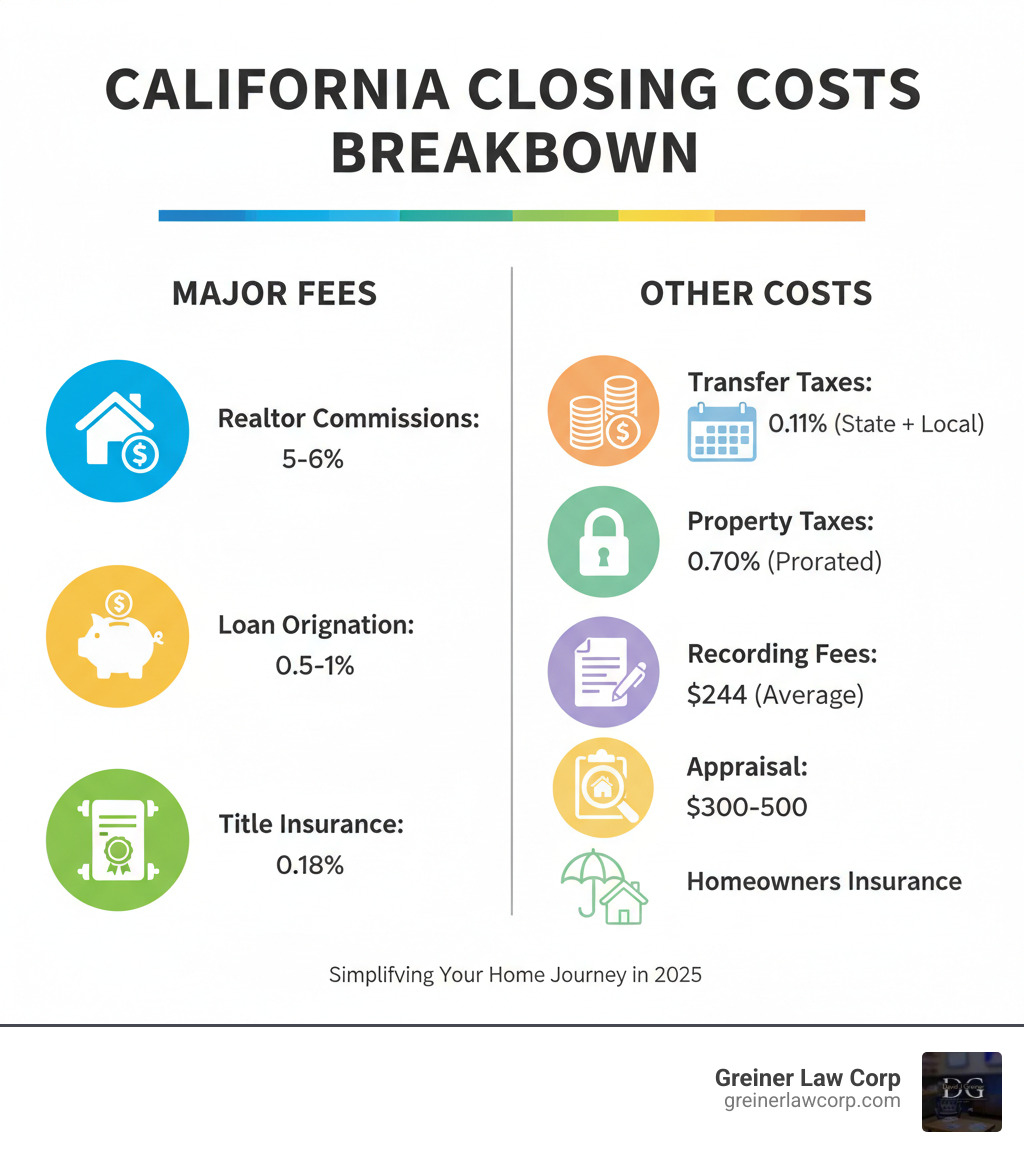
- Loan Origination Fees: Typically 1% of the mortgage amount to cover the lender’s processing work.
- Appraisal and Inspection Fees: An appraisal ($300-$1,000) confirms the home’s value for the lender. An inspection ($300-$1,000) is highly recommended to check the property’s condition.
- Lender’s Title Insurance: A one-time fee (around $200-$250) that protects the lender from claims against the property’s title.
- Homeowner’s Insurance: You’ll need to prepay the first year’s premium, which averages around $1,200 annually.
- Prepaid Property Taxes: You’ll pay your share of property taxes from closing day through the end of the tax period. Your lender may also require you to fund an escrow account for future taxes and insurance.
- Escrow Fees: Covers the cost of the neutral third party coordinating the transaction, often split with the seller.
- Private Mortgage Insurance (PMI): Required if your down payment is less than 20%. It’s typically 0.58% to 1.86% of your loan amount annually.
- Other Fees: Smaller costs include county recording fees, credit report fees, and optional loan discount points to lower your interest rate.
Common Closing Costs for California Sellers
For sellers, the largest expense is typically the agent commission.
- Realtor Commissions: Averages about 5.03% in California. On an $886,560 home, that’s over $44,000. This fee is negotiable.
- Owner’s Title Insurance: Customarily paid by the seller, this protects the buyer from title claims and costs about 0.18% of the sale price.
- Documentary Transfer Tax: A state tax of $1.10 per $1,000 of value. Many cities (like Los Angeles and Culver City) add their own significant transfer taxes. You can check the California Property Transfer Tax Rates for your area.
- Prorated Property Taxes: You’ll pay for property taxes up to the closing day.
- HOA Fees: If applicable, you’ll pay for HOA transfer fees and providing documents to the buyer.
- Escrow Fees: Typically split or negotiated with the buyer.
- Attorney Fees: While not required, legal counsel is a smart investment for complex deals. Attorneys may charge hourly (around $301/hour) or a flat fee. At Greiner Law Corp, we help clients in Victorville, Riverside, San Bernardino, and Los Angeles steer these costs. You can learn more about managing costs in a real estate transaction on our site.
| Cost Item | Buyer Responsibility | Seller Responsibility | Notes |
|---|---|---|---|
| Loan Origination Fees | Primary | Sometimes Negotiated | Typically 1% of loan amount |
| Appraisal Fee | Primary | Sometimes Negotiated | $300-$1,000; ensures home value |
| Inspection Fees | Primary | Sometimes Negotiated | $300-$1,000; recommended protection |
| Lender’s Title Insurance | Primary | Rarely | Protects lender against title defects |
| Owner’s Title Insurance | Rarely | Primary | Protects buyer; about 0.18% of sale price |
| Homeowner’s Insurance | Primary | No | First year prepaid at closing |
| Prepaid Property Taxes | Primary | No | Prorated to closing date |
| Prorated Property Taxes | No | Primary | Seller’s portion up to closing |
| Escrow Fees | Shared/Negotiated | Shared/Negotiated | Covers escrow service |
| Realtor Commissions | No | Primary | Averages 5.03% of sale price |
| Transfer Tax | No | Primary | State plus any local taxes |
| PMI | Primary (if <20% down) | No | 0.58%-1.86% of loan annually |
| HOA Transfer Fees | No | Primary | If property has HOA |
| Recording Fees | Primary | No | Official recording of deed |
Strategies for Reducing Your Closing Costs
While California closing costs are significant, many are negotiable. With the right approach, you can reduce what you owe at closing by asking questions and comparing prices for services.
One of the most effective strategies is requesting seller concessions, where the seller agrees to contribute toward your closing costs. This is common in a buyer’s market. You should also shop around for services. You are not obligated to use your lender’s suggested title company or appraiser; getting multiple quotes can lead to substantial savings.
Finally, your choice of lender is crucial. Compare Loan Estimates from at least three lenders, focusing on the total closing costs, not just the interest rate, to find the best overall deal.

Can Closing Costs Be Negotiated?
Yes, many fees are flexible. Government fees like transfer taxes and recording fees are non-negotiable. However, lender fees—such as loan origination, processing, and application fees—are often adjustable. If you are a strong borrower, ask your loan officer for a reduction. You can also shop for better rates on title insurance and compare prices for appraisal and inspection services.
For sellers, agent commissions offer the biggest opportunity for negotiation. Commission rates are not fixed and can be discussed with your agent. Following the recent NAR settlement, these negotiations are becoming more transparent. If you’re looking for agents with competitive commission structures, you can view agents who offer flexible fees.
Your negotiating power depends heavily on market conditions. In a buyer’s market, sellers are more willing to offer concessions. In a seller’s market, buyers have less leverage.
Assistance Programs and Cost-Saving Options
California offers several programs to help with closing costs, especially for first-time homebuyers.
The California Housing Finance Agency (CalHFA) and the Golden State Finance Authority offer down payment and closing cost assistance, often as grants or deferred-payment loans. The CalPLUS FHA Zero Interest Program, for example, provides a zero-interest, deferred-payment second mortgage to cover closing costs.
Lender credits are another option. You can accept a slightly higher interest rate in exchange for the lender covering some of your closing costs. This reduces your upfront cash needs but increases your monthly payment and total interest paid over the life of the loan.
Some lenders offer no-closing-cost mortgages, but these costs are typically rolled into the loan principal or covered by a higher interest rate. This can be a useful strategy for cash-strapped buyers, but it’s important to weigh the long-term cost of paying interest on those fees.
The Closing Timeline: When Costs Are Due
Understanding the closing timeline helps you plan your finances and avoid last-minute issues.
Within three business days of submitting your mortgage application, your lender must provide a Loan Estimate. This standardized form details your estimated California closing costs, interest rate, and monthly payment. Review it carefully as it’s your financial roadmap for the transaction.
At least three business days before your scheduled closing date, you will receive the Closing Disclosure. This document lists the final, actual closing costs and the exact amount of cash you need to bring to closing. This three-day period is a mandatory waiting period designed to give you time to review the final numbers.
Compare your Closing Disclosure with the Loan Estimate. While some costs can change, significant increases may signal a problem. Use the three-day window to ask questions and resolve any discrepancies.
On closing day, you’ll make your final payment via a cashier’s check or wire transfer, as personal checks are not accepted for these large sums. Coordinate with your bank in advance to ensure funds arrive on time and the closing is not delayed.
For more context, the Bank of America guide on what happens at closing offers a step-by-step overview of the process.
Frequently Asked Questions about California Closing Costs
Here are answers to common questions about California closing costs.
What is the role of title insurance and transfer taxes?
Title insurance protects you from financial loss if a past ownership issue, like an old lien or forged deed, surfaces after you buy the property. There are two policies: an owner’s policy (protects you, usually paid by the seller) and a lender’s policy (protects the lender, paid by the buyer).
Transfer taxes are government taxes levied when property ownership changes. California has a state tax of $1.10 per $1,000 of value. Many cities and counties, such as Los Angeles, add their own local transfer taxes, which can significantly increase costs. You can find local rates at California Property Transfer Tax Rates.
Are there closing costs for an all-cash purchase?
Yes, but they are significantly lower. By paying cash, you avoid all lender-related fees, such as loan origination, appraisal, and lender’s title insurance. This can cut your closing costs nearly in half.
However, you will still pay for essential services like owner’s title insurance, escrow fees, recording fees, prorated property taxes, and homeowners insurance. Government charges like transfer taxes also still apply.
Can I roll closing costs into my mortgage?
Yes, it’s often possible to add your closing costs to your total loan amount, which reduces the cash you need at closing. However, this strategy has long-term implications.
When you roll costs into your mortgage, you increase your loan balance, which results in a higher monthly payment. More importantly, you will pay interest on those closing costs for the entire life of the loan. For example, rolling $10,000 in costs into a 30-year mortgage could mean paying back over $20,000 for those fees over time due to interest.
This option can make sense if you need to preserve cash for renovations or emergencies, but it’s crucial to weigh the short-term benefit against the long-term cost. We can help you learn more about managing costs in a real estate transaction to determine the best strategy for your financial situation.
Secure Your Investment with Expert Guidance
Navigating California closing costs—from the 2-5% buyers pay to the 5-10% sellers shoulder—is a critical part of any real estate transaction. Understanding these costs, which vary between counties like Los Angeles, San Bernardino, and Riverside, allows you to budget accurately, negotiate effectively, and avoid surprises at the closing table.
In California’s expensive market, preparation prevents panic, and knowledge creates leverage. At Greiner Law Corp, my experience as both a transactional lawyer and business owner provides a unique, business-minded approach. We focus on your goals, timeline, and risk tolerance, ensuring you understand every fee and make informed decisions.
Whether you’re buying a home in Victorville or selling a commercial property in Los Angeles, having experienced legal counsel is invaluable. We spot potential issues before they become expensive problems and ensure your transaction is as smooth and cost-effective as possible.
Learn more about managing costs in a real estate transaction or reach out to us directly. Let’s work together to protect your investment with the care and attention it deserves.


